

I’ve been hearing rumors for quite a while that China’s TMSR-LF1, the world’s first thorium-containing molten salt reactor (MSR), has been running for quite a while now in Gansu province, on the edge of the Gobi Desert. I’ve heard that it’s not only been running, but that it runs well. But there was nothing formal I could cite until I saw this on Nick Touran’s twitter:
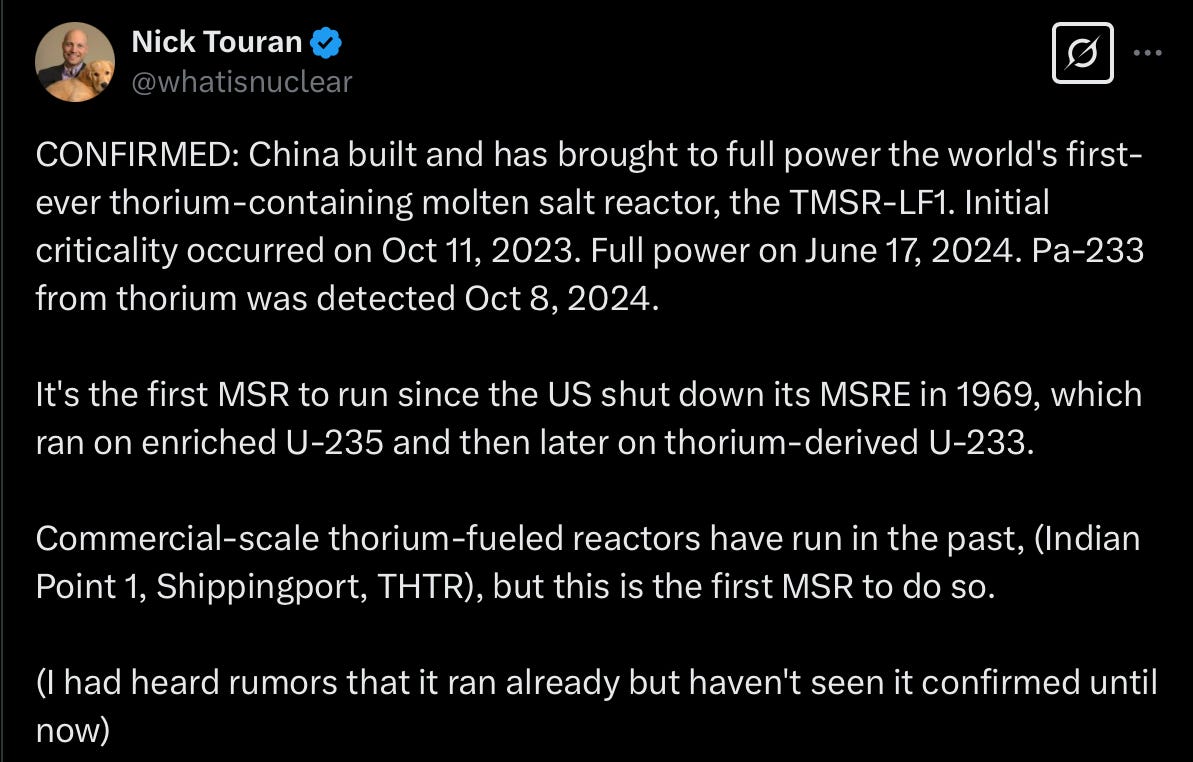
Nick’s source is a presentation by MSR expert Dr. Jiri Krepel. You can find the whole presentation here, but here is the relevant slide.
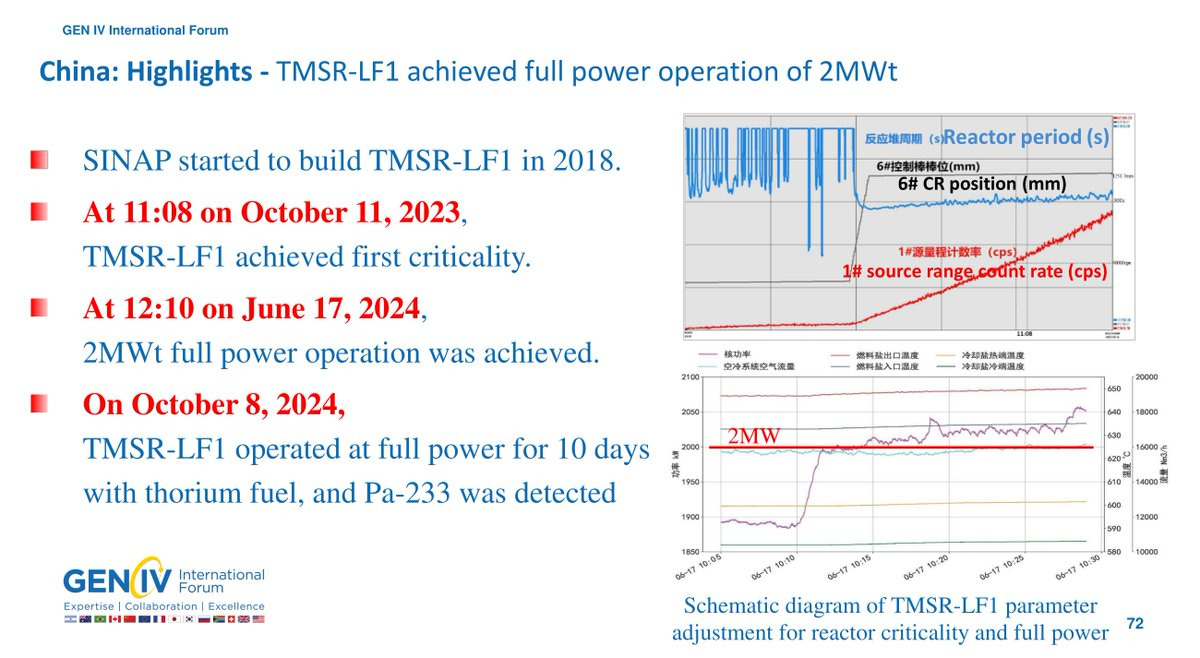
To me, the fact that it’s a thorium-containing molten salt reactor is less big of a deal than the fact that it’s a successful continuous operation of a molten salt reactor full stop.
China has its strategic reasons for using Thorium. It’s basically dirt in its own backyard whereas Uranium, while still cheap as chips, might need to be imported at some point. But it’s so bountiful everywhere from Australia to Canada to Kazakhstan to Namibia I don’t take uranium scarcity as a serious concern. But the molten salt part… that’s where it gets interesting.
Anyhow. This tantalizing success is just the beginning of the hard work of the commercial molten salt reactor. It’s over time that corrosion and the thorny issue of neutron-poison buildup rears its ugly head. Again, as Nick Touran reminds us, “we're still decommissioning the MSRE to this day, though it shut down in 1969. The leftover fuel salt is offgassing UF₆ and all sorts of nasties.” To find out more, listen to Nick’s latest episode on MSRs on Decouple.
But if we (or you know… the Chinese) DO crack it, the potential could be incredible. There’s a reason why there are dozens of MSR startups all over the world (although none of them have ever split an atom yet).
The bulk of the world’s reactors work with solid fuel under very high pressure. This necessitates the construction of a huge containment dome to keep everything inside in the case of an accident. The molten salt reactor works at atmospheric pressure, and in an accident condition, the salt “freezes” in place.
There can of course still be nuclear accidents, but not the kind of widespread contamination that causes disproportionate panic. Could this pave the way for smaller, lighter, cheaper reactors to be licensed?
I don’t think it’s entirely an accident that not long after they started successfully operating the first thorium MSR, the Chinese announced huge new thorium deposits previously undiscovered.
It’s hard to be impressed by this. If you’ve got dirt you’ve probably got thorium. This is a complete nothingburger. Congratulations, China’s got rocks. Despite all the thorium bros glazing it as a miracle fuel, most thorium reactors suck. Its neutron economy is bad and it should feel bad about itself. But mayyyybe that’s not true about the TMSR-LF1? In any case, we don’t have enough data to tell.
The rest of the world has a lot of soul-searching to do.
ThorCon Power. Copenhagen Atomics. Moltex. Terrapower. Terrestrial Energy. Thorizon. Seaborg. <== all these are western MSR startups. I’m sure I’m missing many more. And none of them have ever split an atom.
The Chinese not only got there first when it comes to building the first working MSR after Oak Ridge’s MSRE, they are in the best place to compound that advantage with the enormous pool of engineering talent in the country. According to tech commentator Steve Hsu, China’s pool of workers with advanced degrees in science and engineering is growing rapidly: “Over the next 20 years this pool will grow to be nearly an order of magnitude larger than the corresponding US one.”
MSRs are going to run into all sorts of challenges due to the extreme conditions of working with very hot, toxic, radioactive salt that makes traditional solid fuel and water moderated Big Beautiful Reactors look like Easy Mode by comparison.
To have even a chance of catching up with the Chinese on this exciting technology, we can’t just have more startups, we have to actually let them build WORKING, FISSIONING REACTORS.
No posts
Comments
Nothing yet. Say the first thing.
Sign in to join the conversation.