
I recently came across an article explaining how NASA launched twin sounding rockets into the aurora to map the actual electrical currents flowing through the upper atmosphere. Not the lights. The invisible currents that create the aurora borealis effect.
\
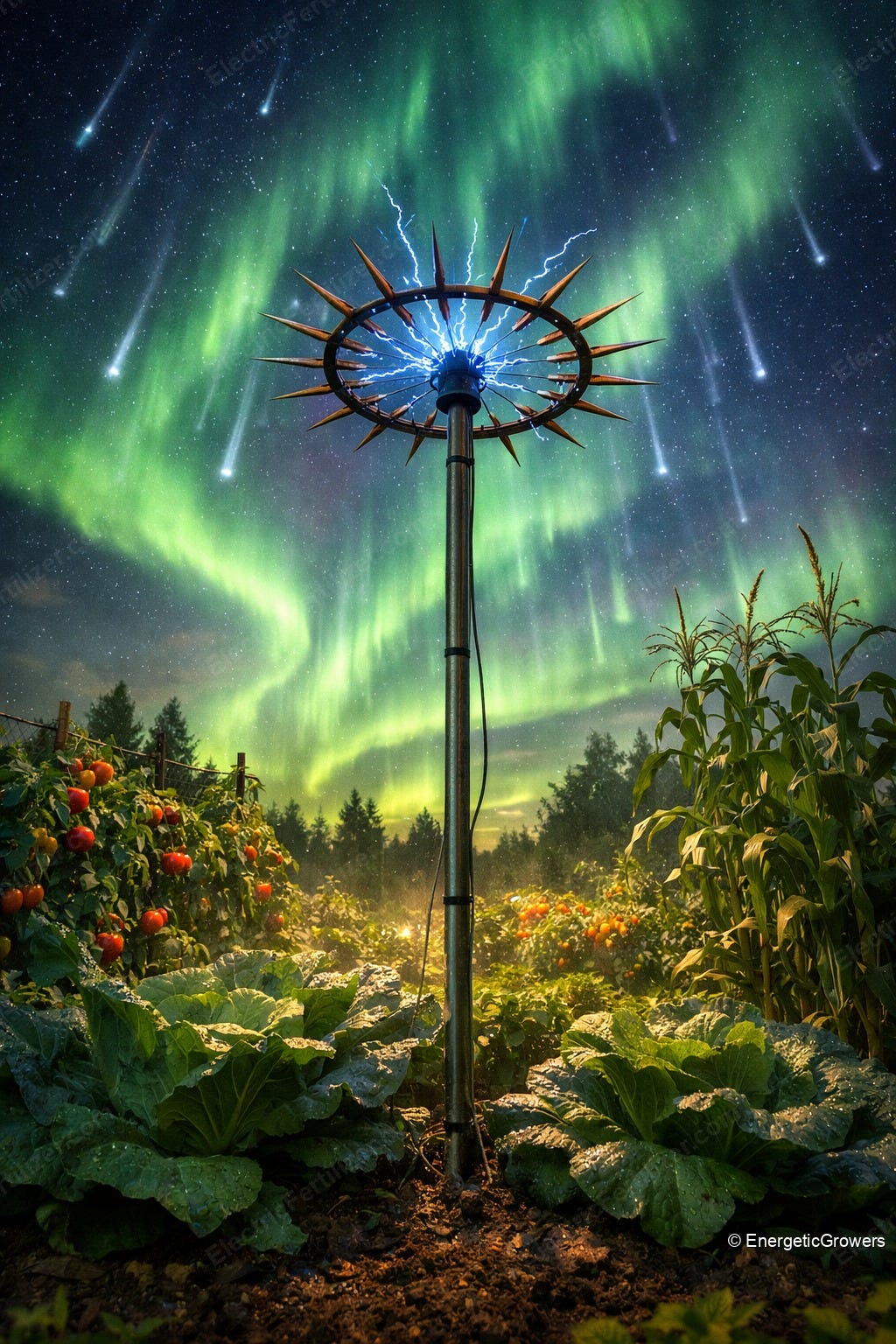
What they’re mapping is not some abstract space phenomenon, it’s part of the Earth’s global electrical circuit. And that same circuit is what those who are practicing passive electroculture with atmospheric charge collectors tap into.
Let’s break this down in practical terms.
Even in completely fair weather, the Earth maintains a vertical electric field between the ionosphere (roughly 60–300+ km up) and the ground.
The typical fair-weather / not storming atmospheric electric field gradient (the amount of vertical electrical field strength) is generally about ~100 volts per meter downward. That means if you elevate a conductive object 2 meters above ground, there is already a measurable potential difference relative to earth ground, which in this case is, about 200 Volts.
That’s physics.
The article explains that NASA’s recent auroral current mapping shows that during geomagnetic activity, e.g. solar wind events, auroras, CMEs, that global circuit becomes more dynamic. Currents intensify, charge redistributes, and field gradients fluctuate.
... and when the electric fields fluctuate, the electric potential around your electroculture antennas change.
If you’re using:
Elevated vertical rods with single points
Multi-point “antenna” arrays (Like the Christofleau or HarvestStorm devices)
or, DIY sharp spike collectors
…you’re creating a coupling from the atmosphere’s electric field into your garden. Your electroculture system is essentially a passive interface between:
Ionospheric potential
⬇
Atmospheric electric field gradient
⬇
Your elevated collector “antenna”
⬇
Earth ground / Garden Subsystem
When space weather increases upper-atmospheric current flows (which is exactly what NASA is mapping in 3D), it modulates that entire column of charge above us in a variety of ways, at various levels up and down the atmosphere.
So, More space-weather activity that’s taking place overhead → more electrical variability below.
Note that with these electrical charge “antennas”, the voltage you’re collecting is not a constant voltage, it’s minute, and constantly changing. It’s free energy, but it’s not free power in the conventional sense. But why does that matter?
In terms of plant science, crops under changing external electrical influences are more affected in an electrophysiology sense. If they’re exposed to static or non-changing electric field energy, they don’t really get a break from the stimulation. So when the fields are changing in intensity over time, cycling from low intensity (low voltage/low current into the garden), the plants get a brief break; and when they flow intensely, they get access to higher voltages and currents. This cycling has proven to be very effective in terms of increasing yields by at least 25% and much more than that in many cases.
Like the post so far? Share it!
From the study of high-voltage systems, i.e. electrostatics, it’s known that sharp points intensify local electric fields. This is why lightning rods are pointed... they are designed to bleed off excess charge from the atmosphere above your various structures, to minimize the chances of a charge difference building up so high to cause a lightning bolt to form.
For electroculture, we leverage that property by using multiple sets of metal-spikes to increase the local field intensity over a larger area, giving us access to greater amounts of electrical power.
And the relevance that’s apparent here, is that when there are atmospheric weather changes causing a changes or bursts in ionospheric activity, with the research that they’re conducting, we can potentially better understand the effects of these changes on the amount of charge that’s being collected for electroculture systems.
NASA confirms here that the gradient is far more structured and dynamic than previously modeled. We already know that atmospheric electricity fluctuates based on:
Solar wind velocity
Geomagnetic index (KP)
Ionospheric current structure
Storm systems
Air ion concentration
and humidity levels
During ionospheric disturbances, long conductors on Earth can even experience induced currents. Power grids deal with this at large scale, and some early electroculture enthusiasts even built underground “antenna” systems to capture these induced currents deliberately!
As someone with a deep experimental mindset, I think it’s interesting to think about... and it gets me thinking about whether changes can be seen across changes in space weather. If you wanted to do something like this, you’d want to be tracking (& logging) the following:
Solar weather data (identified above)
Regional storm conditions
Local humidity levels
Voltage and current levels through your antenna
Along these lines, because the atmospheric conditions will be affecting your entire crop at once, I can see comparing those crops under the influence of an electrostatic energy collector antenna against a normal non-stimulated control plot. But they’re still going to be affected... but in a much lesser way. That may be good enough. I suppose it would be really great if the system as a whole could be monitored over time, in small time scales, so the differences in growth or other attributes could be compared to non-active ionospheric conditions. (If anyone knows of such a study - be sure to reach out to me!)
NASA’s mission reinforces three important truths:
The atmosphere is electrically structured.
Upper atmospheric currents directly influence lower atmospheric electric fields.
These variations are measurable.
Because of this, when you erect these types of electroculture devices, you’re not just picking up a fixed amount of electrical charge that’s an average of the vertical electric field over a given area, you’re collecting charges of varying amounts that are influenced by a number of factors, including space weather. Perhaps as an outcome from this research we’ll get to see the complex patterns that make up the transformation of atmospheric currents as they move down into the lower atmosphere.
And while this information is not likely going to help you with getting better results from electroculture, it should help explain how these devices work, and the interesting atmospheric & ionospheric interactions that influence them.
Thanks for reading! If you have any thoughts on this, be sure to leave a comment - look forward to hearing from you.
-David
Comments
Nothing yet. Say the first thing.
Sign in to join the conversation.