
Hello! This post insisted I write it this morning, when I was supposed to be doing something else. It’s a bit of a rough-and-ready call to not arms but art, for the New Year. It’s also in some ways a coda to the post that drew many of you over to my little corner of Substack, This moment needs your deep weirdness and your intellectual rigour. Though if you haven’t read that essay, it matters not one jot—you can definitely jump straight in with this one.
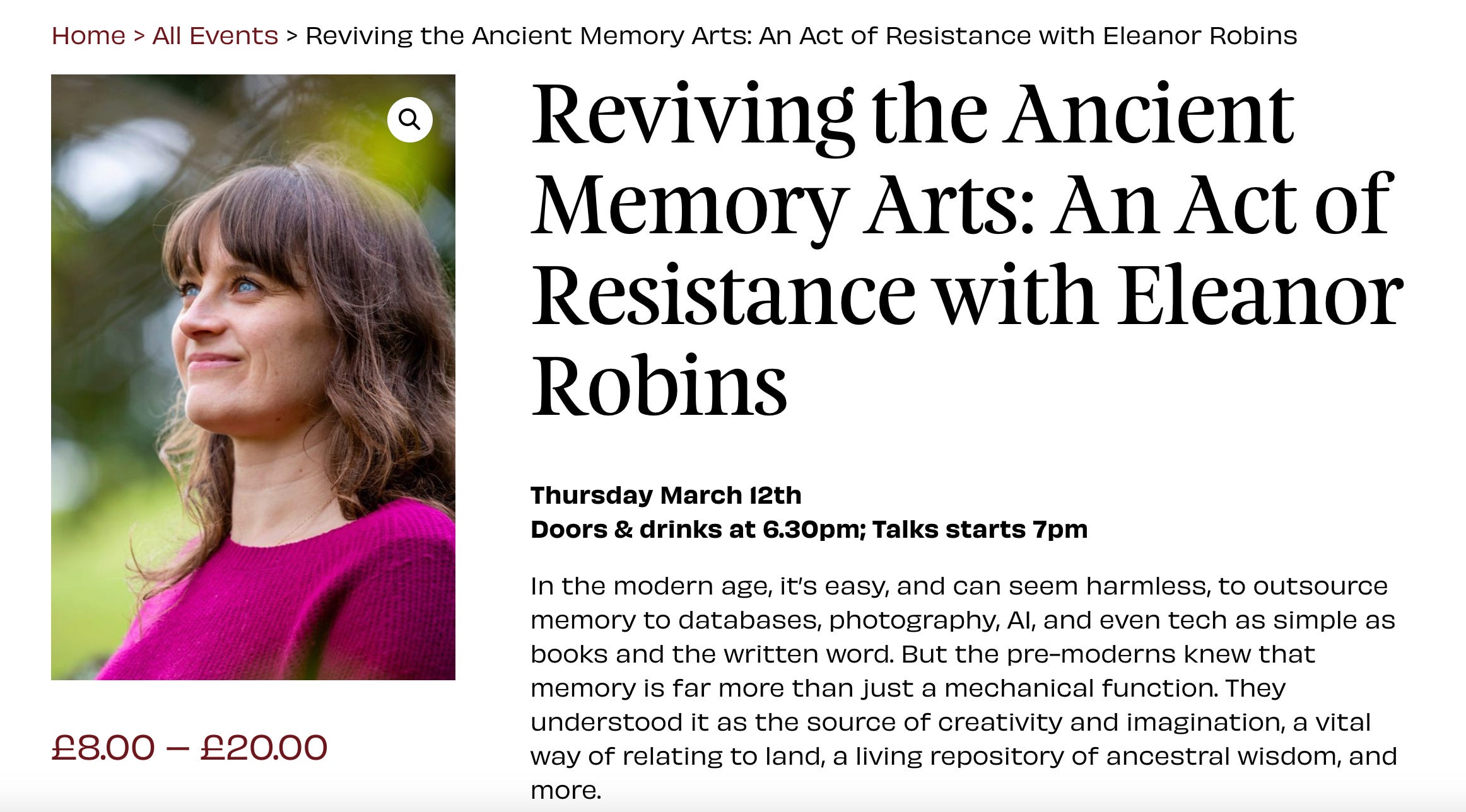
Before I start, a quick note about some upcoming fun. I’m going to be talking at London’s Kairos club again in the spring, on Thursday 12th March. It will be a night themed on memory: memory as the basis of creativity, memory as connection to land, memory as a way to bring otherness into our bodies and embrace a less individualist creative culture. My goal is for you to leave this night fired up to start memorising stories and poems—and with some tools to help, and a little poem already sown in your bones. Tickets here.
As this year draws to a close, I am sending out a call—a prayer—for the new one. I am praying that we radically reorient all of life, from our everyday routines to what happens in our centres of power, around art and the creative act.
I am calling for poetry to be read at the start of every session of parliament. I am calling for our failing institutions to bring storytellers into their board meetings. I am praying for a day when people in conflict are given the resources and support to act out Ancient Greek tragedies together. I am praying for us all to remember that we are not consumers but co-creators of reality, and we don’t have to spend a single second or penny more resigning ourselves to the bullshit baubles thrust at us as the pinnacle of choice under consumerist capitalism, when in truth they’re nothing but a knife to imagination, to the energy and courage to create.
Our unused creativity is a poison, and it is killing us. A human is an inherently, definitively creative being, and when we don’t use this creativity, it curdles inside us and turns destructive. It comes out in attacks against ourselves or others, as aggression, perfectionism, anxiety, depression, over-control, or sheer life-sucking boredom. I know, because I’ve spent too much of my own life being poisoned by it.
About a year and a half ago, I wrote an essay on here that reached a lot of people. It was a sweaty, breathless sort of essay, which suggested that for the past 500 years, the mainstream West has been labouring under a restrictive, straitened consciousness contract—an implicit agreement that only experiences in rational waking consciousness are valid, and things experienced in dreams, imagination, meditative states, intuition, journeys facilitated by plant medicine, and so on, have no value. At best, says the modern paradigm, those experiences are irrelevant. At worst, they’re dangerously delusional.
That essay argued that what many of us—probably most of us in this particular corner of Substack—are experiencing right now is a resurgence of all those subjugated and relegated shades of consciousness and the expanded realities they open.
I still believe this. But I’ve always been embarrassed by the end of that essay. It ends in a very feeble place, essentially saying: to expand the consciousness contract—to safely reintegrate the dangerously relegated parts of reality—make sure you read books as well as embracing being a weirdo. Make sure you’re rigorous with your weirdness.
Which, yes. Do those things. But it’s not enough. It’s not a good enough answer.
Here’s the dilemma I was grappling with—which we’re probably all grappling with: we know it’s a lie that there is nothing beyond the material world. We know that the mystical and expansive experiences we’ve read about or had ourselves are in some deep way true—truer than parking tickets and emails and ready meals. But the core wisdom of modernity—the whole drive behind the Enlightenment and the scientific revolution’s insistence on empirical evidence—is that once you open that door to the beyond, dangerous things can and do happen. If there’s no way to prove what’s true, it can seem that truth is up for grabs, which means that power is up for grabs. Which means mounting tyranny, social media awash with dangerous nonsense, and everyone from dictatorial bigots to yoga-smoothie individualists capitalising on the instability.
I know I’m stating the obvious here. I think sometimes the obvious wants to be stated.
So that’s the lay of the land. The question, of course, is: what now?
And the answer is: now, art.
Art is how we reintegrate our deep weirdness with our intellectual rigour.
Art is how we safely expand and rebalance the consciousness contract.
Art is how we honour the ineffable and unquantifiable dimensions of reality—bring them into the fleshy realm—without sliding into relativism or superstition or the dangerous predations of conspirituality.
Because this is what art does. I would argue it’s what it has always been. It’s why it exists.
The very first art we know of seems to offer visions of expanded worlds, reached through expanded consciousness. When our oldest ancestors went into the caves to paint, they weren’t just sloshing shapes and colours around to see what looked nice. Acoustic studies show that they were highly attuned to resonance—that they were very often working with sound and echo that would have altered their states, bringing them into bodily intimations of more-than-material reality. My strong suspicion is that, in fact, the divide we feel between material and more-than-material reality had yet to be drawn; that all things were felt to be porous and suffused with soul, and perhaps never more so than in one of those art-making cave ceremonies.
And what do you do when your consciousness is wide enough that powerful new marriages of form and formlessness are ever presenting themselves inside you?
You express them.
You create something that reflects this encounter, and which in many ways is truer than the rock it sits on, because it attempts to convey what’s beyond the rock, too—and because it offers this vision of truth in the spirit not of fact but of art, meaning a spirit that holds itself as very real, and yet not single or stable but rather hoping to inspire more unfolding.
To most humans through time, I suspect it would have seemed idiotic to even have to state that when you make a painting or a poem or a play, you are doing so to express intimations of things both within and beyond material reality, in a way that though creative is profoundly true. The Western literary tradition is the one I know best, and it’s shot through with this knowledge. The Odyssey begins, “Sing in me, Muse.” The old Celtic stories tell of Otherworlds, alternate realms where the happenings in this one are often sourced. The first woman to publish a book in English, Julian of Norwich, wrote it to express her mystical experiences. Hildegard of Bingen, the medieval polymath who wrote ten books, invented languages, and revolutionised musical composition, talked about being nothing but a trumpet, who needed the breath of God blown through her in order to produce a sound. The most famous poet in the English language, Shakespeare, lived at the border between the seen and unseen, and spent his life giving voice to the relationship between them. Time and again, his plays—I’m thinking especially of The Winter’s Tale, The Tempest, and A Midsummer Night’s Dream—tell us that art is the mediating link between the realms, and thus in some way more real, because more inclusive, than material reality itself.
Thanks for reading! This post is public and I’d love if you shared it.
And all this is to say nothing of the Romantics, or of course of William Blake, who made his bed in the imaginal more than anyone else in the Western canon. The recent spate of books about Blake suggests we might finally be catching up to what he was always telling us:
This world is wider than you dare dream, and waiting to show itself to us.
If you pay attention, it will reveal itself in mysterious and miraculous ways. In your subtle senses. In the edges and felt spaces of your knowing.
Trust it. Allow yourself to believe it.
But don’t stop there.
Apply yourself to expressing it, whether in words or movement or song or paint.
Because that effort to express the inexpressible, to create something that illuminates your encounter with the world, can be your ticket to a life of joyful rigour and humility and an alert, alive devotional form of attention.
You will fail, because every attempt fails.
The point is not to succeed.
It is to change gears. To remember that we are not consumers but co-creators of reality.
That the world itself is a marriage of form and formlessness, the seen and unseen, and that this marriage is presenting itself to each of us in ways that are asking to be expressed; woven into the world to feed the continued unfolding.
Because, no matter what the modern paradigm would have us believe, reality was never merely material. Was never just a bunch of stuff, sitting solid as rock, revealing its full factual truth in the view through a microscope.
The world has always been a work of art, and you have always been an artist.
Comments
Nothing yet. Say the first thing.
Sign in to join the conversation.