
I was sitting there thinking two things with equal ferocity: one, fuck the US “justice” system. And two, that I’d never actually been as sweaty as I was in that moment.
It was July. In Louisiana. I sat holding their hand in the swamps of the Atchafalaya Basin. The sun was setting orange and gold, the bronze water blurring the lines between earth, water and sky. It was beautiful, even if it was a beauty I recognized wasn’t ideal for my Nordic she-wolf temperament (despite being raised mostly in North Carolina).
The courts never ruled in our favor, even when they did. If they granted a fleeting injunction to stop work, nobody enforced it. We’d go out and take note of continuing work during a work stoppage, and then go back to our camp in the hopes that our small cluster of bodies could do what the entire weight of the US court system wouldn’t: stop a pipeline.
It did for a time. In the end, it didn’t.
I recall sitting there thinking about how we learn about swamps, how we use them as derogatory stand-ins in a language that already degrades and distorts the nature of which we are part. Or maybe I thought that later. Because at the moment, I was having a hard time finishing a thought in my own head.
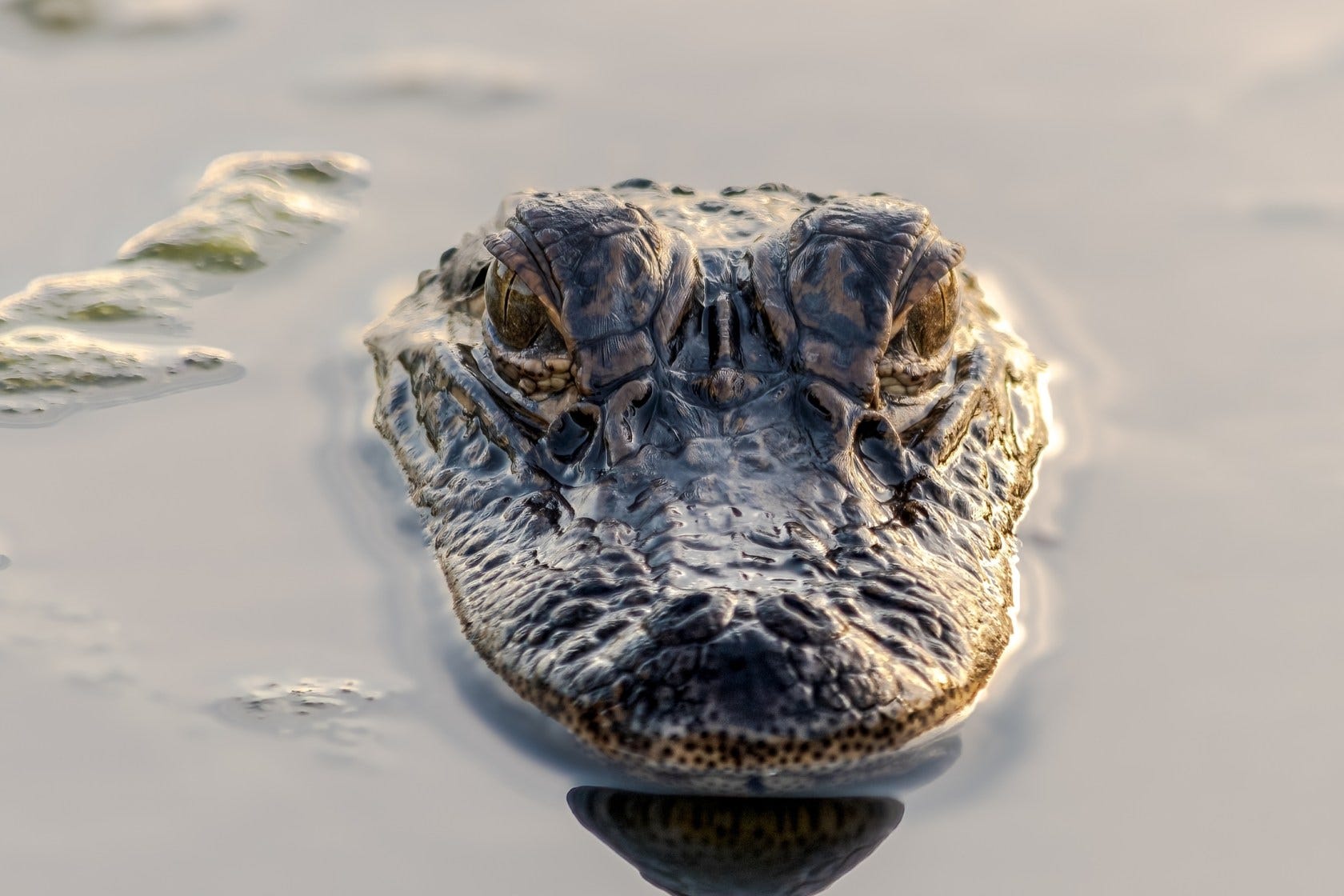
Later that night I would lock eyes with a gator during a visit to the camp toilet (a bucket). In the morning I would do as my comrades reminded and check my boots for snakes and other visitors. At first it seemed absurd to close the tent flap at night, hot boxing yourself in an already hot boxed world. And then the mosquitoes would come in, treating your heavy duty bug spray as an aperitif, and then you’d reluctantly but resolutely close the tent flap, weighing discomforts in sweat-covered scales.
No, this wasn’t my comfort zone. It wasn’t even remotely adjacent to my comfort zone. It isn’t where I feel rooted to place, where I feel home. But for that time it was my home, and the swamps held me as they hold all - with that slow southern reminder of the folly of human hubris, of the fragility of place, the blurred borders between earth’s elements, our finality, its ancientness.
Even when so much of it had and has been destroyed, there’s a feeling of a sad but steady bayou smirk - the kind that pulses with that Bulbancha magic that’s as deep as it is old. We (the) people end up being the losers, all of us.
And it’s something the swamp knows. It’s something that water protectors know. And it’s why we cry, and shake, and scream, and fall into each other with exhaustion and a raw trauma that chafes against everyone and everything. And why we do it again.
When the court’s decision in the Prairieland trial came out, I wasn’t shocked. I’ve long ago lost my ability to be shocked by anything this nation does. But as I like to say, I will never lose my ability to be disgusted. I read Benjamin Song’s statement, a beautiful piece that is as delicate and fucking unbreakable as the human spirit. And it reminded me a lot of similar statements that I’ve read in the past, like Jessica Reznicek’s statement that she wrote back in 2017 after being sentenced for the act of property destruction against pipeline equipment up in Iowa. The argument was and is necessity. We act in these ways because we must. In her statement Jessica makes the point that all other avenues had been taken, and resulted in nothing but revealing “the clear deficiencies of our government to hear the people’s demands.”
And of course! Because our government isn’t for us, never was. We could write books (and people like Ben Price have) about how we don’t have the rights we think we do, weren’t supposed to, and why corporations do, why we and the nature of which we are a part will always be on the losing end.
And this doesn’t mean that we can never win in court. It simply means that winning in court in the US is like winning a point in a match that’s rigged against you. It might feel good in the moment but in the end, we all lose. And this is even before or if we take it to the Supreme Court, who’s just been doing a cracker jack job recently. That cluster-fuck morass of unelected out-of-touch lifers is a whole other can of worms.
And I’m not saying this to scare people or to get people to stop fighting. Indeed, the fact that the system is pushing back in these ways means that it’s threatened. Its stability on our shoulders is tenuous, and the more we shake and move, the more tenuous it becomes.
Unfortunately, this also means that more of us will have and do have targets on our backs, literally and/or figuratively. And we have to act accordingly. Stop hoping that the system will give us a better go if we just vote Democrat, or if we just could make them see fill-in-the-blank-issue. They know. They don’t care.
Again, independence was never ours. We are children of empire - the liminal beings trapped between our oppressors and those in the global South that largely fuel their privilege. Of course that privilege also requires our oppression - an oppression that also demands allegiance. And when that allegiance is not given, we are labeled terrorists. That’s how it’s been since the beginning and that’s how it’ll be as long as this structure stands.
The Prairieland 8 didn’t shock me. Because I’d already been shocked by the Haymarket 8. Jessica’s case didn’t shock me because I myself had a warrant out for my arrest in Louisiana for standing on what they claimed was an easement for critical infrastructure. The raids haven’t shocked me because I learned about the Palmer raids, I learned about the first time SWAT was used was to raid Black Panther member’s homes in LA. I learned about Fred Hampton so I wasn’t shocked by the murder of Tortuguita. I learned about COINTELPRO so the surveillance and infiltration of organizers ranging from eco-defense to pro-Palestine to anti-ICE didn’t shock me. I was five feet away from where Heather Heyer was murdered by a neo-Nazi who drove into a crowd of people in Charlottesville so I wasn’t shocked by the video of a Delaney Hall employee hitting a protestor with their car.
This (and a whole lot more) is America. It might not be who we are personally but it is who we are as a nation. And we can grieve that, we can rage and cry and scream about it. But we also have to act on it.
Because we will never have our government’s support. What we need to survive, to thrive is antithetical to our nation’s survival. What we have are our bodies, we have our minds. We have each other when and if we do the work to care for each other, body and mind. And this is what we’ve always had in this place.
My 4-year old son has a book about water protectors. He has a book about mutual aid. We talk about the world in toddler frames that are different but not whitewashed. We talk about why we can’t visit our friends in Gaza, because bad people are doing bad things, and that those people are connected to the bad people here doing bad things. And that’s why we keep each other safe, and why we show up for our neighbors, our community. We hug trees and go to protests. We talk about why we have to use money but that it’s always better when we can share and trade.
When he gets a little older, I’m not gonna tell him that Abraham Lincoln was a great white man. I’m gonna say that John Brown was, that the Immortal Ten and Silas Soule were. I’m gonna read from An Indigenous People’s History of the United States and A People’s History, and anti-fascist zines. I’m gonna read him statements by the Haymarket 8. I’ll read him Benjamin Song’s statement. I’ll tell him stories of the beautiful people that I’ve been privileged to know who have fought and keep fighting in a whole fucking rainbow of ways every day.
Because there once was and once was not a United States. But there has always been a radical determination to protect one another, to protect our home places, to love, to nurture. That is older than borders, and will outlast them.
Keep telling these stories. Keep fighting.
No posts
Comments
Nothing yet. Say the first thing.
Sign in to join the conversation.