
The first section of The Communist Manifesto says:
The history of all hitherto existing society is the history of class struggles. Freeman and slave, patrician and plebeian, lord and serf, guild-master and journeyman, in a word, oppressor and oppressed, stood in constant opposition to one another, carried on an uninterrupted, now hidden, now open fight, a fight that each time ended, either in a revolutionary reconstitution of society at large, or in the common ruin of the contending classes…. Society as a whole is more and more splitting up into two great hostile camps, into two great classes directly facing each other – Bourgeoisie and Proletariat.
As I was reading this with fresh eyes recently, the first question I wondered was which of these great hostile camps Marx and Engels belonged to. Engels was the son of a wealthy industrialist and worked in the family business. Marx certainly wasn’t a factory worker. Where do writers fit? Shopkeepers? Farmers? Self-employed craftsmen? Professionals? Marx and Engels knew these people existed. They discuss the petty bourgeoisie and other intermediate classes, but predict that these categories will increasingly disappear as capitalism pushes people into the proletariat. Marxists don’t seem overly concerned that history has not worked out the way Marx predicted, at all.
But that led me to a more interesting question. Maybe the problem isn’t that Marx and Engels put people into the wrong categories. Maybe the problem is what we do with categories of people in the first place.
We classify people constantly today: white, person of color, disabled, colonizer, settler, immigrant, LGBT, Trump supporter, progressive, working class, privileged, oppressor. This is natural; each of these can describe something real. Some can be defined more precisely than others. Some are voluntarily chosen, some are imposed from outside, some describe physical facts, some describe political behavior, and some are theoretical constructs. But when we put someone into a bucket, the category often begins accumulating information about the person that wasn’t part of the original definition.
“He is a Trump supporter” becomes evidence about what he thinks about immigration, abortion, race, democracy and perhaps even what kind of person he is. “She is a person of color” can become evidence about her experiences, interests, political views and even her authority to speak about certain subjects. “He is a colonizer” can become evidence about his rights, his culpability and whether violence against him is legitimate.
Something happened along the way. A description became an explanation, then an identity, and finally a moral judgment.
It turns out there is a substantial academic literature on parts of this problem. Psychologists use the term social essentialism for the tendency to understand social categories as reflecting deep, inherent properties of their members. Related work discusses reification and “entitativity,” treating a category as a coherent entity whose members share some underlying unity. Philosophers studying “social kinds” ask related questions about categories such as race and gender. A category can be socially constructed without being imaginary; social institutions can make classifications genuinely consequential.
But I think there is a more fundamental question that comes before all of those: What makes these people a meaningful group in the first place?
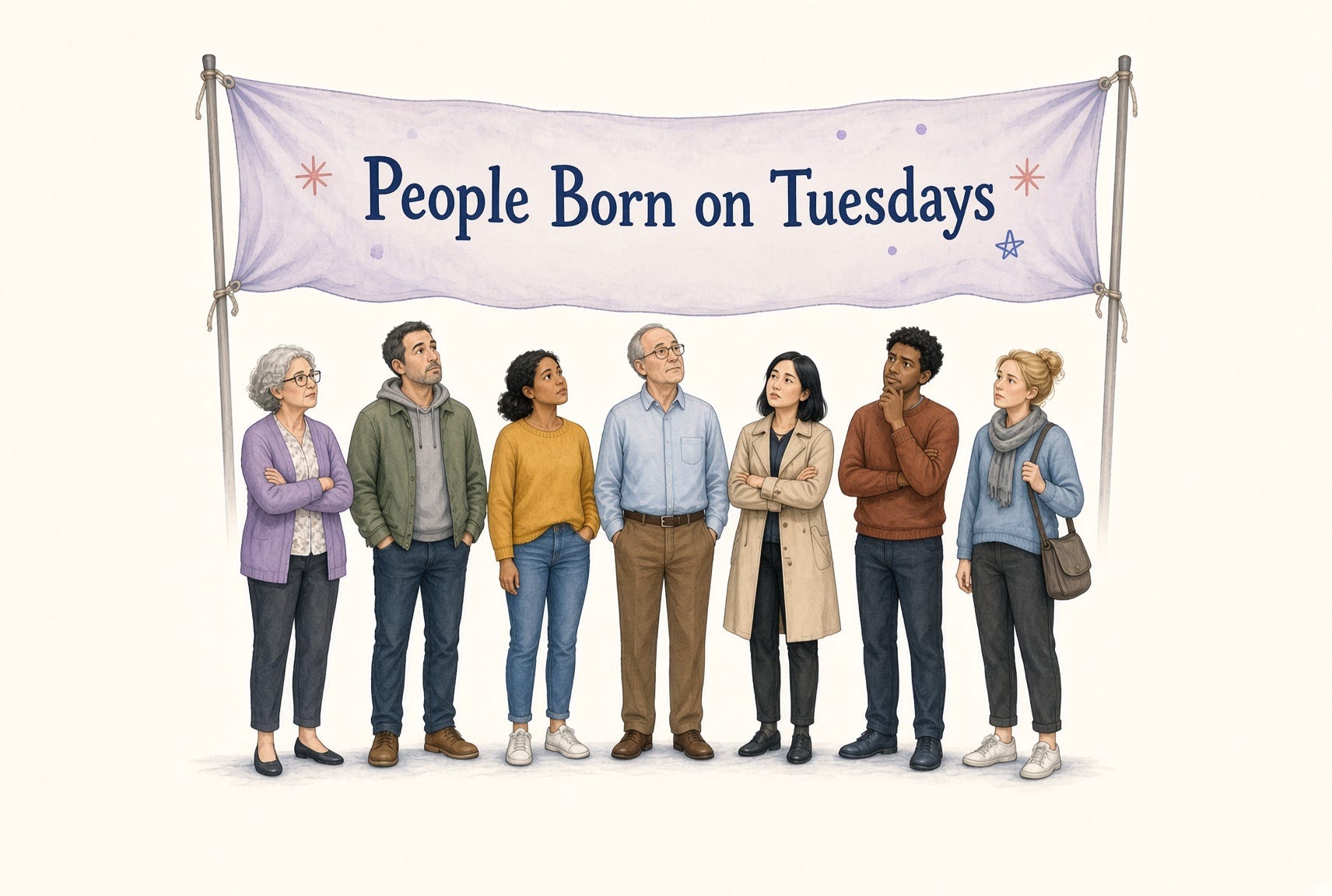
Kurt Vonnegut coined a wonderful word in Cat’s Cradle: a granfalloon, a group whose members imagine that they share some meaningful connection when the supposed bond is largely artificial. People born in the same state can be a granfalloon. Alumni of some enormous university can be a granfalloon. The label groups real people together, but the existence of the label does not itself establish a meaningful relationship among them.
That may be a useful way to think about many of our modern social categories. The question is not merely whether the label describes something accurately. A category can accurately describe a shared characteristic and still fail to establish that its members constitute a morally, politically or socially meaningful group. Brown-eyed people is a real category, and all but meaningless unless there is some medical condition associated with it.
“Proletarian,” at its most defensible, tells us something quite specific. It describes a person’s economic relationship to capital and labor. That can be useful for economics, history and sociology. Researchers might discover that people who occupy that relationship are statistically more likely to have certain interests or beliefs. But the existence of that shared economic position does not by itself create a relationship between all the people placed into the category. It does not tell us that they constitute a political community, share the same interests, possess the same values, should feel solidarity with one another or should regard some other category of strangers as their enemies.
That requires an additional argument.
The same is true elsewhere. “People of color” may be a useful category for studying whether people perceived as nonwhite are treated differently by a particular institution. But what actual relationship exists between a Korean-American physician in New Jersey, a Black farmer in Mississippi and a recent Guatemalan immigrant that makes them one political or moral community? The fact that all three fall outside another category called “white” does not answer the question.
“Disabled” can be indispensable when asking what accommodations a particular person is owed. But blindness, paraplegia, deafness and an intellectual disability are radically different conditions. What makes everyone placed under the umbrella of “disabled” one group for purposes other than the particular question being asked?
The answer may sometimes be excellent. The mistake is assuming that because we have successfully named a collection of people, we have discovered a meaningful human collectivity.
How can we test whether a category is meaningful - or a granfaloon?
The Talmud gives us an answer.
Comments
Nothing yet. Say the first thing.
Sign in to join the conversation.