
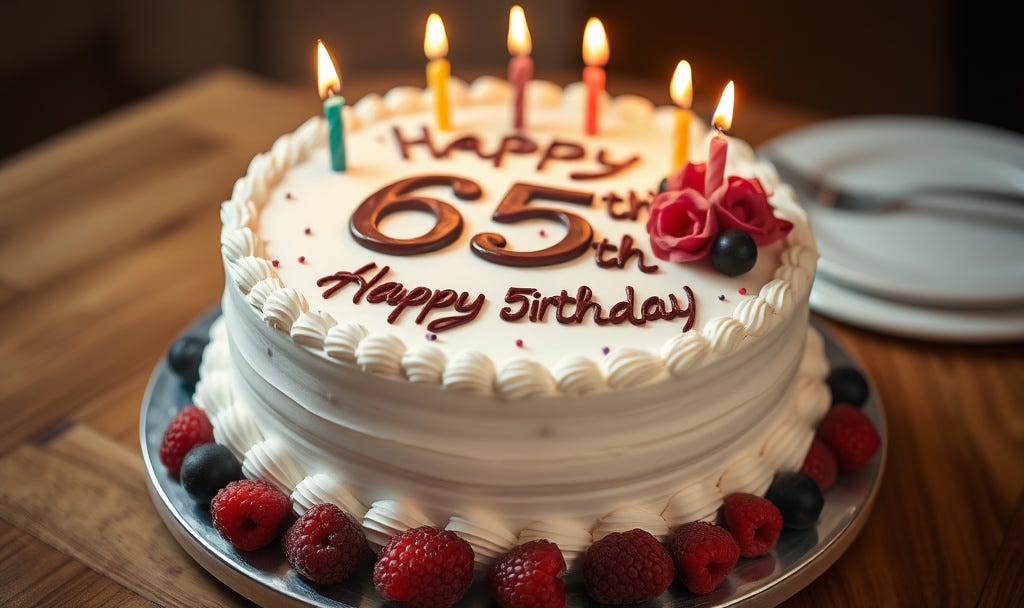
This week I turn 65. Elderberries turns five and is connecting with 5,000 subscribers - and my granddaughter is soon 5. That’s a lot of 5s!
Milestones have a habit of making me reflective. I’ve been daily dog walking with memories swirling around my brain. At 60, I went to Harvard for a year and a career move into longevity. At 65, I hosted my granddaughter for a week in my new country home. The professional pivot, followed by personal growth. As I think back over these midpoint years of my Q3, there are patterns and rhythms I’m still just beginning to learn to read.

This was in the back of my mind as I recorded a podcast with Lynda Gratton, who’s publishing a new book this fall called Living The 100-Year Life. We were talking about her book’s central metaphor: that long lives are a weave made up of many threads (8 in her telling): half on the productive/ professional side, half on the nurturing/ personal side (more, anon). One of the gifts of reaching this stage of life isn’t simply having woven all these threads. It’s finally being able to see the weave, understand the patterns that make it whole and be grateful for the loom you were given to start weaving a life with.
Join me in exploring our new, longer, 4-Quarter lives?
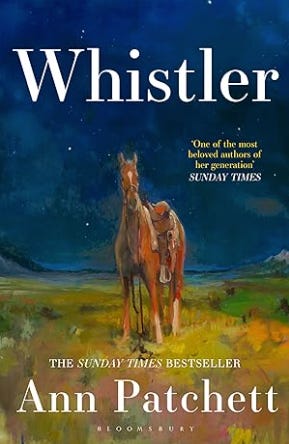
I just finished Ann Patchett’s beautiful new novel, Whistler, (one of her very best) sitting in Senegal with son and granddaughters. Patchett writes so exquisitely about family, memory and the stories we construct about ourselves. She made me remember my own life differently. Or at least re-arrange its telling. Her narrative arc made me see links and echoes between my own decades and generations with new eyes. Let me know if it has the same effect on you.
Just after finishing the book, in the middle of a conversation with one of my kids about the other, I had a flash of déjà vu. I heard myself and thought, “I’m steeped in sibling stories again.” I recognised a role I had occupied before - only then I was the child rather than the parent. I had listened to my mother talk/ complain/ vent about my brothers endlessly. Now I was listening to my own kids.
My mother had a tough life. She survived the Holocaust, emigrated to Canada without speaking English, lost my father to cancer with three kids under 10 and somehow built a new, entirely unplanned life. She went to university, became a professor and remained fiercely independent until the end of her long, 97-year life. She had close friends, but never (as far as I know) another love. Looking back, I see that I became one of the people who helped her carry the emotional weight of life and family across decades.
It was born of love, circumstance and necessity. But it was a role. And roles have a curious tendency to repeat themselves unless we notice them. That conversation with my own kid, a generation later, made me notice. Here I was again. Listening to sibling stories.

It made me think of another part of my usual narrative. For years, I’ve said that I left Canada at nineteen, moved to Paris for a year and stayed for thirty. It’s a tidy story. It suggests departure, independence, reinvention. And distance from family. Like many tidy stories, it isn’t complete.
I left geographically, but I didn’t really leave emotionally. I returned to North America every summer… for 40 odd years. In midlife, before I could really afford it, I bought a summer house in Chautauqua, in northwestern New York State, chosen because it sat between my mother, my in-laws and my brother’s family. I lived far, but holidayed close. It was my attempt to create a place where our internationally scattered family might gather (but not on their turf so I could keep a degree of control). Where my kids could hang out with grandparents - maybe even cousins. Where I could lessen my guilt of having left my mom behind, on a separate continent, by spending summers with her.
If you’ve never been to Chautauqua, it’s hard to explain its magic. I loved it the first time I set eyes on it. My mother did too. What strikes me now is how much it embodies everything I’ve learned since I left almost a decade ago, about longevity readiness, and accompanying different generations with what they need at different stages of life.
The kiddie camp for little kids, ‘club’ for older ones, how it supported me in my sandwich generation years as I juggled gathering my mother, in-laws, friends, kids and kids’ friends. And how it supported the elders too. Like my mother well into her 90s as she buzzed her way around the car-less paths on her motor scooter, direct into the ampitheatre to listen to lectures, the symphony or buzz over to the adorable movie theatre. With kids, grandkids or on her own. Easy, simple, natural.
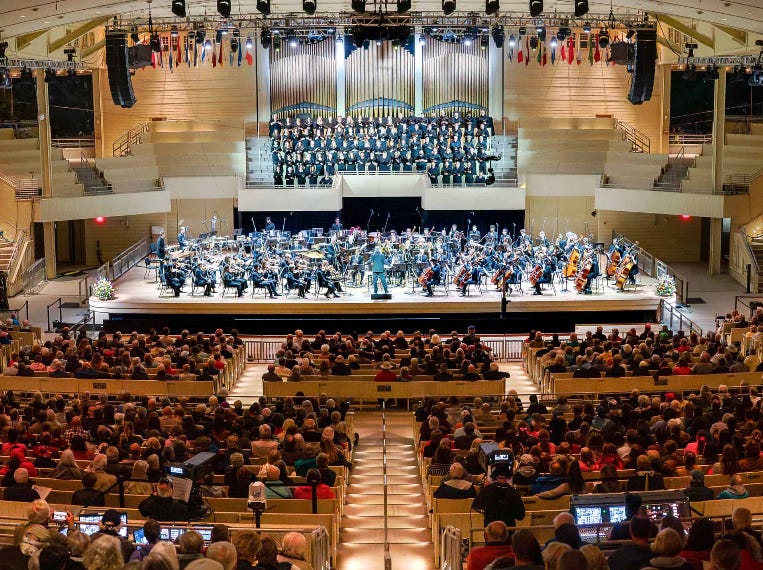
Chautauqua offered an alternative to the way the world usually works. It suggested that families, communities and generations could be designed differently. Not perfectly—we’ve seen that illusion shattered too, not least when Salman Rushdie was attacked on the very stage where we’d spent so many happy mornings listening to writers and thinkers—but intentionally.
It brought together every concept I’ve been learning about since: lifelong learning, art as therapy, intergenerational everything, exercise, beauty, nature, close communities, no cars. Now that I’m the older generation, with no one above me (ahead of me?), I realise more consciously how much joy the place offered its elders, including my mom. I wish there were more places like it - and in Europe.
As I hiked this year’s golden August fields, I thought how much my efforts at bridging connections in my family was training for most of everything I did in life. Whatever the subject, personal or professional, I seem to have spent my life balanced between worlds - seeking to find connections.
Between Canada and France (now between the UK and Senegal).
Between English and French.
Between tech and literature (my first university degree)
Between women and men.
Between younger generations and older ones.
Between business and society.
Between work and family.
Between organisations trying to understand demographic change and individuals living through it.
and (still) between different branches of my own family.
For years I thought my work was about gender. Then I said I ‘moved’ into the longevity space. Sitting with all these memories unfurling like the fields of ferns in front of me, I could see a similar verb, being tensed across different landscapes. Building connections across differences. Not eliminating them. Not persuading everyone to agree. Simply making it easier to cross, even just occasionally, from one world into another. From one person’s shoes to another’s. To become ‘fluent’ across people, cultures and traditions.
The thought is strangely comforting. For much of my life I believed that if I built the most beautiful, (emotionally) intelligent bridges, people would be ready to cross over them. If I chose the right place, opened the right door, hosted the right conversation, connection would follow.
Age has taught me the inevitable. You can build the bridges. You can’t make people cross them.
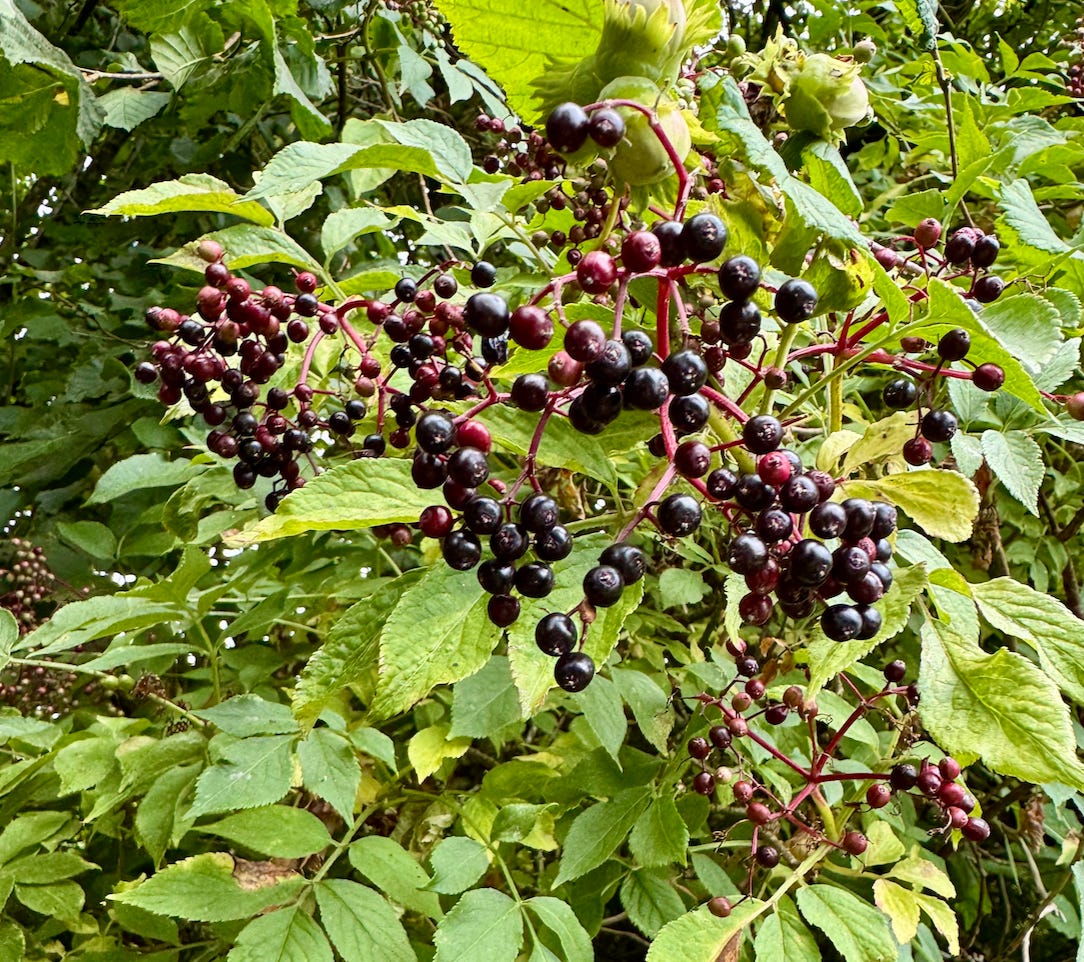
Perhaps that’s what these five years of Elderberries have been about. I thought I was writing a newsletter about longevity. Now, I realise I’ve been building yet another bridge. A narrow strip of sentences where I try and connect where we are and where we’re headed. Where curiosity is valued more highly than certainty, where you explore this new Q3 along with me, and where we’re watching something emerge together rather than alone.
A few days ago Ernesto van Peborgh wrote just that. He said the deeper purpose of writing in public may not be to communicate ideas, but to participate in their co-evolution through “shared attention, shared inquiry, and the quiet reciprocity of many minds thinking together.”
I can’t think of a lovelier birthday gift. A community of writers, walkers, thinkers and sharers. People I know, people I don’t. People I increasingly meet as I move through the years and the world. This essay emerged as most do now. It began as a dog walk, morphed into a birthday reflection, then became something else. Not because I mulled alone and longer, but because conversations—with Lynda, with my family, with the latest Ann Patchett novel, with many of you, and yes, even with AI (I admit it!)—kept revealing connections I hadn’t previously seen.
Perhaps that’s the greatest privilege of a long life. Not simply that we have more memories and experiences. But if we’re lucky, we eventually begin to see - maybe even understand - the tapestry we’ve woven.
"What's the tidy story you tell about your own life — and what happens if you look at it again now?"
Birthday Discount Offer
If any of this is stirring something loose for you too — the patterns, the roles, the bridges you’ve built without noticing — I hope it helps you look at your own weave more closely. With new eyes. To support new looking, here’s a birthday discount offer, with thanks for walking with me across this bridge towards our longer, 4-Quarter lives.
Comments
Nothing yet. Say the first thing.
Sign in to join the conversation.