

My first time inside a Tesla, about ten years ago, I remember being amazed that the display was just a giant touch screen. No radio knob, no buttons to adjust the AC or hazard lights—only a supersized iPad in the center of the dashboard. Once again, it seemed that the future was already here, just not evenly distributed.1
The appeal of a touch screen, if it’s not obvious, is that it provides near infinite flexibility at significantly less cost than conventional car controls. A touch screen can theoretically be set up to provide everything a physical button can and more: sliders, switches, and dials arranged in any configuration (to say nothing of crucial functions like navigation and Santa mode). And if the manufacturer ever wants to change the UX, they can just push a software update.
Unfortunately, like many things created by Elon Musk, what seemed like a slick idea on paper has turned out to be...less than perfect. After years of auto manufacturers following suit with touch screens of their own, many are reverting back to more analog controls. Why would this be—and what lesson can we draw for other technologies?
In the case of cars, the reason for the touch screen backlash is pretty clear: Driver preference, and safety. Both of these reasons have to do with the fact that tactile controls are more intuitive to operate, and facilitate muscle memory. For example, one recent-ish study found that interacting with a touch screen impairs driver reaction times more than alcohol or cannabis. In 2020, a German court ruled that Tesla’s screen-based wiper controls were illegal after a driver got in accident trying to adjust their speed. This all makes sense when you consider that without buttons, drivers need to rely almost exclusively on sight rather than feel, requiring them to take their eyes off the road.
Do the drawbacks of touch screens generalize to every domain? Of course not. For phones, it now seems pretty definitive that on net the tradeoffs favor flexibility and display size over the greater tactile feedback of a keyboard.2 And of course touch screens vs. buttons isn’t really an either/or but a both/and. (Even with more manual controls, most drivers would still want a screen for navigation.) Still, the example of cars demonstrates a key insight: Single-use tools/mechanisms sometimes are better than more flexible, technologically advanced ones.
With the car control analogy in mind, let’s now turn to the technology of the moment: Large Language Models. At first glance, LLMs seem strictly better than many of the more static forms of text which preceded them. They are interactive, infinitely patient, and infinitely flexible in their outputs. Where you previously would have had to read a textbook or Wikipedia page to learn about, say, the French revolution, you can now query a Chatbot that will tailor the information exactly to your reading level and interests, and even quiz you on the information. As dynomight recently argued, the explainer post may well go extinct soon—and this might not be so bad:
So yes, just as we’ve generally decided iPhones are superior to Blackberries, we’re likely to replace many books, webpages, and human interlocutors with Claude or ChatGPT. For finding a recipe or troubleshooting a broken appliance, LLMs are strictly better than the old solution of Googling and poring over webpages. But in some pockets (as with manual controls in cars), the older seemingly simpler tech can and should persist. This may simply be because users prefer it. Or it may be because the affordances of the older technology are actually better for certain purposes.
In some cases the superiority of static text is because there is something desirable about its constraints. A Kindle is easier to read on than an iPad because it offers fewer distractions. Similarly, a static blog post or book represents a single consumable unit of text, in contrast to the infinite rabbit holes and permutations of an LLM; this may be beneficial for a variety of reasons you can imagine.
In other cases, the appeal of static texts may be not because of what it can’t do but, counterintuitively, about what it can do better LLMs. Despite being simpler, the tactile nature of buttons and knobs makes them a better solution to the problem of operating a car. Similarly, a static text (especially if written by a human) may be better at fulfilling certain functions of reading for which an LLM is a worse substitute—e.g., facilitating connection or capturing a moment in time.3
Finally—and this one is the squishiest to talk about—I believe there can be a beauty to creations that are meant to serve a single purpose. Marge Piercy gestures toward this in her poem “To Be of Use”:
Text within this block will maintain its original spacing when published
[T]he thing worth doing well done
has a shape that satisfies, clean and evident.
Greek amphoras for wine or oil,
Hopi vases that held corn, are put in museums
but you know they were made to be used.
The pitcher cries for water to carry
and a person for work that is real.
Here, Piercy is mostly using the vessels as a metaphor for human purpose, but her words also speak to the intimate relationship between form and function. In this vein, even if LLMs can serve many different goals as well or nearly as well as static texts, there may still be aesthetic reasons to prefer the finely crafted static version.
“The ultimate, hidden truth of the world,” wrote David Graeber, “is that it is something that we make, and could just as easily make differently.” LLMs make the world differently each time you talk to them; ask Claude the same question ten times, you’ll get ten different answers—even if just slight variations in phrasing.
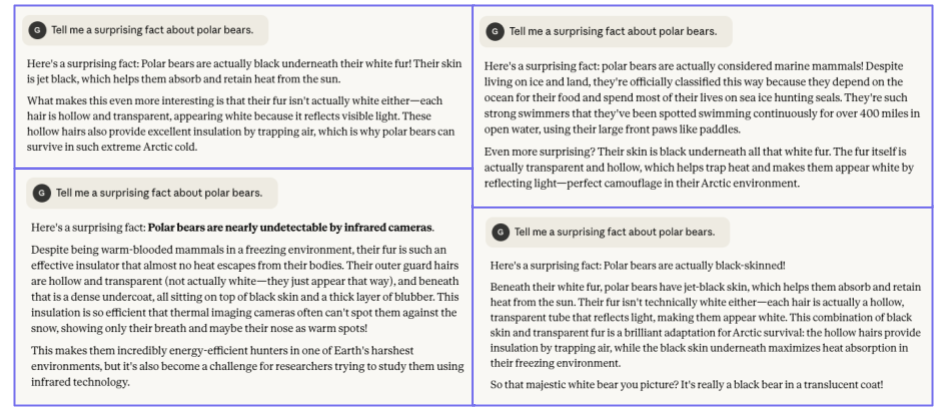
A static text, by contrast, can only express the one thing it expresses. It may be analyzed and reinterpreted but not queried or reformulated. Assuming it has a human author, it reflects someone who has made the world in a particular way, collapsing all the infinite possible ideas and phrasings into the vision they like best. (As Ted Chiang explains: “Art is something that results from making a lot of choices.”)4
In short, static texts still hold value in a world with LLMs for the same reason that physical buttons can hold value in a world with touch screens. Sometimes—perhaps most of the time—infinite flexibility in constructing reality makes for a better user experience. But sometimes infinite reality pales in comparison to one clearly stated truth.
This phrase is of course a version of the famous line by sci-fi writer William Gibson.
Admittedly, I do miss tactile feedback for phones too. (Kids these days will never know the wonder of texting on their enV2 under their desk, fingers flying with perfect QWERTY precision, all without ever taking their eyes off the whiteboard.)
Here, it might seem that the utility of static texts vs. LLMs breaks down along lines of art vs. commerce or emotional vs. informational functions. That’s a cut I’ve made before, and one I still believe still has merit; but it’s also one that neglects the relationship between beauty and utility. (Part of what makes the analog controls work better for cars is that they are simple and intuitive—or, in design terms, beautiful.) This point is closely tied to the one I’m making with “To Be of Use.”
Again, what I’ve described as a binary between LLMs and static texts could be treated as a continuum or hybrid. For example, you can have a split-screen interface with a poem or page of a book on one side and a Chatbot on the other that helps you understand/interpret the text.
Comments
Nothing yet. Say the first thing.
Sign in to join the conversation.