
A QUICK NOTE FOR THE WOMEN READING THIS FIRST
My loves, this article is written directly to the men in our lives. The partners, the brothers, the grown sons, the fathers, the closest friends. I want you to read it first, because you will know whether it lands. And then, if it does, please send it to the men who love you. You do not need to explain or soften it. A simple message will do. Something like, I want you to read this. It will help you understand what I have been walking through. Please take the time. They have been waiting for this map too. And so have we.
Also if you have not yet taken the new quiz “Where Are You In Your Menopause Journey” here is the link!
So. You are here.
Which probably means one of two things. Either someone you love has sent you this article and asked you, in a tone that did not quite invite negotiation, to read it. Or you stumbled in by accident and have not yet realised that almost nothing else on the internet about menopause is written for you.
Either way. Welcome.
I am writing this for the men who love a woman walking through the menopausal passage. The husband. The partner. The brother. The grown son. The father. The closest friend. Whoever you are to her, and however that connection is shaped, if she is in this passage and you are trying, with whatever you have, to walk beside her, this article is for you.
And let me say one thing right at the start, because nobody else has said it to you and somebody needs to.
Nobody gave you a map either.
You are travelling with a partner mid-metamorphosis with no instruction manual, no language, no training, and a culture that has worked very hard to make sure nobody around you knows what is happening to her either. Your doctor was given roughly one hour of training in this menopausal passage during medical school. Your own father, if he is still alive, almost certainly was not given language for it either. Your friends are mostly not talking about it. And the woman you love may not be able to fully explain it herself, because she is inside the storm trying to describe the weather.
So if you have been feeling baffled, helpless, hurt, defensive, or quietly terrified, I get it!
You are moving through something genuinely huge with no preparation.
Let me try to give you some.
Let me be direct about this.
She, whoever the She is in your life, is in a hormonal initiation that is comparable in magnitude only to puberty. The last time her body went through anything this big was when she was twelve. Her estrogen is in a long, unpredictable freefall. Her progesterone has been quietly declining for years. Her brain is actively rewiring. Her nervous system is recalibrating in ways that have real neurological consequences, including disrupted sleep, cognitive fog, emotional intensity, and physical sensations she did not have access to last year and may not have access to next year either.
This is not vague. This is a powerful biological, emotional, psychological, and spiritual rite of passage. Dr Lisa Mosconi, a neuroscientist at Weill Cornell Medical College, has spent years scanning the perimenopausal brain. Her research, published in her 2024 book The Menopause Brain, shows that this passage is one of only two structural neurological transitions a woman’s brain goes through in her entire life. The other one was puberty.
And the medical world, frankly, has been catastrophic at explaining this phase of a woman’s life. Only thirty-one percent of US obstetrics and gynaecology residency programmes include any standardised menopause training. Twenty percent of OB/GYN residents finish their entire residency having received zero lectures on menopause. The clinical professor at Yale Medical School has stated publicly that she gets one hour to teach menopause to medical students during their entire OB/GYN rotation.
One hour. For an initiation roughly two million American women cross every single year.
Which means your partner is walking through one of the largest biological transitions of her adult life, often without language, often without medical support, often without anyone around her having a clue what is going on.
If she has not been able to explain it to you, it is not because she does not want to. It is because she does not yet have the words.
Now I want to take you a layer deeper, because the biological piece is only half of what is happening to her.
Menopause is a powerful rite of passage. A rite of passage is a structural transition between one life and another, marked by an internal threshold and accompanied by the death of who the person was before. Every traditional culture across history has had one for women at this age. Ours does not. Which is part of why she is having such a hard time, and part of why you are baffled.
She is not adjusting. She is not coping. She is not, with any luck and a few supplements, going to return to the woman she was at forty.
She is becoming someone she has not been before.
And here is the part that almost nobody is saying to either of you. In order for that becoming to happen, she has to withdraw her energy from the places she used to put it. The relationships she used to maintain on autopilot. The yes she used to say before checking with herself. The labour she used to absorb without anyone noticing she was absorbing it. The roles she has been performing, often beautifully, for decades.
She is calling that energy back, possibly for the first time in her adult life.
This is what looks, from the outside, like her becoming distant. Or selfish. Or hard to reach. Or no longer the person you fell in love with.
She is not becoming distant. She is becoming present to herself. And that is something most women only do once in their lives. This is when.
She is withdrawing her energy from what she used to do in order to bring that energy into herself. Possibly for the first time.
Which brings me to her symptoms.
The hot flashes. The insomnia. The rage that arrives without warning. The exhaustion that no rest seems to reach. The grief that comes up in the kitchen on a Tuesday for no reason she can name.
Yes, they need to be tended. Yes, she may need medical support. Yes, you can help her find the right doctor and the right framework for her body. All of that is real.
But the symptoms are also messages. They are her body and her psyche telling her, often loudly, what she has been carrying that is no longer hers to carry. What she has been swallowing that needs to be spoken. What she has been postponing that needs to be lived.
Her body is not malfunctioning. Her body is speaking.
If she can listen to what her symptoms are saying, the symptoms move differently through her. Not always faster. Not always easier. But with the meaning intact, instead of being treated as noise to be silenced.
And here is the part of this teaching I most want you to hear.
Her transformation may initiate yours.
If you are the kind of man who can stay close enough to her to actually witness what is happening, something starts to move in you too. Not because you are trying to. Because her becoming, when it is genuinely met by someone close to her, has a way of asking the man beside her, quietly, what he is also being called to become.
You may find yourself reckoning with what you have built. The patterns you have inherited from your father. The work you have not yet done. The questions you have been postponing about who you actually want to be in the second half of your life.
This is not coincidence. It is the deepest possible kind of intimacy. Two people in metamorphosis at the same time, inside the same relationship, both being remade.
Most cultures had a name for this. We have lost the name. But the thing itself is still happening, in living rooms and bedrooms and kitchens all over the world, between women in this passage and the men who are paying close enough attention to be moved by her.
You can be that man. Whether you are now or not. You can become him.
Let me tell you something about my own partnership.
I met my partner thirteen years ago. He has walked alongside me for eleven of those years through this passage. We are still in it. Still in the middle of the great metamorphosis. And we both know now what neither of us knew at the start.
In the early years, neither of us understood what was happening. My PMS (pre-menstrual syndrome) got significantly more extreme. I would become someone slightly different in the days before my bleed. So different, in fact, that I gave her a name.
Helga.
Helga was the more bombastic version of me who arrived without warning, ideally with a list of grievances, and was happy to litigate them at considerable length. She was not subtle. She was not negotiable. And she was, in those early years, putting some real pressure on our intimate life.
My partner, to his credit, became extraordinary at reading Helga’s arrival. He could often feel the shift in my energy before I could. He knew when my period was coming three days before I did. Which, when you think about it, is a kind of magic. He had become more sensitive to the rhythm of my cycle than I was.
And then my cycle began to break apart. Some months it was three weeks long. Some months it was one continuous bleed that did not seem to want to stop. Some months it skipped entirely. The compass that had been quietly orienting me for thirty years was no longer giving me a reading.
I felt cast out into the abyss. Frankly. There is no other word for it.
And as I came unmoored from my own internal rhythm, the tension in our connection became real. Not because either of us was doing anything wrong. Because we had no map. Neither of us knew what was happening, and neither of us had a framework that gave the passage a name.
It is hard to navigate this passage from the inside. I can only imagine how it must look and feel from where you are standing.
Then came the impact on our intimate life. The hot flashes. The night sweats. My body would flare up like a volcano any time he touched me. It wasn’t because I did not want him to touch me, I did. But my body literally could not regulate the heat his hand was transferring to me and it would trigger a hot flash almost immediately. Every loving touch became, biologically, kindling.
I want to share this with you, because the men I have spoken to about this almost never know it. When your partner pulls away from your touch in this passage, it is not because she has stopped loving you. It is because her body has temporarily lost the capacity to receive heat from another body without overheating. The reflex is biological. The love is intact.
Her withdrawal may also be because she is is experiencing other symptoms that make it hard for her to be intimate with you. As estrogen decreases, it often causes a thinning of the skin, in particular the skin of the vulva. Which can lead to increased sensitivity and in some cases vaginal atrophy, (don’t even get me started with the way that this was named) which makes having penetrative sex very painful.
So for me eventually, after years of resistance, I started to enter into the conversation about hormones.
I want to say something about hormone replacement therapy here, because she may be in the middle of this decision and the cultural noise around it is, frankly, two decades out of date.
In 2002, a major study called the Women’s Health Initiative (WHI) was halted early because it appeared to show increased risks of breast cancer, heart disease, blood clots, and stroke in women taking the form of HRT that was standard at the time. A generation of women, and a generation of doctors, walked away from HRT in fear. My own decision to consider it took me years, partly because my mother had both breast cancer and cervical cancer, and I was tentative about anything hormonal as a result.
Here is what has changed.
In May 2024, the same researchers published twenty-year follow-up data in the Journal of the American Medical Association (JAMA) showing no increase in deaths from breast cancer or cardiovascular disease in the women who had been part of the original trial. Women under sixty who started HRT actually showed decreased all-cause mortality.
The form of HRT being prescribed today is largely different from what was being studied in 2002. Lower doses. Bioidentical micronised progesterone instead of the synthetic progestin used in the original trial. Transdermal delivery through patches, creams, and gels, which significantly reduces the risk of blood clots compared to oral pills. The 2024 guidelines from The Menopause Society (formerly the North American Menopause Society) have explicitly removed the old five-year duration limits and now state that arbitrary limits should not be placed on the duration of HRT use.
In November 2025, the United States Food and Drug Administration moved to remove the boxed warnings from HRT products that had been there since the 2002 panic, after a public expert panel reviewed the evidence.
None of this means HRT is right for every woman. The decision is hers, with her doctor, considering her own history and risks. What it does mean is that many women are still operating from fear-based information that is two decades out of date, and may not have been given the current research.
Why I am telling you this. Because if she is wrestling with this decision, she needs accurate information, not the cultural ghost of 2002. And you, as the person closest to her, can help her find the current research. You can come with her to the doctor’s appointment. You can hold the question with her. The choice is hers. The support can be yours.
For my own part, I came to HRT eventually, after careful consideration with my doctors. And I will only say this. Without an honest map alongside her, how is any man meant to understand how deeply this is affecting him too?
If you want to get up to speed, here are the four sources I would put in your hands. Each one is current, evidence-based, and written by people with the credentials to be saying what they are saying.
The New Menopause by Dr Mary Claire Haver (Rodale Books, 2024).
Number one New York Times bestseller. Written by a board-certified OB/GYN and Certified Menopause Provider. Contains an entire chapter on the WHI study and why the 2002 reading has been reassessed. The single best place to start if she is wrestling with the HRT question.
Estrogen Matters by Dr Avrum Bluming and Dr Carol Tavris (Revised and Updated Edition, 2024).
Dr Bluming is an oncologist. Dr Tavris is a social psychologist. The book directly addresses the breast cancer question that has kept so many women, including women with family histories like mine, away from HRT for two decades. If her hesitation is specifically about cancer risk, this is the book.
The Menopause Brain by Dr Lisa Mosconi (Avery, 2024).
Dr Mosconi is a neuroscientist at Weill Cornell Medical College who has spent years scanning the perimenopausal brain. Her work explains the cognitive changes, the sleep disruption, the emotional intensity, and the brain rewiring that nobody has been telling either of you about. Read this and the brain fog stops being mysterious.
The Menopause Society (menopause.org).
The professional body that sets the clinical guidelines. Their position statements are publicly available. If her doctor is not a Certified Menopause Practitioner, the Society’s find-a-practitioner tool on their website will help you locate one who is. This matters. The right doctor or naturopath can change everything.
Here is something I want to acknowledge directly, you are quite possibly also in your own midlife shift, if you are partnered with someone who is going through hers.
And if this is you, then your testosterone has actually been declining for years. Your body is changing in ways nobody briefed you on. Your sleep is probably different from what it was at thirty-five. Your relationship to your own ambition, your own mortality, your own sense of meaning, all of it is in flux. Some men in this phase find themselves in genuine andropause, with measurable hormonal shifts that affect mood, energy, libido, and cognitive clarity. Almost no doctor will say the word to you.
And underneath the hormonal piece, there is the deeper midlife reckoning. Who you are becoming. What you have built. What you have not yet built. What it means to age as a man in a culture that gave you almost no script for the older man as a figure of wisdom, depth, and luminous authority. You were told to stay productive. To not show vulnerability. To fix things. None of which serves you in this phase of your life.
You are walking your own initiation while she is walking hers.
Which means this passage is happening to both of you. Simultaneously. With no shared language, no shared map, and no cultural framework for two people in metamorphosis at the same time inside the same relationship.
If that sounds genuinely demanding, it is.
If it sounds beautiful, it is also that.
In as practical a form as I can give you, after eleven years inside this passage, here is what I have come to understand about what your partner most needs.
1. Do not try to fix her.
This is the single most important thing in this entire article. She is not a problem. This is not a problem. This is a passage. You cannot fix her any more than you could fix puberty when she was twelve. What she needs is not a solution. She needs to be witnessed.
2. Do not say at least you do not have your period anymore.
Or any sentence that begins with at least. I cannot fully explain why this lands as badly as it does. Just trust me. Do not.
3. Believe her body.
If she says she cannot be touched, believe her. If she says she is exhausted, believe her. If she says her brain is not working, believe her. Her body is not malfunctioning. Her body is speaking. The hormonal and neurological shifts are real, and the messages underneath them are also real. She is not exaggerating. She is not over-reacting. She is, on top of an enormous biological transition, trying to function in a culture that does not honour her or help her create the space she deeply needs to make this passage.
4. Sit with her in the dark.
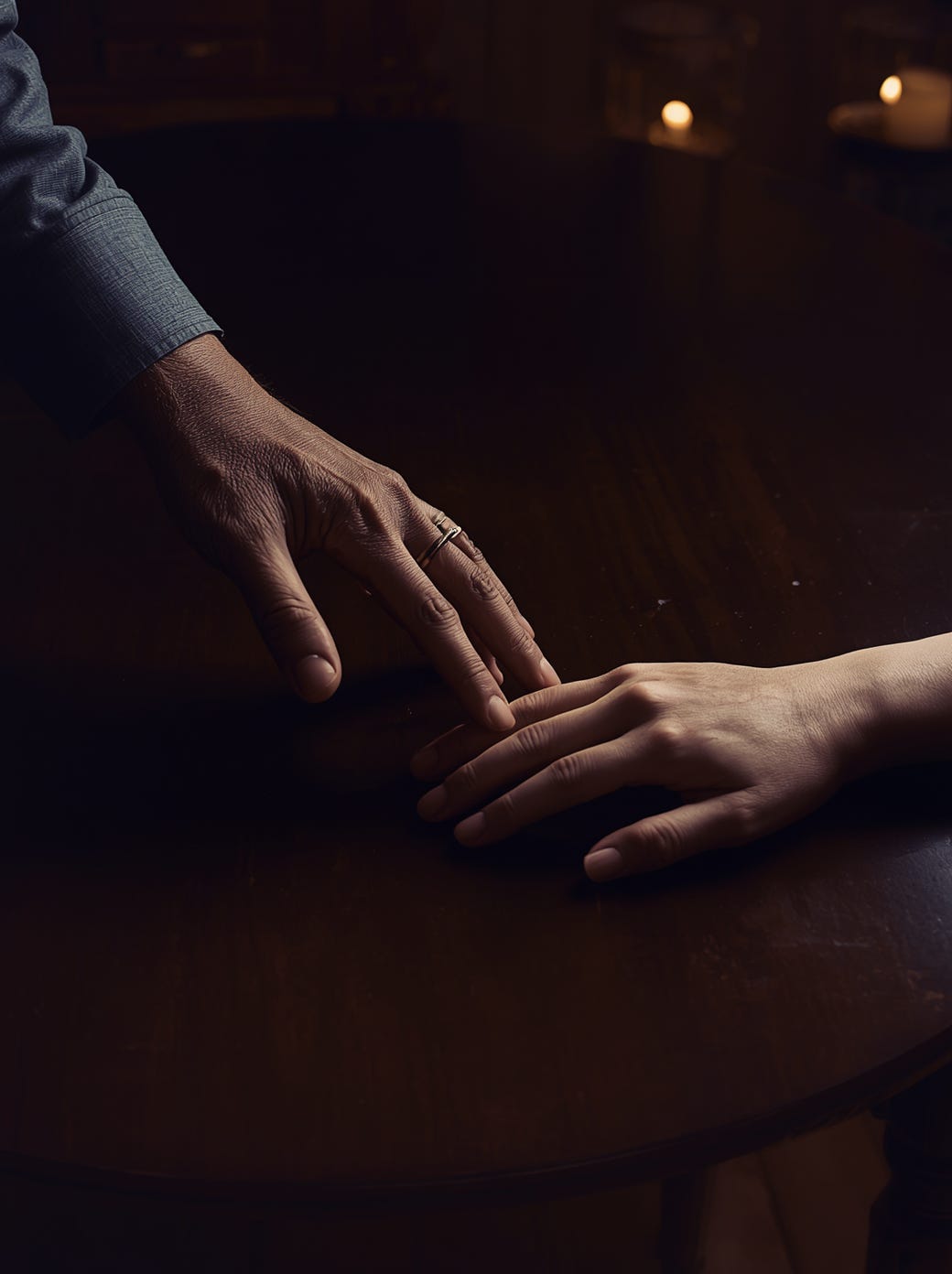
She does not need you to light the candle. She needs you to sit beside her while the candle is out. This is one of the most underrated forms of love available to a partner during this passage. Your presence, without trying to make the darkness brighter, is itself a profound gift.
5. Make her a cup of tea.
Or whatever the equivalent is in your life together. Small ordinary acts of care matter more in this passage than grand gestures. The tea brought without being asked for. The hot water bottle. The bath run for her. The phone call made on her behalf because she does not have the energy. The small things land deepest.
6. Let her withdraw.
She may pull energy back from places she has been putting her for decades. The dinner parties she used to host. The work she used to absorb. The friendships she used to maintain singlehandedly. The way she used to be available to everyone, at all hours, without question. This is not her abandoning the world. This is her bringing her energy back to herself, possibly for the first time in her adult life. If you can recognise the withdrawal for what it is, and not require her to keep performing the old life, you give her the most precious gift available in this passage. Space.
7. Do not take it personally when she changes.
She is becoming someone new. She is supposed to be. The woman she has been for thirty years is being remade. The values she has been carrying may shift. The yes that came automatically may stop coming. The patience she had for your particular small irritations may run thinner. None of this is about you. All of it is about her own becoming, finally, on her own terms.
8. Have your own life.
Your own friends. Your own work. Your own midlife shift to walk. She does not need to be your only world right now. In fact, the men who walk this passage best are often the men who are also walking their own. Get the male friendships. Get the therapy if it serves you. Sit with your own questions. Do your own becoming.
Here is the part of this article that I particularly want you to read.
The men who walk their partners through this passage with real presence end up with a different kind of woman on the other side of her. A woman who is more deeply herself. Who has been through the underworld of her own becoming and come back carrying things she did not have access to before. Clarity. Sovereignty. A truer voice. A body that finally knows what she wants and is, perhaps for the first time, able to say.
And the relationship that survives this passage, when it is walked well, ends up deeper than anything you had before. The roles you both built your earlier life around get retired. What is left is honest. The intimacy that returns, when it does, is rooted in a different ground. Both of you have been through something. Both of you have been remade.
The woman you fell in love with is becoming someone she could not have been at the time you met her. If you can stay through this, you get to know her in a way no younger man ever did.
The men I see at the other end of this passage with their partners are deeply, quietly, properly loved. By women who have come into themselves. Which is a different experience than being loved by a woman who has not yet.
It is, frankly, the great gift of this rite of passage that is menopause.
For the last two years I have been performing in a stage show called So This Is Menopause. A series of monologues by women who have been walking through this passage, delivered live, with humour, with grief, with rage, with reverence.
And at every single performance, men come up to me afterwards. Often quietly. Sometimes with tears.
Thank you. I had no idea this is what she has been going through. Now everything makes sense. Every man needs to see this.
Which is part of why I am writing this article. Because most men do not live in a town where the show is playing. Most men will not, ever, sit in that theatre. But they need the information all the same.
And the women they love need them to have her.
If this article was sent to you by someone you love, here is what I would suggest.
Do not write back a long reply trying to fix everything. Do not promise to be different.
Just breathe for a few moments and then read it again.
Find the part that lands hardest for you and sit with it for a moment.
Then go to your partner, your sister, your mother, whoever sent it, and say one true sentence. Something like, I read the article. I see you. I am here. Thank you for sending it to me.
Then make her a cup of tea.
It really is that simple. And that hard. And that good.
With deep respect for the work you are doing,
in love and devotion Elayne Kalila
No posts
Comments
Nothing yet. Say the first thing.
Sign in to join the conversation.