
I’ve mentioned before that I am a teacher. I teach religion from 7th to 12th grade at a rural Catholic K-12 diocesan school. This school is in my hometown, and I am here as an unworthy replacement for the Dominican sisters who used to teach here, when religious vocations were plentiful.
I am abundantly blessed by this vocation. It was never in my plans, but it was in God’s plan apparently, and the years I have spent teaching have been the happiest and most meaningful of my life.
But with every abundant grace, there comes a responsibility to build the Kingdom of God.
Teaching the Faith to teenagers is extremely difficult for many reasons. They dislike school (as did I). Although our school is excellent, it still generally operates under modern models of education which prioritize measured achievement over human formation. They are distracted by their changing bodies and interests, which is understandable—but instead of looking to parents and mentors who could help them, they have been conditioned to listen to their peers and social media. They are numb and bored as a result of the gamification, poor-quality media, and dopamine deficiency as a result of technological dependence. The brokenness of the family, the fragmentation of cultural identity, the collapse of genuine community, and the crippling of their imaginative, rational, and moral powers have destroyed their mental health. Their ability to learn and grow, their ability to remember, to be quiet, to self-regulate, to recollect themselves, to ponder, to look, to trust… all of it has been harmed by the realities of modern life.
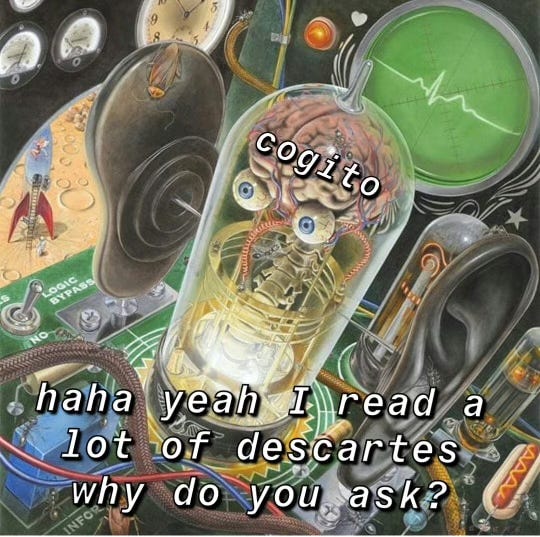
I recognize these things in myself as well. But after years of reflection, I have found that the root of most of these problems is not merely Sin. Rather, the root of the problem is Sin, but the ability to recognize and address this Sin has been diminished by a severe conceptual mistake which we constantly manifest, and which our children inherit. This is the great mistake of dualism, the separation of the internal reality of the Spirit from the external reality of the Body.
I am not philosophically sophisticated enough to take on the epistemological claims of Rene Descartes and all of the thinkers that have inherited his framework. For me the question is both theoretical and practical.
[I suppose that this stance already pushes back against dualism; I don’t believe that something must be perfectly logical to be true. The Truth accounts for all variables, and our limitations in time and space make perfect perception of the Truth impossible. If something doesn’t work, if it doesn’t apply, we have missed something. Logic is the rational mind at play with imaginary realities, but when we pretend the game is real, we do so at our peril. Reality is that which resists our will to change it. When something works, we may then understand it. But the operation of a principle most often comes before the understanding of it.]
Of all the lessons and exercises that I do with my students, none have been so effective at helping them become healthier, holier, and more whole than emphasizing the unity of internal and external realities. Mental prayer is begun by noticing our posture, the location of our bodies in space, our breathing. When singing, I ask them to feel their throats. When it is not painfully hot outside, I take them for a walk while praying. We stand and stretch, we look each other in the eyes when speaking, we rise when the priest walks in. These are not empty rituals but active engagement of both body and mind, an approach that is backed up by decades of scientific pedagogy.
But their worldview is splintered. On the one hand, they are taught that kneeling when everyone else is kneeling in Mass is of utmost importance, but on the other hand, certain adults can give them the impression that kneeling for the Eucharist is merely a matter of preference. The same people who talk to them about marriage can only be between a man and woman might have motivational posters and “quotes of the day” that tell kids to “Be whoever you want to be.” Parents of my students tell them unequivocally that they love them just the way they are, but then proceed to talk exclusively about their children’s accomplishments. The media is the worst, though. The popular messaging of perfect personal autonomy, authenticity, and expression is paired with an incitement to buy products which everyone else has. The students are pulled constantly between the directive to “express yourself” and the idea that “it’s what’s on the inside that counts”.
Because of this constant tug-of-war, I spend the vast majority of my time in class knitting back together the separation of interior and exterior that has been inflicted on our children. Although the actual dispute is whether there is or is not a separation between exterior and interior, the students (and parents, and teachers) believe that the dispute is whether the interior or the exterior actually matters. In other words, they are Cartesians by default.
They are utterly caught up in a worldview that they cannot even sense. They have inherited many lies about their humanity, and their place in it.
For instance, they believe in the lie of “the morally neutral action.” They believe that morally neutral action constitutes the majority of their lives. They believe the lie that “it’s the thought that counts.” They do not apply this just to gifts, as a reminder to gratitude, but rather to every aspect of their moral decisions. Good intentions, to them, are equal to good action. Or they believe the opposite, that as long as the right thing is done, it doesn’t matter for what reason it was done, or in what spirit. They can as easily say “I cheated, but at least I got the answer correct” as “I know I did poorly, but at least I tried.”
They believe (and often are) the parody of the “superstitious Catholic.” Some secretly belive that with enough rosaries muttered, enough brown scapulars worn, or enough candles lit, they’re earning their way into heaven—without experiencing any of the devotional and internal growth that those sacramentals are meant to inspire. Some are functionally Jansenist, though they are shockingly critical of astrology, crystals, and dreamcatchers. They are superstitious about their own faith, while decrying material objects or practices from “other religions” as superstitions.
And some, both Catholic and Protestant students, are instead the parody of the superstitious Protestant, who nervously rejects the “idolatry” of rosaries, confessionals, and statues. Rather, their superstition is focused decidedly inward towards their emotional state, or their perceived “sincerity” or “authenticity.” Some go so far as believing that a temporary movement of their emotions toward Jesus has forever saved them—that if they profess belief in Christ crucified, they’ve been redeemed entirely. The superstition here is not focused on a mistaken understanding of physical objects or actions, but about propositions, “beliefs,” and feelings. They read the Bible this way, as if their decontextualized interpretation of some passage is a conviction of the Spirit.
A variety of this are the few students who are unwittingly New Agers. They might generally believe in Jesus, but they are functionally hippies, and will likely be tempted into that vague “spirituality” when their cultural Chrisitianity is first called into serious question. These students (and others) are comfortable with the use of “externals,” but only to influence their “internal” state. A variation on this is “do this if it works for you.” They will pray the rosary and fast during Lent, but only to the extent that it is perceived as spiritually “useful.” They are one step away from the TikTok religion: believing that their “positive” attitude is putting “good vibrations” or “love and light” or “positive energy” into the universe.
And of course this dualist confusion has caused confusion about gender, as we are all aware. The question as to whether someone could “be” a different gender than their body should be completely nonsensical to Catholics, or indeed any people that question the “separation” of the Body and Mind. The body is not an arbitrary meat puppet in which someone’s gender-neutral “self” is sleeved. The Self is gendered, and the body expresses that, from external characteristics, to genetic makeup, to psychological patterns. You cannot be “inside” something you are not “outside.” My rural, conservative students will happily affirm the Church’s traditional teaching on marriage, but then wonder why gender-differentiated clothing is important.
Most students, though, in this high pressure/high achievement environment (with involved and active parents encouraging their children to perfect grades and star team positions), essentially believe that people ought to whatever they want, so long as it doesn’t infringe on someone else’s freedom. They act as if your external achievement are an accurate measure of your personal value to society. In this way of thinking, the consequences for your actions are much more important than motivation. Action→Consequence. Nothing else seems to be considered. They cannot imagine being poor because they have done the right thing. They can’t imagine getting in trouble for doing Good. To them, “rules are rules.”
From a bird’s-eye view like this, it is very easy to see that these poisonous attitudes are a result of dualism. Dualism proposes that action and intention, internal state and external facts are fundamentally separate. It separates our motivations from our actions, objects from subjects, seer from seen. Body from Soul. This bifurcation of the Self in all of us leads to almost constant hypocrisy, in which the real “Self” is hidden from the world, and the external “Self” is worn like a costume. The cognitive dissonance is painfully obvious.
We may not believe in dualism, but we all act like dualists.
When it comes to the practice of their faith, it becomes even more obvious. Many of the questions I receive from students and parents are about Catholicism’s insistence on externals; things like confession to a priest, rosaries, statues, rituals, and rules. Some students, as stated, believe that these “externals” are truly unnecessary to “authentic” faith—that the only thing that matters is “loving Jesus in your heart.” Others, usually from Mexican and Irish families (that is, historically Catholic cultures), believe that only the externals matter; and they become scrupulous about an occasional missed word in the Hail Mary or when a candle blows out on the altar.
But Christ had harsh words for both those who believed without changing, and for those who cared about only about the purity of the flesh—He fought both the tendency not to act and the tendency to act without intention.
Christ never condemned “externals”. Rather, He condemned mere externals. He did not incarnate as a culture-less, wandering exile who just worshiped from His heart, without concern for the “meaningless rituals”. Rather, He incarnated into perhaps the most religiously observant population of the ancient world. The Scourging of the Temple and the condemnation of the Pharisees was not because Christ hated the practices and statutes of the Hebrew Law, but because He loved them. He hated the emptiness of His people’s hearts.
Protestants frequently criticize Catholics for “Phariseeism”. And, indeed, sometimes this criticism is justified—for a certain kind of Catholic, the kind that believes that they just have to go to Mass to be saved, even though they only attend to be seen as pious. But the sword cuts both ways: for every Catholic who has more faith in the rosary than in Christ Jesus, there are Protestants who are only Christian on Sundays, who believe that religion is a matter of “personal preference,” or believe that “feeling sorry” for your sins constitutes repentance. For every Orthodox who believes that a donation to a monastery will erase their crimes, there are Protestants who ignore their moral weight of their own crimes because they aren’t technically illegal.
The Chosen TV series (which I enjoy) is produced mostly by American Protestants, and predictably, Christ’s criticism of the Pharisees is more heavily emphasized than His external devotions. It is of course the case that the Gospels focus on internal disposition rather than right practice, but to use Scripture to justify a merely “interior” faith is to ignore its context completely. The Pharisees weren’t tempted to Pietism. But if Paul was to show up at our doors, I’m sure he’d have words for us—not about our beliefs so much as how we act. An excellent example of this Protestant-leaning tendency of the show is a scene which stuck out to me: at one point, some of the women disciples are trying to choose what color He should wear to preach the Sermon on the Mount. Christ’s response to this entirely legitimate concern for appearance is: “I can’t tell you how much I do not care about such things.”

It is foolishness to put such words and sentiments in Christ’s mouth. Christ never said “it doesn’t matter.” He never said “I don’t care.” He insisted that the externals and internals were properly connected. Hypocrisy and emptiness was the problem. Not the existence of ritual.
When Christ forgives a sinner for their contrite heart, He tells them to “go and sin no more”. He expects not only a change in disposition, but a change in action. This should not be confusing for us. A person whose heart has truly turned towards holiness will act in a holy manner, and a person who acts in a manner consistent with holiness will experience a change of heart.
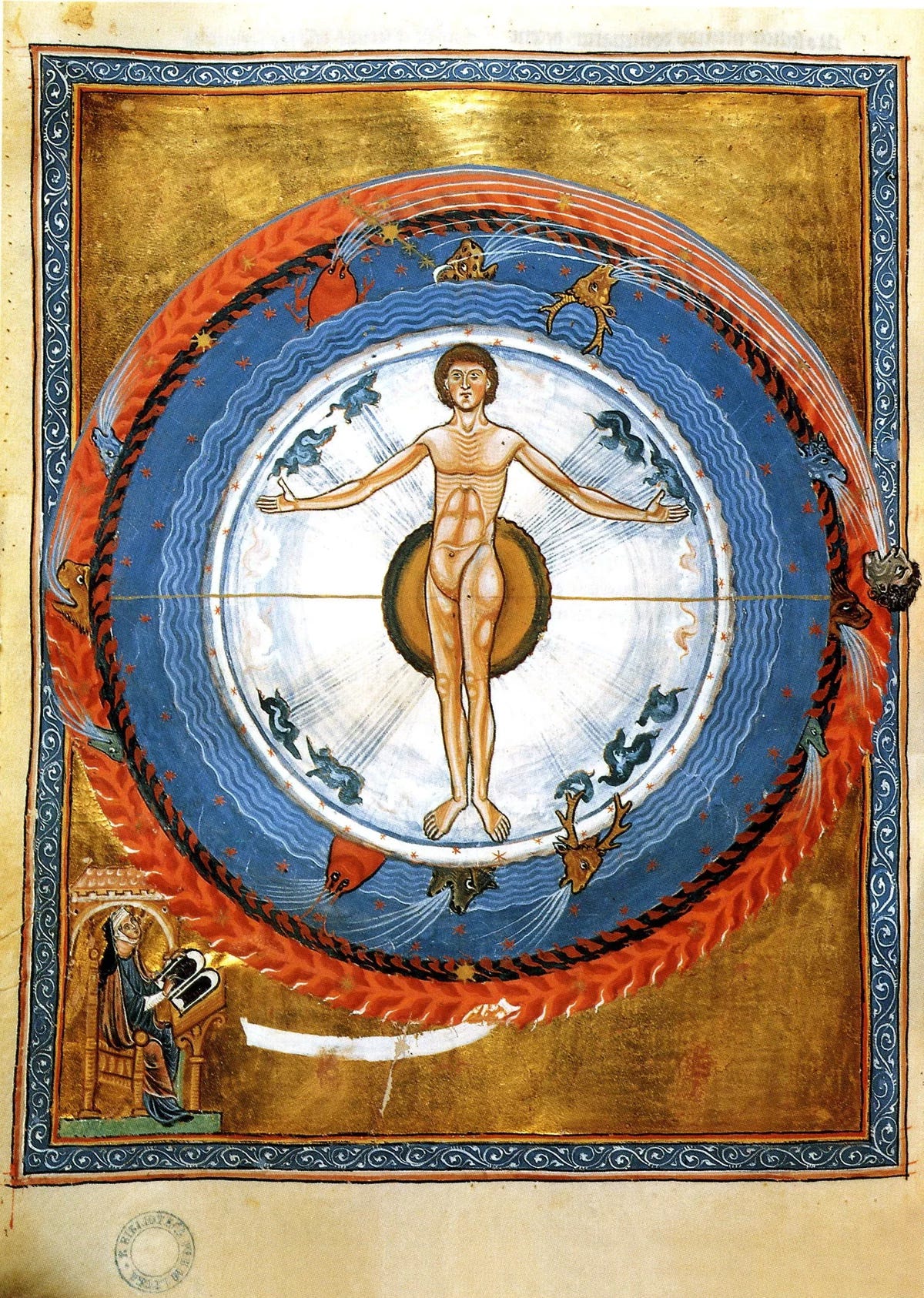
The supposed contrast between God’s concern for a contrite heart above all sacrifices, yet obvious concern for proper externals in the building of the ark, tabernacle, and temple is not a contrast at all. The hard distinction between faith and works is fictional. Faith is to believe and do His Will, and to follow God’s statutes is a joy to the heart. Grace inspires us to change of heart, and grace modifies our action. There is no such thing as “faith alone” or “works alone”, because humans are not a mind inside a body, or a body disconnected from the mind. Neither our internal disposition nor our external actions are the “real us.” The Self is a body-soul composite. Our body both expresses and impresses the soul; what we do with our body has spiritual effects, and what we do with our spirit has bodily effects.
In fact, to speak of them as having causes and effects almost separates them too much. Our bodies are ensouled and our souls are embodied. We are clay, yes, but clay that breathes the Breath of Life—the Spiritus. We are souls, yes, but souls made physical in this flesh that is fearfully and wonderfully made—our Corpus.
If we do not constantly recall this, if we do not recollect ourselves, we fall prey to the most diabolical lie ever perpetrated on humanity; that Reality is either all internal or all external.
Undoing the damage that this lie has done to me has been difficult. God is patient with me, and His Grace has penetrated my stubborn foolishness on occasion while deep in prayer.
Here is yet another example of His abundant mercy towards me, and I believe, to the Church as a whole. He has given us, through the Church, many practices of contemplative prayer which serve to both deepen our internal landscape and to take us out of ourselves. I have found the practice of interior silence, centering prayer, and the writings of Thomas Merton to be extremely important. But I have also found Brother Lawrence’s writings, the visionary prayer of Hildegard, and Adoration to be essential.
I need both the Interior Castle and the Practice of the Presence of God. They seem, to our broken minds, to be opposing or to at least go in different directions. Perhaps we believe that some people are drawn to interiority, and others to exteriority. One to meditation, one to adoration.
But in the depths of contemplative prayer, I have found it extremely important to not only come deeper into my own Being, to find that deep silence underneath my discursive thought, but also to adore that which is outside of my Being. Meditation, in which one finds the center of one’s Being as a perfect stillness and luminous darkness, is essential in recognizing our Oneness with our creator, the ephemeral nature of Selfhood, the dependence we have on Him in which we have our Being. But it is also important to recognize that in Him we also live and move. In Adoration, in which we focus so completely on another that our internal reality almost ceases to exist, in which our Selves are poured out, forgotten in the mighty Presence of Another, we find a different kind of insight. His Life is in me, yes, but also I am in Him. He is deep inside, yes, but also deeply outside. He is both internal and external. I dive deep into the well of my Self and I find Him there. I empty that well of the self outward and He is there too. If all the world rushes past me but I am confidently still upon the Rock that is at the base of my soul, I am contemplating God. If I am so lost in the dance of doing His will that I forget that I even exist, I am contemplating God. Benedict and Francis. Hildegard and Therese. Body and Spirit are One.
Internal and External are one.
The effect of dualism is hypocrisy and fragmentation. The effect of holism on myself and my students has been an increase in devotion and contemplation simultaneously.
When my internal disposition is united with my external actions, there is a certain resonance between them which increases the power of both. I have seen this effect in many of my students in both directions. For some, when they have been given an insight into the faith which increases their internal love for God, or deepens their prayer life, the external effect is notable. They are not only more graceful, and physically healthier, but they dress differently. They treat others with more kindness and openness. And at Mass, they fall on their knees and look up to heaven.
And it works the other way, too, for those that resolve to change their habits. They delete apps on their phone, and bashfully try to wear a veil. They try to listen to better music, to watch less junk, to eat better. They go to Adoration and maybe get a beautiful rosary. And as their habits change, they are forced to confront the grayness and turmoil within, and to invite Christ there, where He works to transform them.
Our body expresses and impresses our soul. They are not the same, but they are one. And just as in marriage, if we deny their essential oneness, if we cannot work as one, we will experience a separation tantamount to a divorce.
I have a suspicion that many of the debates and arguments in the Church today are, in essence, a problem with the unconscious adoption of dualism. One of the largest issues, it seems to me, is to what extent Catholics should be “involved” in politics; as if political truth and spiritual truth can be separated. The Catholic Church wonders what should be “done” about gender, as if we can ever deny the teaching of the Church on the essential unity of body and soul, as if we can minister to these poor souls in any other way besides inviting them to embrace their dignity as whole human persons. We wonder about “the benefits” of unity with the Eastern Orthodox, as if a separated Body is an acceptable reality. We attack the defenders of the traditional Mass as Pharisees and Formalists, as if Catholicism hasn’t always taught lex orandi, lex credendi. That we worship as we believe, and believe as we worship. We wonder about our position in relation to other faiths, as if someone’s cultural practices are inconsequential to their “sincerity”. We erode moral teachings and practices because they are “difficult” or “unnecessary” or “optional,” and wonder why people have stopped believing the things that they no longer practice. Or perhaps we focus exclusively on form; relentlessly disobeying the living hierarchy in favor or what we interpret as valid, sneaking behind our bishops to practice “real” Catholicism. Or the horrifying trend of people who insult and defame their “enemies” (their brother Christians)—in the name of the Love of Christ.
I have participated in this, and I have experienced this. Mea Culpa. Kyrie Eleison.
To be healthy, to be whole, and to be holy, are the same.
May we become hale again.
+Pax Christi+
No posts
Comments
Nothing yet. Say the first thing.
Sign in to join the conversation.