
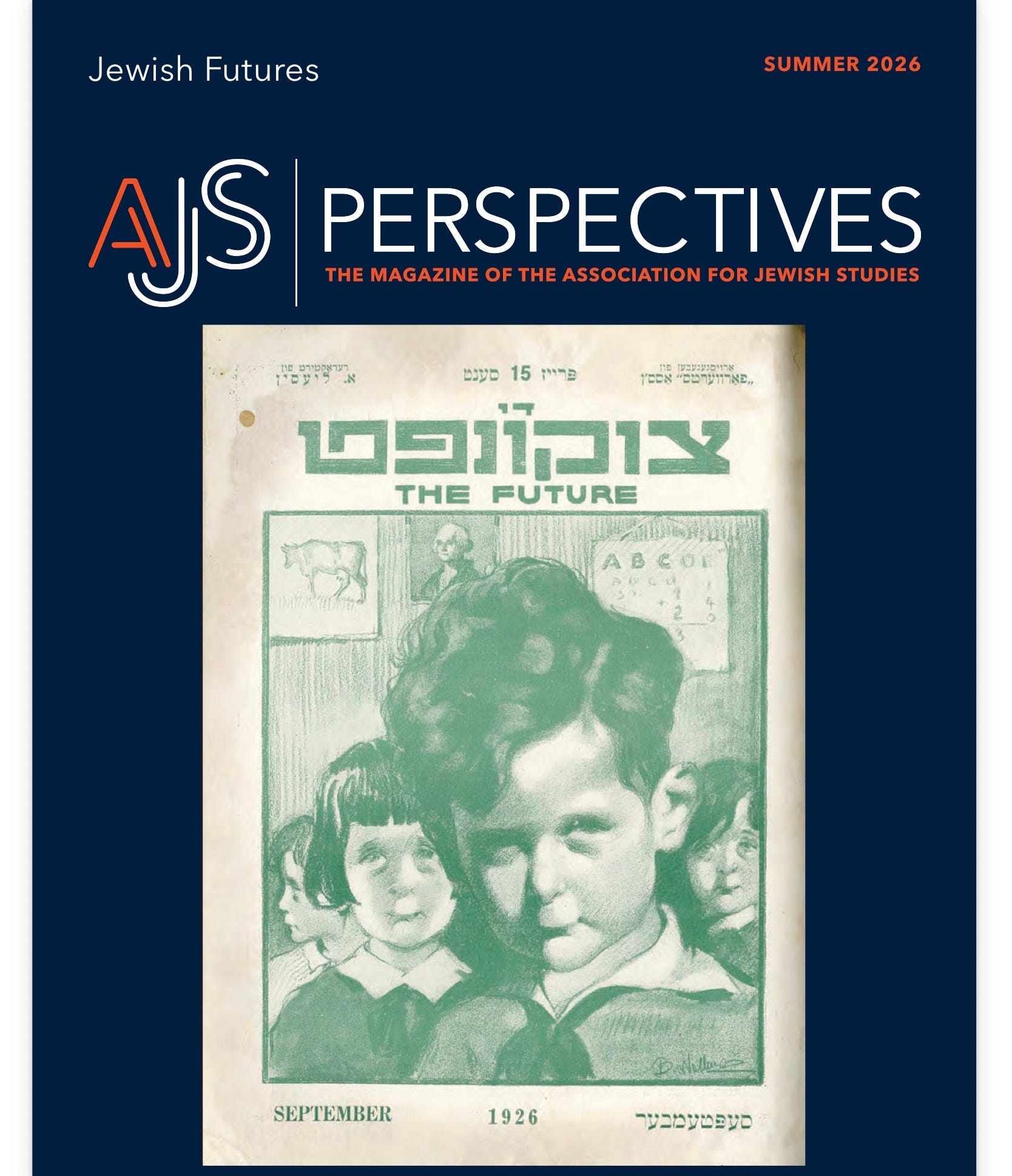
Dear Subscribers! This is an unscheduled post. I decided to share with you my recently published essay about the speculative fiction response to October 7. At the end, I also provide a link to the entire issue of the AJS Perspectives discussing the issue of Jewish Futures. More original essays are coming soon!
As with other historical catastrophes that befell the Jewish people, October 7 has engendered two opposite responses by writers and literary scholars. On the one hand, some demand scrupulous documentary-style realism, a modification of Theodor Adorno’s famous dictum about the barbarism of writing poetry after Auschwitz.[1] On the other hand, many feel that the horror of the event requires its representation through symbolism and metaphor. This debate fits into the protracted conversation within Israeli literature as to whether realism or fantasy can best do justice to the Israeli experience. While there has been a significant shift toward speculative fiction (SF) in the last twenty years, October 7 has resurrected the sense of precarity that characterized the first years of the state and that inspired the first wave of Israeli realist writers, such as A.B. Yehoshua and Amos Oz.
Having been born from a literary utopia – Altneuland (1902) by Theodor Herzl – the project of Zionism seems to be naturally congruent with SF. But in practice, in the first decades of the state, the opposite was the case. Israeli literature was singularly deficient in the Hebrew analogues of science fiction, fantasy and supernatural horror, while psychological realism reigned supreme (Gomel and Gurevich 2013). This, in my view, is the result of the unique cultural and social ambience of that period when a succession of almost-miraculous events, from the Six-Days War to the mass immigration from the Middle Eastern countries, generated the sense of both euphoria and foreboding. Living through the miracle of the Jewish state’s rebirth, the Israeli public was hungry for the ordinary and the commonplace. The great writers of that period Amos Oz, David Grossman, A. B. Yehoshua, and others tried not so much to represent the already-existing reality, as was the case with Western realism, but to create it. They generated a sense of stability through representing “ordinary” Israeli families and individuals in their typical settings, despite the fact that there was nothing ordinary or even representative in the first chaotic years of the state. Realism became the Israeli fantasy.
The situation changed in the 1990s and especially in the 2000nds. The flowering of Israeli speculative fiction in that period was unprecedented. First, there was an explosion of print and online magazines dedicated to the genre, such as Holomot be-Espania (Dreams in Spain). Then there was the annual SF and fantasy cons Utopia and Olamot that are still going strong, attracting hundreds of eager fans from all over the country. And finally, a new generation of writers, such as Keren Landsaman, Sarah Blau, Gail Hareven, Etgar Keret and many others, rejected the “thick” texture of everyday reality that constituted the bedrock of the previous generation of writers who tried to reassure their audiences that despite wars and terrorism, Israel could still be a “normal” country, in which people care about relationships, families, and money. Instead, the emerging Israeli SF reflected the twin demons of foreboding and boredom that seemed to plague Israel. On the one hand, the First and Second Intifadas generated anxiety about the future. We survived this; but can we survive what is coming down the pipeline next? On the other hand, and somewhat paradoxically, until October 7 Israel often felt stuck in the mud of the “situation” – the unresolved Israeli-Palestinian conflict that seemed to drag on and on without offering any resolution. Thus, the dominant genre of Israeli SF literature at the time was neither utopia nor dystopia but “limbotopia”: being caught in limbo of the eternal present (Gomel and Shemtov 2018).
October 7 changed everything, rewriting both Israeli reality and the culture’s sense of history. On the one hand, it resurrected the sense of precarity that plagued the first years of the state. But as opposed to the 1973 war, which was also characterized by the initial military and intelligence failure, the atrocities of October 7, hostage-taking, and widespread sexual violence exceeded the “normal” parameters of war or terrorism, creating a phantasmagoria of horror. The subsequent war in Gaza, the twelve-day war with Iran, and the explosion of antisemitism across the globe further shook the already shaken Israeli and Jewish narratives.
We do not yet know how SF will finally respond to this pivotal moment in Jewish and global history. It took at least thirty years for Holocaust SF to appear, defying Adorno’s prohibition on fictionalizing the atrocity (Kerman and Browning 2014). In Israel itself, the trauma seems to manifest as return to the documentary-style realistic representation. The two TV series dedicated to the event, Red Alert and October 7, are quasi-documentaries based on real events and thinly disguised real people. According to the Israeli National Library, 170 books have been published after October 7 relating to this event. Approx. 80 of those are nonfiction investigations, reports, and military reviews; about 30 are personal testimonies, 14 are poetry collection, and only 9 are prose fiction, none of which are SF.[2] There are reputedly Israeli and Jewish SF creators working on October 7 fictions, including myself, but so far nothing has been published. This is why I want to end this essay with a brief discussion of a Jewish SF novel, which, though started before October 7, seems to reflect with unerring accuracy the dizzying feeling of history veering off course and falling into the black hole of unpredictability and chaos.
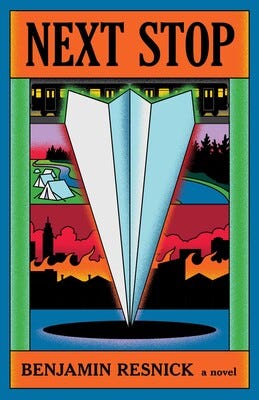
Benjamin Resnick’s Next Stop (2024) is both sublime and horrifying in its prescience. Israel is literally swallowed by a black hole overnight; and the resulting wave of antisemitism drives American Jews into ghettoes. Following a young Jewish couple Ethan and Ella in NYC, the novel slowly evolves into a dreamlike - or rather, nightmare-like - vision of the world in which Jews are mocked, persecuted, and pushed out of sight. Eventually, in the NYC ghetto, Jews are beginning to board subway trains that are taking them – elsewhere. But as Ella and Ethan with their son Michael are trying to board, their tickets are lost and they have to let their young son take the train alone, like the Jewish children on Kindertransport, many of whom never saw their families again.
The image of a black hole, which is at the heart of the novel, is particularly apposite for representing sudden and wrenching historical cataclysms. A black hole is the term for a “tear” in the fabric of spacetime, in which ordinary laws of physics no longer apply. But in relation to narrative representation, a black hole serves as a metaphor for an event so traumatic and unexpected that it overwhelms the capacity of the historical imagination. British writer Helen Dunmore describes it as a narrative singularity: “Some events are so overwhelming that time, rather than carrying them away, brings them back again and again to the same place” (241). The collective PTSD of a cataclysm, such as October 7, generates the sense of narrative paralysis:
“It’s an undoing. It’s where things come apart and fall silent. There is nothing to say. It’s a wound, ancient and endless” (Resnick 167).
As the novel progresses, the familiar story of persecution, silencing, invisibility and displacement is playing out in NYC, all the more horrifying because it unfolds gradually and piecemeal. As opposed to the sudden and catastrophic disappearance of Israel, the Jewish community is NYC are slowly driven into “the Pale” where their continuing incarceration is papered over with the bureaucratic newspeak about “preventing further anomalies” which spring up in response to the “movement of Jews” (133). The two distinct timelines play out in the magic realism of Resnick’s novel: the sudden cataclysm of Israel’s disappearance and the continuous deterioration of the Jewish time in the diaspora, symbolized first by the squeeze of restrictions and then by the schedule of subway trains. But those trains, with their open-ended drive toward an unknown destination, also symbolize Jewish survival and resilience. The novel ends abruptly, in medial res, but on a strangely hopeful note: Michael riding the train into nowhere, sees the subway screens change into “promises of the next station, the new station. And he was not afraid” (287).
So, what will the SF response to October 7 be? Will it be cast into the modality of a sudden catastrophic change, a black hole of trauma, or of the continuity of Jewish survival? Will it emphasize hope or despair? Will it expand into the future vista of science fiction, seek escape in the alternative worlds of fantasy, or regress into the obsessive recycling of the tropes of horror?
Only time and history will tell.
AJS_Perspectives-Summer-2026-web.pdf
[1] In his 1949 essay 1949 essay “Cultural Criticism and Society” (Kulturkritik und Gesellschaft).
No posts
Comments
Nothing yet. Say the first thing.
Sign in to join the conversation.