
Most people treat Vastu like a rulebook they’re too scared to break. After years of designing homes, I’ve learned it’s actually a negotiation. And someone has to win.
Almost every family I work with brings two things to our first meeting.
A Vastu chart, and a Pinterest board.
They rarely notice that these two documents disagree with each other. But they always do. The chart says the kitchen belongs in the south east. The Pinterest board wants it in the open corner with the big window. The chart wants the master bedroom in the south west. The morning light is in the east.
And so, before we have chosen a single tile, a quiet tug of war has already begun.
Most homeowners handle this tug of war badly. Not because they’re foolish, but because nobody ever told them the truth about it.
“Ekta, do we really have to follow all of this?”
I understand it Because Vastu, in most Indian families, is not really about direction. It’s about a parent. A grandparent. A belief someone you love holds so deeply that going against it feels less like a design choice and more like a betrayal.
That’s the real weight in the room. Not the compass. The relationship.
So I never answer that question with “yes” or “no.” I answer it with a better question: Where does this rule actually cost you something, and where does it cost you nothing at all?
Because once you separate those two, most of the fear disappears.
Here is the thing that would surprise the people who fear Vastu, and annoy the people who worship it.
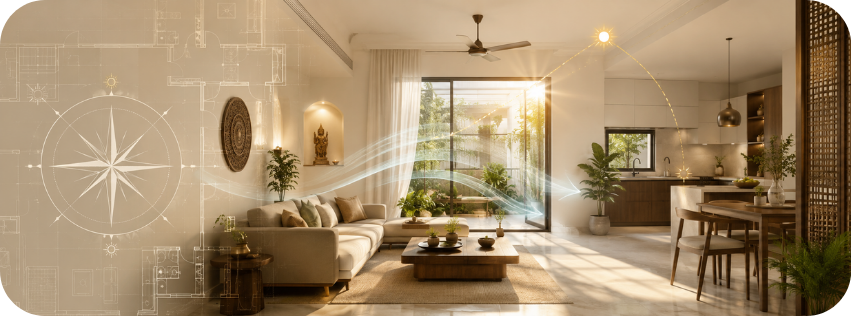
A large part of Vastu is just old climate science wearing traditional clothes.
Vastu was written for this land, for this heat, for a time before electricity and exhaust fans and air conditioning. So when it tells you to put the kitchen in the south-east, forget the ritual and look at what really matters.
The south-east gets strong morning sun that once helped keep a cooking space dry and clean, and it stays away from the harsh western afternoon heat.
That isn’t superstition. That’s ventilation.
When it tells you to keep the north and east open and light, look again. In our hemisphere, that’s the softest, steadiest daylight you get. Exactly the light you want in a living room. Heavier walls and storage to the south and west shield you from the harsh sun.
That isn’t a rule. That’s passive cooling.
So here’s my first honest truth:
When Vastu and function point in the same direction, there is nothing to debate. Follow it. You get a cooler, brighter, better ventilated home, and you get peace at the dinner table. Both are worth having.
Then there’s a second category, and this is where I watch families waste most emotional energy for no reason.
Some Vastu rules ask nothing of your home.
Sleeping with your head to the south changes nothing about how your bedroom works. Keeping a mirror off the wall that faces your bed? Function actually agrees with Vastu here, because a mirror throwing light and movement at a sleeping person genuinely disturbs rest. Placing the heaviest furniture toward the south-west of a room often looks better anyway.
None of these cost you light, Or space, Or money.
So my advice is simple: you can do it.
Not because I can prove the energy flows differently. But because they take nothing from you and they give someone you love their peace of mind. In a home, that peace is not a small thing. Don’t spend your fight here.
And now the part I wish more designers would say out loud.
Some Vastu rules, followed blindly, will quietly make your life worse every single day.
I’ve seen a family try to relocate a bathroom in a compact apartment to satisfy direction, when the plumbing stack was fixed and the “correct” spot meant long, wasteful pipe runs and a bedroom shrunk to a cupboard.
I’ve watched people reject a genuinely good apartment over an “inauspicious” entrance, as if a builder’s door placement could outweigh everything right about the home.
I’ve seen a kitchen pushed into a dark, airless corner because that was the “right” direction, in a room where a family cooks and eats every day.
This is the moment I stop being polite.
A bathroom belongs where it drains cleanly and sits conveniently, because you use it ten times a day. A kitchen needs light and air, because a dark kitchen is a daily misery and a real hygiene problem.
An apartment is something you didn’t design from scratch, the front door is where it is. Breaking structure to chase a direction costs a fortune and often fails anyway.
When a rule written for a courtyard house starts damaging the way you’ll actually live in your apartment, function has to win.
And choosing function here is not a defeat. It’s not disrespect. It’s you deciding that your daily comfort and your hard-earned money matter more than a technicality.
So the next time a Vastu rule lands on your floor plan, don’t panic and don’t dismiss it. Just ask three questions.
Does following it improve, or at least not harm, the light, air, space, and storage of the room? Then follow it. You’re simply doing good design.
Does following it cost you almost nothing, and give someone you love peace of mind? Then follow it. Harmony is worth a small accommodation.
Does following it force you to spend heavily, shrink a room, block the light, or live with a daily inconvenience? Then this is where you consciously, unapologetically compromise.
That’s it. That’s the whole framework.
All these years of experience, I’ve noticed something.
The families who end up regretting their homes are almost never the ones who “broke” a Vastu rule.
They’re the ones who followed one blindly. Into a dark kitchen. A cramped bedroom. A bathroom that cost a fortune to move. And then lived with that mistake every single day, long after they’d forgotten which direction it was even supposed to protect.
Respect the tradition where it serves you. Respect the people who hold it dear, because that respect is its own kind of design.
But never let a rule written for another century decide how your family lives in the home you worked this hard to build.
Because long after anyone remembers which way the kitchen faced, you’ll still be living in how it feels.
No posts
Comments
Nothing yet. Say the first thing.
Sign in to join the conversation.