

Imagine watching $38.2 million leave a known criminal wallet — live, on-chain, in a single transaction — and having absolutely nothing to show regulators. No traceable path. No attributable link. Not because the money was hidden in a mixer or tumbled through a chain of wallets. But because, at the transfer layer where every major forensics platform operates, the economic causality simply doesn’t exist.
That’s not a hypothetical. It happened in Ethereum Mainnet Block 15,937,667. And according to a new paper out of EigenPhi, it’s not a bug or an edge case. It’s the future of DeFi-native money laundering — and it’s already structurally generative.
Every major blockchain analytics platform — Chainalysis, Elliptic, TRM Labs — operates by building transaction graphs: maps of who sent what to whom, stitched together into networks of addresses, clusters, and risk scores. The logic is intuitive: follow the money. If a tainted wallet sends tokens, the taint travels with them.
This paradigm powers compliance at every major VASP, underpins FATF Travel Rule enforcement, and drives the suspicious transaction reporting obligations embedded in EU Regulation 2023/1113. It is, without exaggeration, the entire architecture of crypto financial crime detection.
The architecture rests on three assumptions:
Flow continuity — value migration can be reconstructed from transfer-layer observations
Initiator visibility — illicit actors initiate the suspicious transactions themselves
Endpoint linkage — transfer edges reliably proxy for who ultimately controls the funds
The new paper, PEB Separation and State Migration: Unmasking the New Frontiers of DeFi AML Evasion (Cao, Cheng & Liu, 2026), proves formally that all three assumptions collapse in composable smart-contract environments.
In Block 15937667 on Ethereum Mainnet, approximately 38.2 million USDC was converted into 38.1 million DAI — a near-complete asset swap at institutional scale. The source address was flagged as a phishing-linked wallet. The destination was a fresh beneficiary address. And between the two? No direct transfer edge. No detectable causal link. Nothing that transfer-graph traversal could uniquely follow.
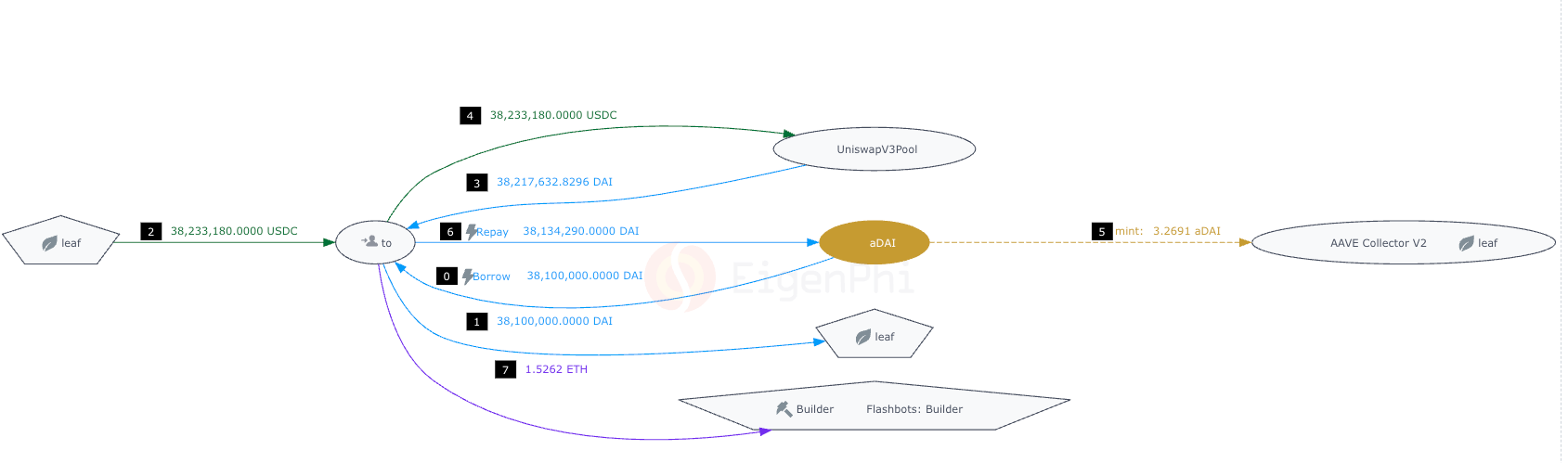
Here’s how it worked:
A phishing-labeled address — call it P (Principal) — signed an off-chain limit order using the 1inch Limit Order Protocol. This signed intent never touched the mempool as a transaction from P. An independent MEV bot — E (Executor) — picked up the order, submitted the on-chain transaction (appearing as the msg.sender), sourced DAI via an Aave flash loan, filled the order, and routed the proceeds to a separate B (Beneficiary) address. The entire sequence is executed atomically in a single block.
At the transfer layer, what’s observable is: P transferred USDC to a contract; a contract transferred DAI to B. The economic link between P and B is enforced inside execution logic — AMM invariants, flash loan callbacks, order-fill mechanics — none of which leaves a uniquely attributable path in the transfer graph.
The authors call this PEB Separation: the functional decoupling of the intent originator (Principal), the transaction executor (Executor), and the economic beneficiary (Beneficiary). Under composable DeFi, these three roles are structurally separable. And wherever they’re separated, the foundational assumptions of transfer-based AML are violated.
PEB Separation requires a willing executor. The paper’s second contribution is more unsettling: a mechanism that requires no role separation at all.
Using a standard constant-product AMM model (the same math underlying Uniswap), the authors construct a four-step atomic transaction sequence — two back-to-back cross-pool arbitrage loops — that achieves a net economic migration of asset A from Principal to Beneficiary without any direct transfer between them. The transfer-layer footprint is observationally identical to routine market arbitrage.
Authors validated this on a real Ethereum Mainnet fork (Block 21808947), using Uniswap V2 (WETH/USDT) and SushiSwap (WETH/USDT). The results are striking:
10 WETH migrated from EOA P to EOA B
Flash loan of 50.49 WETH used for the dislocation phase
Total protocol fees: ~1.2% (four swaps × 0.3%)
Net relocation efficiency: 93.5% — only 0.6459 WETH lost as the “cost of washing”
Put differently: an adversary can relocate significant on-chain wealth with greater than 90% efficiency, leaving a forensic footprint indistinguishable from legitimate DeFi activity. No forensic tool restricted to transfer connectivity can uniquely link the 10 WETH outflow at P to the 9.35 WETH inflow at B.
A natural response is: expand what we monitor. Capture internal calls. Analyze execution traces. The paper anticipates this — and closes the door.
The problem isn’t incomplete data collection. It’s a fundamental abstraction gap: economic causality in composable DeFi is enforced at the execution layer (via AMM state invariants, flash loan callbacks, intent-matching logic), but current monitoring abstracts it away into transfer-layer edge connectivity. Multiple execution paths can produce observationally identical transfer patterns. No amount of additional transfer-layer data resolves this ambiguity — because the ambiguity is baked into the abstraction itself.
This is what the authors call structural generativity: as the number of composable liquidity venues, routing layers, and MEV supply-chain participants grows, the space of undetectable laundering constructions expands superlinearly. The detection problem doesn’t scale — it degrades.
Chainalysis itself has acknowledged in public reports that attribution baselines shift as new intelligence becomes available, and that on-chain observables are frequently limited to high-level transfer metadata. The Elliptic 2024 Typologies Report similarly flags DeFi composition as a growing evasion frontier. What this paper adds is formal proof that the evasion isn’t a workaround — it’s an intrinsic property of how composable execution works.
The paper doesn’t just diagnose the problem. It calls for a paradigm shift: from transfer-graph monitoring toward execution-semantic AML — systems that reason directly about call graphs, state invariants, and atomic execution logic to reconstruct economic causality, rather than inferring it from transfer edges.
This mirrors a well-worn transition in cybersecurity: from signature-based malware detection to behavioral analysis. Just as advanced malware mutates its binary signature while retaining core functionality, adversarial DeFi constructions can mutate their transfer-layer structure while achieving identical net economic migration.
The regulatory and compliance implications are significant. FATF frameworks and national regulators currently anchor obligations around identifiable intermediaries and visible transfer flows. In permissionless DeFi environments, neither is guaranteed. The authors argue — convincingly — that enforcement built on transfer observability has reached a formal boundary.
If the foundational assumption of crypto AML is broken, the industry needs to know. The tools we’re trusting to catch $38 million in motion are, provably, not equipped to see it.
Wonder if you have any misconceptions about MEV? Download our latest free e-book: MEV Myth Busters - From Microstructures to Macro Impacts.
Follow us via these to dig more into the hidden wisdom of DeFi:
EigenTx | Website | Discord | Twitter | YouTube | Substack | Medium | Telegram
No posts
Comments
Nothing yet. Say the first thing.
Sign in to join the conversation.