
The last two years since the Hamas attack on October 7th 2023 We’ve seen a tide wave of “Anti Zionism/Israel”, as well as “Anti Jews /Antisemitism”. As you are about the read, this wave puts in danger not only Jews but also the whole world. What makes this wave so unique and so dangerous is that the setting, the environment in which this wave is rising and washing away the world we know.
Instead of focusing on the symptoms of antisemitism and antizionism, the purpose of this article is to introduce a new multidisciplinary prism, one that combines insights from psychology, neurology, and biochemistry, demonstrating that what we are witnessing not merely a political upheaval, not just cycles of hate, but a symptom of a deeply traumatized civilization.
If you believe that only truth sets us free and regardless if you are “Pro/Anti Palestine”, “Pro/Anti Israel/Zionism” or “Pro/Anti Judaism”, I invite you to read the article. This in-depth article aims to provide a clear and thorough understanding of the topic and its nuances. I hope you find it insightful! If you value my work, I’d greatly appreciate your subscription (if you’re not yet subscribed) and support.
PS - I know you many of you are waiting for part 3 of my series about AI - it will come soon, but I had to take a break and write this as a result of the Manchester terror attack on a synagogue that happened in Manchester, and as you will soon see, it is related to what I’ve published so far.
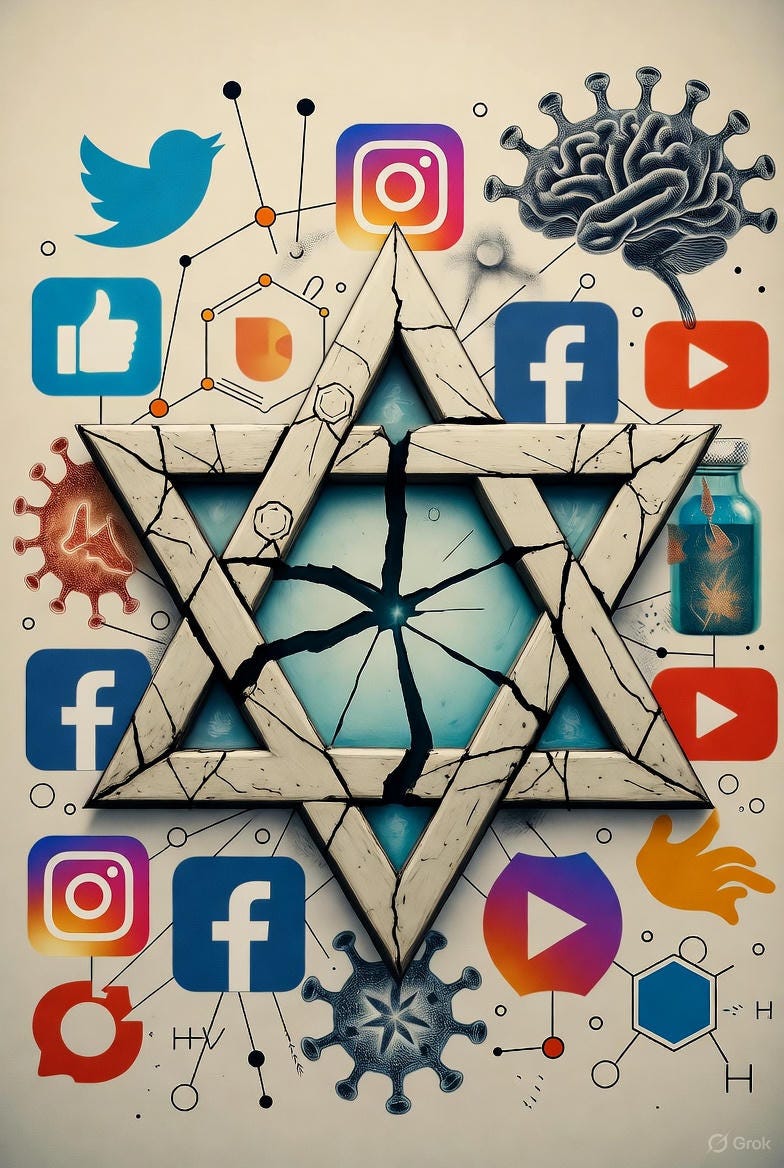
If you’ve never stumbled upon the Drama Triangle, let me pull back the curtain on this psychological trap that’s been messing with human relationships since forever!
Back in the 1960s Stephen Karpman mapped out how we humans get sucked into toxic cycles in our interactions, like actors in a bad soap opera that never ends. He called it the Drama Triangle because it forms this vicious loop with three roles—Victim, Persecutor, and Rescuer. Trust me that once you’re in it, it’s hard to break free without some serious self-awareness.
The drama triangle is plays out in boardrooms, families, global politics, and it’s always the same: people bouncing between these positions, feeding off the drama instead of solving anything real. As you will see, antisemitism has everything to do with it as well.
Let’s break it down, shall we?
The Victim is the one who feels helpless, oppressed, always whining “Why me?” or “It’s not my fault!”. Victims are not truly powerless, but they act like it to dodge responsibility and pull in sympathy. After all, you don’t need to obey any moral code if you convinced yourself that moral rules has not been applied to you. This is the most powerful position, and by power I mean not limited by the laws of ethics, morality, legality or sanity.
Then comes the Persecutor, the bully in the room, blaming and attacking with lines like “You always screw up!” or “This is all your doing!”. Persecutors are driven by anger or control, pointing fingers to feel superior, and using their false sense of morality to judge others and execute their judgement.
And finally, the Rescuer swoops in like a hero, saying “Let me fix this for you!” but in reality their actions are counter productive because they are enabling the mess, and in fact they are getting a kick out of being needed while keeping everyone stuck.
The crazy part is that people switch roles mid-drama—one minute you’re the victim, and next minute you’re persecuting someone else! It’s all about avoiding genuine connection and growth, trapping you in blame, guilt, and fake rescues. Sound familiar? I’ve lived through enough corporate games to know this triangle thrives on manipulation, and it’s everywhere if you look.
Let’s dig a little bit deeper into it.
The Drama Triangle model was created under the supervision of Eric Berne, the founder of transactional analysis (TA). What is Transactional Analysis?
In the 1950s a brilliant psychiatrist named Eric Berne got fed up with the Freudian mumbo-jumbo of his time and decides to hack the human psyche like it’s a faulty computer program. He creates Transactional Analysis, or TA for short, as a way to decode the “transactions”—those everyday exchanges between people—that shape our relationships, our behaviors, and yeah, even our deepest screw-ups.
TA is a practical toolkit for understanding why we keep repeating the same dumb patterns, like actors stuck in a never-ending script. Trust me, once you see it, you’ll spot TA everywhere—from family dinners gone wrong to the Israeli-Palestinian conflict that feels as if it was scripted by a bad Hollywood writer!
Let’s break it down, shall we? At the heart of TA are the three “ego states” we all flip between:
The Parent - that’s the bossy or the spoiling voice echoing your upbringing, dishing out rules like “You should do this!” or “Poor you, let me help”. The third type of parent is the nurturing, the one who does not try to control or less you lose but explains to you the consequences of your actions and tell you the truth.
The Adult - the rational, fact-based operator who says “Let’s look at the evidence and decide calmly”; and
The Child - the emotional, playful or rebellious side that whines “I want it now!” or hides in fear.
Berne figured out that our interactions—or transactions—can be “complementary”, meaning smooth sailing when ego states match up, or “crossed”, meaning boom, conflict when they clash.
The fascinating part is that people play “games”, sneaky psychological maneuvers, to get attention or avoid real intimacy, like the infamous Drama Triangle I just told you about. In fact, Stephen B. Karpman, a psychiatrist and a graduate of Duke University School of Medicine, developed the model of the drama triangle during his postgraduate studies under Berne in the late 1960s. Berne, who pioneered TA in his 1964 book Games People Play, actively encouraged Karpman to refine and publish the concept, even referring to it as “Karpman’s triangle”. Karpman’s seminal article, “Fairy Tales and Script Drama Analysis,” appeared in the Transactional Analysis Bulletin in 1968, and the work earned him the Eric Berne Memorial Scientific Award in 1972.
The Drama Triangle emerged as a tool within TA to map dysfunctional social interactions, illustrating how people unconsciously shift between three roles in conflicts, perpetuating cycles of blame and dependency rather than resolution. Berne’s influence was pivotal, as the model built directly on TA’s emphasis on analyzing “games” (reciprocal yet ulterior transactions leading to predictable, often harmful outcomes).
It is important to mention two other key elements in Transactional Analysis: “life scripts”, or as some refers them simply as “scripts” which are unconscious stories we write as kids thanks to parents and society, dictating our future, and “strokes” which are the little units of recognition we crave like digital likes today.
Antisemitism which is the prejudice, hatred, or discrimination against Jews, can be framed within the drama triangle as a relational pathology: antisemites often cast Jews as the eternal Persecutor (e.g., conspirators harming society), position themselves or their group as the Victim (oppressed by Jewish “influence”), and invoke a Rescuer (an ideology, deity, or leader) to “liberate” them. This dynamic fuels scapegoating, where Jews are abstracted into a monolithic threat, perpetuating cycles of blame and violence.
Below, I will analyze antisemitism through this prism in the contexts of Christianity (via the “Jews killed Jesus” narrative), Islam (via anti-Jewish Quranic verses), and atheism (via the rejection of God as truth), drawing on historical and textual elements while noting how the triangle sustains these biases.
In Christian antisemitism, the deicide myth—accusing Jews collectively of killing Jesus—positions Jews as the archetypal Persecutor, responsible for the ultimate crime against divinity. This narrative, rooted in selective New Testament interpretations (e.g., Matthew 27:25, where a crowd says, “His blood be on us and on our children”), fueled centuries of pogroms, expulsions, and the Holocaust’s ideological backdrop.
Jews as Persecutor: They are blamed for deicide, seen as eternally cursed for rejecting and murdering the Messiah, thus persecuting Christians by proxy through their “stubborn” adherence to Judaism. This role abstracts Jews into a rigid category of betrayers, ignoring historical context like Roman execution methods or Jesus’ own Jewish identity.
Christians as Victim: Early and medieval Christians (and later societies) viewed themselves as victims of Jewish “malice,” with the deicide charge justifying their suffering under perceived Jewish economic or spiritual dominance. This fostered a sense of collective helplessness, where antisemitic violence was framed as self-defense against an ongoing “threat”.
Jesus/Church as Rescuer: Jesus is the ultimate Rescuer, sacrificing himself to save humanity from sin (including Jewish “perfidy”), while the Church acts as an institutional rescuer by converting or subjugating Jews (and of course by prosecuting them, because as I said the roles in the drama triangle are fluid). This dynamic perpetuates the cycle: when Jews resist conversion, they “re-persecute” Christians, prompting calls for rescue through crusades or inquisitions.
Modern churches, like the Catholic Church via Nostra Aetate (1965), have renounced this myth, shifting toward an Empowerment Dynamic by recognizing shared humanity. However the triangle lingers in many Christian groups, sustaining antisemitism as a dysfunctional relational script.
Islamic antisemitism often draws on selective Quranic verses that criticize certain Jewish tribes for alleged disobedience, hypocrisy, or enmity toward Muhammad, portraying Jews negatively (e.g., Quran 5:82, calling Jews and polytheists the “most hostile” to Muslims; or 5:64, accusing Jews of “spreading corruption”). While the Quran also praises Jews as “People of the Book” and permits intermarriage (with a Jewish woman), antisemites emphasize pejorative passages to justify hostility, blending them with hadiths like the apocalyptic one urging Muslims to kill Jews. This has historically manifested in dhimmi status (protected but subordinate) and modern Islamist rhetoric.
Jews as Persecutor: Verses depict some Jews as treacherous (e.g., breaking covenants in 2:83-86 or turning into apes in 5:60 for disobedience), casting them as persecutors who undermine Islam’s truth. Antisemites extend this to all Jews, framing them as eternal enemies corrupting society or conspiring against Muslims.
Muslims as Victim: Muhammad and early Muslims are positioned as victims of Jewish betrayal (e.g., during Medina conflicts), with contemporary Muslims seeing themselves as oppressed by “Zionist” or Jewish influence in global affairs. This victimhood narrative justifies defensive aggression, perpetuating cycles of conflict.
Allah/Muhammad as Rescuer: Allah rescues believers through revelations condemning Jewish “misdeeds,” while Muhammad (or caliphs/leaders) acts as the earthly rescuer by subduing or expelling Jewish tribes. In extremist interpretations, this role shifts to jihad or leaders like in Hamas rhetoric, “rescuing” Muslims from Jewish “persecution”.
Moderate Muslims argues this antisemitism is a distortion, as the Quran’s critiques target specific behaviors, not Jews inherently. Nonetheless, the triangle which is widely popular in Muslim communities reinforces it by locking participants into blame-shifting without contextual empathy.
Atheistic or secular antisemitism often stems from viewing religion—particularly monotheism originating with Judaism—as a source of irrationality, oppression, or backwardness. Atheists like Voltaire or modern figures (e.g., in Enlightenment or Marxist thought) have critiqued Judaism as the root of “superstition,” rejecting God as truth and seeing Jews as perpetuators of this “delusion”. This manifests in cultural or economic stereotypes, as in Soviet antisemitism or contemporary secular conspiracies (e.g., Jews controlling media to impose “theistic” morals).
Jews as Persecutor: As originators of monotheism, Jews are blamed for “imposing” God on humanity, persecuting rational thought by clinging to “outdated” truths. Atheists frame this as cultural persecution, where Jewish influence (e.g., via ethics or finance) hinders secular progress.
Atheists/Humanity as Victim: Atheists position themselves as victims of religious dogma, with Judaism symbolizing the “original sin” of theism that stifles freedom and reason. This extends to society as a victim of “Jewish-inspired” moral constraints, echoing tropes in secular nationalism or left-wing antisemitism.
Reason/Science as Rescuer: Enlightenment ideals or atheism itself rescues humanity from God’s “tyranny,” advocating for emancipation by marginalizing Jewish religious influence. In practice, this has led to “rescue” through assimilation policies or purges, as in Stalinist eras.
This form of antisemitism is subtler, often cloaked in anti-religion rhetoric, but the triangle reveals its dysfunctional core: scapegoating Jews to affirm secular “superiority”.
Across these prisms, antisemitism exploits the Drama Triangle’s rigidity to dehumanize Jews, sustaining hatred through role-switching.
Anti-Zionism which is the opposition to the Jewish nationalist movement for self-determination in Israel, Anti-Israel sentiments which is an hostility toward the state of Israel, and Pro-Palestine advocacy which is the support for Palestinian rights and statehood even if the result will be the annihilation of the state of Israel can be framed within the drama triangle as a relational pathology: critics often cast Israel/Zionists as the eternal Persecutor (e.g., oppressors or colonizers harming Palestinians), position Palestinians or their allies as the Victim (oppressed by Israeli policies), and invoke either themselves or others a Rescuers (an ideology, faith, or international community) in order to “liberate” them.
This dynamic fuels scapegoating, where Israel is abstracted into a monolithic aggressor, perpetuating cycles of blame and activism, but it is not isolated from antisemitism:
In Christian anti-Zionism, theological frameworks like supersessionism (replacement theology)—where the Church replaces Israel as God’s chosen people—position Zionism as illegitimate, often linking it to broader antisemitic legacies like the deicide charge. This view, held by some Protestant and Catholic groups, sees the modern state of Israel not as fulfillment of biblical prophecy but as a secular or sinful nationalist project that displaces Palestinians, echoing historical Christian critiques of Jewish sovereignty.
Israel/Zionists as Persecutor: Israel is blamed for “occupying” holy land and persecuting Palestinians through policies like settlements or military actions, viewed as a continuation of Jewish “rejection” of Christ, thus dominating and corrupting Christian sacred spaces. This role abstracts Israel into a rigid category of aggressor, ignoring contexts like security concerns or peace efforts.
Palestinians as Victim: Palestinians being portrait as the “native” population in the land of Israel, are seen as victims of Zionist “dispossession”, and are being portrait as being oppressed and displaced by Israel. This acts as a confirmation to the belief that Israel not as fulfillment of biblical prophecy but a secular or sinful nationalist project, and it fosters a sense of collective helplessness, where pro-Palestine activism is framed as solidarity against an ongoing “injustice”.
Jesus/Church as Rescuer: Jesus or the Church (and indirectly, those who follow the Church hence Christians) acts as the Rescuer, advocating for “justice” through boycotts and theological condemnations, aiming to “save” Palestinians while affirming Christian superiority over Judaism. This dynamic perpetuates the cycle: when Israel defends itself, it “re-persecutes” the victims, prompting calls for ecclesiastical or international rescue.
Note that this anti-Zionism can veer into antisemitism by denying Jewish ties to the land. The triangle reinforces it by locking participants into blame-shifting without contextual empathy.
Islamic anti-Zionism often interprets Quranic verses criticizing ancient Jewish tribes for disobedience or corruption as prophetic warnings against modern Zionism, portraying Israel as an illegitimate entity on Muslim land. On top of that Verses like Surah Al-Isra 17:4-6 (warning of Israelite corruption in the land) or 5:21 (Moses urging entry into the Holy Land) are selectively used to argue that Jewish sovereignty is temporary or sinful, fueling narratives in Islamist groups and pro-Palestine movements. This has historically supported resistance to Israel, blending religious duty with political activism.
Israel/Zionists as Persecutor: Verses are cited to depict Zionists as “corrupters” (e.g., 5:64) who stolen Palestinian land, persecuting Muslims through occupation and “apartheid”. Antisemites extend this to frame Israel as an eternal enemy, abstracting it as a colonial implant.
Palestinians/Muslims as Victim: Muhammad’s community and modern Palestinians are positioned as victims of Zionist “betrayal” and displacement, with anti-Israel rhetoric emphasizing suffering under siege or checkpoints. This victimhood narrative justifies resistance, perpetuating cycles of conflict.
Allah/Ummah as Rescuer: Allah rescues through divine promises of victory (e.g., hadiths on end-times battles), while the Muslim ummah (community) or leaders act as earthly rescuers via jihad or solidarity movements. In extremist views, this shifts to armed struggle, “rescuing” the land from Zionist “persecution”.
Scholars argue this is a distortion, as the Quran also recognizes Jewish ties to the land (e.g., 5:20-21), but the triangle reveals its dysfunctional core. However, many Muslims believe Israelites and Jews (which they call “Yahood”) are not the same, and thus Jews do not have any rights to the land of Israel.
Atheistic or secular anti-Zionism critiques Zionism as a religious-based nationalism or colonial enterprise, rejecting any divine claim to land and viewing Israel as an ethno-state perpetuating inequality. Figures like Marxist theorists or modern atheists (e.g., in leftist circles) see it as complicit in imperialism, with pro-Palestine activism framed as anti-colonial struggle. This manifests in critiques of Israel as “apartheid” or a product of Western guilt post-Holocaust.
Israel/Zionists as Persecutor: As a “theocratic” or settler-colonial state, Israel is blamed for persecuting Palestinians through displacement and inequality, imposing religious nationalism on a secular world. Atheists frame this as cultural aggression, where Zionist “myths” hinder rational progress.
Palestinians/Humanity as Victim: Palestinians are victims of colonial “oppression,” with atheists seeing broader humanity as harmed by religious conflicts rooted in Zionism. This extends to secular societies as victims of “Zionist influence” in politics or media.
Reason/Internationalism as Rescuer: Secular humanism or global movements (e.g., UN resolutions) rescue through advocacy for equality, pushing for one-state solutions or boycotts to emancipate from “religious tyranny” of “Zionist tyranny”. This has led to “rescue” via activism, as in anti-Zionist protests.
This form is subtler, often cloaked in human rights rhetoric, but can overlap with antisemitism by singling out Israel.
(the following section is taken mostly from my previous article)
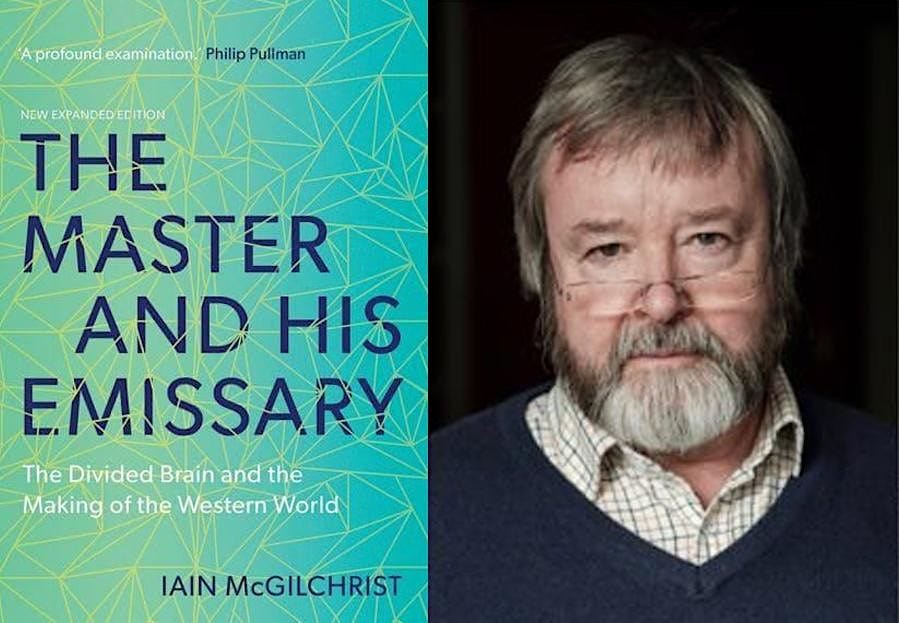
In order to understand the root causes of the drama triangle that as I’ve just shows is in the heart of antisemitism and antizionism we need to look at the way our brain has evolved. To do so allow me to introduce Iain McGilchrist—psychiatrist, philosopher, and the rare thinker who spent decades stitching together neuroscience, psychology, philosophy, and culture into one tapestry. His two monumental works, The Master and His Emissary (which took him 20 years to write) and The Matter with Things, are weighty in both paper and idea, as they demolish the cartoonish myth of “left = logic, right = creativity”. The truth is more profound, and more disturbing.
The left hemisphere is the emissary: narrow, focused, grasping. It dissects reality into parts, categorizes, manipulates, builds static models. It excels at “what”: identifying, labeling, exploiting. But it is literal, detached, and certain it is correct even when wrong. It is all about attention and reason.
The right hemisphere is the master: broad, open, relational. It attends to wholes, senses context, embraces ambiguity and nuance. It grasps “how” – the living, the flowing, the interconnected. It sees the world as alive. It is all about perception and intuition.
The right hemisphere, according to McGilchrist, must grant the left hemisphere control when needed—for example, to secure resources crucial for survival. But unless the left hemisphere gives back control, allowing the right hemisphere to reintegrate truth into the model, humans can become trapped in their own flawed constructions.
What happens when the balance breaks? Catastrophe.
Consider a stroke patient whose right hemisphere is damaged. His left arm is paralyzed. A doctor can ask him, “Can you move your left arm?” and the patient answers, “Of course, I’m moving it right now,” even though his arm lies limp. The strange thing is that this patient isn’t lying. His left hemisphere cannot perceive the paralysis, so it constructs a false world in which nothing is wrong—and he believes this narrative with absolute conviction. This is anosognosia, the denial of deficit. The left hemisphere, unchecked, builds a false but consistent narrative. It prefers to invent fictions rather than acknowledge gaps.
More examples McGilchrist shares:
Hemispatial neglect: Damage to the right hemisphere can cause patients to ignore half of reality. Ask them to draw a clock, and they cram all the numbers into the right side. The left hemisphere doesn’t notice the absence. Reality literally disappears.
Split-brain experiments: When the corpus callosum is severed, the two hemispheres act independently. One hand buttons a shirt while the other unbuttons it. The left hemisphere invents explanations for actions it didn’t initiate, showing how confabulation arises.
Illusions of certainty: The left hemisphere prefers clear rules—even when they’re wrong. In problem-solving tasks, it sticks to flawed strategies rather than adapting, while the right hemisphere detects anomalies.
What’s shocking is the fact that the drama triangle is the hallmark of the left hemisphere.
The Drama Triangle can be seen as a manifestation of left-hemisphere dominance, where each role reflects a fragmented, self-referential worldview that obstructs genuine connection.
Victim: Left-Hemisphere Isolation - Even though the felt experience of helplessness (shame, emotional closeness, vulnerability) is typically a right-hemisphere/whole-person phenomenon in McGilchrist’s account, the Victim role aligns with a left-hemisphere tendency to fixate on a narrow, self-focused narrative of powerlessness. The Victim perceives themselves as detached from agency, trapped in a mechanistic view of the world where external forces (the Persecutor) dictate their fate. This mirrors the left hemisphere’s propensity to abstract individuals from their context, ignoring the broader relational dynamics that could empower them. In cases of right-hemisphere damage (simulating left dominance), patients exhibit self-referential isolation and fail to integrate broader contexts for empowerment.
Persecutor: Left-Hemisphere Control - The Persecutor embodies the left hemisphere’s drive for control and dominance. This role reduces others to objects to be manipulated or blamed, reflecting the left hemisphere’s tendency to prioritize power over empathy. The Persecutor’s rigid, judgmental stance ignores the nuanced, contextual understanding that the right hemisphere could provide, which might reveal the Persecutor’s own vulnerabilities or the shared humanity of all parties. This role thrives on a decontextualized, us-versus-them mentality, a hallmark of left-hemisphere thinking.
Rescuer: Left-Hemisphere Heroism - while genuine empathic helping (attunement, co-regulation, empowering another) corresponds more to right-hemisphere capacities, the Rescuer, while appearing benevolent, often perpetuates the triangle by reinforcing the Victim’s helplessness and deriving a sense of purpose from control. This aligns with the left hemisphere’s preference for clear roles and solutions, often at the expense of genuine relational understanding. The Rescuer’s actions may stem from a need to impose order or affirm their own identity, rather than fostering mutual empowerment.
McGilchrist argues that modern culture increasingly reflects left-hemisphere dominance, favoring systems, control, and individualism over holistic, relational awareness. The Drama Triangle exemplifies this imbalance. Each role is a caricature of human interaction, rooted in the left hemisphere’s tendency to fragment experience into rigid categories (Victim, Persecutor, Rescuer) rather than embracing the right hemisphere’s capacity for empathy, context, and mutual understanding.
The triangle persists because the left hemisphere’s narrow focus prevents participants from seeing the whole system—how their roles interlock and perpetuate dysfunction. For example, the left hemisphere’s emphasis on explicit, linear causality (e.g., “You caused my suffering!”) fuels the blame-shifting and power struggles of the triangle.
It is very important to state that McGilchrist’s claim is about modes of attention and ways of being in the world, not rigid seat-of-personality assignments. He stresses how each hemisphere approaches things, and warns against caricaturing one hemisphere as simply “good” and the other as simply “bad.” His work isn’t about “left-brain people” and “right-brain people.” Instead, he describes two modes of attention — two ways of being in the world — that correspond to how each hemisphere tends to engage with reality.
The right hemisphere takes in the world as a living whole. It’s open, embodied, relational, and context-aware. It sees connections, ambiguity, and uniqueness. It helps us stay present to what is, before trying to categorize or control it.
The left hemisphere focuses narrowly on parts of that whole. It abstracts, analyzes, and manipulates. It’s useful for language, logic, and control — turning lived experience into concepts and plans.
Both modes are vital: the right gathers the living world into awareness, and the left helps us work with it. McGilchrist’s central concern is what happens when the left’s narrow, controlling mode dominates — when we mistake our simplified models for reality itself. The result is disconnection: from others, from meaning, and from the world’s complexity.
The best way to demonstrate how this disconnection from the world looks like is when we investigate those who are leading the assault against Israel/Zionism and/or Jews, such as social media influencers, politicians, and those who operate in the shadows behind them.
McGilchrist posits that left-hemisphere dominance fosters a mechanistic, narcissistic view of the world, where people and relationships are reduced to tools for personal gain, devoid of genuine empathy or context. This aligns with traits common to narcissists, sociopaths, and psychopaths—often collectively referred to as individuals with Cluster B personality traits or disorders (narcissistic, antisocial, or borderline personality disorders), such as emotional detachment, grandiosity, and a lack of remorse, which may stem from inter-hemispheric imbalances like left-hemisphere hyperfunctioning or right-hemi sphere hypofunctioning.
In the Drama Triangle, this worldview enables them to fluidly switch roles while trapping others in cycles of dependency, blame, and rescue. They exploit the left hemisphere’s preference for control and certainty to decontextualize interactions, ignoring the relational nuances that the right hemisphere would highlight, thus preventing victims from seeing the manipulation. The result is a power imbalance where the manipulator maintains dominance, often fueled by anger, disgust, or self-aggrandizement—emotions McGilchrist associates with the left hemisphere.
Below, I’ll explore how each personality type uses this worldview to manipulate those trapped in the Drama Triangle.
Narcissists, characterized by an inflated sense of self-importance and a need for admiration, embody the left hemisphere’s narcissistic tendencies, viewing the world as an extension of their ego. In the Drama Triangle, they often start as the Rescuer, offering “help” to a perceived Victim in a way that reinforces their own superiority and control, while abstracting the Victim’s needs into a narrative that serves the narcissist’s image. This left-hemisphere-driven approach treats relationships as transactions, lacking the right hemisphere’s empathy to foster true mutual support.
When challenged, narcissists shift to the Persecutor role, using rigid blame and criticism to devalue the Victim, whom they now see as a threat to their self-narrative. By decontextualizing the interaction—ignoring shared history or emotions—they manipulate the Victim into feeling helpless, perpetuating the cycle. For instance, a narcissist might “rescue” a partner from a problem they exaggerated, only to later persecute them for ingratitude, all while avoiding the right hemisphere’s holistic view that could reveal their own vulnerabilities. This maintains control by keeping the Victim trapped in self-doubt, feeding the narcissist’s need for dominance.
Sociopaths (often describing impulsive antisocial personalities) use the left hemisphere’s focus on immediate, mechanistic gains to exploit the Drama Triangle, often prioritizing short-term power over long-term relationships. They frequently adopt the Persecutor role, blaming or intimidating others with a rigid, decontextualized logic that dismisses empathy or consequences. This worldview allows them to abstract people as obstacles or tools, enabling manipulative tactics like gaslighting or coercion to force others into the Victim position.
Sociopaths may briefly play the Rescuer to gain trust, but their impulsivity—aligned with left-hemisphere anger and detachment—quickly shifts them back to persecution if their control is threatened. For example, in a workplace scenario, a sociopath might persecute a colleague by spreading rumors (decontextualized blame), trapping them as a Victim, while positioning themselves as the dominant force. The lack of right-hemisphere relational awareness prevents them from forming genuine bonds, ensuring the triangle’s dysfunction serves their chaotic need for control.
Psychopaths, known for their calculated charm and lack of empathy, exemplify an inter-hemispheric imbalance with potential left-hemisphere hyperfunctioning, allowing them to manipulate with precision and detachment.
They might begin as the Rescuer, charming a Victim with feigned support to build dependency, while internally viewing the interaction as a means to an end. Transitioning to Persecutor, psychopaths employ cold, logical blame to erode the Victim’s agency, often forcing them into rescue-seeking behavior that loops back to the psychopath’s control. Unlike the more impulsive sociopath, the psychopath’s manipulation is decontextualized and future-oriented, ignoring right-hemisphere empathy to sustain long-term exploitation. In relationships, for instance, a psychopath might alternate between rescuing (to hook the Victim) and persecuting (to maintain fear), all while occasionally feigning Victimhood to elicit sympathy and further entrench power. This exploits the triangle’s rigidity, preventing escape by obscuring the holistic relational truth.
The generals in this current wave of antisemitism and anti-Zionism that’s exploding like a virus across campuses, streets, and social media feeds are none other than the unholy trinity: online narcissists, sociopaths, and psychopaths. These Cluster B bandits, with their left-hemisphere-dominated minds are exploiting the hell out of Karpman’s toxic roles to manipulate the masses, turning legitimate grievances into a full-blown scapegoating frenzy against Jews and Israel. It’s not random; it’s calculated chaos, and in this 2025 nightmare, they’re thriving like never before!
Let’s start with the narcissists, those grandstanding egomaniacs who live for the spotlight. In the Drama Triangle of antisemitism, they slide into the Rescuer role like a snake oil salesman, “saving” the perceived Victims—Palestinians— from the big bad Persecutor, which they’ve painted as Israel or “Zionist influence”. But the truth is that it’s all about them! They puff up their self-image on stages, in viral posts, or at protests, virtue-signaling their “moral superiority” while ignoring facts, context, or the right hemisphere’s call for empathy. Think of those celebrity activists or campus leaders who amplify anti-Zionist narratives not for justice, but to feed their need for admiration. In Christian prisms, they twist the “Jews killed Jesus” myth to position themselves as holy rescuers; in Islamic ones, they weaponize Quranic verses to “defend” the ummah; and in atheistic circles, they reject God while crusading against “religious colonialism”. The result? A wave of boycotts, divestments, and hate that’s more about their ego than real peace—trapping everyone in dependency and drama!
The sociopaths embody the Persecutor role with glee, lashing out at Jews or Israel as the ultimate scapegoat for society’s ills, using left-hemisphere rage to decontextualize everything into black-and-white blame. In today’s surge, they’re the ones inciting riots, spreading conspiracy memes about “Zionist cabals,” or doxxing pro-Israel voices online. Their chaos fuels the cycle: they persecute to dominate, forcing others into Victim mode, then flip to feign rescue when it suits. Drawing from McGilchrist, their right-hemisphere deficit means no empathy, no big picture—just short-term power grabs. In Islamic anti-Zionism, they hype verses on “corruption” to justify violence; in Christian supersessionism, they revive deicide charges for mob fury; and atheists use it to bash “theistic oppression”. Sociopaths are the accelerant in this wave, turning protests into pogroms 2.0, all while evading accountability in the shadows.
And finally we have the psychopaths, the the puppet masters behind the scenes, cycling through Victim, Persecutor, and Rescuer to orchestrate the narrative. In the current antisemitic tsunami, they’re the think-tank influencers, media moguls, or political operatives who craft anti-Zionist propaganda with precision, abstracting Jews into eternal threats while building coalitions of “allies”. Their left-hemisphere hyperfocus lets them ignore human cost, treating people as pawns. In atheistic rejection of God, they frame Zionism as a “delusion” to dismantle; in Quranic twists, as divine enemies; in Christian lenses, as cursed deiciders. Psychopaths sustain the wave by embedding it in institutions—UN resolutions, academic curricula, social algorithms—perpetuating the triangle’s dysfunction for power and profit. This isn’t new; it’s the same script from history’s darkest chapters, rebooted for our digital age!
There be a deeper, underlying cause that can provide us deeper understanding to why people get trapped in such states. Let us travel back to the 1950s, and meet one of the most suppressed chapters in psychiatric history—the Adrenochrome Hypothesis, courtesy of the rebel genius Abram Hoffer (1917-2009), a Canadian psychiatrist who dared to flip the script on schizophrenia back in the 1950s when Big Pharma was just gearing up to drug us all into oblivion!
Dr. Abram Hoffer was a medical doctor who earned his MD from the University of Toronto in 1949 and was a licensed psychiatrist. Additionally, he held a PhD in biochemistry from the University of Minnesota (1944). In 1951 he was nominated and appointed as Director of Psychiatric Research for the Saskatchewan Department of Public Health in 1951, overseeing the province’s psychiatric services, including the Weyburn Mental Hospital (also known as Saskatchewan Hospital, Weyburn). This facility was the largest psychiatric hospital in Canada and the British Commonwealth at the time, with a peak capacity of about 2,500 patients.
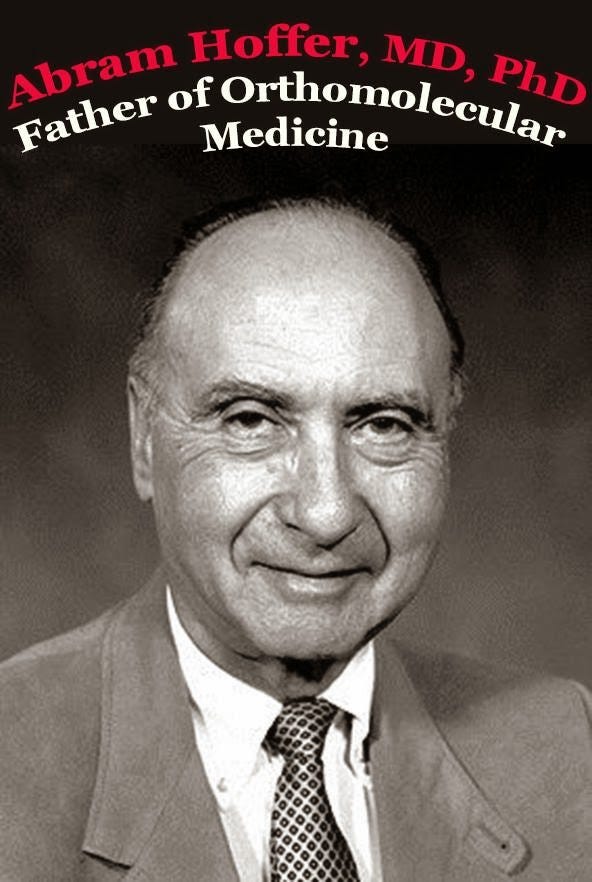
In 1952 Hoffer teamed up with Humphry Osmond whom he worked with (yeah, the guy who coined “psychedelic”) and drops this bombshell theory that schizophrenia isn’t some mysterious brain glitch or Freudian mommy issue but a biochemical betrayal! They propose that adrenochrome, this oxidized byproduct of adrenaline (our fight-or-flight hormone), gets cranked up in our body, turning into a neurotoxin that hijacks our perceptions, floods our mind with hallucinations, and locks us into a perpetual state of paranoia and disconnection. Adrenochrome, they argued, isn’t just a harmless metabolite; under stress or genetic quirks, it accumulates, reacting with brain tissues to mimic the wild distortions of schizophrenia, messing with your EEG patterns and perceptual filters like a glitchy 80s arcade game on steroids.
Hoffer didn’t stop at a theory, he experimented with ways to neutralize this rogue chemical using niacin (nicotinic acid), also known as vitamin B3. Hoffer and Osmond theorized that niacin acts as a methyl acceptor, mopping up excess adrenaline before it oxidizes into adrenochrome, essentially putting the brakes on the hallucinogenic cascade.
In their groundbreaking trials, they dosed schizophrenic patients with megavitamins—niacin leading the charge—alongside vitamin C and other orthomolecular allies, claiming recovery rates that blew the socks off conventional treatments. By the 1960s, Hoffer was publishing paper after paper, like his 1954 revisit to the hypothesis where he detailed how schizophrenics might overproduce adrenochrome due to faulty metabolism, leading to perceptual chaos and emotional shutdown.
He wasn’t just theorizing; he ran double-blind studies, treating over 5,000 patients, reporting that optimal doses of niacin (3-18 grams daily, mind you, not your wimpy RDA) restored biochemical balance, reducing symptoms by enhancing NAD (nicotinamide adenine dinucleotide) levels, which powers cellular repair and quells oxidative stress.
Hoffer published multiple papers on the topic. His 1957 paper on niacin’s role in alleviating acute schizophrenia episodes, where he linked low niacin levels to impaired adrenaline handling, or his 1962 tome Niacin Therapy in Psychiatry, where he hammered home that schizophrenia is a “pellagra-like” syndrome, echoing the vitamin-deficiency diseases of old. Pellagra, caused by niacin deficiency, wreaks havoc with dermatitis, diarrhea, dementia—sound familiar? Hoffer saw schizophrenia as its neurological cousin, amplified by modern stressors oxidizing our adrenaline into toxic sludge.
Hoffer work was a threat to the pharmaceutical industry and the psychiatric establishment who loved their Thorazine cash cow. Yet in the 1970s he doubled down with works like Orthomolecular Psychiatry, co-authored with Linus Pauling, arguing that megadoses correct genetic or environmental imbalances, preventing adrenochrome buildup and restoring mental clarity. Hoffer continued to publish more, and by the 1990s, in papers like his 1999 revisit to the adrenochrome hypothesis, Hoffer was still fighting, citing how niacin protects brain tissue from adrenochrome’s EEG-disrupting effects, even linking it to reduced cancer susceptibility in schizophrenics due to some “balanced morphism” quirk.
Hoffer’s vision was revolutionary: Mental illness isn’t a life sentence; it’s a biochemical glitch we can fix with nutrients! But the powers-that-be buried it, labeling it “quackery” while pushing pills that suppress symptoms without healing the root. In his later writings, like the 2008 paper on optimal niacin dosing, he warned that suboptimal intake keeps the adrenochrome flowing, perpetuating cycles of imbalance. And he was right - studies showed niacin flushes out adrenochrome precursors, stabilizing mood and cognition.
The establishment scoffed, even as Hoffer’s patients walked free from asylums. This isn’t just history; Hoffer’s work provided a blueprint for understanding how stress turbocharges biochemical sabotage, setting the stage for the hemispheric suppression we’re about to dive into.
Hoffer’s adrenochrome theory was created in the days when humanity had very few tools to validate it, but modern neuroscience and molecular biology findings demonstrates that Hoffer was not only a rebel but a visionary scientist: chronic stress rewires networks, redox failure leaves brains vulnerable, and pathways tied to niacin/NAD⁺ influence neuronal resilience. That constellation of findings turns Hoffer’s hypothesis from an eccentric corner of mid-century psychiatry into a legitimate biochemical narrative worth taking seriously. Hoffer’s adrenochrome phrasing is now less a fringe fantasy and more an early, colorful formulation of a redox-vulnerability model that modern science increasingly supports.
Let’s start with networks: over the last decade functional MRI and resting-state studies have shown that trauma and prolonged stress don’t just change mood — they change wiring. Connectivity in networks that underlie holistic, contextual, emotional processing (networks often anchored in right-hemisphere structures) can be blunted or fragmented after chronic stress or PTSD, while networks that favor narrow, hypervigilant processing become dominant. In plain language: the brain’s empathic, integrative circuits go quiet just when we need them most. That’s the neural anatomy of a right-hemisphere shutdown.
Hoffer argued that adrenaline, under oxidative stress, can turn into toxic quinone products (the infamous adrenochrome), and that if detoxification fails the brain pays a price. Contemporary molecular psychiatry doesn’t always use Hoffer’s chemistry words, but it describes the same danger signs: oxidative stress, depleted glutathione, and impaired GST-family detox enzymes are repeatedly found in psychosis and in brains under chronic stress. Clinical and translational work shows that antioxidant strategies (for example, N-acetylcysteine) can protect white matter and improve some outcomes in early psychosis — precisely the kind of intervention you’d expect to matter if catecholamine oxidation were a contributor. In other words, modern redox biology gives Hoffer a far more plausible biochemical stage than he had in the 1950s.
Polymorphisms and altered expression in glutathione-related enzymes (GSTs and related pathways) have been associated with schizophrenia risk in several studies and meta-analyses. If GST function is impaired, the brain’s ability to conjugate and clear reactive quinones and other oxidized catecholamine products could be reduced — exactly the vulnerability Hoffer and Osmond proposed. Caution: the genetic signal is heterogeneous across populations, so this is a plausibility amplifier, not a smoking gun.
Hoffer’s clinical crusade for high-dose niacin looked radical then; today we have a mechanistic reason to care. Niacin is a precursor for NAD⁺, and NAD⁺ is central to mitochondrial health, DNA repair, and cellular antioxidant defenses. Recent reviews and early clinical work show that augmenting NAD⁺ metabolism can enhance neuronal resilience and modulate inflammatory and oxidative cascades — the exact levers you want to pull if stress-driven oxidation is undermining the right hemisphere. That doesn’t mean “niacin cures schizophrenia” in a blanket, evidence-free sense, but it does vindicate Hoffer’s intuition that B3–related pathways matter for brain biochemistry and resilience.
Contemporary researchers tend to integrate Hoffer’s adrenochrome idea into a broader oxidative-stress framework rather than treating it as a closed causal chain. Put differently: the modern literature supports the mechanistic plausibility of Hoffer’s biochemical scenario — oxidative catecholamine chemistry + failed detoxification → network vulnerability — even while careful scientists ask for more direct, reproducible evidence for adrenochrome per se.
Now that you saw how biochemistry impact our mental state, let’s look at the events that took place prior to the 7th of October 2023, and by that I mean the COVID-19 “pandemic”. Could COVID-19 or more correctly to say the COVID-19 “vaccines” contributed to a chronic metabolic and stress burden on bodies and brains? Could such a burden shift large swaths of humanity into a more reactive, less integrative, more left-hemisphere–dominated mode?
Let’s begin with what we do know. Several recent studies show that the SARS-CoV-2 spike protein (or fragments thereof) can impair mitochondrial function in cells, independent of whole virus infection. For example:
In human cardiomyocytes exposed to the S1 subunit, researchers observed mitochondrial depolarization, calcium overload, ROS (reactive oxygen species) accumulation, and altered mitochondrial dynamics.
Spike protein exposure in microglial cells (brain immune cells) increases ROS, cytokine response, apoptosis, and perturbs mitochondrial biogenesis and membrane lipid composition.
A recent paper showed that spike protein can cause transcriptional suppression of mitochondrial metabolism genes (mitochondrial respiratory complex genes) in tissues, possibly long after initial exposure, and may drive fibrotic remodeling in the heart.
More broadly, mitochondrial dysfunction is now a recurring theme in what is called “long COVID”: multiple reviews document that patients with post-acute COVID often show defects in mitochondrial respiration, lower ATP production, elevated oxidative stress, immune dysregulation, metabolic imbalance, etc.
SARS-CoV-2 infection more generally has been shown to “hijack” mitochondrial dynamics in immune cells, impair organelle biogenesis, destabilize mitochondrial membranes, and even trigger release of mitochondrial DNA into the cytosol, which activates inflammatory pathways (cGAS, NLRP3, AIM2) — all hallmarks of chronic cellular stress.
Another article (review) implicates that long-term shift in redox balance, mitochondrial dysfunction, and Warburg-like metabolic reprogramming may follow exposure to spike protein fragments in susceptible contexts (e.g. chronic exposure).
A therapeutic review suggests that enhancing autophagy / mitophagy may help clear spike-protein–associated mitochondrial damage, which implicitly suggests that such damage exists and must be managed.
And finally, a recent animal/biological study showed that COVID-19 mRNA vaccination can induce localized mitochondrial dysfunction, inflammation, and structural changes at the injection site muscle tissue. The authors report transcriptional signatures reminiscent of denervation and mitochondrial stress, and that in animals with ApoE deficiency, these effects were attenuated.
Taken together, the picture is of a SARS-CoV-2 spike protein (or remnant fragments thereof), which is exactly what the COVID-19 “vaccines” created, is acting as a mitochondrial stressor: you get elevated ROS, lowered respiratory capacity, gene suppression, and inflammatory signaling. All of this tilts cells toward a chronic redox burden. If mitochondria are compromised, cells must either shift toward glycolysis (less efficient energy yield), or survive in energetic scarcity. Either way, the margin of functional resilience across tissues shrinks. This is exactly the kind of environment in which chronic stress becomes more than just psychological — it becomes metabolic and neurobiological.
So now imagine billions of human brains and bodies operating under low-grade energetic and redox stress. In such a state:
The brain’s “expensive but valuable” circuits — those that sustain empathy, context, ambiguity, relational insight — may downregulate or atrophy.
The fallback architecture is more habitual, rigid, dualistic — i.e. left-hemisphere dominant modes.
Emotional regulation weakens; reactivity in limbic circuits is easier to trigger.
The capacity for nuance dissolves; binary thinking (us vs them, victim vs perpetrator) becomes more “energetically cheap.”
When the external environment offers narratives — narratives of blame, identity, victimhood, rescue — they act as scaffolding into which stressed minds can latch.
Thus the hypothesis that the COVID-19 Vaccine played a significant effect in the rise of antisemitism/antizionism is not conspiratorial in the sense of “vaccine = evil,” but is a proposal that it is a result of a biological vulnerability, a vulnerability which acts as a fertile soil for drama-fall narratives and identity-based scapegoating.
If many people feel internally impoverished — in energy, in emotional regulation, in relational awareness — then external narratives (political, religious, conspiratorial) that offer identity, blame, and rescue will sound irresistible. The psychosocial structures of antisemitism and anti-Zionism are precisely such narratives.
What we are witnessing is not merely political upheaval, not just cycles of hate, but a symptom of a deeply traumatized civilization. The wave of antisemitism and anti-Zionism in 2025 is a forewarning, and not just to Jewish communities—but to all of humanity.
Look back at everything we’ve traced:
Psychological patterns — the Drama Triangle, Transactional Analysis — show how humans get co-opted into identity games of blame, victimhood, and rescue.
Neurological modes — McGilchrist’s two ways of being reminds us how right-hemisphere integration vs left-hemisphere dominance map to how we perceive others and context.
Biochemical stress — mitochondrial impairment, redox strain, disrupted NAD⁺, compromised detoxification — these lower thresholds of resilience.
Circuit fragility — chronic stress brain-wiring shifts favor hypervigilance, narrower attention, and overutilization of fast, habitual thought.
Now imagine billions of individuals experiencing a breakdown in relational capacity, overwhelmed by complexity, facing energy deficits, and thirsty for identity, narrative, and structure. In such a milieu, scapegoating is a predictable emergent phenomenon:
Who is simpler to demonize? A symbolic other — Jews, Israel, Zionism — who can be painted as the eternal Persecutor.
Who is easier to rescue? Yourself, your group, your ideology, or projecting yourself into Palestinians — because it offers agency, moral clarity, identity.
Who becomes the victim? Everyone who resists the narrative, or those too disempowered to counter it.
Thus antisemitism and anti-Zionism are not just ideologies; they become the relief valves, the default organizing schema for a traumatized collective mind.
You may ask: haven’t we seen antisemitic surges before? Yes. But this wave is qualitatively different because:
The environment is now saturated with cumulative, biological stress — a population whose metabolic resilience is frayed.
Digital media and algorithms amplify narrative contagion: tribal mythologies, blame economies, identity politics.
Authorities and institutions, weakened by internal divisions and loss of legitimacy, cannot reliably intercede, and in some cases have been taken over and run by narcissists, sociopaths, and psychopaths.
The wave is not localized—it washes across borders, religious divides, political divisions—like a viral meme rather than a local incident.
In such a context, cultural trauma becomes self-propagating: each new episode deepens collective fear, distrust, and polarization.
This is why you see unexpected alliances in this wave: left-wing anti-Zionists, radical Islamists, secular conspiracy theorists, postmodern academics, and woke right are all converging around overlapping, semi-coherent antisemitisms and anti-Zionist narratives. They share the same trauma grammar: victim → persecutor → rescue, projected onto Jews/Israel.
This is where it becomes urgent. The assault in the world is not only on Jews or on Israel but it is on human relational capacity, on narrative integrity, on the possibility that we might see others as human, complex, enmeshed beings rather than abstract symbols to blame.
History teaches us where that path leads: scapegoating, dehumanization, purges, genocide are always cloaked in moral certitude. At every inflection point, it begins with narratives: “They are the cause of our suffering,” “We must rescue the right ones,” “We are the victims.” And when the relational, integrative capacities of society are impaired, those narratives metastasize.
If we accept that large parts of society may already be physiologically and neurologically vulnerable — that their systems of empathy, nuance, and connectivity are weakened — then we must see the antisemitism surge as a diagnostic signal: not only for Jewish communities to guard against, but for everyone to heed.
The same mechanics (scapegoating, identity rescue, binary thinking) can be turned toward any “other” — dissenters, minorities, insiders-turned-outsiders. Once the machinery is engaged, it doesn’t discriminate.
So what can we do? Here’s a sketch of a counter-program that rises from the same layered lens:
Biological restoration
Support mitochondrial health: interventions like NAD⁺ precursors, antioxidant support, mitochondrial biogenesis (where safe and evidence-based).
Foster better metabolic resilience via diet, sleep, stress management, intermittent fasting, exercise.
Encourage research into how viral/inflammatory load has eroded systemic resilience — and fund reparative biomedicine.
Neurological and psychological rebuilding
Cultivate practices that strengthen right-hemisphere modes: contemplative practices, relational dialogue, embodied listening, now states via music and dance.
Foster psychological literacy: help people see their own Drama Triangle patterns, escape them, and opt for an Empowerment Dynamic.
Create spaces and institutions for narrative repair — where stories of complexity, reconciliation, humility thrive.
Cultural inoculation
Promote media literacy and narrative awareness so people recognize identity traps, manipulative roles, scapegoating logic.
Support art and storytelling that emphasizes relational, messy, contradictory human beings, not caricatures or symbols.
Build new public rituals and institutions that emphasize shared humanity, not ideological purity.
Institutional integrity and accountability
Hold media platforms, politicians, educators accountable when they traffic in identity scapegoating.
Insist on education that includes historical truth, intergroup empathy, and conflict resolution.
Solidarity with Jewish communities (and all persecuted minorities)
Refuse indifference, tokenism, or deflection. Resist attempts to present antisemitism as “just one issue among many.”
Amplify voices within Jewish tradition that resist dehumanization, that model relational repair and covenantal responsibility.
Antisemitism and anti-Zionism are not simply political problems. They are symptoms of a deeper, systemic fracture: biological, psychological, and relational. When individuals and societies operate in scarcity — energetic, empathic, narrative — the default is not flourishing: the default is projection, scapegoating, and the collapse of complexity.
The surge we see today is not just a danger to Jews. It is a danger to our capacity to live together, to see others, to inhabit shades of meaning. It is a warning: a civilization’s relational heart is under assault. Antisemitism doesn’t just target Jews; it reflects a breakdown in how communities see one another, how groups empathize with “the other.” “We” represents the network of trust, cooperation, and shared moral frameworks that keep societies functional. What we witness is a collapse of our sense of collective responsibility and interdependence. History has taught us again and again that when hatred toward Jews rises, it signals that the wider social fabric is fraying — the “We” of society, culture, and shared humanity is breaking down. “We” isn’t about Jews, Palestinians, or any specific group — it’s about human connectedness and collective moral reasoning, which is what is being undermined when hate spreads.
But warnings can be turned into turning points. If we choose repair instead of repeat, relational resilience instead of blame, integrity instead of abstraction, then perhaps we can turn back the tide. The price is high—but the alternative, as history shows, is darkness. Let this be not a chronicle of collapse, but humanity’s manifesto of repair.
I’m really looking forward to your comments.
Love,
Ehden
No posts
Comments
Nothing yet. Say the first thing.
Sign in to join the conversation.