
There is one thing about Colombia that I will never, ever forgive that country as long as I live. I have beef with Colombia over it. I really do. Honestly. Colombia, how could you?
That thing is magical realism.
See, I‘m obsessed with Gabriel Garcia Marquez. I have read all his books, I love them all equally, but also especially the Hundred Years of Solitude, the General In His Labyrinth, and extra especially but equally, the Autumn of the Patriarch.
(I‘m big on Italics today – forgive me, the first snow had fallen last night, and I am plagued by the urge to emphasize things as if the world has lost its definition a little).
Anyway; as a die-hard Marquez fan, I have been pestering Colombia to produce all this magical realism for me whenever I found myself in Cartagena or Salento or Medellin; I kept inspecting the Botero statues, the dusty villages in Boyaca, and the green rolling hills for traces of it; granted, I have detected some in the filigree jewelry and window shutters of Mompox, as well as an old, wooden barge moving slowly along the silted Magdalena River; and indeed, there were echoes of it in the forgotten places along the Devil‘s Trampoline, and sometimes in the way a certain person smiled, or how the sea of clouds rolled over the Andes, but, excuse me, where was all of it?
Where, I ask, was Macondo?
Or at least some sort of proof of magical realism?
A sense of it, por favor?
So you see, I‘ve been a little upset with Colombia about all of this.
Now look, I do fully grasp that Macondo isn‘t on a map or an AirBnB. I do also understand, rationally, that Marquez‘s genius does not have a fixed address anywhere in Colombia, and if, by means of time travel, allowing for quantum transmission of dialogue, should I ever be able to confront Marquez himself on this matter, he would likely – though I suspect, politely - suggest I embark on a fast journey to hell, because what a moronic thing it is to expect an author and his creations to magically be real in their place of birth.
(no, that wasn’t a very clever pun; yes, I do find myself tiresome sometimes).
But perhaps Mr. Marquez would approve of something that happened to me in Mexico instead.
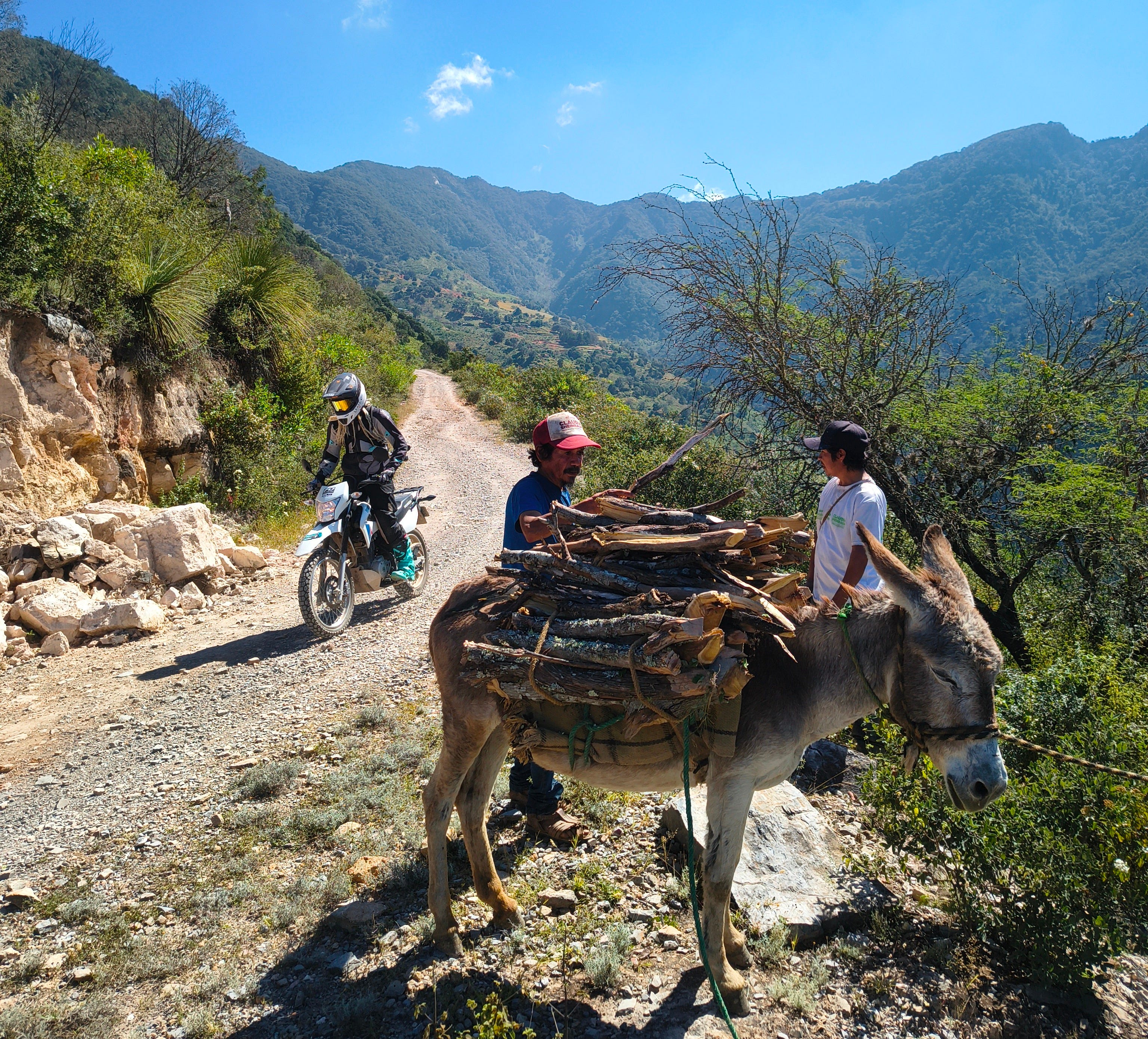
Recently, I had an obscene privilege to take a crew of women riders to the mountains of Sierra Gorda, this spectacular, hidden pocket of rugged canyons and wild places in Queretaro State.
It’s all dusty little trails and cloud forests and mountain passes, and dizzying switchbacks and riverbeds and canyons, and sleepy pueblos and ruins of old Franciscan missions; we were there for the dirt bike adventure – but we began with the Dia de Los Muertos festivities in Tequisqiapan, or Tequis if you’re local, or wanting to sound like one for a little while – you just say, “oh yeah, we’re off to Tequis” kinda casually, you know?
Anyway.
I’d heard a lot about the Day of the Dead in Mexico, but the timing was never quite right, and I’d never actually experienced it. To the uninitiated: it’s not like Halloween, but it is a tiny bit like Samhain, or Vėlinės; the idea is that the veil between this world and the other is at its thinnest during October 31 – November 2, and, while the Catholic tradition is all about saints, stiffness, mourning, and stuff, the Dia de Los Muertos is about memory and softness and celebration.
So I expected the sugar skulls and the Catrina makeup, the music and the bright colors, the candles and the decorations; and Tequis delivered all that and then some, but it also delivered... oh yes – the magical realism.
You see, Dia de Los Muertos isn‘t loud.
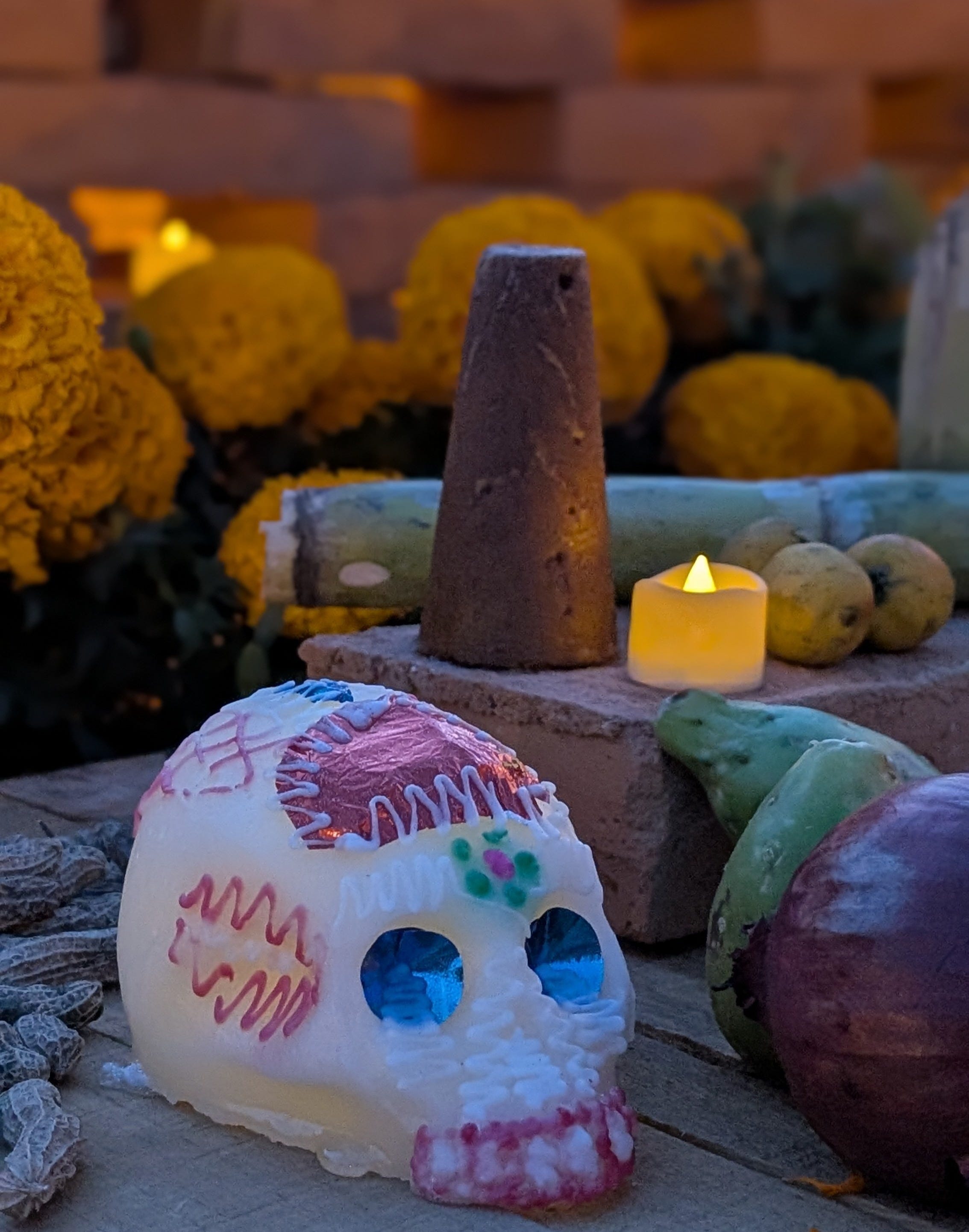
Instead, it is all soft amber glow and twilight; it‘s a lonely little candle placed next to a tiny sugar skull with just one word, „abuelo“ („Granddad“) written on it; it‘s a pet cemetery mural and old couples singing along to a band on stage, and flickering lights in the dark, and people being a little kinder to each other as if the dead was indeed walking among us that night, not as a scare or a dare, but to hold your hand or sit beside you on a bench for a little while, with longing, there to remind you of something you‘d long forgotten, and perhaps give courage.
It wasn‘t about grief but love, the kind that lingers long after the beloved is gone; it wasn‘t about hurt but gratitude, and the shadows merged with the gentle orange hues and I found myself missing my own abuelo very, very much; but more than that, for one fleeting moment, I felt the presence of someone I‘d loved madly as I stood alone in the crowd listening to the mariachi – for one flickering second and an entire lifetime all at once, his ghost was right there behind me, and we were swaying together to the music as the world fell away and nothing else mattered – then it was gone as if a waking dream, and at the same time it lingered for days like thin mist in the mornings.
One might say the heart does crazy things when it has been broken; but as the Dia de Los Muertos faded, the thing persisted. The magical and the real. It shifted shapes, manifesting itself as inexplicable longing for something I couldn‘t quite define in the pockets of perfect silence at high altitude; it looked a lot like mischief at times, making cinnamon and sugar faces in the pan de muertos bread at lunch; it came out in big, childlike tears as I sat on the edge of a canyon so vast and so impossibly green, sheer cliff walls and mountain faces crashing down, down, down, blanketed by trees and wildlfowers, and I suddenly felt like this ancient place held space for all of it, and maybe, on the other side, an old forgotten mountain god, a benevolent abuelito, was drying his socks on the granite wall, and maybe he waved at me with a crooked smile, and the mountains sighed after ten thousand years of silence.
It‘s not so much that I was seeing things that weren‘t there – but I felt them, acutely, and it started a thawing of sorts; icicles that had formed around my heart so long ago began melting, slowly, and after decades on ice, feeling like I had been living on a strange, barren planet where gravity felt off and the sun never fully rose and the alien terrain had always felt hostile, and I kept waiting to just go home, please could I just go home?, one foot out the door already, never fully here, bracing for impact, for the howling winds that never stopped – I finally fully exhaled, and looked around, and saw that I was always home.
Most curiously, the thawing appears to continue.
It has been weeks that I boarded the plane in Mexico City and returned to Lithuania; one could only blame the disorientation of the jetgal for so long; I find myself wandering the local woods with my dogs and still feeling it all just as acutely. Old forgotten dreams from childhood returning in the form of a small pond in the forest I had never seen before; the ghost-like quality of my footsteps on frost-covered leaves; the way the fir trees seem to talk with each other in gentle whispers, the sweeping bend of the river carrying secret messages on the wings of swans, snow falling quietly in the night like a soft lullaby; I feel sad a lot of the time, but it is the sadness of the good kind – the kind that brings that strange longing and with it, wonder; the kind that makes you remember, with tenderness, what you had long forgotten; the kind that says, oh, but there‘s still so much over horizon, even though you cannot see it yet, and it‘s okay to feel it all, to let your soul bleed all over the wooden floors as you hold several impossible realities at once, as you decide to stay, really stay, and be, and become, slowly letting go of the tension and the hypervigilance of the Night‘s Watch on the ice wall you‘d so carefully built over decades of trying to outrun it all.
And so I shall forgive Colombia for its rude indifference to my efforts to find and soak up all the magical realism that old books had promised, finding it instead in the mountains of Mexico, the soft orange glow of the Dia de Los Muertos, and the home within where I‘ve always belonged but forgot how to open the door for over thirty strange years on a zero-gravity planet of my own making.
Yes, this world has a way of leaving bruises, and it hurts like a bastard sometimes; abuelitos die, people leave without explanation, the threat of war pulls the rug right from underneath you, nothing feels safe at times and scar tissue builds like alligator skin in places; the air feels thin and alien in the small hours, fear snarling at you in the dark corners of the room making horrible faces that scream, get out, get out before it‘s too late, you have not earned your place under the sun.
But, no, I refuse to go back on the ice.
Because a tiny sugar skull and a vast green canyon somewhere in Mexico whispered,
this world is for you, too.
Comments
Nothing yet. Say the first thing.
Sign in to join the conversation.