
Hello and welcome to new subscribers. I write about technology’s impact on us humans and our beleaguered planet and I’m extremely grateful to all who read, share, or comment on The Egg. Please consider becoming a subscriber if you’re not one already. It’s free(!) and it really helps to support my work.
One word says it all.
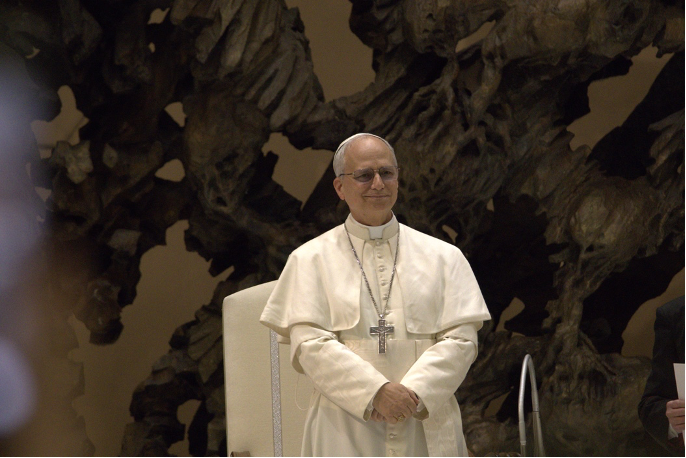
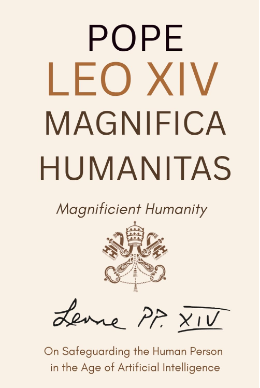
In Magnifica Humanitas (Magnificent Humanity), Pope Leo XIV’s extensive critique of artificial intelligence that was published last Monday, the word “dignity” appears 105 times.
In The Techno-Optimist Manifesto, venture capitalist Marc Andreessen’s paean to artificial intelligence that sums up the Silicon Valley viewpoint, the word “dignity” appears 0 times.
For that matter, it’s hard to find this word in any of the recent writings of the AI revolution’s most effusive boosters.1 Why is this? Why does this one word form a central theme in the pope’s first encyclical letter (which means it’s a major papal teaching) while it is avoided, perhaps unconsciously, by leaders of the industry the encyclical addresses?
The answer says much about this pope’s priorities—and about the direction in which he hopes to nudge society in the coming years.
The answer begins with the definition of the word itself. Catholic theology recognizes several different notions of dignity, some of which that can be enhanced or diminished. For example, the “social” form of dignity refers to a person’s living conditions and the concrete respect received from society. At the same time, the encyclical recounts how the most profound form is the kind that can’t be enhanced or diminished:
This is the dignity that belongs to every human being simply by virtue of existing, of having been willed, created and loved by God. No sin, failure, humiliation or exclusion can diminish the profound value of a human life…
Such conceptions of human dignity form the backbone of the Church’s social teaching dating back more than a century to another Pope Leo—Leo XIII—whose 1891 encyclical Rerum Novarum (Of New Things) placed the dignity of work, and of the workers themselves, at the forefront of its reflection. Written during a time of rapid industrialization and social change, it affirmed the right to fair wages for oneself and one’s family and recognized that workers have a fundamental value that takes precedence over capital and profit.
Magnifica Humanitas is presented as a modern extension of this earlier work, one that notes how the convergence of automation, robotics, and AI is rapidly transforming the very structure of work. Quoting his predecessor, Pope Francis, Leo warns that “new” does not automatically equal better:
…while AI promises to boost productivity by taking over mundane tasks, it frequently forces workers to adapt to the speed and demands of machines, rather than machines being designed to support those who work.
Thus, says Leo, we need to design systems that are centered on the human person and not solely on performance, because the human person is an end, not a means. “The economic order must remain subordinate to human dignity,” he writes. That’s easier said than done when that economic order is based on technology that, Leo reminds us, is “never neutral,” and that instead “takes on the characteristics of those who devise, finance, regulate and use it.”
This might seem merely academic, but it turns out to be a direct papal challenge to the small number of private tech companies that now dominate the world:
We cannot be satisfied with merely calling for the moralization of machines — the so-called “alignment” of AI with human values — without also having the courage to insist on a further condition: the possibility of…subjecting them to shared standards of social justice. Otherwise, those who control AI will impose their own moral vision, which will become the invisible infrastructure of these systems. A more moral AI is not enough if that morality is determined by a few. [Emphasis mine.]
This warning against technological power being concentrated in the hands of the few occurs throughout the encyclical. Indeed, it’s one of the most striking features of the document when you consider the hundreds of billions of dollars that have been spent over the past few years on a techno-optimist dream that seems to regard the biological human body and biological human mind as obstacles. The pope is right to question just who these dreamers are and what exactly is their dream.
He calls out “transhumanism,” the idea that we should continue exceeding human biological limitations through technology until we become “posthuman” with highly modified bodies or, perhaps, computers instead of bodies. He calls it out because it’s a direct affront to that pesky idea of human dignity. Leo warns:
If the human being is treated as something to be perfected or surpassed, it becomes easier to accept that some lives are less useful, less desirable or less worthy. In the name of progress, “necessary sacrifices” may begin to be justified, placing the burden on the most vulnerable in pursuit of a supposed optimization of the species.
To flesh this problem out, he also emphasizes the fundamental difference between “thinking” machines and the biological minds that conceive them. For example, whereas an algorithm views errors as merely flaws to be corrected, human beings often experience them as catalysts for personal change. In other words, unlike computers, human beings often flourish not in spite of their limitations but through them.
And this is why, in one of the encyclical’s most important passages, Leo drives home the point that we should never equate machine “intelligence” with the real thing:
These systems merely imitate certain functions of human intelligence. In doing so, they often surpass human intelligence in speed and computational capacity… Yet this power remains entirely tied to data processing. So-called artificial intelligences do not undergo experiences, do not possess a body, do not feel joy or pain, do not mature through relationships and do not know from within what love, work, friendship or responsibility mean. Nor do they have a moral conscience, since they do not judge good and evil, grasp the ultimate meaning of situations, or bear responsibility for consequences. They may imitate language, behavior and analytical skills, or even simulate empathy and understanding, but they do not understand what they produce, for they lack the affective, relational and spiritual perspective through which human beings grow in wisdom.
In other words, an AI system can amaze but it can never possess human dignity.
Although Magnifica Humanitas is written from a Catholic perspective with abundant references to Christ and Scripture, Leo explicitly addresses the whole world with a “heartfelt appeal to all the Catholic faithful, to all Christians and to all men and women of goodwill.” So, yes, it’s a Catholic teaching but it’s also explicitly humanist. This enhances its power and reach, which seems especially important when we get to parts about what the world—we as individuals and the institutions we entrust—should do to confront the disruptions caused by emerging technologies. Leo challenges us to:
Question the global distribution of power that decides who can train AI models and who is merely subjected to them.
Prevent the emergence of new forms of exclusion and deprivation of freedoms (i.e., communities exposed to invasive surveillance and social groups penalized by opaque algorithms that perpetuate prejudice and discrimination).
Rigorously evaluate and even, at times, slow the pace of AI development as needed to exercise responsible care for the human family.
Pass legislation for setting age limits and holding service providers accountable rather than shifting the whole burden of control onto families; provide for specific protections against all forms of online sexual exploitation and violence.
Ensure that taxation, social protection and industrial policies correct the imbalances created by the concentration of wealth and power.
Adopt labor policies that promote continuity and the quality of employment, countering insecurity as a normal condition of life.
Invest in accessible education and retraining, so that the professional mobility demanded by the digital economy does not become a harsh selection between those who are able to update their skills and those who cannot.
In short, the pope wants the world to “disarm” AI in order to respect human dignity. He writes:
To disarm means discrediting the assumption that technical power automatically confers the right to govern. To disarm does not mean rejecting technology, but preventing it from dominating humanity. It means freeing technology from monopolistic control and opening it to discussion and debate, therefore making it human-friendly and restoring it to the plurality of human cultures and ways of life.
All of this looks good on paper, but the real question is whether Magnifica Humanitas will, as they say, “have legs.” The Vatican appears to be hoping so. Encyclicals are technically letters to Catholic bishops and the business of presenting them is often left up to cardinals. However, in a break with tradition, this Pope chose to present his first encyclical himself at a Vatican ceremony. During the announcement, he was clearly aware that using words like “disarm” would raise eyebrows. “The word is strong, I know,” he said. “But deliberately chosen because this moment needs words capable of attracting attention.”
The word dignity is strong too, and it needs to remain front and center in a world forever changed by AI.
Comments
Nothing yet. Say the first thing.
Sign in to join the conversation.