
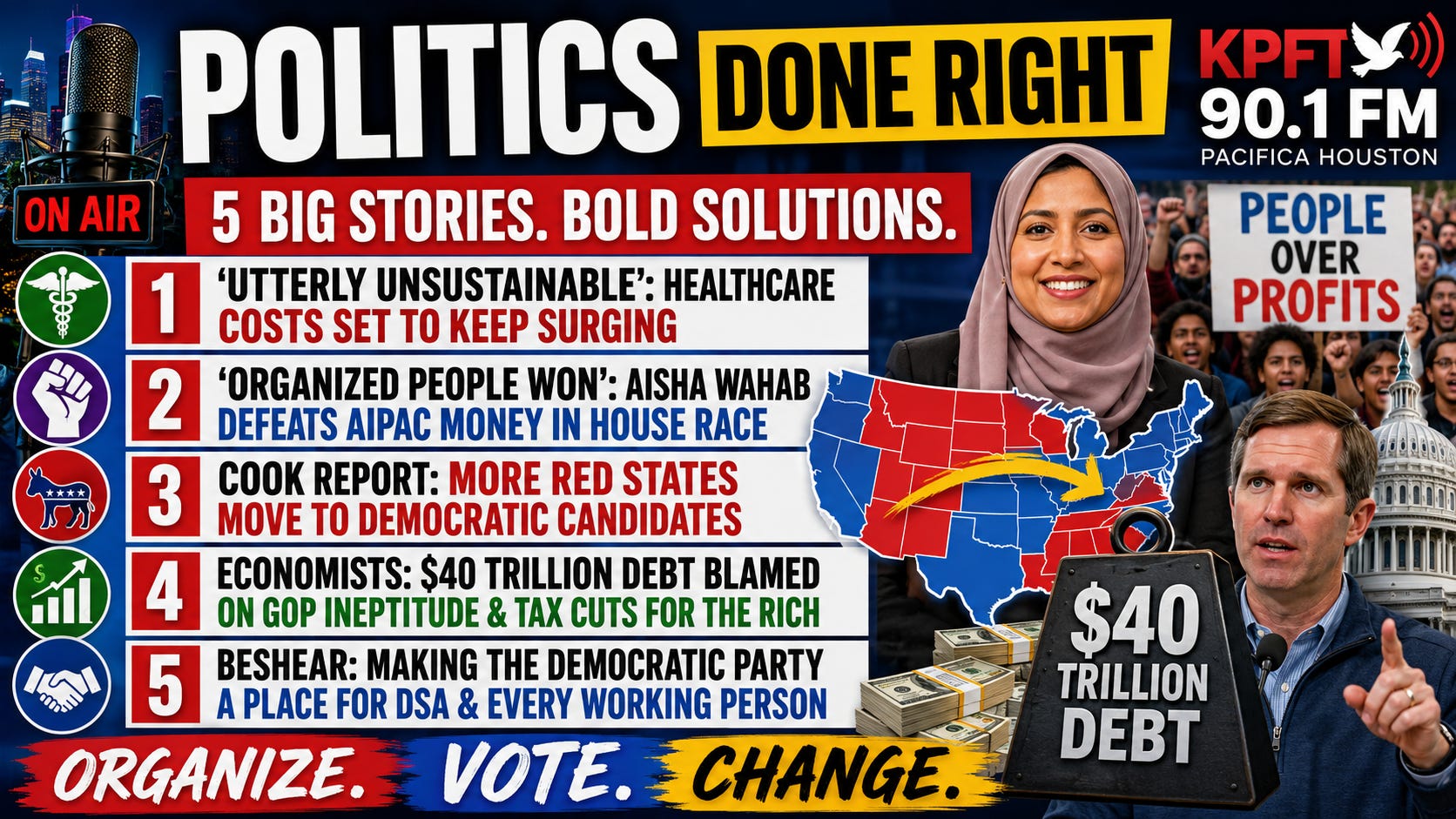
Today’s stories expose a political system being forced to confront what working people have understood for years. Employer-sponsored healthcare is becoming increasingly unaffordable even as Democratic leaders resist Medicare for All. Aisha Wahab just demonstrated that organized voters can defeat millions in outside spending. Republican strongholds like Texas and Iowa are suddenly competitive. Meanwhile, the national debt has crossed $40 trillion after decades of tax cuts tilted toward the wealthy, and Kentucky Gov. Andy Beshear is telling Democrats something their establishment needs to hear: a winning party must make room for big ideas and a broad progressive coalition. Employer healthcare costs are projected to jump sharply again in 2027, while Wahab won despite millions in pro-Israel outside spending and Cook moved both the Texas and Iowa Senate contests to toss-ups.
Employer-sponsored healthcare is failing its affordability test. Workers with job-based insurance are expected to spend an average of $5,297 in 2026 on payroll premiums, deductibles, and copays—$388 more than last year. Employers expect their healthcare costs to rise another 11.1% in 2027, potentially the largest increase in more than two decades.
Employer insurance is not “free-market healthcare.” Employers pay premiums instead of wages, workers pay through paycheck deductions and out-of-pocket charges, and corporations increasingly struggle with the expense. One West Virginia manufacturer cited in the reporting now spends a larger share of revenue on healthcare than it earns in profit.
The Medicare for All debate should focus on total costs, not the word “tax.” The question is whether families would pay less overall after eliminating private premiums, deductibles, copays, and much of the administrative waste embedded in the current system. Common Dreams points to recent Yale research estimating enormous potential savings and more than 100,000 lives saved annually under a universal system.
Aisha Wahab’s victory delivers a direct message to big-money politics. Wahab won California’s 14th Congressional District special election despite $2.5 million from AIPAC’s United Democracy Project supporting Melissa Hernandez, plus additional millions from another AIPAC-funded super PAC.
Money remains powerful, but organization can neutralize it. Wahab’s victory illustrates why door-knocking, trusted local relationships, labor support, and issue-based campaigning can sometimes overcome an advertising avalanche. She now serves the remainder of Eric Swalwell’s term and faces Hernandez again in November for a full term.
The Republican Senate map is deteriorating in places the GOP once treated as secure. Cook Political Report moved both Texas and Iowa from Lean Republican to Toss-Up. In Texas, Democrat James Talarico is battling Republican Ken Paxton; Iowa’s open Senate race has also become genuinely competitive.
Texas is especially significant because Republicans engineered the political terrain to protect themselves. Yet even after aggressive redistricting, declining Republican support and changing Latino voting patterns have put multiple races back into contention. Electoral engineering cannot permanently override voter dissatisfaction.
The $40 trillion national debt exposes Republican fiscal mythology. Republicans routinely brand social investment as reckless spending, but economists including Dean Baker and Paul Krugman point directly to repeated tax cuts—particularly those benefiting wealthy households and corporations—as major contributors to long-term deficits.
Tax cuts have consequences just as surely as spending does. Budget analyst Bobby Kogan previously calculated that Bush- and first-term Trump-era tax cuts accounted for 57% of the rise in the debt-to-GDP ratio since 2001, excluding extraordinary recession and pandemic costs. The latest Trump tax package adds still more debt while disproportionately benefiting the wealthy.
Andy Beshear is offering Democrats a more constructive response to the DSA surge than ideological warfare. Beshear told CNN that Democrats must remain a “big tent party” where people can disagree about solutions while agreeing on the problems facing working families. He said the moment demands “big ideas,” and argued that media obsession with Democratic divisions obscures the far greater differences between Democrats and Republicans.
Countering billionaires—and soon trillionaires—is hard, probing work. They flood the zone with propaganda, policy distortions, and economic fallacies rooted in the Powell Memo and financed by concentrated wealth. We work every day to answer that machinery with truth, context, and critical thinking. But independent media cannot survive on conviction alone. It needs support from people who understand the stakes. Please become a paid subscriber today. Your support keeps this work alive, expands its reach, and helps build a media ecosystem that serves people, not plutocrats. This is not charity. It is an investment in truth, democracy, and the public good.
While I am decidedly Progressive, I believe in engaging, listening, and learning from everyone, irrespective of their political ideology. You will never get disrespected by this program. I believe in civil coexistence.
There are many ways to listen to or watch Politics Done Right live.
Watch on Substack at egberto.substack.com.
Tune your radio dial to 90.1 FM in the Houston metro area.
Stream KPFT 90.1 FM via your mobile phone's Tune-In (Android, Apple) app.
Stream KPFT 90.1 FM via our website at kpft.org/listen-live-hd1/.
Watch live on Facebook at facebook.com/kpfthouston.
Watch live on YouTube at politicsdoneright.tv.
Get the podcast at politicsdoneright.com/podcast.
Please call the show live at (713)526-5738 ext. 2 with your comments. Every comment is appreciated. Please drop me an email at kpft@politicsdoneright.com with suggestions for future topics on future shows.
Comments
Nothing yet. Say the first thing.
Sign in to join the conversation.