
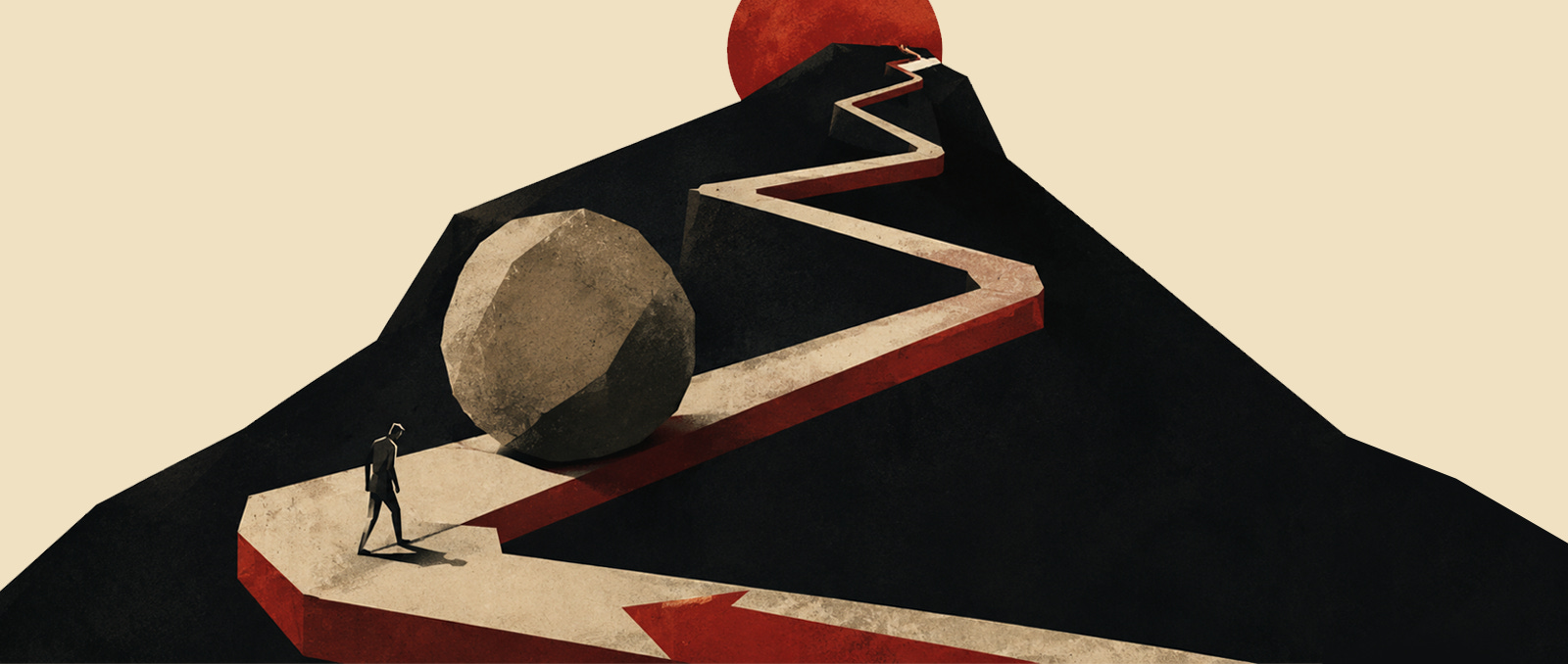
In 1942, in an occupied country in the middle of a collapsing world, Albert Camus wrote the most famous sentence in the history of boulder-related philosophy:
“One must imagine Sisyphus happy.”
I reject this.
The argument runs like this. Sisyphus is condemned to roll a boulder up a mountain forever. The boulder always rolls back down. The task is meaningless, endless, unwinnable. And yet, Camus says, in the moment Sisyphus walks back down the mountain, fully aware that his labor amounts to nothing, he becomes free. He has abandoned hope. He has accepted the absurd. The struggle itself fills his heart. Happiness, of a strange and flinty kind.
It is a beautiful argument. It has consoled generations of exhausted people, and it gets quoted in graduation speeches and gym posters with equal confidence.
But there is a question Camus never asks. How does Camus know?
The myth tells us what Sisyphus does. It never tells us what Sisyphus believes. Homer gives us the straining legs, the sweat pouring off his limbs, the dust rising from his head as the stone thunders back down to the plain. Not one word about what is happening inside that head.
That silence of Sisyphus is important, because there is another person you can put on that mountain, and he is in far worse shape than the one Camus imagined.
The Greek sources are behavioral. Homer’s Odyssey gives Sisyphus a single scene in the underworld: Odysseus watches him heave the stone toward the crest, watches it roll back, watches him start again. The camera (I am no classicist, but I have read the passage more times than I can count) never once goes inside the person. We get muscle. We get gravity. We get physics. We do not get psychology. Homer was, in this one scene, a perfect behaviorist: all response, no cognition.
Every claim about what Sisyphus feels is therefore an interpolation, a modern writer projecting an inner life onto a figure who was never given one. Camus understood this and exploited this gap, and rightfully so. His essay is not archaeology. It is a proposal: if we choose to imagine Sisyphus lucid and hopeless and unbroken, then we learn how to live without appeal to false comfort. The happiness is not discovered in the myth. It is installed there, because Camus needed it to be there.
Which means the question is still open. The mountain has room for other interpolations, and any of them competes with Camus’s on equal footing, because nobody ever interviewed the person. As much as Sisyphus has become part of almost-everyday vernacular, we have no idea really what he was thinking or feeling, if anything.
Reinterpreting him is not even a radical act. Lucretius did it two thousand years before Camus: in his telling, Sisyphus is the politician, forever chasing an office the people keep refusing him, pushing the same campaign up the same hill. The mountain has been a mirror for as long as anyone has looked at it. Every century sees its own face in the rock.
So, here is mine: Sisyphus never abandoned hope, because hope is the cruelest punishment any god could ever inflict, and is precisely the reason why an “eternity in Hell (of the biblical sort)” is pointless without two things: awareness of the passage of time (which eternity precludes), and the internal feeling you might be able to escape (which eternity also precludes).
Put yourself in Zeus’s position for a moment. You are designing an eternal punishment for the cleverest mortal in Greece, a person who chained Death to a wall and talked his way back out of the underworld. Pain will not do it; bodies adapt to pain, and this person is a specialist in adapting. You need a torment that renews itself. You need something that cannot be gotten used to.
Consider two prisoners.
Prisoner A sits in a cell and knows, with total certainty, that escape is impossible. The walls are solid. The sentence is forever. Nothing she does will ever change it.
Prisoner B sits in an identical cell, except her door has a lock that almost opens. Some days the mechanism clicks and turns halfway. Some days a guard forgets a round. Escape is never guaranteed. But it is always close.
Which one suffers more?
Prisoner A grieves, and then she adapts, because human beings are terrifyingly good at adapting to certainty. She builds a life inside the walls, because the walls are simply the world now. Ask anyone who has fully accepted an unchangeable thing: acceptance is not defeat. It is the beginning of everything else. It is on coffee mugs and quilts: Radical Acceptance, they call it.
The serenity prayer.
Loving what is.
Et cetera
Et cetera
Et… cetera.
All saying: why bother worrying about things you can’t change?
Prisoner B never gets to begin. Every halfway click of that lock resets her to day one. She cannot grieve, because grief means giving up on a door that might open tomorrow. She cannot adapt, because adapting is surrender, and surrender is irrational when you are this close. Her patience, her attention, her ingenuity (every good quality she has) gets conscripted into the machinery of her own captivity. And the cell needs no torturer on staff. She runs the machinery herself, every day, for free, because you definitely should bother with things you think you can change.
Despair is a wall, but hope is a treadmill. If you want to torture someone forever, do not take their hope away.
Give them more of it. It is not despair that is a human’s greatest pain, it is unrealized hope. It is longing. It is the limerence for freedom you almost cannot attain, but with just one more try… maybe you can.
We treat hope as a virtue. It sits in the same moral bucket as courage and kindness, the things we paint on classroom walls. Hopeful people are good people. Losing hope is a tragedy. But the systems that actually run on hope tell a different story.
Skinner worked this out with pigeons decades ago. Reward a behavior every single time and you get steady, almost bored responding. Reward it unpredictably and the behavior turns frantic, compulsive, nearly impossible to extinguish. A pigeon on a random schedule will keep pecking long after the rewards stop entirely. The pigeon is not stupid. The pigeon is hopeful. The next peck might be the one.
We built an economy on that finding.
Slot machines that pay out just often enough to prove that winning is possible
Pyramid schemes where someone you personally know really did make money
The partner who will finally change, truly this time, once the stress lets up
The promotion that is always one more impressive quarter away
“One more interview and I think you’re a lock”
Next quarter. Next election. Next funding round. Next year, when things finally calm down.
The quiet, private belief that this time the effort will be enough.
None of these systems work because people are hopeless. Hopeless people leave. They cash out, quit, unsubscribe, walk away, and the machine starves. These systems work because people remain hopeful, and they are engineered (carefully, deliberately, profitably) to keep people that way.
Hope is not the thing the machine is trying to crush. Hope is the fuel.
You have run this machine yourself. It is three in the morning after the breakup, the divorce, the funeral, and you are lying in the dark rolling the scenario uphill one more time. If I had said it differently that night in the kitchen. If I had come home earlier. If I had made them see the doctor in March instead of May.
The reality is closed. Finished. Certified. And hope does not care. It keeps generating the one attempt that would have worked, the version where they stayed, the version where they lived, and it pushes that version up the incline of everything you actually know until it rolls back down and lands on you. And this is what convinces me Sisyphus would not be free even if he dropped the boulder and walked away. He would lie at the base of the mountain, eyes open in the dark, running tomorrow’s ascent.
The punishment was never the pushing. The punishment is that the mountain follows you to bed. Just one more chance you’d have gotten it right. They’d be here. They’d be alive. You wouldn’t be alone.
None of this makes Camus wrong. It makes him a man of his moment.
He wrote The Myth of Sisyphus in 1942, in a Europe where the meaning had visibly collapsed out of everything. The question in front of him was nihilism at its bluntest (his essay literally opens by calling suicide the only serious philosophical problem). His whole project was to answer that question without reaching for false comfort. And in that fight, hope was the enemy. Hope meant appeal: to God, to history, to some future redemption that would make the suffering retroactively worthwhile. Camus refused all of it. Strip hope away, stare directly at the absurd, and revolt by living anyway. Against despair, that is a genuinely heroic move.
But the machine has changed since 1942. Modern institutions do not demand resignation. Resignation is useless to them; a resigned user churns. What they demand is engagement.
Keep trying.
Keep investing.
Keep applying.
Keep refreshing.
Keep scrolling.
Keep rolling.
The systems that structure daily life are not built to crush your spirit. They are built to keep your spirit exactly alive enough to push again. Imagining Sisyphus happy is a death sentence.
Notice what happens to the people who stop. Declaring something impossible is treated as a character flaw now. Pessimism reads as disloyalty. Quitting reads as weakness. Entire cultures (corporate, political, personal) have quietly converted hope from a feeling into a duty, where announcing that the door will never open is the one thing you are not permitted to say out loud. Optimism has become a form of compliance.
It is unacceptable in the modern world to be negative, to be frustrated, to be nihilistic, to be anhedonic, to be hopeless. The modern world has found a poison far more toxic than despair. Corporate geniuses weaponized hopemaxxing and hopecore into things that prevent you from doing the one thing that would end the punishment, which is giving up.
The cardinal sin in the modern world, the workplace, your personal life, is disengagement.
Camus armed us against a world that wanted us to give up. He could not see a world that would never let us give up. His remedy assumed hope was the thing being taken from you. He never imagined it would become the thing being sold to you. He never imagined that hope would become the opioid of the masses and the chief weapon of the social oppressor.
So go back to the mountain and run the other interpolation.
Camus pictures Sisyphus on the walk back down: lucid, hopeless, and therefore free. Now watch him differently. Watch him walk down calculating:
“The line was wrong.”
“Too far left, where the grade steepens.”
“Tomorrow, the right side.”
“The start was too slow.”
“Momentum is the whole game.”
“A faster launch off the plain and the crest is mine.”
“It wobbled at the top, just before it went, anyone could have seen it. It wobbled. One more hand’s width of push.”
Or, on the worst days, the most dangerous hypothesis available:
“Maybe the gods made a mistake.”
A mind like that does not experience failure as a verdict. It experiences failure as data. Each collapse generates the next hypothesis, each hypothesis demands the next ascent, each ascent produces fresh data, and the loop closes perfectly on itself. This is not a person crushed by meaninglessness. This is a person running an experiment that cannot end, because the experimenter cannot imagine a result that means stop. There is no thousandth failure that proves anything the first one did not. Every attempt is a sample size of one, forever.
That is the true cruelty of the design. Zeus did not aim the punishment at Sisyphus’s body; bodies adapt. He took the person’s crowning asset, the restless, scheming, lock-testing intelligence that beat death itself, and pointed it at a problem with no solution.
The boulder is not the punishment. The punishment is intelligence held captive by possibility. The punishment is that Sisyphus must believe he can push the boulder one more time and this time, it will work.
This time it will work. Without rumination and hope, Sisyphus is merely a perpetual motion machine. But if he thinks it will end, he is damned for eternity and doesn’t know it won’t.
The obvious objection: why not stop? Refuse the boulder. Sit down at the base of the mountain, cross his arms, let the gods glare. Even in the underworld, that is a choice.
But watch what quitting actually requires. To put the boulder down, to leave it down, and to feel that decision as peace instead of failure, you need to know. You need certainty that the summit is unreachable, certainty solid enough to grieve on and then build on. Quitting is not weakness. Quitting is a conclusion, and conclusions require evidence that hope refuses to admit.
That refusal is not a side effect of hope. It is the function. As long as one microscopic possibility remains (one wobble at the crest, one drier line up the right side, one maybe), the conclusion never arrives, and the boulder gets pushed again. Nobody forces him. Pushing is simply the only rational response to almost.
The cruelest punishment is not the knowledge that freedom is impossible. It is the belief that freedom is almost possible.”
And this is the distinction we keep collapsing: acceptance and anticipation are not neighbors on a spectrum. They are opposites. Acceptance closes the case and releases you. It is what Prisoner A found inside her walls, and what Camus was actually prescribing. Anticipation holds the case open forever, and holds you with it.
“Never give up” becomes the weapon. You can test a chain. You can rage at it, file at it, understand it. But hope? You cannot even see it, because it looks exactly like the best part of you.
Hope is stronger than chains. The gods knew it first. Never condemn someone so hard they don’t think they can escape. Suffering only exists when it is a form of “what if?” and “what next?”
Hope in a fair game, hope with an exit, hope attached to evidence: that is just courage with a plan, and courage is not what is on trial here. The trap is hope inside a rigged system. Hope as the mechanism. Hope installed in you, on purpose, by something that profits every time you push. Hope as the anesthesia and opioid you need so you don’t have to realize: you already lost. Hope is not fuel for an answer, it is the fuel for denial.
You are allowed to ask which kind you are holding. You are allowed to check whether the lock on your door has ever actually turned, or only ever clicked halfway. And if the evidence says wall, you are allowed to call it a wall. You are allowed to put the boulder down. Not as failure. As the one conclusion the mountain was designed to keep you from reaching, because once you accept that the summit is unreachable, there is no more reason to roll the boulder.
Zeus cheated by building the punishment out of the individual’s own mind, and the authors of antiquity never told us what was going on inside it. Camus closed his essay with the most generous sentence he could write. “One must imagine Sisyphus happy.” It was the right sentence for a world drowning in despair.
I reject it. I do not imagine Sisyphus as the absurdist, rolling the boulder out of spite and accepting his fate, thereby nullifying the punishment.
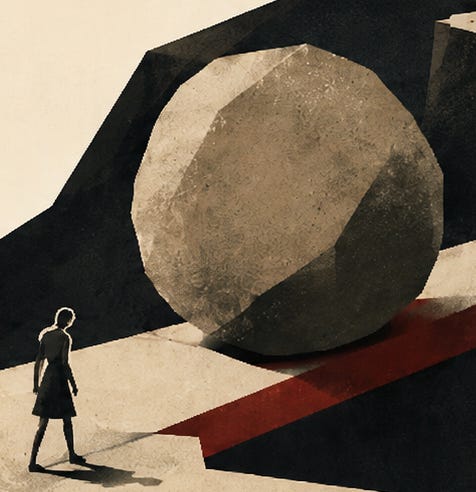
Instead, look at the person up there rolling that boulder. Watch the walk back down: the eyes already tracing tomorrow’s line up the rock face, the mind that beat death twice assembling one more hypothesis. Sisyphus is not happy, and he is not absurd. He is driven by the idea he can escape, for there is no other reason to keep going.
One must imagine Sisyphus hopeful. Not because hope saves him. Because hope is what condemns him. He is stuck believing an inescapable situation is escapable, and that is the cruelest punishment of all.
And yet… the most dangerous hypothesis available isn’t actually dangerous to Sisyphus. It is dangerous to Zeus: maybe the gods made a mistake. Maybe there is a flaw in the punishment, and the cleverest person in Greece is exactly the person to find it.
After all, Sisyphus beat death twice. Every scheme he ever ran worked, right up until it didn’t.
“Maybe there is a flaw in the punishment.”
“I got this.”
“I can do it.”
No posts
Comments
Nothing yet. Say the first thing.
Sign in to join the conversation.