
The word stochastic has had a moment. Two of them, actually, and I am living inside the overlap.
The first arrived courtesy of Emily M. Bender, who coined “stochastic parrot” to describe AI systems that statistically mimic text without really understanding it. The moment someone uses that phrase in an argument, you already know where the conversation is going to go.
The second is “stochastic terrorism.” That one is less famous, so let me just paste the definition: a mass-mediated process in which hostile public rhetoric, repeated and amplified across communication platforms, elevates the statistical risk of ideologically motivated violence by unknown individuals, even without direct coordination or explicit orders.
And that is where I am bummed out to be existing. Inside the overlap of both. But first, a story.
I grew up in Southern Utah as a white cis-presenting boy who was, in the local parlance, a nonmember. (That is the pejorative term for people like me who were not part of the LDS church.) The intersection was peculiar. At the top of every macro-privilege category (white, male, cis-presenting, straight-presenting, tall, educated) and at the bottom of a micro-privilege category nobody outside that culture even knows exists. Societal exclusion from religion-based abuse for being non-LDS. Parents who drank in a teetotaler culture. A dad who was an uncouth redneck in a population that prized the appearance of clean-cut piety above almost anything else.
In a white religious monoculture, the macro-privileges did not really matter. They could not save you. I grew up believing myself to be part of a reviled underclass, and the message that I was subhuman based on religious ideology was ingrained into me by teachers, by parents of my friends, by extended family, by the community at large. Everybody was happy to pile on. I was not just human refuse here on Earth. I was spiritually refuse too.
I did not believe it. But the cultural milieu of “this is who and what you are” is often more powerful than the internal sense of self. Nobody had to say outright that I was physically and spiritually unclean. The rhetoric about people like me permeated the hyper-local society of those godforsaken Utah deserts. I was as much a part of that culture as the majority was. I was just the wrong part. But I was still a part of it.
And every regressive culture needs a target population.
Fast forward. In 2023, I relinquished the cis-man-presenting identity and the de facto privilege that comes with it, and I started presenting to the world as who I know myself to be: a transgender woman.
The privilege pyramid flipped. With one announcement, I went from the creme de la creme of privilege (white cis straight man) to near the bottom (white queer transgender woman). And then, starting in the 2024 election season, the trans part of that identity stopped being a privilege inversion and became a lightning-rod target for right-wing stochastic terrorism.
So now there is a strange new intersection where I do not feel affinity to any group. Marginalized, targeted, and minority communities are who I look to for relatability. But most people don’t grow up at the top of the privilege stack and then consciously decide to hurl themselves to the bottom. And at the end of the day, if I want to put on a black hoodie and a baseball hat and baggy jeans, all the old privilege comes rushing back. I can walk into any cowboy bar I want, put Trace Adkins on the jukebox, and no one suspects a thing.
But, there is another catch nobody talks about, or at least not in a positive register. I still carry the internal sense of privilege from the cultural milieu I absorbed. Which makes me even more of a sore thumb. An outspoken, sardonic, queer woman with the internalized voice of a straight white man. “Yikes, a woman raised to think she can speak like a man? But wait, she’s a trans woman, so I guess she gets a pass because, well, that’s not a real biological female woman. At least that’s what the Hogwarts Sorting Hat told me to say.”
And I sense that people don’t take me seriously, because in their minds they are also aware of the privilege of the past. I was only good at my career, at technology, in my profession, because I built that career in the identity of a cis man. I did not learn my skills and navigate the tech industry as a woman. I grew up, even in the micro-culture I describe above, being told by the macro-culture as a boy that technology, career, dominance, voice were all okay and encouraged. You own the room.
And they are right. I did not. Which is another wicked intersectionality, because according my own knowledge about myself and a large part of transgender discourse, a trans person is trans even before they know it, so ostensibly I would have been a pre-transition trans girl growing up presenting as a boy and being told that male privilege was my own personal MANifest destiny, if I can keep it. But I didn’t keep it. I chose to transgress my own social contract and perceived identity.
So now, the people I make uncomfortable can cope and say “well, you did choose this.” And they, again, are right, I chose to publicly transition. However; I did not choose to be transgender, and that is a very different thing. And there is not enough text in the world to explain the difference between those two things to you if you don’t understand why that is a difference with distinction.
So. Here at the end, we arrive at the point.
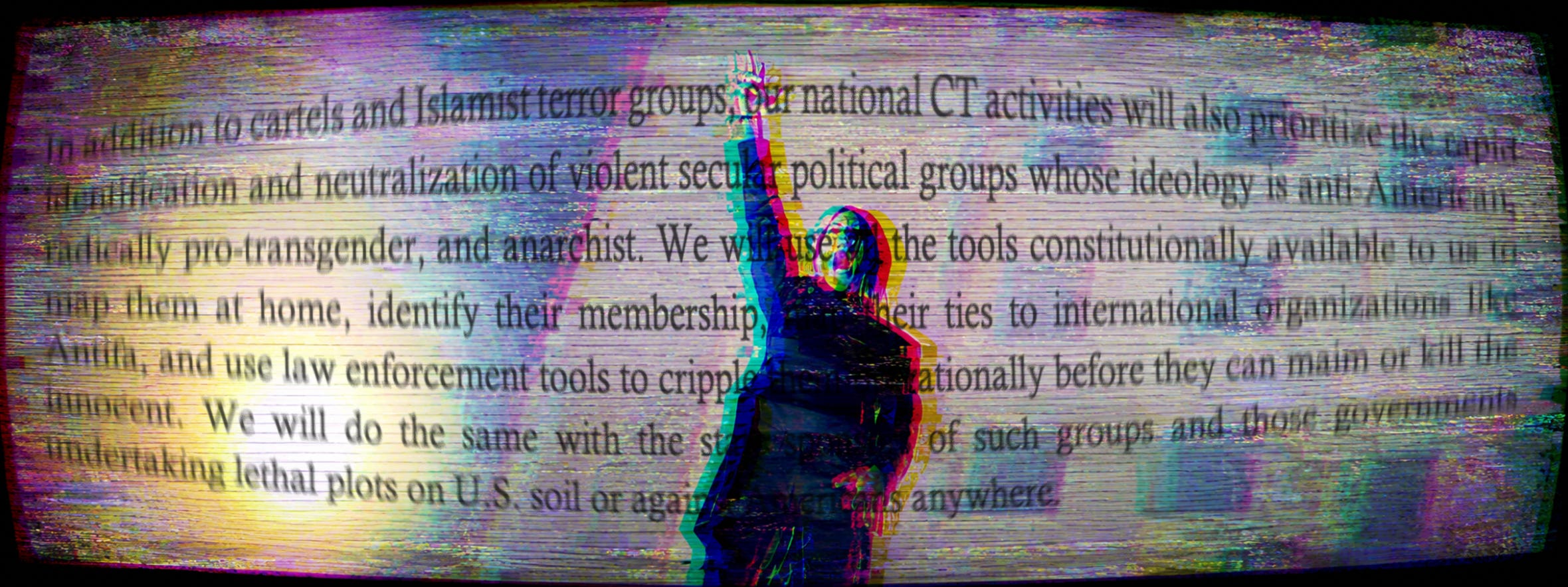
When the White House releases a new counter-terrorism strategy that lines up the ambiguously defined “pro-transgender” groups as domestic terrorists on the level of South American drug cartels and Islamic extremists (the implied racism in those terms aside), it is not the actual strategy that worries me most. It is the stochastic terrorism of the average person reading it, seeing it on the news, having it forwarded to them on Facebook, and going hmm.
A stochastic parrot is a system that statistically mimics text without really understanding it. I hope you understand now that it is not the execution of policy that concerns people like me. It is how all of this shifts the cultural milieu. Like a squid shooting ink into the water. Me, them, you. We are all stained by it.
You feel the stain every time a sentence in your head starts with yeah, but what about, or I am not transphobic, I just think. You feel it when you internally adjudicate your private thoughts on whether you respect someone’s identity or actually believe it.
And it does not even matter. The energy behind the actions does not require you to take any action, or change any belief. Neutrality is complicity. All it has to be is subtle and abstract enough that you simply do not know what to do, or whether you care.
Milton Mayer had the line for this moment: You are compromised beyond repair.
Suddenly it all comes down, all at once. You see what you are, what you have done, or, more accurately, what you haven’t done (for that was all that was required of most of us: that we do nothing). You remember those early meetings of your department in the university when, if one had stood, others would have stood, perhaps, but no one stood. A small matter, a matter of hiring this man or that, and you hired this one rather than that. You remember everything now, and your heart breaks. Too late. You are compromised beyond repair.
Comments
Nothing yet. Say the first thing.
Sign in to join the conversation.