
THE EFFECTIVE PROBLEMSOLVER #115
I’ve just moved my course to Gumroad — now priced at $119.
For the next 24 hours, you can get 20% off with code EFFECTIVE20.
Happy Spring Break!
I’m going to say something unusual for a newsletter:
This is not an article you passively read.
It’s an activity.
And here’s why.
The truth is that most of us read emails, articles, and think pieces the same way. We passively consume them, maybe consider them for a moment, maybe ignore them, and then move on with our day.
Another meeting.
A few emails.
Commuting.
Pushing the rock up the hill.
Meanwhile, the actual work of understanding the problem we care about… rarely happens.
I’ll bet you $100 that most of you (including me) haven’t mapped a problem in the last 30 days.
Maybe ever.
So today there’s no narrative.
No hot take.
No clever feedback loop to entertain you while you procrastinate.
All you need is a piece of paper and a pencil.
In the middle of your paper, write the name of the issue or problem you care about most — or the one you’re actively working on.
It could be:
Elementary school literacy
The unemployment rate in your community
Rising office vacancies downtown
Something else entirely
It doesn’t matter what the problem is.
What matters is that:
You’re committed to working on it.
It’s specific.
Now actually write it down before moving on.
Seriously.
Grab the paper and pencil.
Don’t read without writing.
Now write the top five causal factors affecting this issue.
Important rule:
Don’t write correlations.
Only write things that can go up or down.
At this point, you should have:
One bubble in the middle (your problem)
Five bubbles around it (causal factors)
Now rank those five causal factors based on how much influence you have — or could have — over each one.
1 = most influenceable
5 = least influenceable
Let me give an example using elementary school literacy.
Possible causal factors might include:
Quality of early reading instruction
Chronic absenteeism
Access to books at home
Teacher training in literacy methods
Student mobility between schools
Now imagine ranking those based on what you could actually influence.
Not what matters most in theory.
What you can actually affect.
That’s the key distinction.
By now, you should have:
A problem in the center
Five causal factors around it
Ranked 1–5 by influenceability
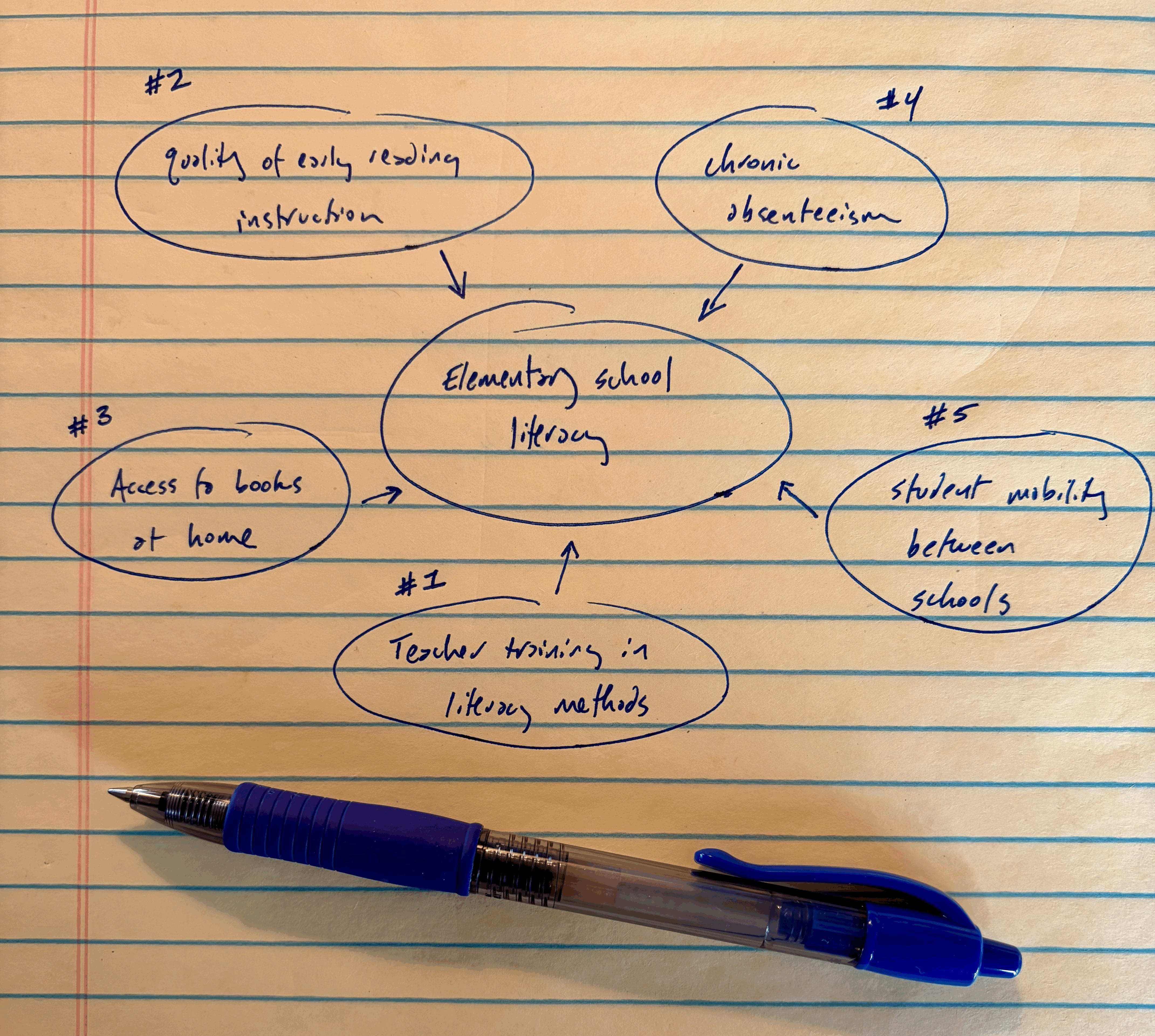
If you haven’t done this yet, just stop reading and do it.
This newsletter is for effective problem solvers, and effective problem solvers know:
The top causal factors of their problem
Which of them is most influenceable
Right off the top of their heads.
(Encouraging note: most people don’t. That’s why this is useful.)
Now that you’ve done the map, here’s the rest of the exercise.
Over the next week, casually ask a few colleagues:
Which factor causing the problem we’re working on do you think is most influenceable?
You’ll discover two interesting things.
First, many people don’t actually have the causal factors top of mind — and therefore haven’t ranked them.
Second, even when they do, they might rank a different factor as most influenceable.
That’s the interesting part.
Don’t try to change their answer.
Don’t argue that yours is better.
Just seek to understand.
This week is a success if you:
Map the problem.
Rank the causal factors by influence.
Ask at least one colleague what they think is most influenceable.
That’s it.
It’s not everything.
But it’s a start — and honestly, it’s much more than pretending you’re trying to solve a problem when you don’t actually know the first thing about it.
I’m kind of joking.
But I’m also kind of not.
Do the work.
Be critical about where you can be most effective.
Share that with others.
Then be ruthless about making sure you are tackling that cause.
See you in two weeks.
-Bryan
No posts
Comments
Nothing yet. Say the first thing.
Sign in to join the conversation.