
TL;DR
Newton’s laws had all the ingredients:
Feynman’s ‘guess and check’
Bad data held it back
Explained more with less
Successful out-of-sample predictions
Anomalies refined without epicycles
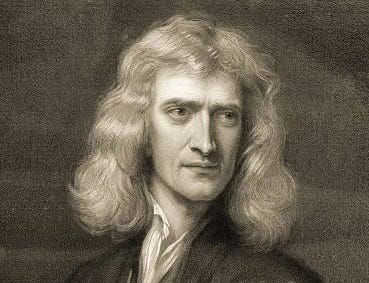
Newton received his Bachelor of Arts degree from Trinity College, Cambridge, in April 1665, and shortly after returned to his family farm to avoid the London plague. He returned to Cambridge in 1667 after the plague subsided and was elected a Fellow of Trinity College that same year. While at his farm, he made several groundbreaking advances in calculus, optics, and gravitation.
Whether he actually saw an apple fall from a tree, and then thought about the moon falling likewise, the main point is that he did contemplate the known effect of Earth’s gravity on apples and billiard balls, and whether this extended to the Moon. Consider a body moving in a circle of radius r, with speed v. In a very small time interval Δt, the body moves along a straight line a distance vΔt. To stay on the circle, it must be pulled in toward the center, approximated by
\(\Delta s \approx \frac{(v \Delta t)^2}{2r}\)
Divide that inward displacement by
\(\tfrac{1}{2} (\Delta t)^2\)
Gives you the Moon’s acceleration as a function of its velocity and distance from the Earth.
\(a = \lim_{\Delta t \to 0} \frac{\Delta s}{\tfrac{1}{2} (\Delta t)^2} = \frac{v^2}{r}\)
Five years later, Christiaan Huygens published the same formula applied to pendulum swings, which Newton acknowledged in his masterpiece. Newton used this to test the idea that Earth’s gravitational force applies to the Moon. First, he substituted the Moon’s acceleration into Newton's second law (then unpublished), F = change in momentum. This is what we now write as F = ma, though Newton always framed it in terms of momentum.
\(F = m \frac{\left( \frac{2\pi r}{T} \right)^2}{r} = m \frac{4\pi^2 r^2}{T^2 r} = m \frac{4\pi^2 r}{T^2}\)
Isolating T2
\(T^2 = \frac{4 m\pi^2 r}{F}\)
Newton could then substitute this expression into Kepler’s third law, which states that the square of the orbital period is proportional to the cube of the radius:
\(T^2 = \frac{4 m\pi^2 r}{F} \propto r^3\)
Rearranging, he deduced that the Earth’s gravitational force is inversely proportional to the square of the distance.
\(F \propto \frac{1}{r^2}\)
If so, the hypothesis that the Earth’s gravitational force applies to the moon generates a falsifiable prediction. The acceleration of the moon should be independent of the mass of the moon, just as it is independent of the mass of objects on Earth. Given the Moon is 60 Earth radii away, his theory implied it should be weaker by (1/60)^2.
The force of gravity on Earth was estimated as
Earth acceleration = g = 32 ft/s2
So the force of the Earth’s gravity on the moon should be
Moon acceleration = g/60^2 = 32/3600 = 0.0088 ft/s2
Newton knew the moon’s acceleration using its orbital speed, 27.3 days, and used the common estimate for the radius of the Earth in his day, 3500 miles.
Given orbital velocity
\(v = \frac{2\pi r}{T}\)
and the Moon’s acceleration
\(a = \frac{v^{2}}{r}\)
we get
\(a = \frac{\left( \frac{2\pi r}{T} \right)^{2}}{r} = \frac{4\pi^{2} r^{2}}{T^{2} \cdot r} = \frac{4\pi^{2} r}{T^{2}}\)
The Moon’s orbit period of 27.3 days translates to 2.359e6 seconds, and Newton’s estimate of the Earth’s radius, 3500 miles, translates to 1.109e9 feet. Newton calculated the empirical estimate of the Moon’s acceleration as
Moon acceleration = 0.0079 ft/s2
This is off by 10% from his theoretical extrapolation, so he filed this away and worked on optics and math.
Over a decade later, Robert Hooke corresponded with Newton, urging him to reconsider planetary motion under inverse-square attractions using Picard’s new 1671 estimate of the Earth’s radius (1% from the current value). Newton recalculated and found the Moon’s orbital acceleration now matched the inverse-square prediction.
The new Earth radius of 3960 miles implies r = 1.255e9 feet. Applied as above, we now get
Moon acceleration = 0.0089 ft/s2
The error is now only 1% from his theoretical estimate back in 1667. At this point, 1679, Newton knew he was on the right track, but still didn’t rush into print.
In the Principia Mathematica, Newton presents his inverse-square law as a deduction from his laws of motion + Kepler’s empirical laws. In Newton’s actual discovery process, he guessed the inverse-square relation first (based on planetary periods and geometric reasoning), then later built the three laws of motion as the axiomatic framework in which the guess could be deduced and generalized.
Consider two rocks of masses m1 and m2, with accelerations a1 and a2. Acceleration of objects on Earth has the same constant regardless of mass, so a1=a2=a. This implies
\(F_1 = m_1 \cdot a , F_2 = m_2 \cdot a\)
Rearranging, we get.
\(a = \frac{F_1}{m_1} = \frac{F_2}{m_2}\)
The force must be proportional to the rock’s mass, in that m1 and m2 cancel out. If the force of Earth's gravity on rocks is inversely proportional to their identical distance from the center of the Earth, r2, and proportional to their mass, then for some constant K, these two rocks have a force:
\(F_i = K \cdot \frac{m_i}{r^2}\)
Newton’s intuition was that the force between two bodies is equal and opposite (his third law). Given the force is proportional to the mass of one of the objects, like rocks on Earth, the obvious candidate is:
\(F_i = G \cdot \frac {m_i \cdot m_{earth}}{r^2}\)
With this force, the mass of different objects would cancel out, and objects would all fall at the same rate of acceleration on Earth.
Kepler’s third law was needed to discover the inverse-square law. Once Newton discovered the inverse-square law as a universal law of gravitation, he could use two laws:
Law of inertia
Universal gravitation, inverse-square
To derive Kepler’s three laws. This is classic compression, explaining more with less, but he didn’t stop there.
In 1684, Edmond Halley visited Newton in Cambridge, asking what orbit a planet would follow under an inverse-square law. Newton immediately replied, “an ellipse,” and promised to send proof. He published a short paper, De motu corporum in gyrum (“On the motion of bodies in orbit”), containing nine pages of propositions and corollaries, and circulated privately in late 1684. Halley convinced Newton to expand this more fully, leading to Principia Mathematica in 1687, which proposed his three laws of motion as general and axiomatic as Euclid’s postulates — applying to all mechanics, not just celestial phenomena.
Law of inertia — A body continues in its state of rest or uniform straight-line motion unless acted upon by a force.
Fundamental law of dynamics — The change of momentum is proportional to the impressed force and in the direction of that force.
Action–reaction — To every action there is always opposed an equal reaction.
With these three laws, he could then derive the two laws needed to explain Kepler’s three laws and much else. This is because the gravitational law is a special case consistent with the action–reaction law. This is the top-down/bottom-up scientific discovery method mentioned by Richard Feynman, who wrote:
“In general we look for a new law by the following process. First we guess it. Then we compute the consequences of the guess to see what would be implied if this law that we guessed is right. Then we compare the result of the computation to nature, with experiment or experience, compare it directly with observation, to see if it works. If it disagrees with experiment it is wrong. In that simple statement is the key to science.” ~ Richard Feynman
Newton fit his model to the Moon’s orbit and the Earth’s gravitational force. Yet it extended beautifully to several other empirical predictions.
Before Newton, tides were attributed to mythical causes, winds, or planetary vortices (e.g., Descartes). Kepler correctly linked tides to the Moon's gravity, but Galileo mocked this idea, attributing tides to Earth's motion. Newton established the fundamental cause of tides: the gravitational attraction of the Moon and Sun. Pierre-Simon Laplace realized that tides are not a static bulge chasing the Moon, but a dynamic wave phenomenon. He treated the ocean as a complex fluid forced into motion by gravitational forces. Future work built on improved data and processing to capture the complex interplay of forces, but it began with Newton.
French Cartesians, followers of Descartes, argued the Earth was a prolate spheroid (elongated at the poles, like a lemon). Newton’s laws implied the Earth should be an oblate spheroid, flattened at the poles due to rotation. Newton estimated Earth’s polar diameter should be shorter than its equatorial diameter by about 1 part in 230 (today estimated around 1/298). French expeditions in the 1730s by Pierre de Maupertuis to Lapland (near the pole), and another group to Peru (near the equator), confirmed Newton’s prediction of an oblate spheroid.
Comets were mysterious, often treated as one-off phenomena or omens. Even Kepler thought comets traveled in straight lines, not closed orbits. There was no reason to believe a comet seen in 1531 had any connection to one seen in 1607. Using Newton’s gravitational theory, Halley computed the orbital elements of comets seen in 1531, 1607, and 1682, and in 1705 predicted it would return around 1758, which it did. The successful prediction was hailed as a triumph for Newtonian mechanics, confirming both Halley’s insight and Newton’s gravitational theory.
Maupertuis not only did field work, but he also came up with one of the most profound ideas in physics, the principle of least action. In any physical process, the quantity called ‘action’ (e.g., energy × time, or momentum × distance) is minimized. The path a physical system takes is the one for which this action is the smallest possible. Maupertuis was inspired by Fermat’s observation that light travels between two points along the path that takes the least time, but he was not a rigorous mathematician. Euler provided the rigorous mathematics, showing that the least-action principles can reproduce Newton’s geometrical proofs. Euler showed that for a single particle moving in a plane under conservative forces, the path that minimizes the integral of m·v·ds is the same path determined by Newton's laws. Lagrange generalized the principle and put it on a solid mathematical footing by developing the calculus of variations, which is the necessary mathematical tool to find the path that minimizes an integral like ‘action.’ Lagrange’s work directly led to Hamiltonian equations used in quantum mechanics.
In Newton’s day, Jupiter appeared to be gradually accelerating, and Saturn appeared to be gradually decelerating. He understood that when Jupiter and Saturn are in conjunction (aligned on the same side of the Sun), their mutual gravitational attraction would significantly perturb each other's orbits. This was an immense challenge because it was the first serious attempt to solve the Three-Body Problem (Sun, Jupiter, Saturn). Using his geometrical methods, Newton made an estimate of the effect, but could only explain half of the empirical anomaly, and suggested that God might have to nudge the planets occasionally to keep orbits stable.
Around 1785, Laplace, using more advanced mathematical techniques (analysis), showed the solar system needed no nudges. He showed that gravitational kicks from Saturn consistently add energy to Jupiter's orbit, causing it to speed up and move slightly inward. These same interactions rob energy from Saturn, causing it to slow down and move slightly outward. The orbits don't spiral away; they wobble around a stable average. This creates a closed, predictable cycle that repeats every ~900 years.
Modern theories are often not testable, become more complicated over time as more anomalies are generated, or generate math for math’s sake. It would be great to see another theory like this in my lifetime, but perhaps the low-hanging fruit is gone.
No posts
Comments
Nothing yet. Say the first thing.
Sign in to join the conversation.