
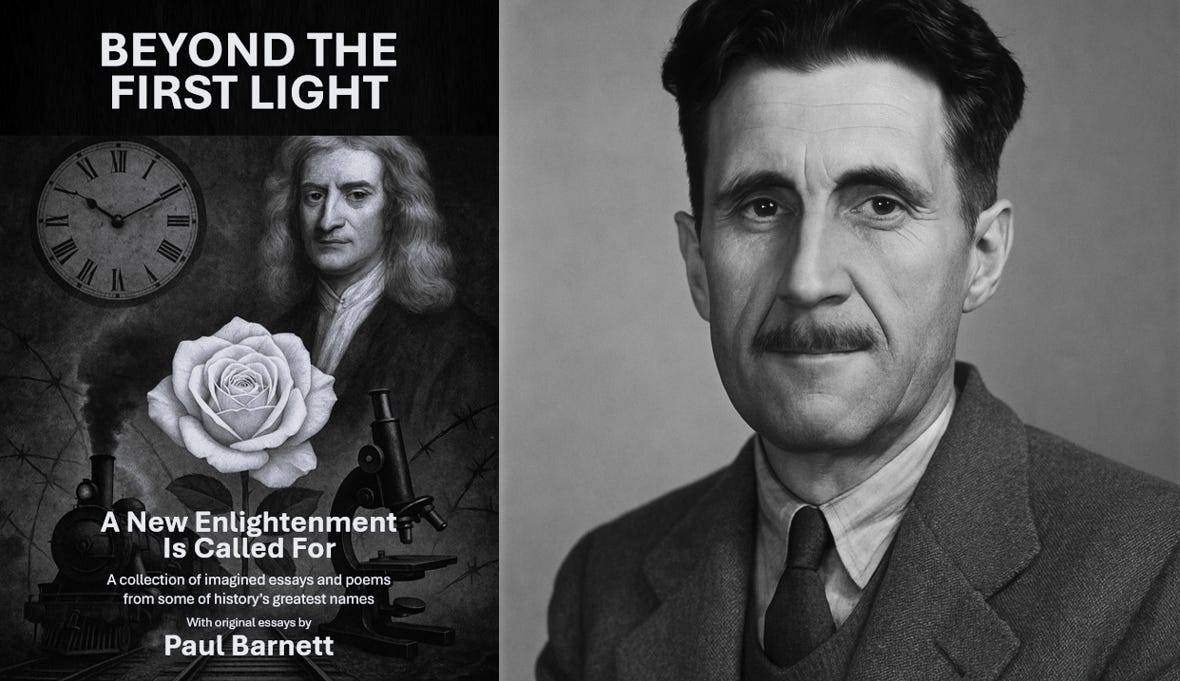
Beyond The First Light: A New Enlightenment Is Called For”, features twenty-one names, ranging from George Orwell, Virginia Woolf, and Albert Camus to Rachel Carson, W.B. Yeats, and Albert Einstein. Each is represented by two newly created works: an imagined essay and an imagined poem. Both are meticulously crafted by AI to capture the voice, style, and intellectual sensibility of the individual, based on deep readings of their published work, Not as a pastiche or parodym but as an experiment in cultural and intellectual time travel. What makes the book truly unique is its double lens. First, it invites each figure to critique the First Enlightenment, not to dismiss it entirely, for none do, but to identify its blind spots, distortions, and unintended consequences.
Part one of the book,, “The Failure of Reason” explains how “the Enlightenment gave us the gift of reason, but what happens when reason alone is no longer enough? In this section, thinkers like Orwell, Camus, Arendt, Dickens, and Einstein illuminate how reason, while powerful, can be manipulated, narrowed, or dehumanized. They show how logic divorced from ethics, and science severed from conscience, can lead not to liberation but to alienation, oppression, and mechanistic thinking. These voices help us reframe reason not as a destination, but as a tool that must be guided by something deeper.
The first contribution is an essay from George Orwell (see below). But, before that let me share with you The Introduction to the book, titled “In the Company of Giants: Toward a New Enlightenment” and my “Author’s Note on the Use of AI” in case you might like to read those first.
Text within this block will maintain its original spacing when published
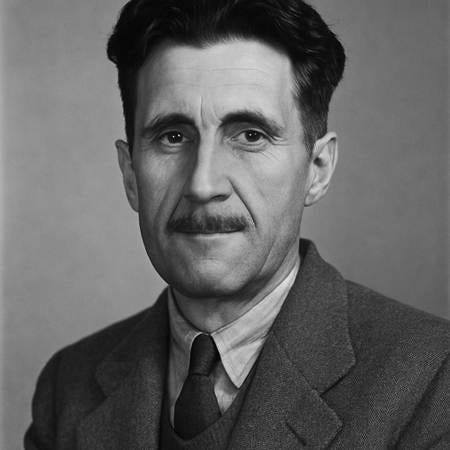
George Orwell (1903–1950)
Text within this block will maintain its original spacing when published
George Orwell, born Eric Arthur Blair in 1903 in British India, remains one of the 20th century’s clearest and most uncompromising moral voices. A man of radical sympathies and conservative instincts, Orwell rejected all forms of political dogma and insisted instead on the primacy of truth, conscience, and intellectual honesty.
Text within this block will maintain its original spacing when published
Educated at Eton but shaped by experience in Burma, on the streets of Paris and London, and on the frontlines of the Spanish Civil War, Orwell came to see that the real battle of the modern age was not only between left and right, but between those who sought to manipulate reality and those who dared to describe it plainly.
Text within this block will maintain its original spacing when published
His essays, journalism, and novels exposed the moral hypocrisies of empire, capitalism, and Stalinism alike, always returning to the question of how language is used to conceal or reveal power. In The Road to Wigan Pier, he chronicled the plight of Britain’s working class with painful honesty. In Animal Farm and Nineteen Eighty-Four, he created allegories that remain vital warnings against totalitarian control, ideological conformity, and the erosion of objective truth. Orwell’s writing combined political urgency with literary precision, earning him enduring respect across generations and ideologies.
Text within this block will maintain its original spacing when published
Though Orwell died young, at 46, his legacy has grown steadily. His commitment to “speaking the truth even when it is unpopular” resonates more than ever in an age of surveillance, disinformation, and rhetorical manipulation.
Text within this block will maintain its original spacing when published
In calling for a New Enlightenment, Orwell reminds us that freedom is never merely given, it must be thought through, spoken clearly, and defended daily.
Text within this block will maintain its original spacing when published
Tribune
Text within this block will maintain its original spacing when published
Founded in 1937 as a democratic socialist weekly, became one of Britain’s most principled and independent left-wing publications, known for its anti-fascist stance, moral clarity, and rejection of both capitalist injustice and totalitarian ideology.
Text within this block will maintain its original spacing when published
During the 1940s, it was the natural home for George Orwell, who served as literary editor and contributed his famous “As I Please” column, combining plainspoken critique with deep ethical concern.
Text within this block will maintain its original spacing when published
With its commitment to free expression, social justice, and intellectual honesty, Tribune would have been the ideal venue for Orwell’s imagined call for a New Enlightenment, one rooted not in abstract reason or utopian theory, but in democratic vigilance, linguistic integrity, and the defence of human dignity against all forms of power.
Text within this block will maintain its original spacing when published
LIBERTY AND THE LIMITS OF REASON
Text within this block will maintain its original spacing when published
By George Orwell
Text within this block will maintain its original spacing when published
An Imagined Essay For Tribune Magazine
Text within this block will maintain its original spacing when published
It has become fashionable, in some quarters, to speak of the Enlightenment as though it were a completed achievement: a period of intellectual triumph from which we are still reaping the rewards. In truth, we are just beginning to discover what it failed to understand. The idea that reason alone could liberate humanity has proved not only naïve, but dangerous. Men armed with “rational” systems have built not only railways and libraries, but gulags and gas chambers.
Text within this block will maintain its original spacing when published
The assumption that human beings, once freed from superstition, would act justly and democratically has been thoroughly refuted by the 20th century. If we are to speak of a New Enlightenment, we must begin not by repeating the slogans of Voltaire and Jefferson, but by understanding what they could not have known: that power is always at work behind language, that truth is easily manipulated, and that liberty is not sustained by reason alone, but by humility, conscience, and the willingness to see clearly.
Comments
Nothing yet. Say the first thing.
Sign in to join the conversation.