
A few years ago, while working with tribal energy leaders in the Southwest, I encountered a question that went well beyond the familiar concerns about electricity prices and access.
Wildfire exposure and grid vulnerability had forced community leaders to decide what would have to keep operating if electric service failed for several days.
Water pumping. Refrigeration for medications. Emergency communications. Cooling centers during dangerous heat. Community buildings that could function as resilience hubs.
The issue was continuity.
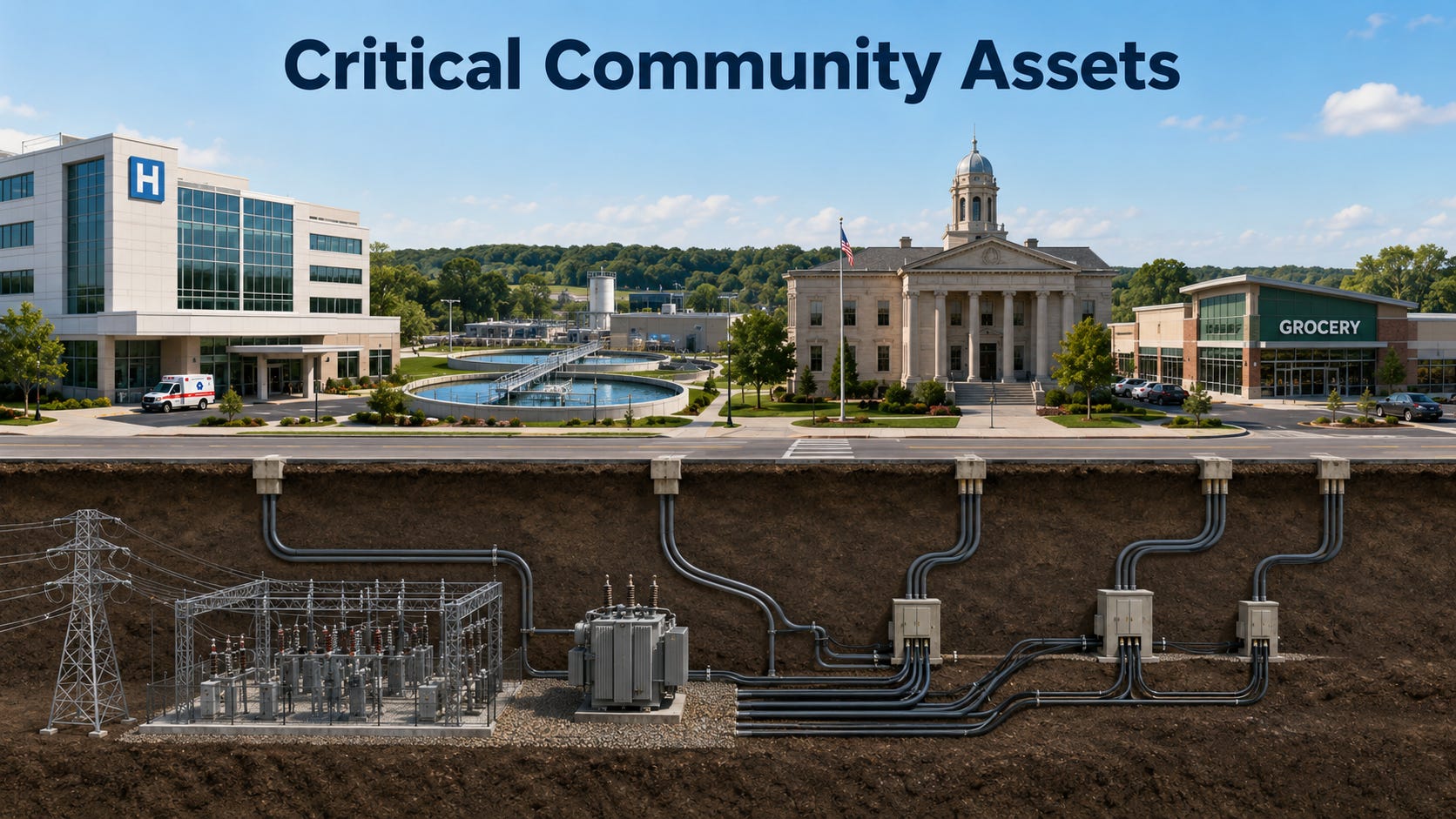
That same question confronts communities and institutions across the country. Electricity supports hospitals, water systems, communications, emergency services, transportation, financial networks, logistics, cloud computing, and much of the digital economy.
The Cybersecurity and Infrastructure Security Agency has documented how critical infrastructure systems depend on one another and how a failure in one can increase risk across an entire community.
The grid has become continuity infrastructure, the foundation that allows the essential functions of modern society to continue.
Reliability, resilience, and continuity are related, but they are not the same.
Grid professionals generally distinguish reliability from resilience. Reliability concerns whether the system can meet demand and remain secure. Resilience concerns how it withstands and recovers from disruption. Tribal and community concern is whether the hospital, water system, communications network, and other essential services will continue to function while the grid is impaired.
That distinction matters. A regional grid can meet prevailing reliability standards while a hospital, water system, communications network, or isolated community remains poorly prepared for a multiday outage. A utility can quickly restore service to most of its customers, while a small number of essential facilities remain without service.
The public question is therefore broader than whether the grid is performing as designed. It is which functions must continue, how long they must operate independently, and who is responsible for making that possible.
The capacity market operated by PJM Interconnection shows how quickly the pressure is building.
PJM coordinates the regional grid and wholesale electricity market serving more than 67 million people across thirteen states and the District of Columbia. In July, its latest capacity auction procured 138,318 megawatts at the federally approved price cap of $325 per megawatt-day.
Even at that price, PJM remained 6,831 megawatts short of its reliability requirement. It was the second consecutive auction in which the entire region failed to obtain the capacity associated with its one-event-in-ten-years reliability standard.
PJM cautioned that the shortfall does not mean customers will necessarily lose power. It does mean the region has a smaller reserve cushion and greater risk.
Rapid data-center growth is a major part of the imbalance. The North American Electric Reliability Corporation reports that new data centers supporting artificial intelligence and the digital economy account for most of the projected growth in North American electricity demand over the next decade.
PJM’s independent market monitor estimated that data-center load produced $6.3 billion, or 38.2 percent, of capacity charges in the latest auction. Across the past four auctions, it attributed $29.4 billion, or 46.2 percent of capacity charges, to data-center demand.
Data centers did not create every problem facing PJM. The broader condition is that demand is growing faster than dependable new supply can enter service. But the figures expose an unresolved public choice: how much of the infrastructure required by rapidly expanding private loads should be paid for by those customers, and how much should be spread across everyone else?
No single institution controls the whole continuity problem.
Federal regulators oversee interstate transmission, wholesale markets, and bulk-system reliability. Regional grid organizations coordinate markets and high-voltage planning. State commissions govern retail rates, utility investment, and local distribution. Utilities operate the system. Hospitals, water authorities, emergency managers, local governments, tribes, and communications providers are responsible for many of the services that must continue when electricity fails.
Each controls part of the answer.
PJM can manage regional capacity, but it cannot decide how long a community water system should operate without grid power. A state utility commission can approve infrastructure investment, but it cannot govern every hospital, fuel supplier, or communications network that depends on electricity. A hospital can maintain backup equipment, but it cannot independently correct weaknesses in regional generation, transmission, or local distribution.
Authority is divided among many institutions, but responsibility for the overall continuity of essential services is not clearly assigned.
A serious continuity framework begins with three decisions.
Communities need to identify the services they cannot afford to lose. Regions need to examine how a power failure would spread through water, communications, fuel, healthcare, and emergency response. Regulators then need to decide who should pay, based on who creates the need and who benefits from the protection.
First, communities and states must define which services must continue during extended outages and for how long. Those requirements will differ by location, hazard, climate, and population, but they should be established before failure exposes the absence of a plan.
Second, regions must test how electric outages would cascade through water, communications, transportation, fuel distribution, healthcare, and emergency response.
CISA’s infrastructure-dependency work makes clear that these systems cannot be planned for separately.
Third, costs must be allocated according to who creates the need and who receives the benefit. Large new electricity users should pay for infrastructure reasonably attributable to them. Ratepayers should support investments that improve general utility reliability. Public funding should support protections whose benefits extend to hospitals, water systems, emergency communications, vulnerable communities, and the wider economy.
None of these choices eliminates the tradeoff between resilience and affordability. They would make the tradeoff visible before a crisis forces decisions under emergency conditions.
The stability test for the electric system is straightforward:
When ordinary power service is disrupted, can society’s essential functions continue?
If the answer is uncertain, the work of grid reliability is incomplete.
These questions will be at the center of the next Security and Sustainability Forum webinar:
September 1, 2026
2:15 to 3:45 p.m. ET Free Webinar
The 90-minute discussion will examine where the financial and physical systems running the grid are falling out of alignment, what that means for households and businesses, and which practical responses are available.
The webinar is cohosted with George Washington University’s Environmental and Energy Management Institute and the GW Alliance for a Sustainable Future. Register even if you cannot attend live, and you will receive the recording.
Everyone who registers will also receive the full SSF special report, The Grid Has Become Continuity Infrastructure, by Edward Saltzberg, Scott Sklar, and Matt Haupt. The report examines data-center demand, regional reliability, cost allocation, institutional responsibility, and a proposed framework for protecting essential public functions.
Comments
Nothing yet. Say the first thing.
Sign in to join the conversation.