
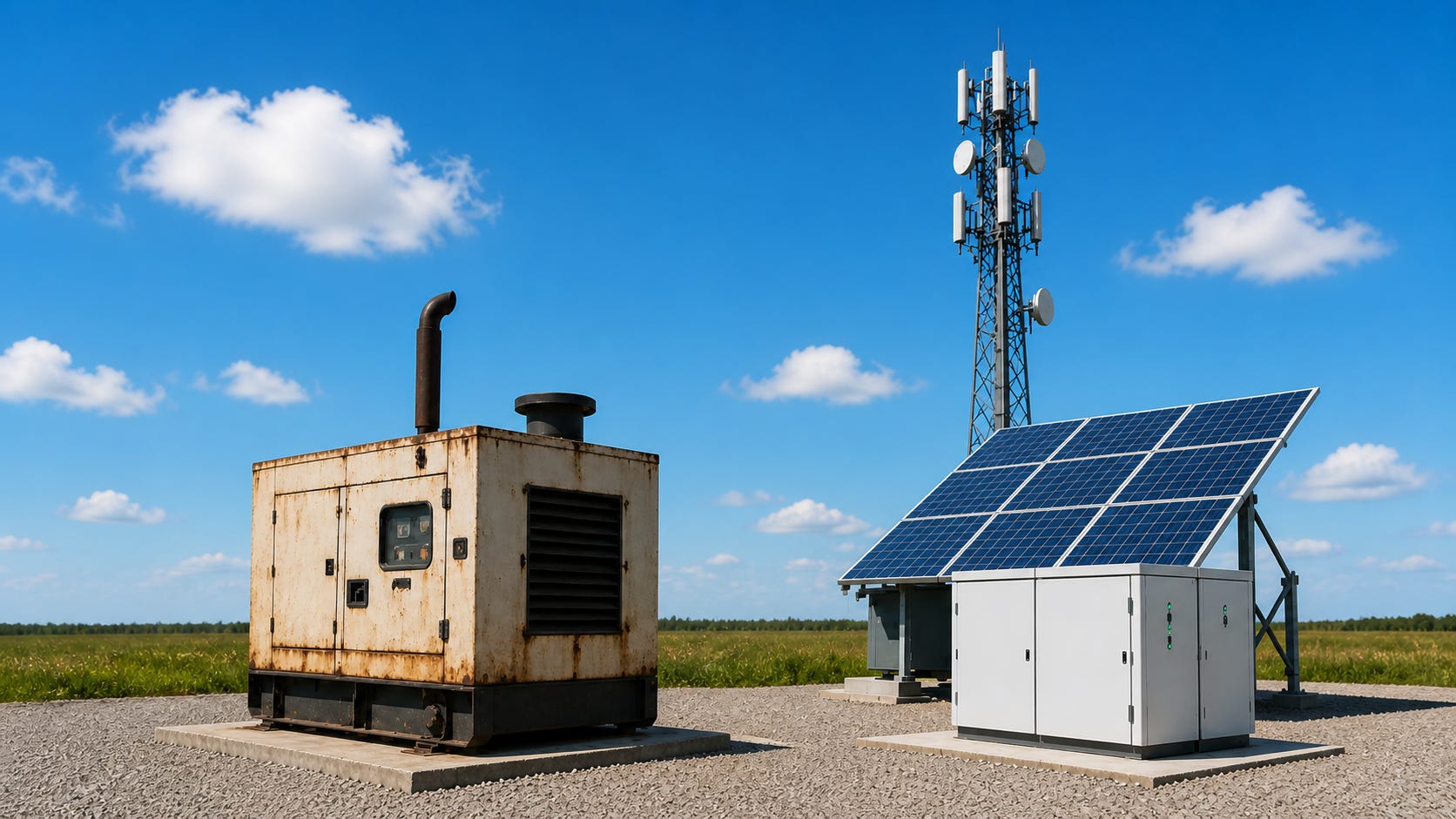
For decades, diesel generators have been the default answer to fragile power systems.
In some places, diesel is the backup. In others, including many off-grid telecom towers across Africa, it is the main source of power. Diesel is portable, familiar, dispatchable, and widely available. It is not clean or elegant. It has been treated as dependable.
But that assumption, that diesel is the dependable answer, is now breaking down.
Across Africa, telecom operators are moving cellphone towers from diesel generators to solar and battery systems. The reason is urgent: diesel is expensive, fuel supply chains are under stress, and imported fuel can be hard to secure when markets tighten, or conflict spreads. The Associated Press reports that diesel powers most of Africa’s roughly 500,000 telecom towers, and that energy can account for up to 60 percent of operating costs for off-grid towers.
That is the visible story.
The deeper signal is that the safety net is no longer safe.
Diesel generators were supposed to provide reliability. But diesel depends on a fragile delivery system. Fuel must be produced, shipped, insured, protected, paid for, and delivered again and again. When that chain breaks, the people depending on emergency calls, mobile banking, health information, school access, and basic communication are exposed.
The disruption in the Strait of Hormuz in 2026 makes the security risk harder to ignore: fuel is not just fuel. It is a chain of exposure. The risk falls hardest where power systems are weak, fuel is imported, and delivery routes are long.
This changes the energy calculation. As fuel risk rises, solar-battery systems become more attractive because they reduce exposure. In some places, they are becoming the power source people depend on to keep communications running. Diesel may remain part of the mix, but it no longer deserves unquestioned status as the safe answer.
The AP reports that major operators, including Vodacom, Safaricom, MTN, Airtel, Orange, and iSAT Africa, are expanding solar and hybrid tower systems. GSMA has also documented why African mobile operators are turning to renewables to power networks.
This is what infrastructure transition often looks like in practice. Climate goals may pull the transition forward, but risk is pushing solar-battery systems into essential services. The change begins when the old safety net no longer protects people.
Diesel is the example. The deeper warning is broader: every safety net should now face the same test. Does it rest on assumptions that still hold, or on fragile systems that may fail when society needs them most?
That is the signal: a safety net fails when the answer meant to protect the system becomes part of the risk.
Question for readers: What safety net are we still trusting, even though the assumptions beneath it may no longer hold?
Share this Signal with someone responsible for keeping essential systems running.
Comments
Nothing yet. Say the first thing.
Sign in to join the conversation.