
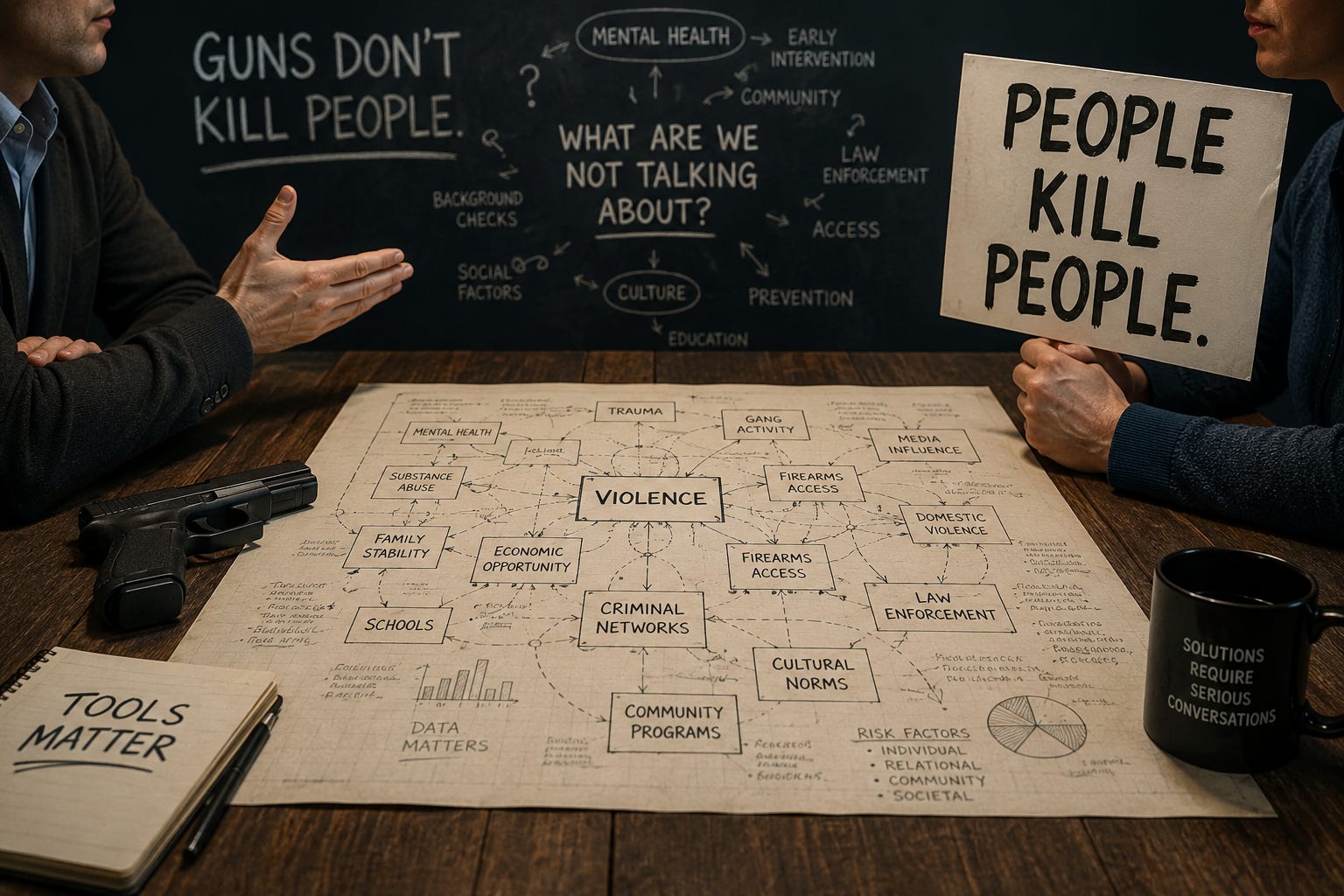
“Guns don’t kill people. People kill people.”
It is one of the most familiar lines in America’s gun debate. It is also an obstacle to serious debate.
Of course people commit murder. Guns have no agency of their own. The slogan is literally true as far as it goes. The problem is that it invites a false conclusion: because people choose to commit violence, the tool they use no longer matters. That does not follow.
Human intent and human capability are different. The person provides the intent. The tool shapes what that intent can accomplish.
A fist, a knife, a handgun, and a rifle are not morally different. They are operationally different. They differ in range, speed, accuracy, lethality, and the number of people who can be harmed before anyone can intervene.
Public policy routinely recognizes this principle. We regulate explosives differently than hammers. Commercial aircraft differently than automobiles. Prescription drugs differently than aspirin. Not because the objects possess intent, but because different tools create different risks.
Reducing the entire discussion to “people kill people” avoids the harder conversation about risk, capability, access, incentives, and prevention. It replaces analysis with a slogan.
A slogan can unite people behind a cause. It cannot substitute for understanding the problem.
Whether one favors more gun regulation, fewer restrictions, or something in between, serious debate begins by acknowledging that both human intent and the tools available matter.
That is the Signal: Reducing complex problems to simple slogans can make consensus harder precisely when public issues require it most.
Signal is The Stability Brief’s short-form series identifying system-level patterns behind current events. Some Signals are later expanded into full Stability Briefs that examine the underlying mechanisms, historical context, and implications.
Edward Saltzberg has been analyzing public policy for 50 years as a consultant to the federal government. He is currently the Executive Director of the Security and Sustainability Forum and a Visiting Scholar at George Washington University.
Comments
Nothing yet. Say the first thing.
Sign in to join the conversation.