
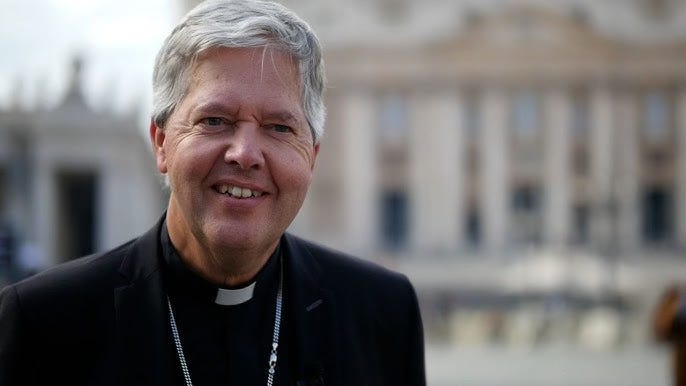
Auxiliary Bishop Rob Mutsaerts of ‘s-Hertogenbosch has become the latest prelate to criticise synodality, asking what are its fruits and voicing deep skepticism about its entire model — one, he argues, that fails to teach the Gospel authoritatively and clearly at a time when that is most needed.
In a lengthy open letter to Pope Leo XIV published on his website Aug. 13 (see full English translation below), the Dutch bishop makes many significant points, including what he views to be the “greatest tragedy” of the whole enterprise.
He writes:
“The modern world is undergoing an extraordinary spiritual crisis. People are searching for meaning. Young people are searching for an identity. Loneliness is on the rise. Families are breaking down. Technology is penetrating ever more deeply into human existence. Pornography distorts sexuality. Materialism fails to satisfy. Climate change is becoming a surrogate religion for many. People are afraid of death, yet they hardly know what they are living for anymore.
And in the midst of that world, the Church possesses something extraordinary. It possesses the Gospel. The sacraments. The Eucharist. Confession. Two thousand years of wisdom. Scripture. The Church Fathers. Thomas Aquinas. Augustine. The mystics. The saints. An unrivalled tradition of art, music, philosophy, morality and spirituality. And above all: Jesus Christ.
The world is not waiting for yet another organisation to listen to it. There are already enough of those. The world is waiting for someone to tell it why it was created.”
Bishop Mutsaerts joins a number of other prelates who have been publicly critical of the Synod on Synodality. They include Cardinals Joseph Zen Ze-Kiun, Raymond Burke, Walter Brandmüller, Robert Sarah, Juan Sandoval Íñiguez, Gerhard Müller, and the late George Pell. Outspoken episcopal critics have included Bishop Joseph Strickland, Auxiliary Bishop Athanasius Schneider and retired Auxiliary Bishop Marian Eleganti.
Here below is the full text of Bishop Mutsaerts’ letter, translated using Deepl (h/t Il Blog di Sabino Paciolla):
Holy Father,
Out of respect for the ministry entrusted to you as the successor of Saint Peter, and in solidarity with the Church which Christ built upon the apostles, I address you with this open letter. I do not do so lightly. What prompts me to speak these words publicly is a concern which, ultimately, transcends every other ecclesial consideration: the salvation of souls. Salus animarum suprema lex — the salvation of souls is the supreme law. My question is simple and serious: does the synodal process truly help to draw souls closer to Christ and to eternal salvation? For me, this is the decisive question.
Holy Father, I am fully aware that the Petrine ministry entails a responsibility of which those who do not hold that office can only have a vague idea. It is precisely for this reason that I write these words, not out of any lack of respect for the papal ministry, but out of love for that very ministry. Peter, in fact, received from Christ not only the mandate to unite his brothers, but also to strengthen them in the faith: ‘And you, once you have come to your senses, strengthen your brothers.’ After all, the world has very little use for a Church that merely repeats what the world itself already thinks. It needs a Church that, with love but without fear, points it towards Christ.
My concern regarding the Synod on Synodality should be understood in this light. Above all, I wonder what all this means for the ordinary faithful, who do not expect a permanent process from their Church, but clarity on the path to God.
This letter is therefore not an indictment of individuals. Nor do I intend to deny the good intentions of the many who have sincerely committed themselves to the synodal process. Good intentions deserve recognition. But good intentions do not exempt us from the duty to examine their fruits. Christ himself has provided us with a simple criterion for this purpose: ‘By their fruits you shall recognise them.’ For this reason, I believe that, after years of synodal consultations, meetings, reports and documents, the time has come to ask ourselves in all frankness about these fruits. Not out of cynicism, but out of love for the Church. Not out of nostalgia for an idealised past, but out of concern for her future. And not to wage a political-ecclesial struggle, but because behind all the discussions lies a reality of infinitely greater importance: the eternal salvation of the souls which Christ has entrusted to his Church. Driven by this concern, Holy Father, I submit the following reflection to you.
The Synod on Synodality
Anyone who assesses the Synod on Synodality solely in the light of its own objectives can easily draw a positive conclusion. People listened to one another. People spoke. Thousands of people were consulted. Bishops, priests, religious and laypeople came together. There was talk of communion, participation and mission. A whole new ecclesiastical vocabulary has even emerged: synodality, listening, discernment, participation, conversation in the Spirit, initiating processes.
But one can also look at the same story from a completely different perspective. Allow me to ask the uncomfortable question: What has all this actually achieved? Not: how many meetings were organised? Not: how many reports were drawn up? Not: how many people took part?
But: has faith been strengthened? Has Christ been proclaimed more clearly? Has Catholic identity been deepened? Have more people been converted? Has attendance at Sunday Mass increased? Are there more priestly vocations? Has catechesis become more effective? Has greater respect for the Eucharist arisen? Has the Church’s moral teaching become clearer? Has missionary courage increased?
When one asks such questions, it is impossible to regard the Synod as a success. To this is now added another aspect. The synodal initiative has not really come to an end. The official implementation phase is continuing and, through diocesan, national and continental meetings, is set to culminate in an ecclesial assembly in Rome in October 2028. In May 2026, the Vatican once again published a detailed roadmap to this end. This makes the criticism all the more pertinent. What once began as a synod running from 2021 to 2024 risks becoming a permanent form of governance.
A synod on a synod
The first noteworthy aspect is already in the name itself: Synod on Synodality. Traditionally, a synod was convened because the Church needed to discuss something: evangelisation, marriage and the family, the priesthood, the Eucharist, Scripture, a heresy, a pastoral crisis or a specific problem. In the Synod on Synodality, however, it is the process itself that becomes the subject. One might compare it to a meeting that drags on indefinitely to discuss how meetings should be held from now on.
The Church has had councils and synods since ancient times. The apostles gathered in Jerusalem. Bishops deliberated amongst themselves. Popes consulted the bishops. The great ecumenical councils are inconceivable without joint ecclesial consultation. But this is quite different from synodality understood as a permanent ecclesial paradigm. The classical synod was a tool. In today’s synodal discourse, synodality risks becoming an end in itself. And it is precisely here that, from a traditional Catholic perspective, the problem begins.
The Church is not a dialogue, but a reality received
The Church, in fact, does not begin with our dialogue. It begins with Christ. This seems obvious, but it has far-reaching consequences. Christ did not found a discussion group. He called the apostles. He conferred authority upon them. He sent them out to preach, baptise and teach: ‘Go therefore and make disciples of all nations’. Leadership is fundamental in this context. Faith does not arise from the Church first taking stock of what people believe and then distilling a common conviction from all those experiences. Faith is received.
Paul constantly uses words such as receive, pass on and preserve. The Church does not possess Revelation because it devised it, but because it received it. This means that Christianity, by its very nature, cannot be democratic. Not because democracy as a form of government is bad, but because truth does not arise from a majority of votes. If tomorrow 90 per cent of Catholics were no longer to believe in the real presence of Christ in the Eucharist, Christ would not be any less truly present for that reason. If 80 per cent were to reject a particular moral doctrine, that doctrine would not automatically become false. Truth is not produced by consensus. This constitutes the first major point of tension surrounding the synodal project.
Listening: to whom?
A key word throughout the entire process has been listening (as if we had never done so before). In itself, there is nothing to object to. A bishop must listen. A priest must listen. Christians must listen to one another. A shepherd who never listens to his flock is not a good shepherd. But the question immediately arises: to whom, above all, must the Church listen? The traditional answer is: to Christ, to Scripture, to the Apostolic Tradition, to the saints, to the witness of twenty centuries of Christianity, and to the Magisterium. And, of course, to the faithful as well.
In some synodal texts, however, the order seems easily to be reversed. We start with the experiences, desires, frustrations and expectations of people today, and then ask ourselves how the Church should respond to all this. This may seem pastorally appealing, but it conceals a danger. For what happens when the desires of modern man clash with the Gospel? In that case, it is not the Gospel that must change; it is man who must change. In Christianity, this is called conversion. And it is precisely this word that is surprisingly rarely heard in many modern ecclesial discussions.
The great absentee: conversion
Herein lies the deepest weakness of the entire project. The Church does not exist primarily to confirm people in what they already are. It exists to lead them to Christ. The first words of Jesus’ public preaching were not: ‘Tell me first how you feel about the current ecclesiastical structures.’ But: ‘Repent and believe in the Gospel.’ This is decidedly less bureaucratic. And decidedly more radical.
The Church of the martyrs did not change the Roman world by organising listening sessions on how Romans might perceive the Christian community in a more inclusive way. It proclaimed Christ. Peter proclaimed Christ. Paul proclaimed Christ. Francis proclaimed Christ. Dominic proclaimed Christ. Francis Xavier proclaimed Christ. John Mary Vianney proclaimed Christ. Mother Teresa proclaimed Christ. John Paul II proclaimed Christ. Undoubtedly, they listened to people. But listening was never the end goal. The end goal was conversion to Christ.
The elephant in the synod hall
There is also a curious discrepancy between the issues discussed at length in the synodal process and the actual crisis facing the Western Church in particular. The fundamental problems facing the Church in the Netherlands, Belgium, particularly in Germany, but also across much of Western Europe, are not hard to recognise. Churches are emptying. Parishes are being merged. Monasteries are disappearing. Religious orders are ageing. Knowledge of the Catholic faith is dwindling. Confession has all but disappeared for many Catholics. The number of priestly vocations remains low in many places. Many baptised Catholics barely believe in the fundamental truths of the faith. Among large groups of Catholics, sacramental life is severely weakened. In this context, one would expect a global ecclesial initiative to ask, above all, one question: how can we win the world back for Christ?
Yet much of the focus is on structures, participation, decision-making processes, the role of women, inclusivity, relationships of authority and the way in which ecclesiastical bodies function. These may be legitimate topics. But a house on fire has different priorities from administrative matters.
A sort of ecclesiastical ‘Parkinson’s Law’
Institutions that lose sight of their original purpose often tend to talk ever more intensely about their own organisation. Companies then talk endlessly about processes. Universities about governance. Public administrations about models of participation. And ecclesiastical organisations about structures. The less evangelisation there is, the more committees on evangelisation are set up. The fewer vocations there are, the more documents on vocations are drawn up. The fewer people attend church, the longer the meetings on ‘being the Church’ become. It may sound cynical, but there is a serious point behind it: bureaucracy can create the illusion of activity whilst reality shows the opposite. We are sailing without a compass.
Expectations that cannot be met
The synodal process has raised expectations. This has happened above all because, during the various consultative phases, topics were admitted that touch on issues on which the Church already has a clear doctrine. The female diaconate. The priesthood. Sexual morality. Same-sex relationships. The relationship between laity and clergy. Ecclesiastical authority. Decentralisation. The position of women. When such topics are ‘discussed’ for years on end, the impression naturally arises that they might eventually be changed. Otherwise, indeed, they would not be discussed ad infinitum.
This creates a pastoral paradox. People are asked to express their expectations. Subsequently, some of these expectations prove impossible to fulfil without jeopardising continuity with Catholic doctrine. What happens then? Widespread disappointment. The Church has thus itself raised expectations that it ultimately cannot fulfil. This is not a positive pastoral outcome. It is a recipe for frustration.
The Protestantisation of the Catholic conception of the Church
From a traditionalist perspective, there is also a historical irony to be glimpsed here. Certain elements of modern synodal culture bear similarities to developments that have been observed for decades in Protestant Churches. Greater emphasis on participation. A greater say in administrative matters. More consultative structures. Greater weight given to local communities. Greater emphasis on individual experience. Greater debate on changing social attitudes. Less unquestioned acceptance of hierarchical authority. All this, in itself, need not necessarily be wrong. But the historical question is unavoidable: has this model led, in the Protestant world, to a spectacular Christian revival? In much of Western Europe, the answer is clear: no. Why, then, should the Catholic Church adopt the administrative and pastoral models of ecclesial communities that have often undergone the very same secularisation even earlier and to a greater extent? A sick person rarely recovers by taking the medicine prescribed for the patient in the bed next to them, who is even worse off.
The forgotten alternative: striving for holiness
Major Catholic reforms have almost never begun with structures. They began with the saints. After periods of corruption, the reformers arrived. Benedict, Bernard, Francis, Dominic, Catherine of Siena, Ignatius of Loyola, Teresa of Ávila, Charles Borromeo, Francis de Sales, John Bosco, Thérèse of Lisieux, Maximilian Kolbe, John Paul II. Their programme was surprisingly simple: to become saints.
For a saint possesses a missionary power that no policy document can match. A parish with a saintly parish priest has a brighter future than a diocese with twenty working groups on synodality and highly paid executives. A monastery with ten fervent religious evangelises more effectively than a hundred pages of ecclesiastical jargon. A priest who visibly believes he is standing before God at the altar can lead more people to the faith than a conference on participatory liturgy.
Perhaps this is precisely where the alternative lies that the Synod has not sufficiently emphasised: not less listening, but more holiness. Not less participation, but more conversion. Not less dialogue, but more proclamation.
The liturgy as a litmus test
From a traditional perspective, it is also surprising that the crisis in the liturgy has played a relatively marginal role. For if one truly wishes to know the state of the Church, one must look to its worship. Lex orandi, lex credendi. The way in which one prays is the expression of faith.
When Catholics hardly understand any longer that the Mass makes Christ’s sacrifice sacramentally present, when the sense of the sacred weakens, when silence disappears, when the confessionals are empty and Eucharistic adoration becomes marginal, then the Church does not have a management problem. It has a problem of faith. A new structure for participation cannot solve this problem. Nor can a new assembly. Perhaps a rediscovery of God.
The paradox of participation
The synodal project emphasises participation. But here a curious paradox emerges. People who participate intensely in ecclesial consultation processes are not necessarily representative of the whole Church. The silent Catholic who goes to Mass every morning, prays the Rosary and teaches the catechism to their grandchildren, does not usually draft a synodal report. The young Catholic who travels three hours to attend a traditional liturgy is not usually part of the diocesan working group. The mother of six who is trying to bring up her family in the Catholic faith probably has little time to attend listening sessions. A contemplative nun does not fill in a questionnaire. Yet their faith may be more deeply rooted than that of those who regularly attend church meetings. Anyone who listens only to those who step up to the microphone can easily forget that the People of God are greater than the circle gathered round the meeting table.
Synodality or collegiality?
Perhaps some of the confusion would disappear if we were to return to using more precise language. Catholic tradition recognises a clear concept: collegiality. The bishops, together with Peter and under his guidance, form the episcopal college. There are also presbyteral councils, pastoral councils, synods, chapters, religious communities and countless other forms of deliberation. Why, then, was a new, all-encompassing category needed: synodality?
Precisely because the concept is so broad – it defies definition – everyone may understand something different by it. For some, it means listening. For others, decentralisation. For others still, democratisation. For others, pastoral renewal. For others, reform of the ministry. For others, a different sexual morality. A concept that can mean everything ultimately means nothing. This is why the question of proportionality is justified. How much more energy must still be invested in this? How many meetings? How many synodal groups? How many reports? How many evaluations of the evaluations?
And above all: what would happen if the same amount of time, money, intellectual energy and episcopal attention were invested in catechesis, seminaries, Catholic education, the liturgy, confession, Eucharistic adoration, marriage pastoral care and direct evangelisation? It strikes me as a rhetorical question.
The deeper problem: ecclesiology
Ultimately, therefore, the discussion is not really about meetings. It concerns the question: what is the Church? Is it, first and foremost, a community that seeks together what it is to become? Or is it, first and foremost, a divine reality that has received what it is to be? The Catholic answer can only be the latter. The Church must continually be converted, but she is founded on the apostles. She safeguards a faith that she did not invent for herself. For this reason, all synodality must, in the final analysis, be bounded by something that is not the subject of synodal discussion: the truth revealed by Christ.
The world is not waiting for a synodal Church
And herein perhaps lies the greatest tragedy. The modern world is undergoing an extraordinary spiritual crisis. People are searching for meaning. Young people are searching for an identity. Loneliness is on the rise. Families are breaking down. Technology is penetrating ever more deeply into human existence. Pornography distorts sexuality. Materialism fails to satisfy. Climate change is becoming a surrogate religion for many. People are afraid of death, yet they hardly know what they are living for anymore. And in the midst of that world, the Church possesses something extraordinary. It possesses the Gospel. The sacraments. The Eucharist. Confession. Two thousand years of wisdom. Scripture. The Church Fathers. Thomas Aquinas. Augustine. The mystics. The saints. An unrivalled tradition of art, music, philosophy, morality and spirituality. And above all: Jesus Christ.
The world is not waiting for yet another organisation to listen to it. There are already enough of those. The world is waiting for someone to tell it why it was created.
From Emmaus to Jerusalem
Perhaps the Gospel account of the disciples of Emmaus ultimately offers the best model for authentic Catholic synodality. Christ walks alongside the disciples. He truly listens to them. He asks them what is troubling them. He lets them speak. He gives space to their disappointment. Up to this point, any synodal handbook could enthusiastically agree. But then the decisive moment occurs. Christ does not confirm their interpretation. He corrects it. He opens the Scriptures to them. He teaches them how to understand the events. And in the end, they recognise him in the breaking of bread. This is Catholic synodality in its purest form. And after that, the disciples do not remain gathered indefinitely at Emmaus to reflect on their experience of the journey. They set off. They return to Jerusalem. They go to proclaim the Gospel. The synodal process has run aground at Emmaus, and the question is whether they will still manage to break free from it. We are so busy discussing how the Church should walk together that we sometimes forget where she is heading.
The Catholic Church, after all, does not need a permanent synod on itself. It needs saints. Bishops who teach. Priests who pray. Religious who live radically for God. Parents who pass on the faith. Young people who discover that the truth is more than just an opinion. A liturgy in which God is truly at the centre. Confessions in which sinners find forgiveness. Seminaries where men are trained to give their lives to Christ. Catholics who do not constantly ask themselves how the Church should adapt to the world, but who have the courage to invite the world to allow itself to be transformed by Christ.
For, after all, Christ did not send his Church into the world saying: Go and organise synodal processes everywhere. He said: ‘Go into all the world and preach the Gospel to every creature.’ That is how the Church came into being. And every time it has been truly renewed, it has set out anew from there.
Holy Father, allow me to conclude this letter with the same thought with which I began it: the salvation of souls. I hope and pray that under your pontificate it may once again become abundantly clear that the Church is not called to discuss itself endlessly, but to proclaim Christ; not to reflect the spirit of the times, but to lead the world to eternal life.
It is precisely from the Successor of Peter that the faithful can expect, amidst the confusion of our times, that he will strengthen his brothers and sisters in the faith. May he remind us that the truth which the Church proclaims is not a possession we can dispose of as we please, but a precious treasure which we have received and which we must pass on intact. May he instil courage in priests who faithfully fulfil their vocation, in religious who have consecrated their lives to God, in parents who, going against the tide, seek to bring up their children in the Catholic faith, and in young people who, precisely in an age of relativism, yearn for truth, holiness, beauty and the radical adventure of a life with Christ.
My prayer for you is therefore simple: grant us clarity. When the world speaks with uncertainty, ensure that Peter speaks with clarity. When the Church grows weary because of internal disputes, direct us once more towards Christ. When we lose ourselves in procedures and structures, remind us of our mission. When we are afraid to proclaim the Gospel in its fullness because it might upset modern man, remind us of the words of Peter himself: ‘Lord, to whom shall we go? Your words are words of eternal life.’
Holy Father, I write all this with sincere respect for your ministry and with love for the Church. My criticism of the synodal process does not stem from a desire to sow division, but from the fear that we are wasting precious time whilst so many people no longer know Christ. The harvest is plentiful. The labourers are few. The churches of the West are emptying, whilst at the same time the younger generations seem to be seeking truth and transcendence once more. Right now we do not need a hesitant Church, but a missionary Church that knows what its treasure is and is not afraid to show it to the world.
For this reason, I pray that your pontificate may be characterised by a renewed focus on what, ultimately, lies at the heart of every true ecclesial reform: Christ, conversion, holiness, the Eucharist, evangelisation and the salvation of souls. For, once all the synods have ended, all the documents have been drafted, all the commissions have been dissolved and our names have been forgotten, only the question that truly matters will remain: have we brought the people entrusted to us closer to Jesus Christ?
May Saint Peter intercede for you. May the Blessed Virgin Mary, Mater Ecclesiae, keep you under her protection. And may the Lord grant you the wisdom, courage and paternal steadfastness to guide his Church in truth and love.
With sentiments of sincere veneration, united in prayer,
in Christ,
+Rob Mutsaerts
Auxiliary Bishop of the Diocese of ‘s-Hertogenbosch
Comments
Nothing yet. Say the first thing.
Sign in to join the conversation.