
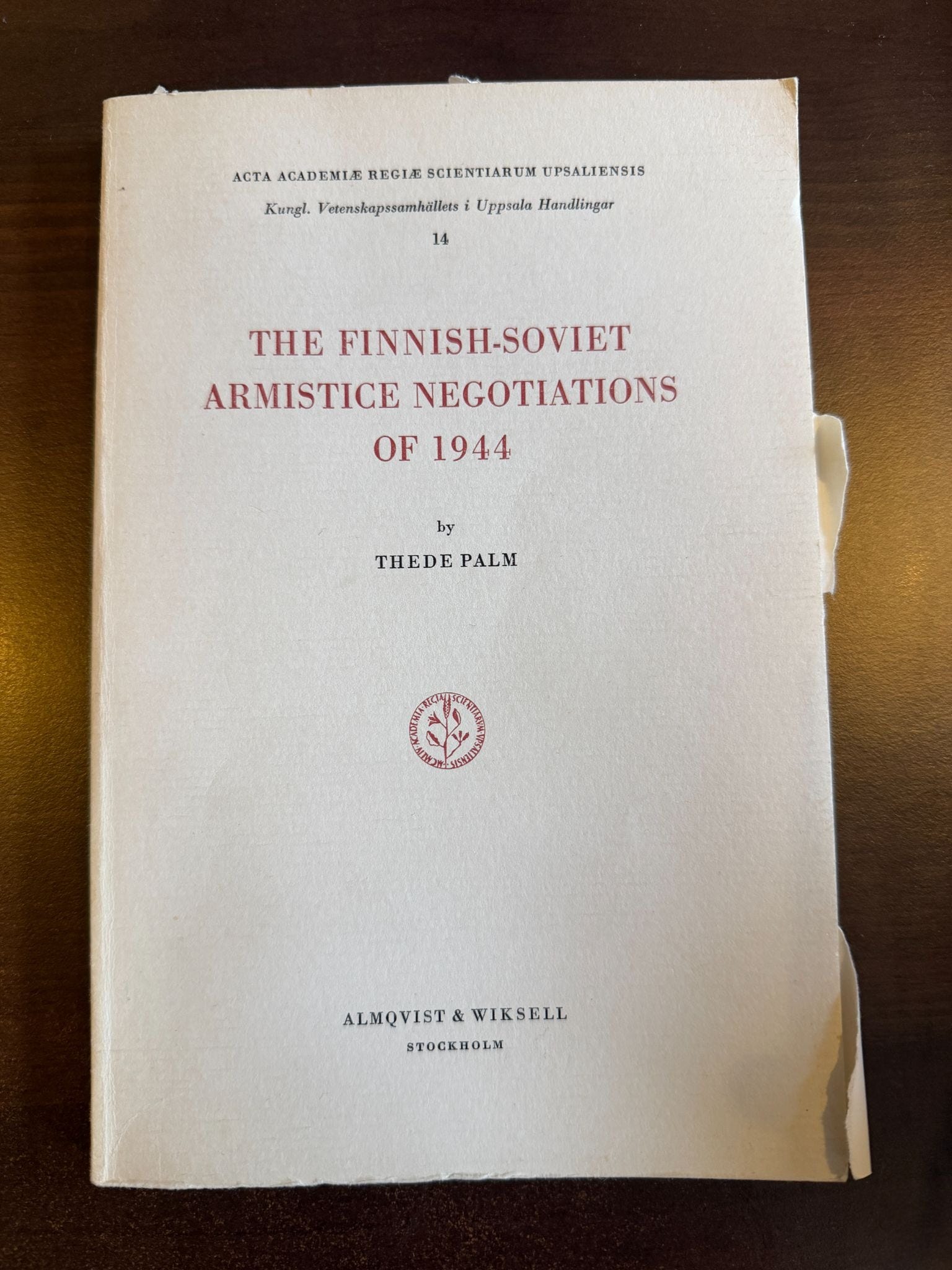
I’ve just finished reading this book: The Finnish-Soviet Armistice Negotiations of 1944.
The idea of a “Finland model” for Ukraine was put on my radar by the President of Finland, Alexander Stubb, mentioning it as a negative example during the September YES Conference in Kyiv:
“What happened to Finland in 1944, with an uncomfortable peace with Stalin after the Winter War and the War of Continuation – we [Finland] retained independence, unlike our Baltic friends. But we lost our sovereignty to decide the clubs where we want to participate, and we lost 10% of our territory. So I would never like for that to happen to Ukraine.”
The very next day at the same conference, Sir Niall Ferguson suggested that the Finnish outcome actually looked quite favorable (given battlefield realities) to Ukraine:
“The most interesting thing that I heard yesterday was from President Stubb, pointing out Finland got independence, but not full sovereignty. And it lost territory. Finland’s still here. It looks pretty good. South Korean-good.”
This 1971 book is a very detailed account of the in-the-room negotiations that led to the Finnish-Soviet armistice. The first 60 pages analyzes discussions, while the rest of the book provides transcripts from the actual negotiations – so you can read everything each envoy said, as if it’s a screenplay.
I had to order the book second-hand from Sweden. And when it arrived, the pages were still uncut: nobody could ever have read this copy, and I’m quite sure few people alive will have read it at all.
Reading the Soviet dialogue, led by Stalin’s Foreign Minister Vyacheslav Molotov (whom “Molotov cocktails” are named after, from improvised incendiary Finnish weapons to hold off this very invasion) feels like studying an old chess game and seeing an opponent’s prior moves. It’s revealing, and provides a sense of Russian/Soviet negotiating “tricks”.
The transcripts and accompanying notes were only intended for internal Finnish purposes – so they’re written with remarkable candor. We see Molotov, I think it’s fair to say, manhandling those on the opposite side of the table – not only because his side has the military leverage, but that he was clearly the more formidable negotiator.
Though the ultimately agreed terms were fierce, Finland and the Soviet Union/Russia haven’t had another major border conflict since – and this following three wars within 25 years. Any equivalent agreement today for Ukraine that lasts for 81 years (and counting) feels like it would be a win.
- German troops (this was during WWII) were housed in Finland – the number one condition the Soviets demanded immediate resolution of, and what triggered recurrence of the war that had been brought to an end in 1940
- In the early part of this war, Finland had actually captured significant Soviet territory (considerably more than Ukraine took in Kursk)
- The negotiations were conducted directly by both sides – no mediating country
- Ukraine today has much broader international backing in Europe; Finland had virtually none
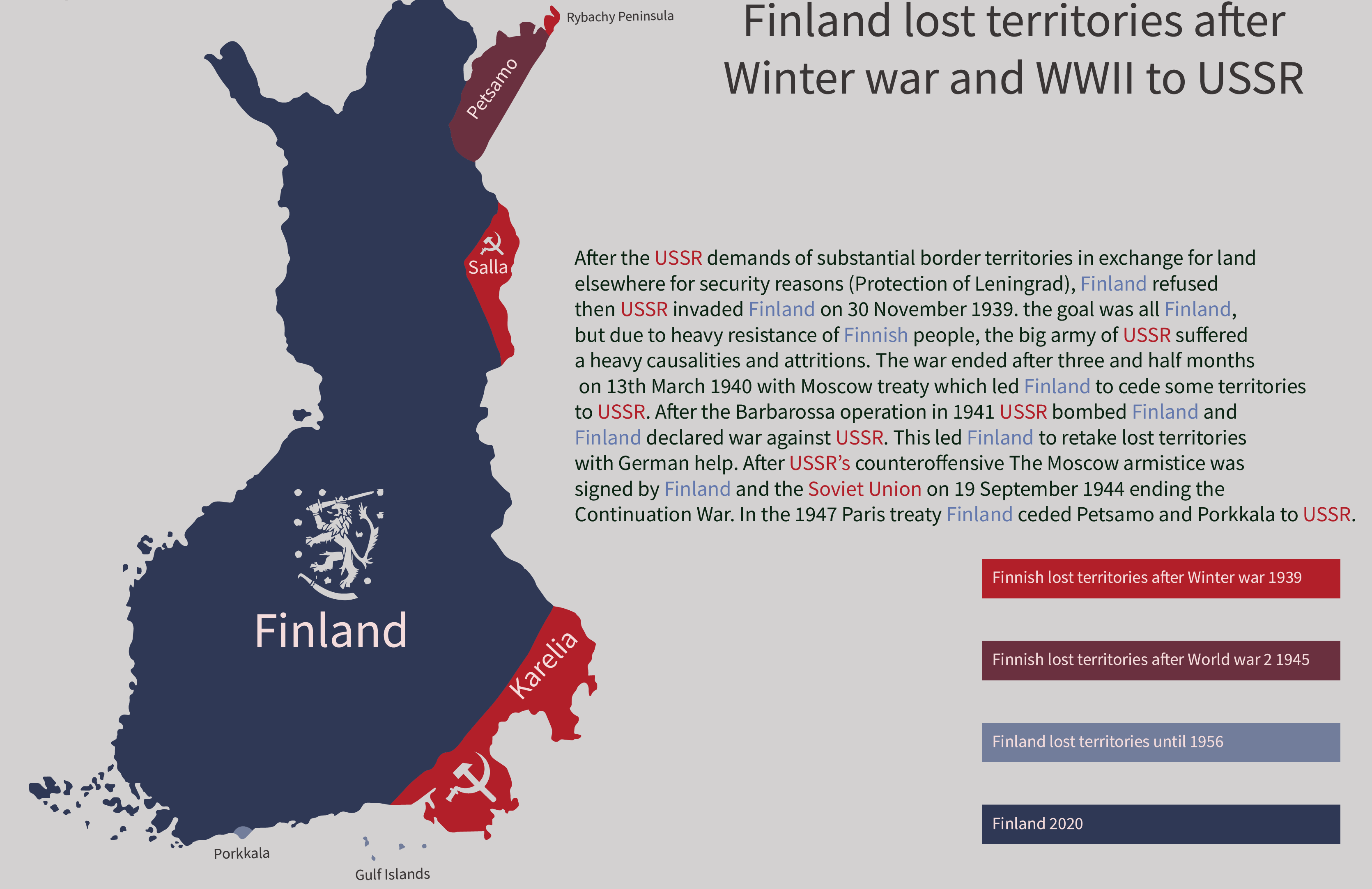
The area of Karelia is strikingly similar to the Donbas. In geography, in economic viability, and sentimentality to both sides.
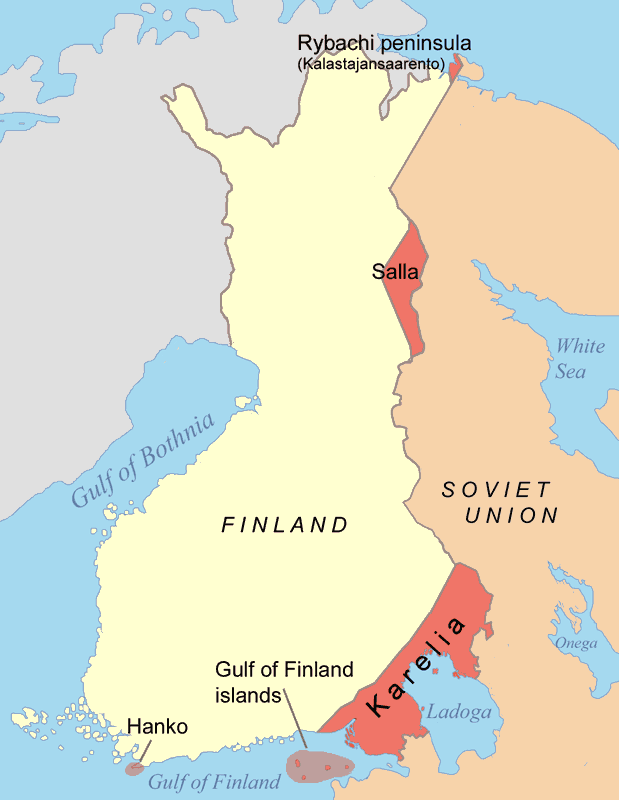
Much of this territory was still held by the Finnish Army during talks. Military troops and remaining civilians were hastily evacuated inside the new border: 422,000 Finns (12% of Finland’s population) left their homes.
The Soviet Union insisted the ceded areas be completely evacuated in 10 days. The evacuees were partly compensated for their losses – farmers receiving land in proportion to their earlier holdings.
The below book highlights are long (and dense).
To make this accessible, I’ve put the “TLDR” into a video overview:
This video on X here.
Getting into the book…
(I’ve included photos of my highlights, but I’ve typed out maximally relevant bits below each. If you read just my quotations below each image, you get all the best bits.)
1) Does the following sound familiar?
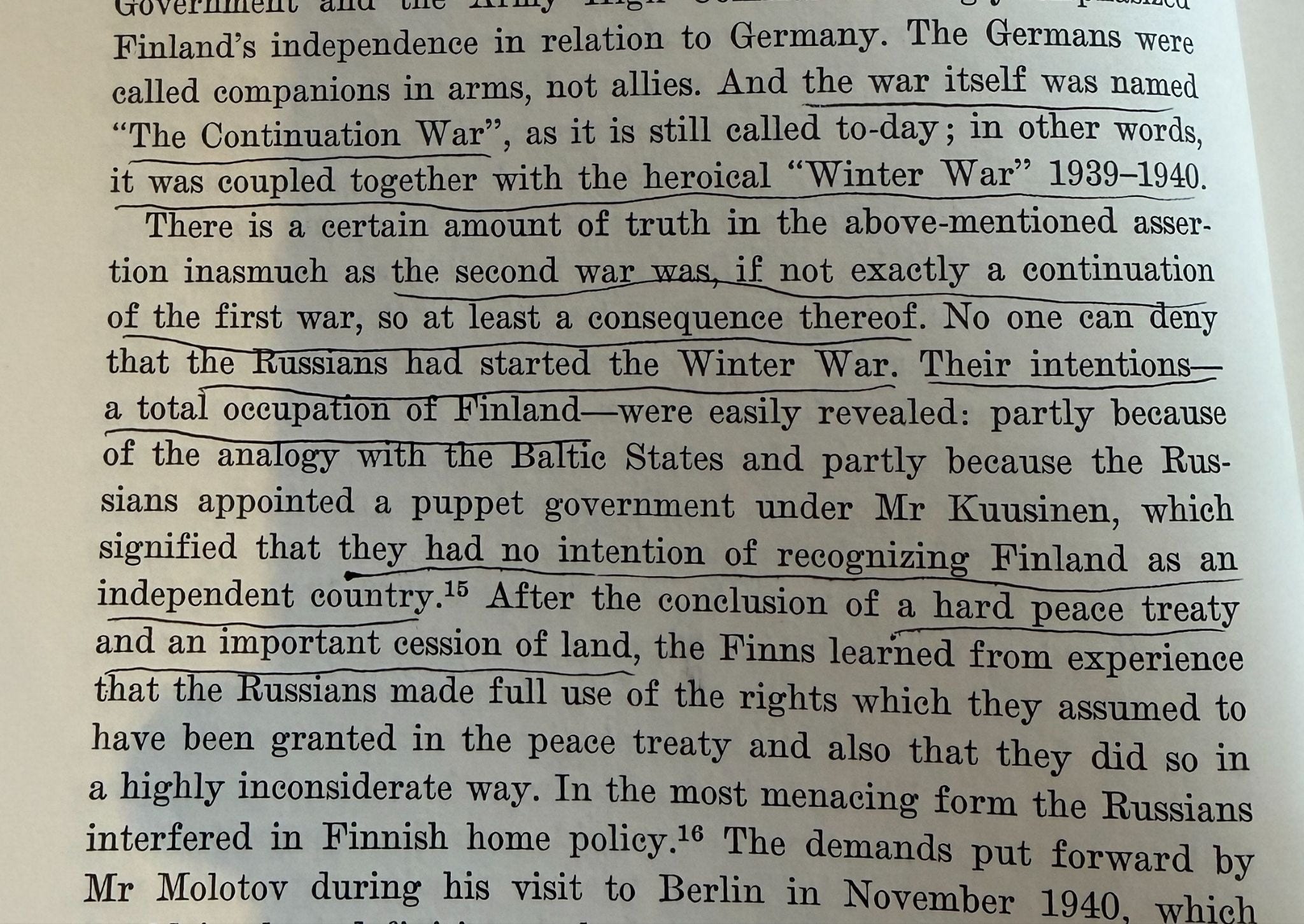
The second war was, if not exactly a continuation of the first war, so at least a consequence thereof [very similar to 2014-2022 with Ukraine] … the Russians had started the Winter War [with the] intention of a total occupation of Finland … the Russians appointed a puppet government … they had no intention of recognizing Finland as an independent country. After the conclusion of a hard peace treaty and an important cession of land, the Finns learned from experience that the Russians made full use of the rights which they assumed to have been granted in the peace treaty and also that they did so in a highly inconsiderate way. In the most menacing form the Russians interfered in Finnish home policy.
2) For several years during the second Continuation War, the Finns thought they could win:
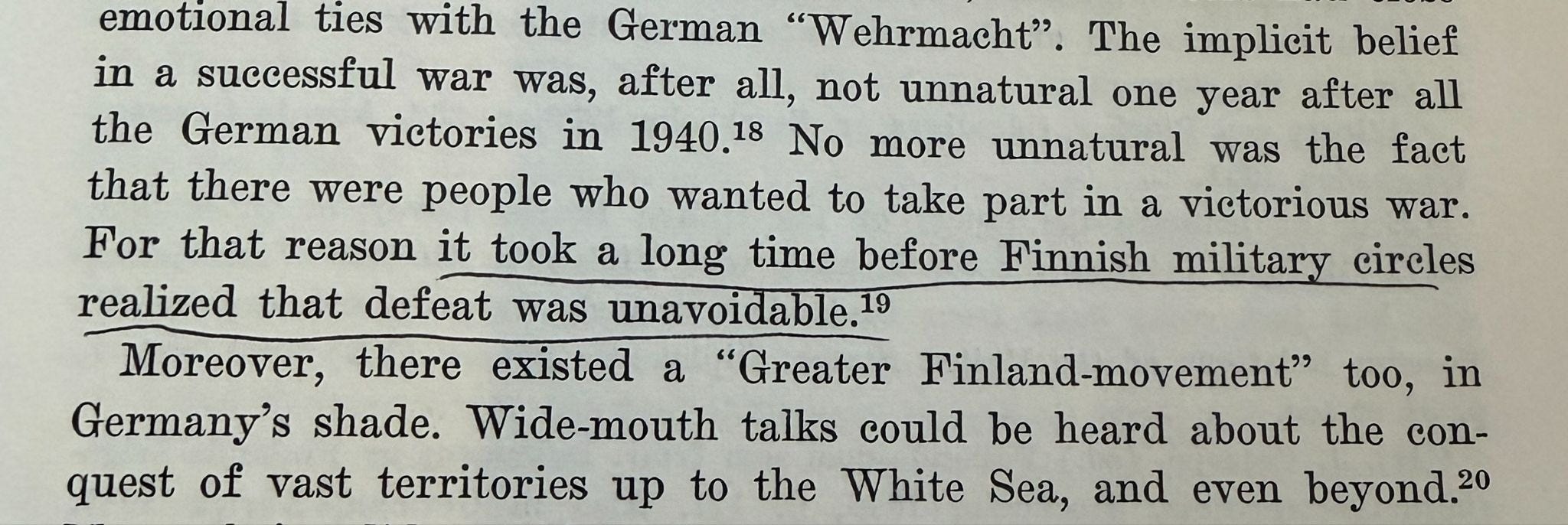
The implicit belief in a successful war was, after all, not unnatural one year after all the German victories in 1940. [Finland had allied with Nazi Germany in an attempt to get back territory from the Soviet Union it had lost in the earlier 1939-40 Winter War.] … it took a long time before Finnish military circles realized that defeat was unavoidable … [Early on] Wide-mouth talks could be heard about the conquest [by Finland] of vast territories up to the White Sea, and even beyond.
3) “Soviet leaders would be replaced”, and “easier to deal with” leaders would come about:
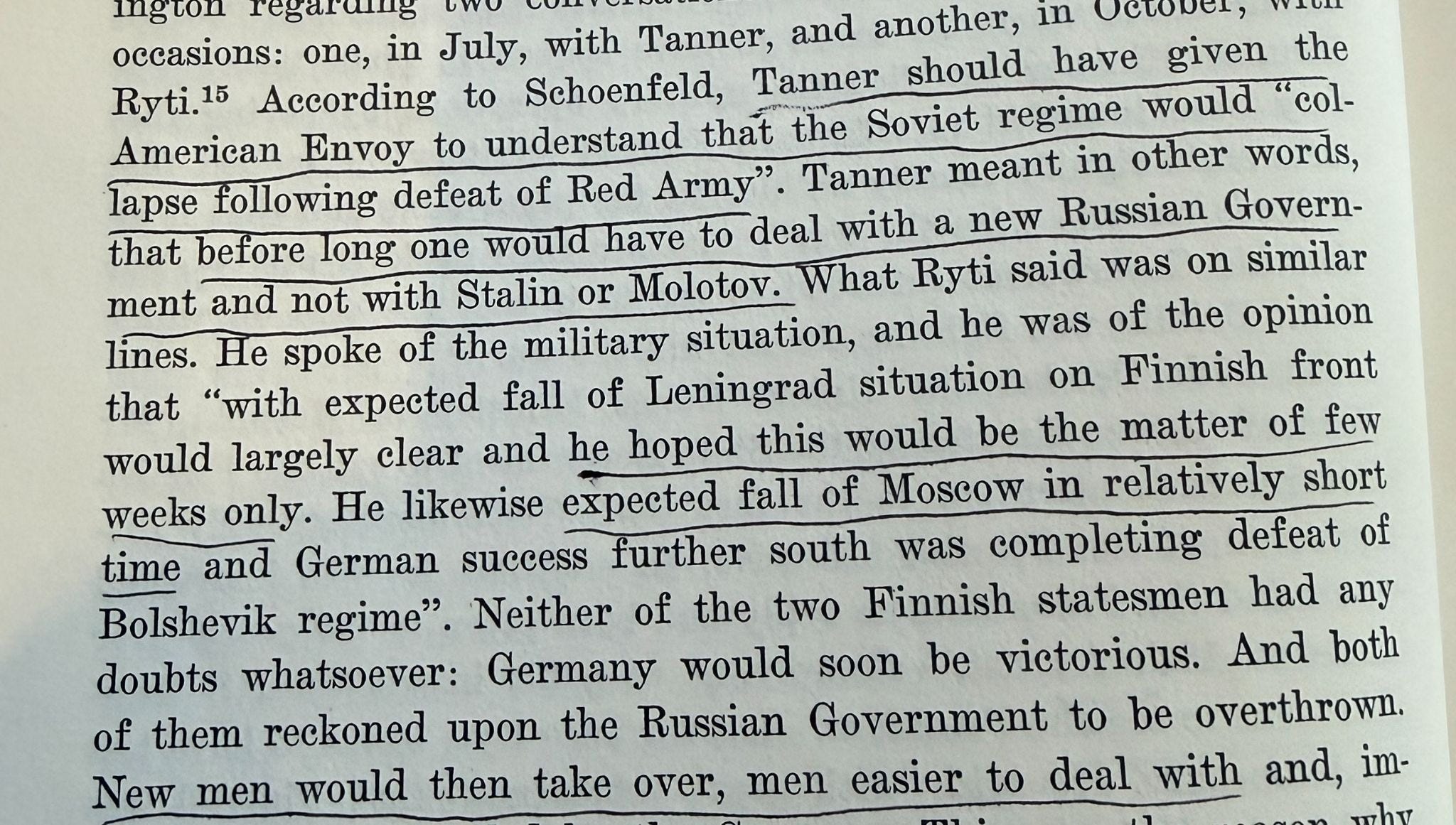
the Soviet regime would “collapse following defeat of [the] Red Army” … before long one would have to deal with a new Russian Government and not with Stalin or Molotov … He likewise expected fall of Moscow in relatively short time … Both of them reckoned upon the Russian Government to be overthrown. New men would then take over, men easier to deal with”
Very, very similar to Western media thinking in 2022.
4) The Finns hadn’t seen the invasion coming:
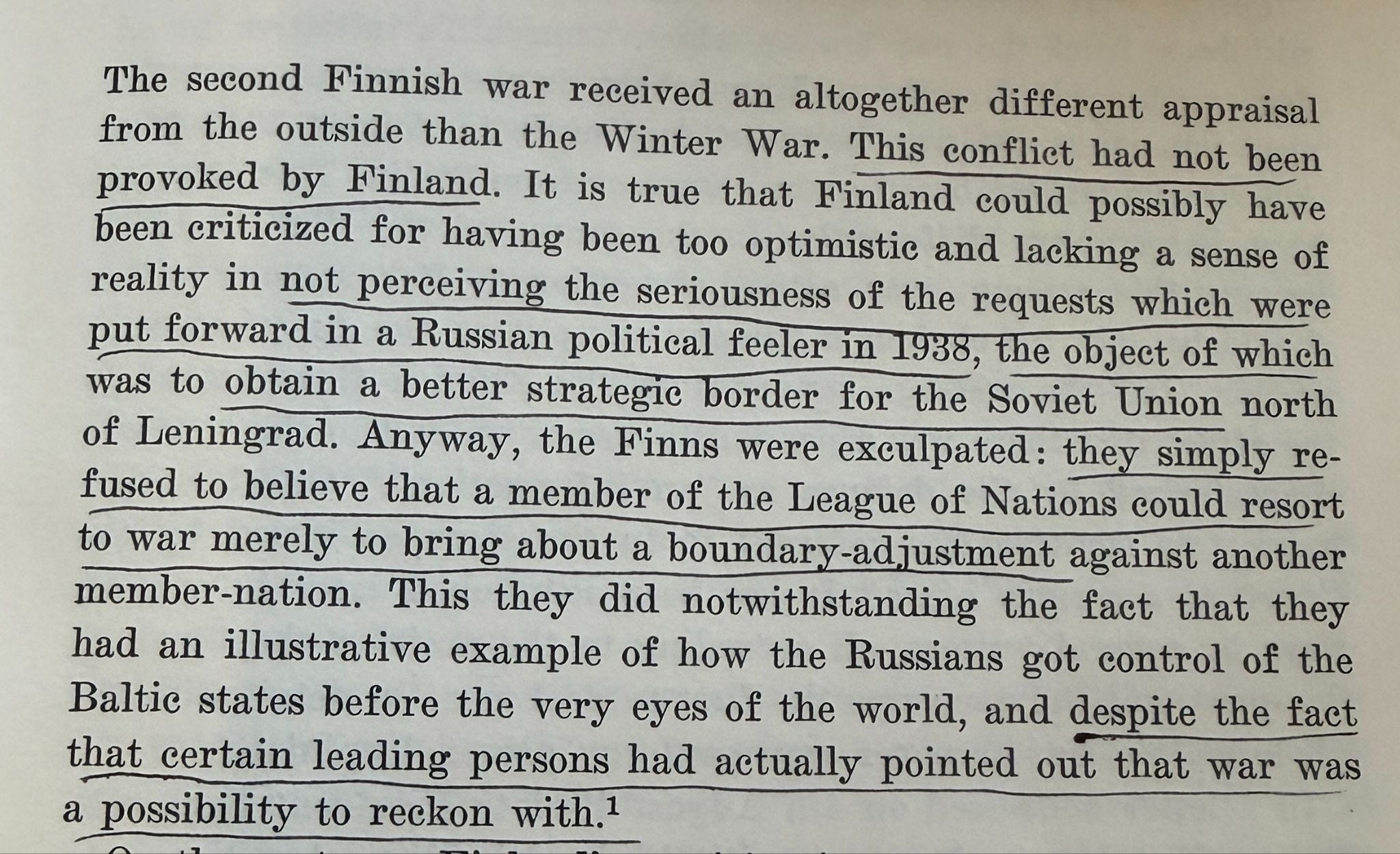
This conflict had not been provoked by Finland. It is true that Finland could possibly have been criticized for having been too optimistic and lacking a sense of reality in not perceiving the seriousness of the requests which were put forward in a Russian political feeler in 1938, the object of which was to obtain a better strategic border for the Soviet Union [analogous to US-Russia talks under Biden in December 2021 requesting NATO prohibit Ukraine joining] … the Finns were exculpated: they simply refused to believe that a member of the League of Nations could resort to war merely to bring about a boundary-adjustment … This they did notwithstanding the fact that they had an illustrative example of how the Russians got control of the Baltic states before the very eyes of the world, and despite the fact that certain leading powers had actually pointed out that war was a possibility to reckon with.
5) The war became protracted, and the Finns wanted out:
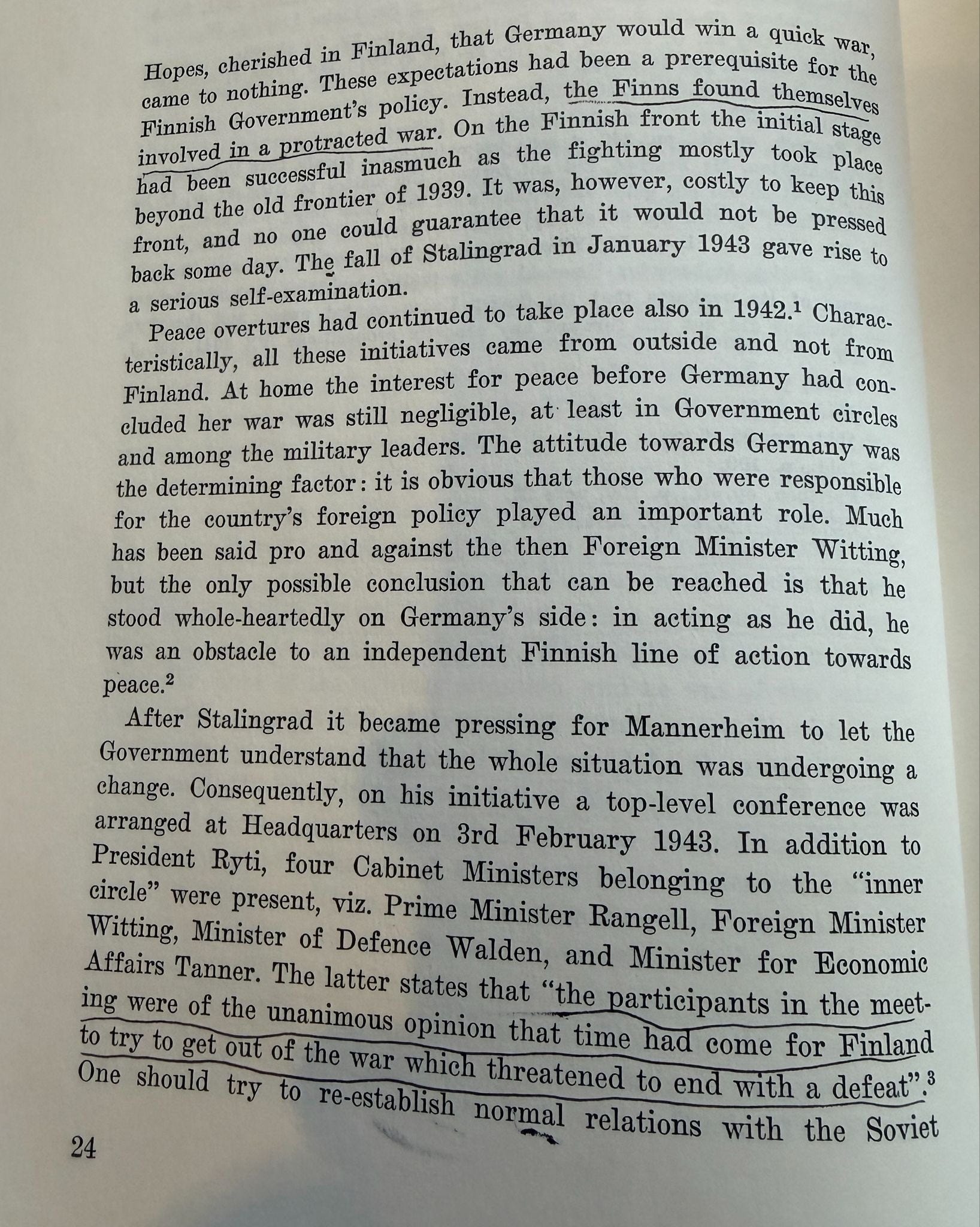
The Finns found themselves involved in a protracted war … the participants in the meeting were of the unanimous opinion that time had come for Finland to try to get out of the war which threatened to end with a defeat.
6) Finland would have to cede land, but this was very unpopular:
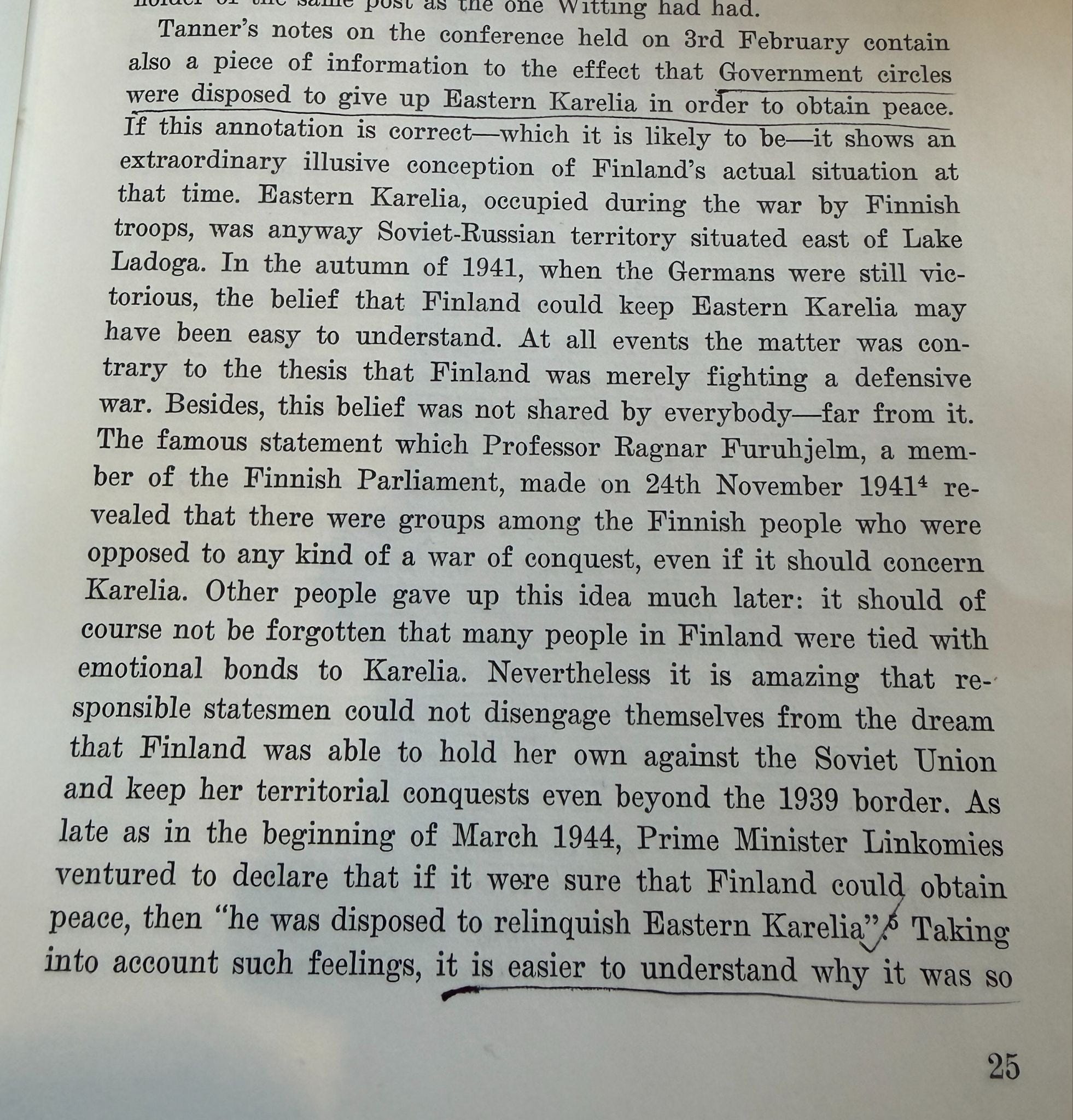
Government circles were disposed to give up Eastern Karelia in order to obtain peace … There were groups among the Finnish people who were opposed to any kind of a war of conquest, even if it should concern Karelia … It should of course not be forgotten that many people in Finland were tied with emotional bonds to Karelia … It is amazing that responsible statesmen could not disengage themselves from the dream that Finland was able to hold her own against the Soviet Union and keep her [Finland’s] territorial conquests even beyond the 1939 border … Taking into account such feelings, it is easier to understand why it was so difficult to obtain a hearing in Finland for the Russian peace terms when these at last were produced.
7) This created major internal friction:
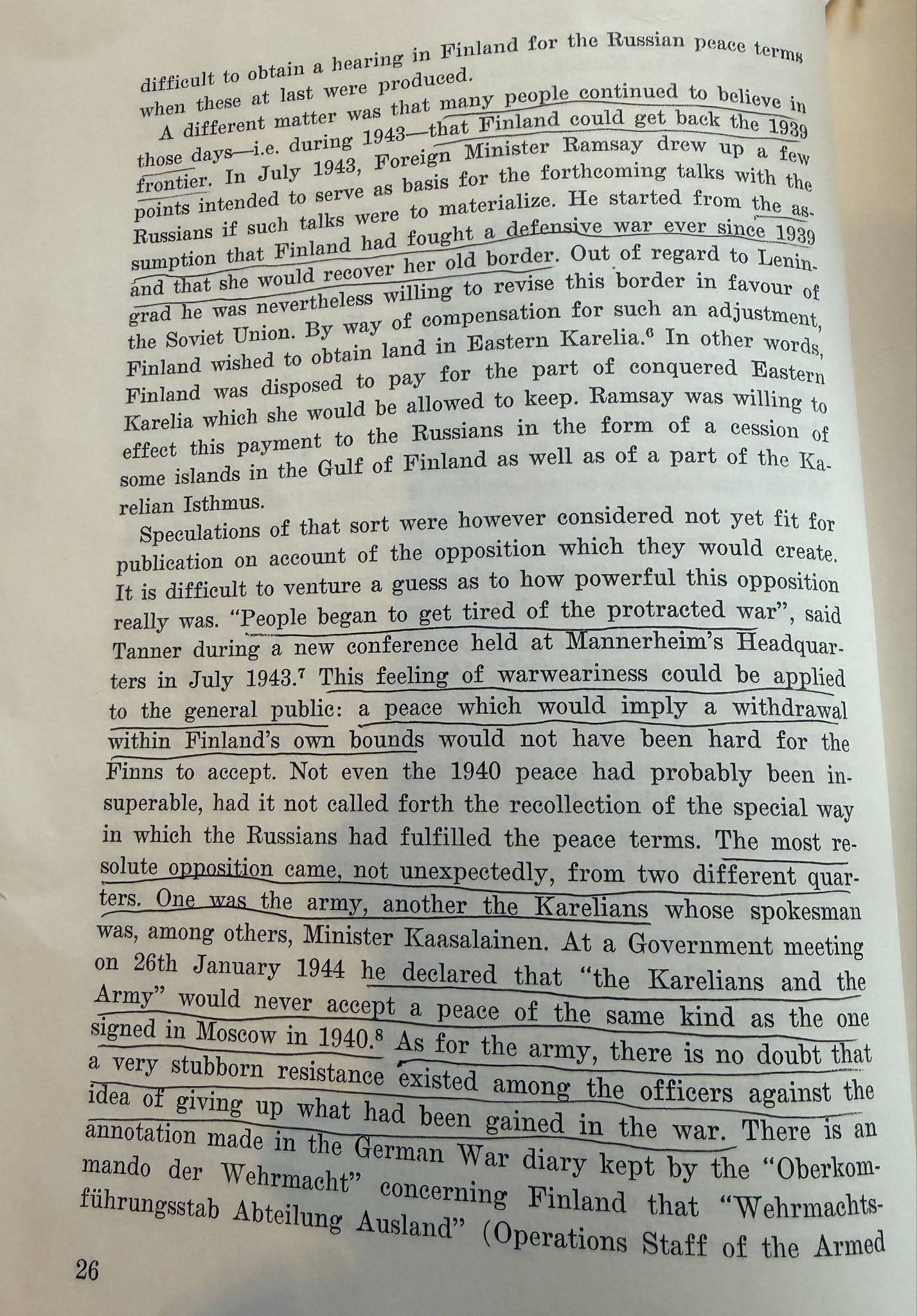
Many people continued to believe in those days … that Finland could get back the 1939 frontier [equivalent to Ukraine’s pre-2014 border]. In July 1943, Finnish Foreign Minister Ramsay drew up a few points intended to serve as basis for the forthcoming talks with the Russians if such talks were to materialize. He started from the assumption that Finland had fought a defensive war ever since 1939 and that she would recover her old border. [Very like Zelensky’s 2022/23 “Peace Formula” wanting back Crimea.]
People began to get tired of the protracted war … This feeling of war-weariness could be applied to the general public: a peace which would imply a withdrawal within Finland’s own bounds would not have been hard for the Finns to accept … [But] The most resolute opposition came, not unexpectedly, from two quarters. One was the army, another the Karelians … A Minister declared that “the Karelians and the Army” would never accept a peace [that conceded territory] … As for the army, there is no doubt that a very stubborn resistance existed among the officers against the idea of giving up what had been gained in the war.
8) This was made worse by the lack of faithful media coverage of the grim military reality – very analogous to Ukraine today:
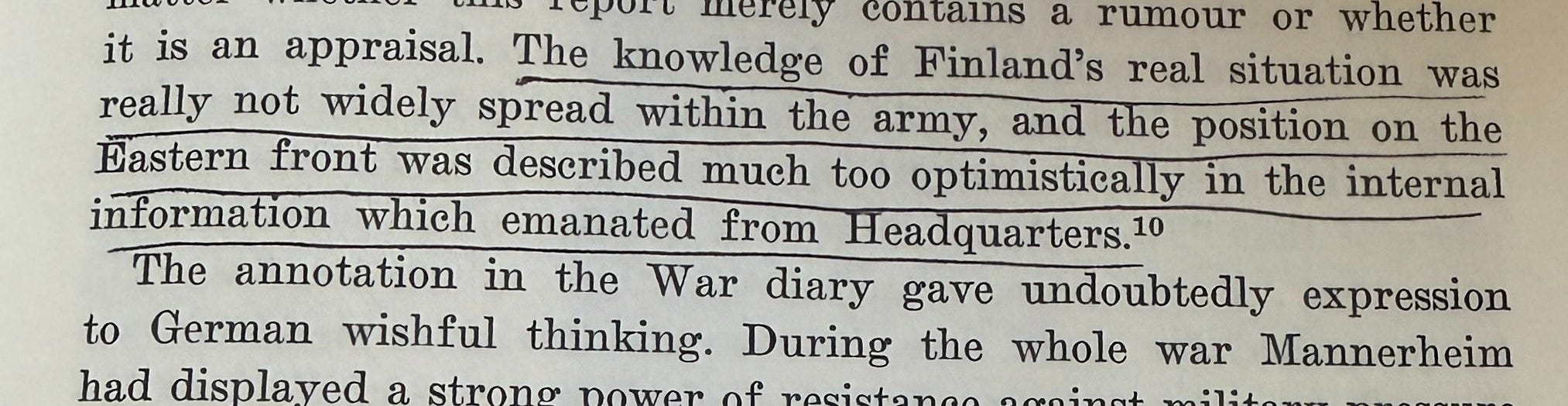
The knowledge of Finland’s real situation was really not widely spread within the army, and the position on the Eastern front was described much too optimistically in the internal information which emanated from Headquarters.
Journalists and editors in the West who have thought over the past three years they’re helping Ukraine by concealing reality are misguided. As demonstrated here: perpetuating delusion makes diplomacy harder, and the ultimate terms worse, not better.
9) The Soviets were later angered that the Finns hadn’t come to the negotiating table sooner in good faith:
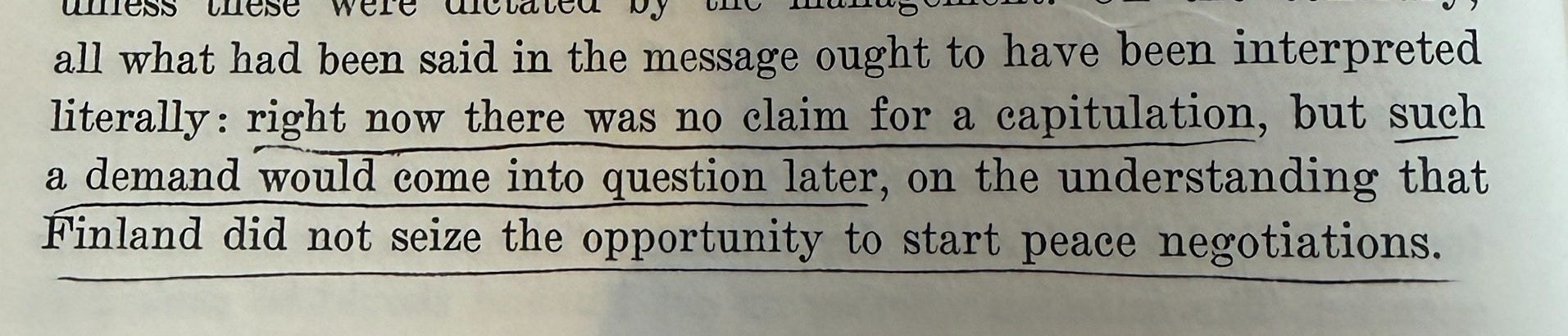
Right now there was no claim for a capitulation, but such a demand would come into question later, on the understanding that Finland did not seize the opportunity to start peace negotiations.
This feels analogous to Ukraine throwing away the diplomatic opportunity of March/April 2022, and putting in place a decree prohibiting further talks from October 2022.
10) However, the Finns fought valiantly, and Stalin had to downsize his objective:
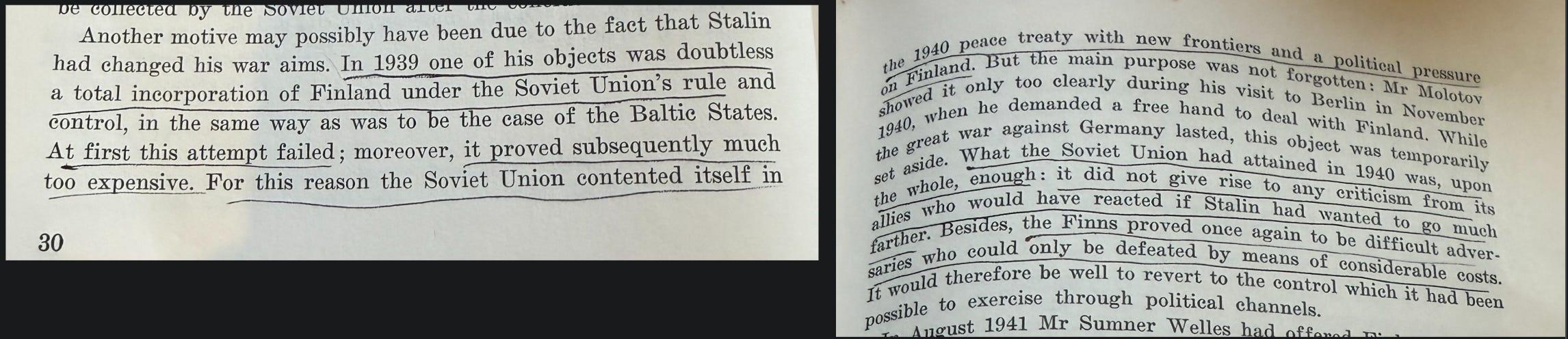
The fact that Stalin had changed his war aims. In 1939 one of his objects was doubtless a total incorporation of Finland under the Soviet Union’s rule … At first this attempt failed; moreover, it proved subsequently much too expensive. For this reason, the Soviet Union contented itself in the 1940 treaty with new frontiers and a political pressure on Finland … What the Soviet Union had attained in 1940 was, upon the whole, enough: it did not give rise to any criticism from its allies who would have reacted if Stalin had wanted to go much farther. Besides, the Finns proved once again to be difficult adversaries who could only be defeated by means of considerable costs. It would therefore be well to revert to the control which it had been possible to exercise through political channels.
11) The Finns put forward faux terms the Soviets would never have accepted:
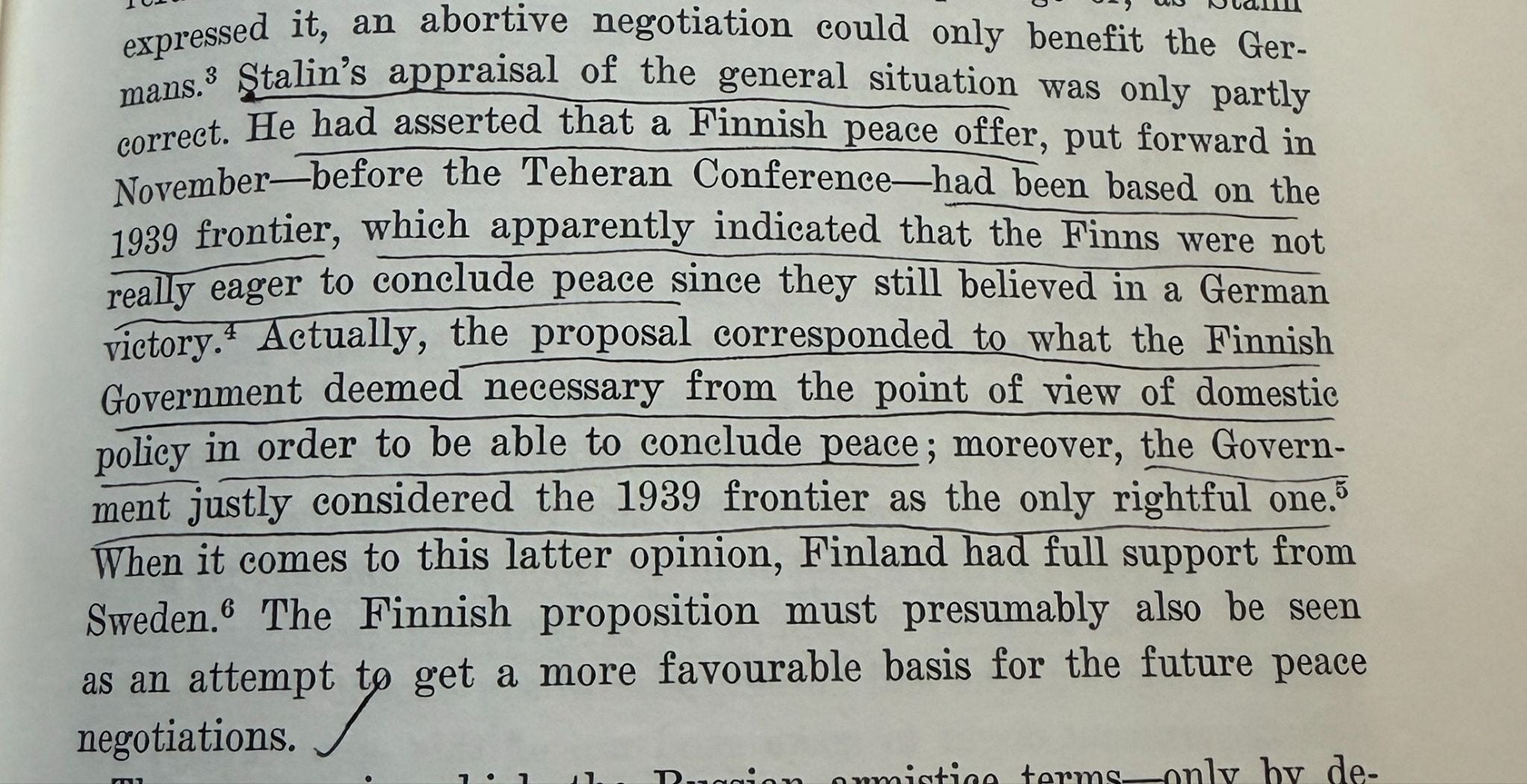
A Finnish peace offer … had been based on the 1939 frontier [equivalent to the pre-2014 Ukraine border], which apparently indicated that the Finns were not really eager to conclude peace … Actually, the proposal corresponded to what the Finnish Government deemed necessary from the point of view of domestic policy in order to be able to conclude peace; moreover, the Government justly considered the 1939 frontier as the only rightful one … The Finnish proposition must presumably also be seen as an attempt to get a more favorable basis for the future peace negotiations.
12) For Stalin, prestige was a huge factor:

As soon as the Soviet Union’s allies were informed of the Russian claims, it became a matter of prestige for Stalin that these very claims and no others should be carried into effect.
Putin perhaps feels the same today? He does not want to look weak to his own allies.
13) The Soviets tried to baby-step unveiling of their terms:
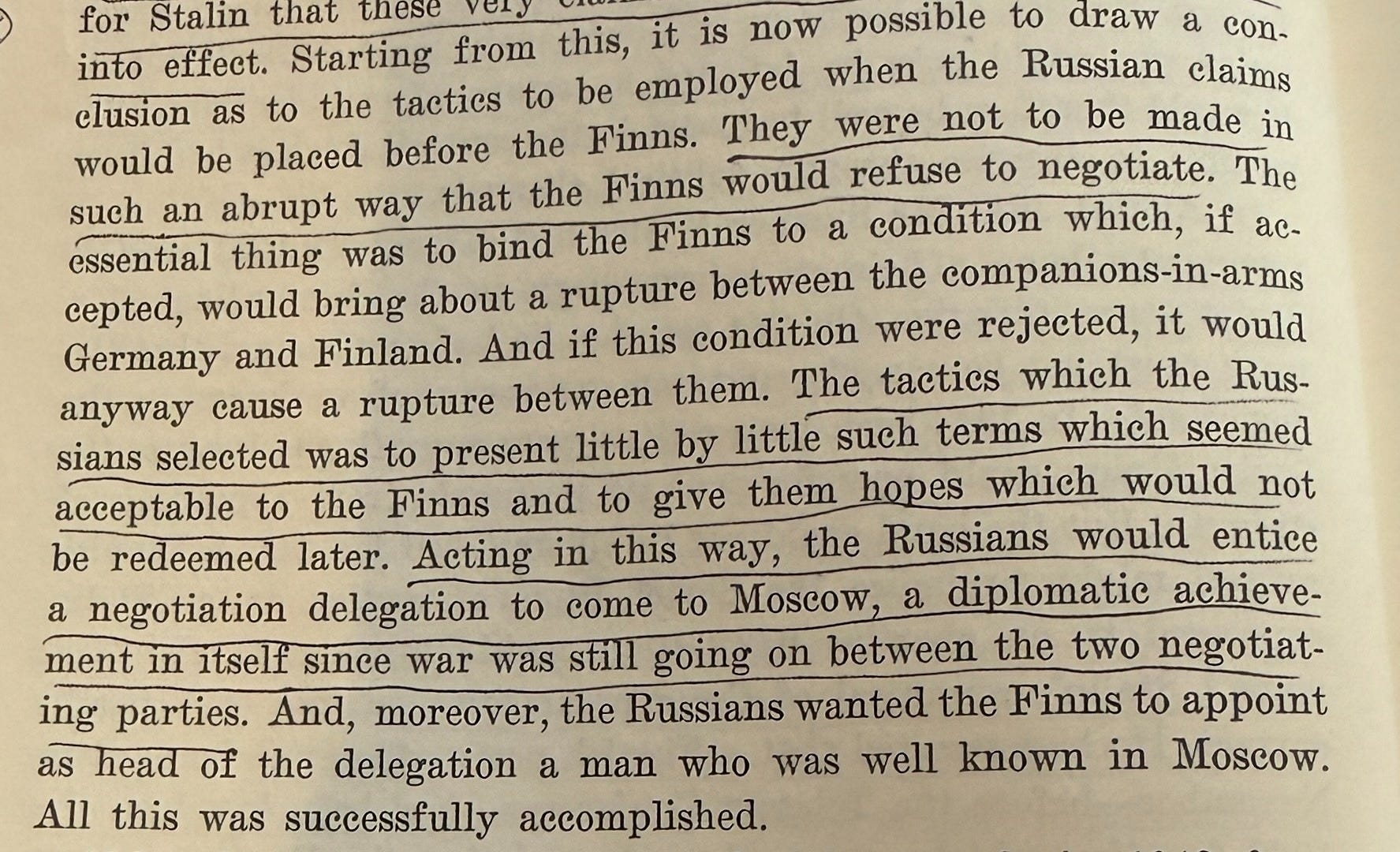
The Russian claims would be placed before the Finns. They were not to be made in such an abrupt way that the Finns would refuse to negotiate … The tactics which the Russians selected [were] to present little by little such terms which seemed acceptable to the Finns and to give them hopes which would not be redeemed later. Acting in this way, the Russians would entice a negotiation delegation to come to Moscow, a diplomatic achievement in itself since war was still going on between the two negotiating parties.
I think correct to say this is something that Putin has not done. He has been explicit in his harsh demands, and thus getting Ukraine and Russia in the same room has proven harder.
14) The Soviets said one thing while doing another:

[The Soviet Ambassador in Sweden] added that the Soviet Union had no intention of encroaching on Finland’s sovereignty – a peculiar remark in this connection.
15) The sides traded what would be the basis for the talks:
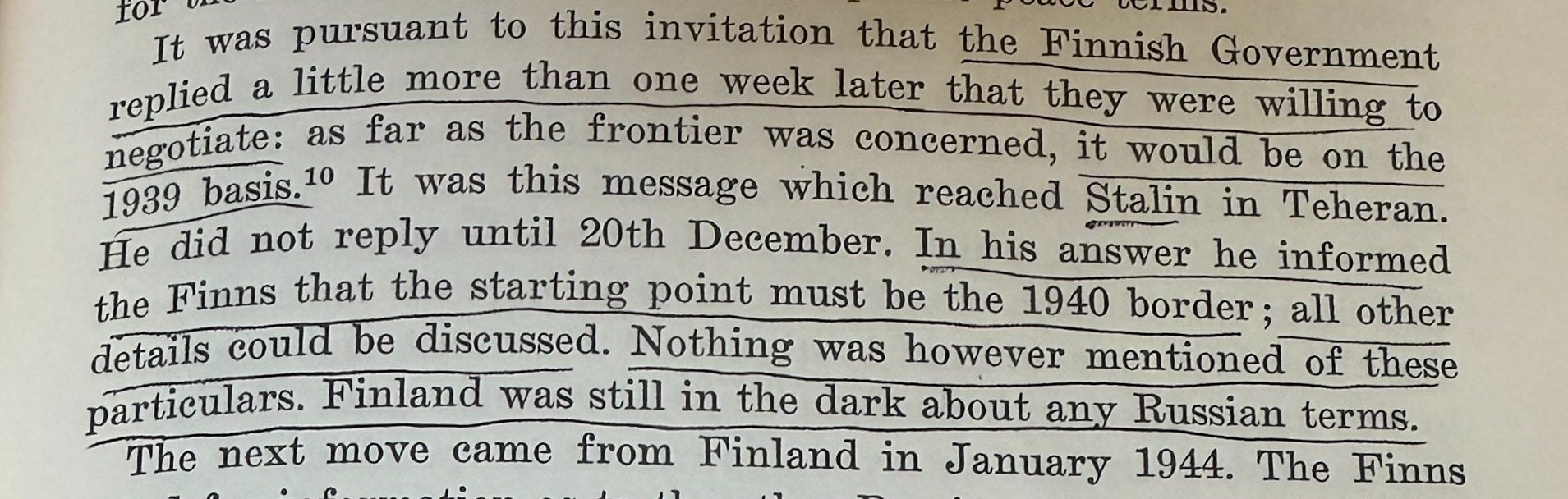
The Finnish Government replied a little more than one week later that they were willing to negotiate … on the 1939 frontier basis … [Stalin] informed the Finns that the starting point must be the 1940 border; all other details could be discussed. Nothing was however mentioned of these particulars. Finland was still in the dark about any Russian terms.
16) The Soviet terms, when finally presented, were structured sequentially:
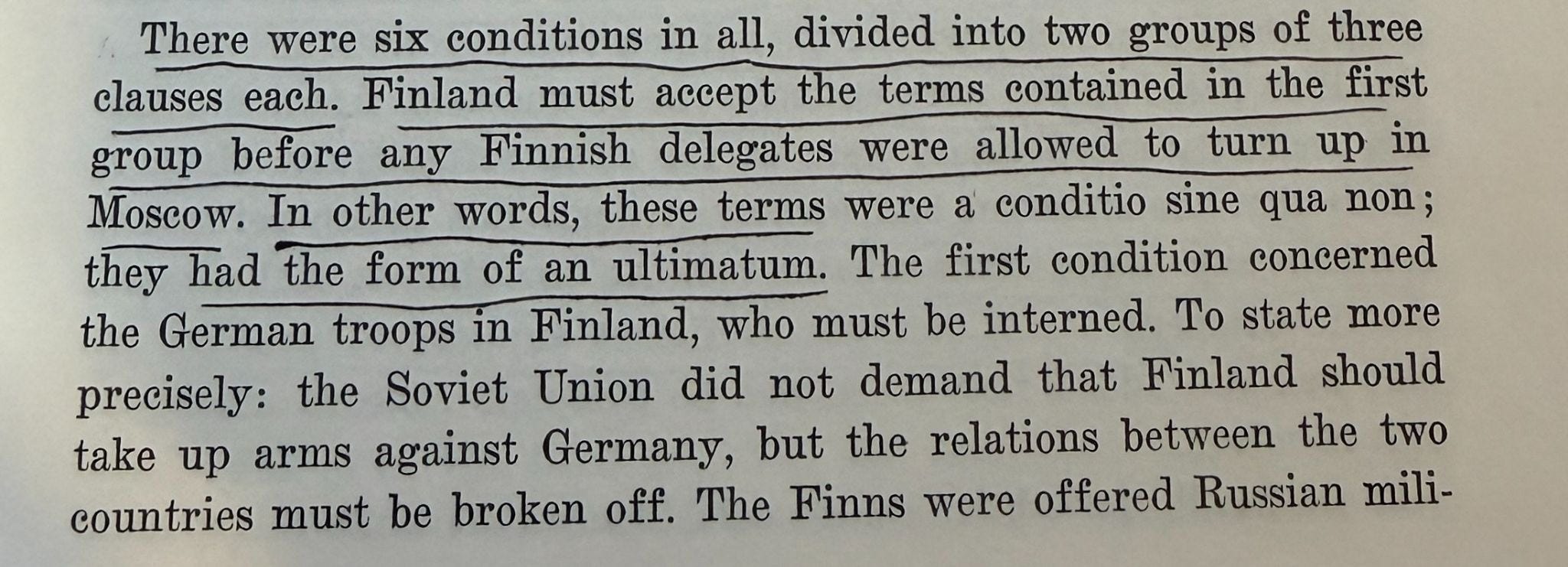
There were six conditions in all, divided into two groups of three clauses each. Finland must accept the terms contained in the first group before any Finnish delegates were allowed to turn up in Moscow. In other words, these terms … had the form of an ultimatum.
[This next bit becomes significant later:] The first condition concerned the German troops in Finland, who must be interned [captured and disarmed for the remainder of the war]. To state more precisely: the Soviet Union did not demand that Finland should take up arms against Germany, but the relations between the two countries must be broken off.
17) An acceptance of Finland’s territorial concession was demanded before proceeding:
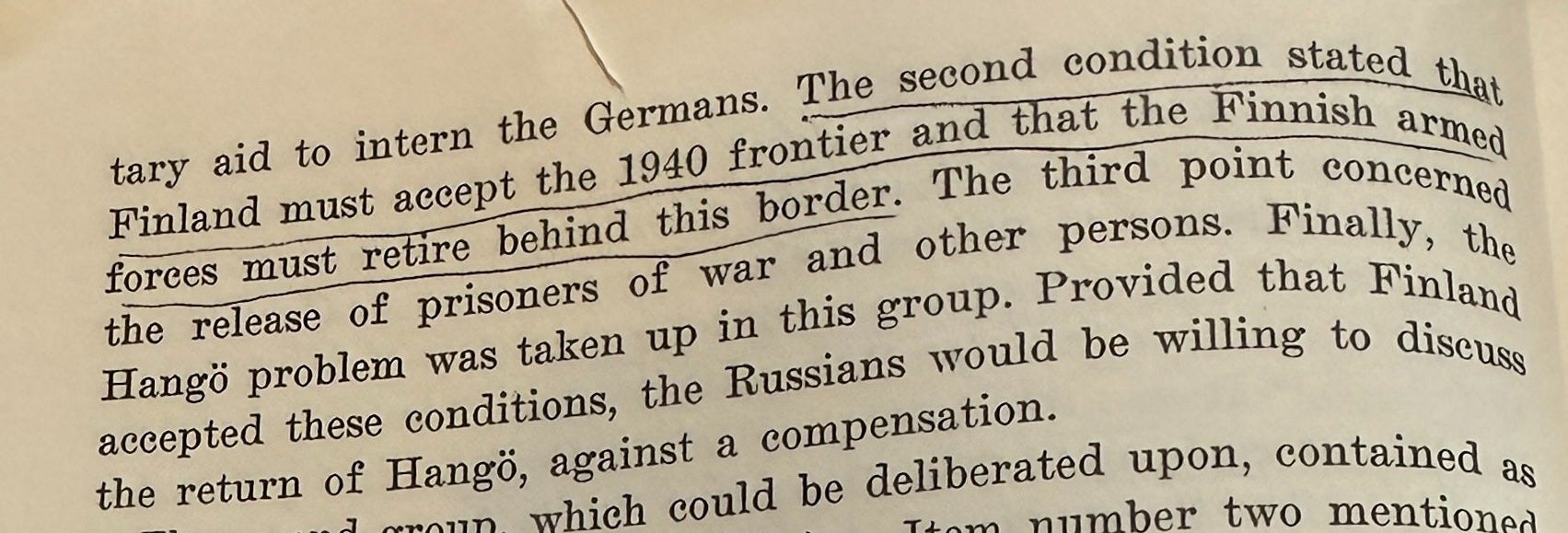
The second condition stated that Finland must accept the 1940 frontier and that the Finnish armed forces must retire behind this border.
And just to say: though this line had been established as “the 1940 border” – that outcome had been a galling territorial loss for Finland, that Finland had gone to the length of allowing 200,000 German troops on its territory in a bid to rectify. I don’t think it can have been considered an especially stable line. This was, in effect, taking new Finnish land.
18) The Soviets imposed a hard deadline before there was clarity as to precisely what terms meant, while confusion was swirling:
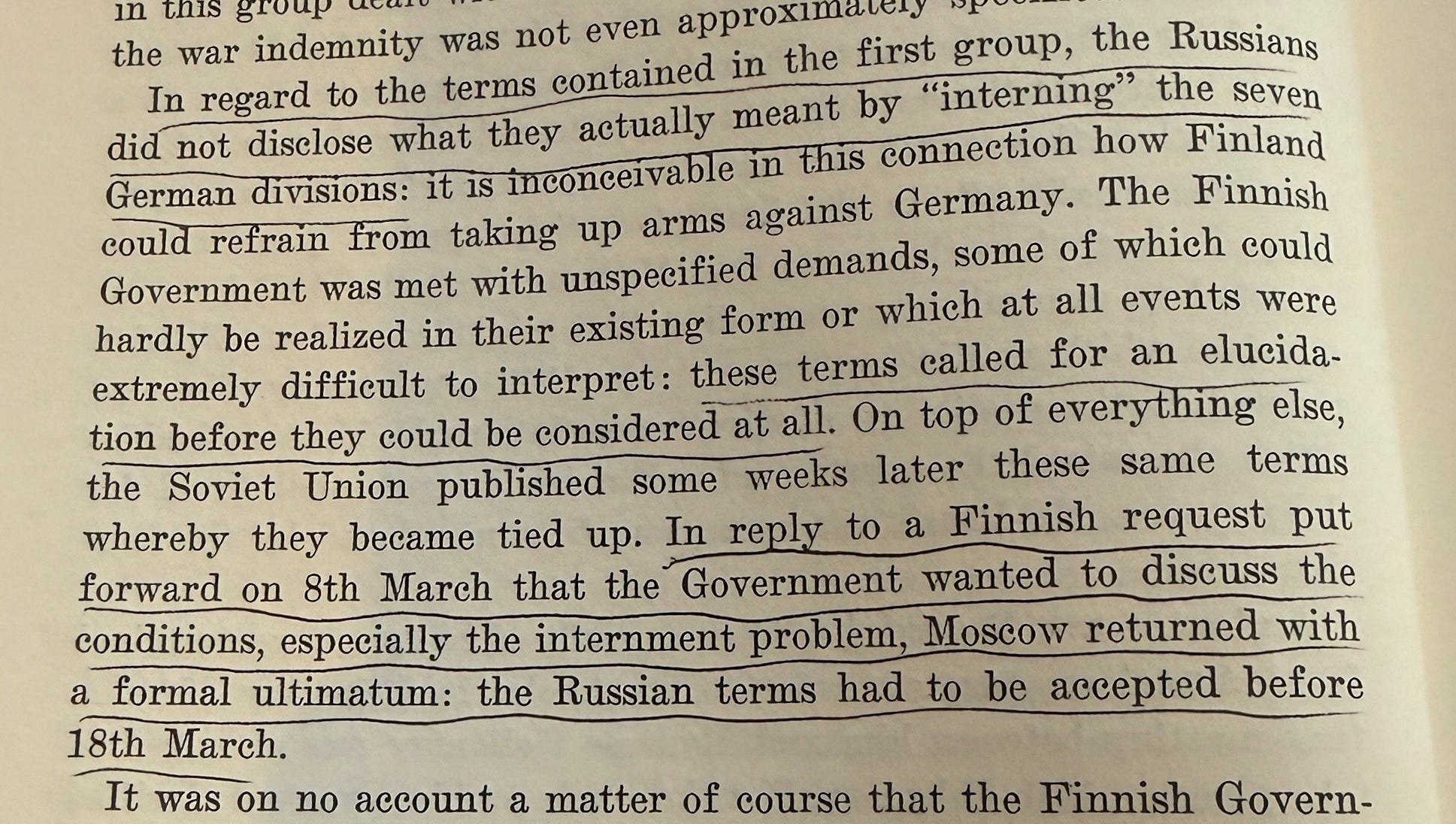
In regard to the terms contained in the first group, the Russians did not disclose what they actually meant by “interning” the seven German divisions … The Finnish Government was met with unspecified demands, some of which could hardly be realized in their existing form or which were extremely difficult to interpret: these terms called for an elucidation before they could be considered at all … In reply to a Finnish request put forward on 8th March that the Government wanted to discuss the conditions, especially the internment problem, Moscow returned with a formal ultimatum: the Russian terms had to be accepted before 18th March.
19) This led to a very divided Finnish parliament:
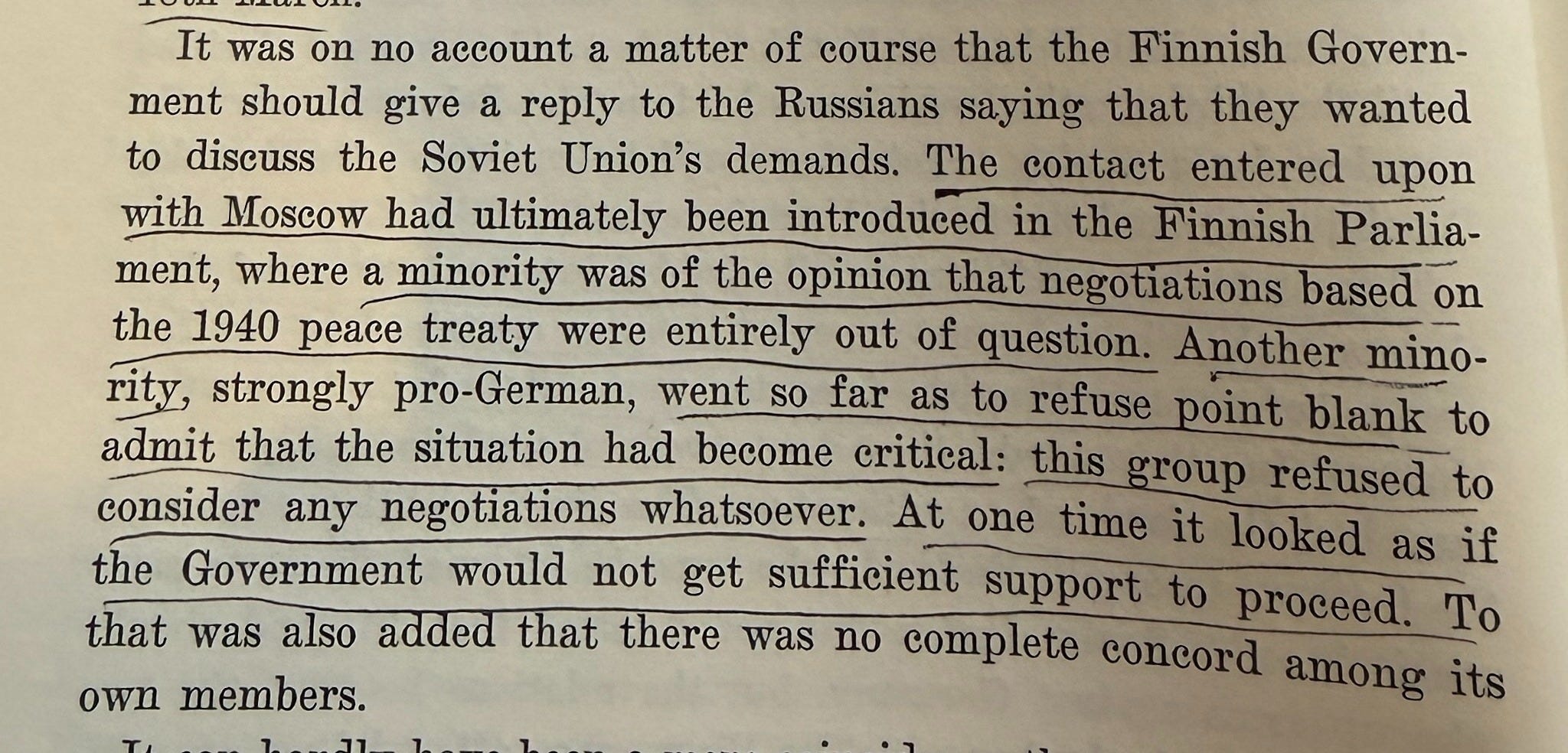
The contact entered upon with Moscow had ultimately been introduced in the Finnish Parliament, where a minority was of the opinion that negotiations based on the 1940 peace treaty [roughly equivalent to Putin’s demands today] were entirely out of the question. Another minority … went so far as to refuse point blank to admit that the situation had become critical: this group refused to consider any negotiations whatsoever. At one time it looked as if the Government would not get sufficient support to proceed. To that was also added that there was no complete concord among its own members.
20) The Soviets baited the Finns by saying “come and have direct talks so we can clarify misunderstandings”:
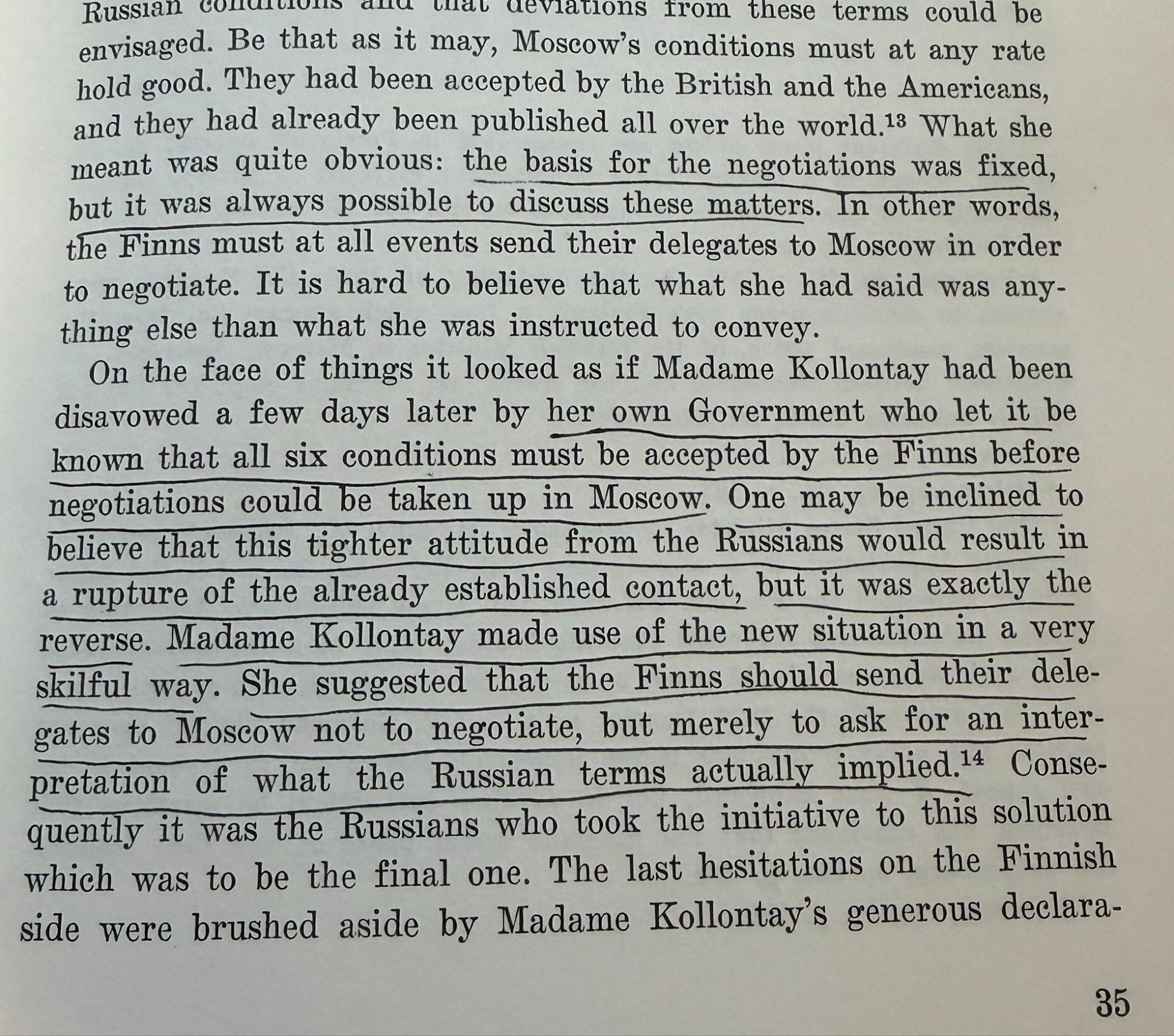
Moscow’s conditions must at any rate hold good. They had been accepted by the British and the Americans, and they had already been published all over the world … [The Soviet] Government let it be known that all six conditions must be accepted by the Finns before negotiations could be taken up in Moscow. One may be inclined to believe that this tighter attitude from the Russians would result in a rupture of the already established contact, but it was exactly the reverse. Madame Kollontay [the Soviet ambassador in Stockholm] made use of the new situation in a very skillful way. She suggested that the Finns should send their delegates to Moscow not to negotiate, but merely to ask for an interpretation of what the Russian terms actually implied. Consequently it was the Russians who took the initiative…
21) The two sides went in with very different expectations:
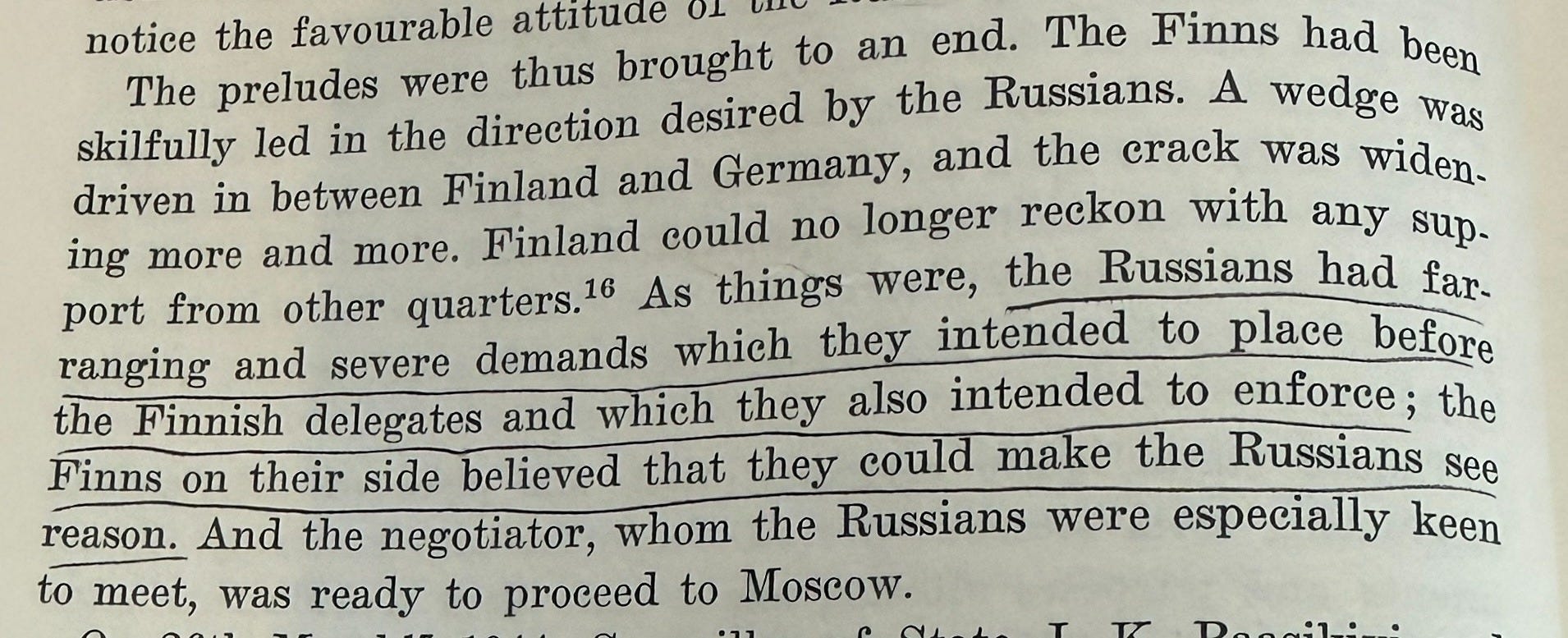
A wedge was driven in between Finland and Germany [Finland’s ally], and the crack was widening more and more. Finland could no longer reckon with any support from other quarters. As things were, the Russians had far-ranging and severe demands which they intended to place before the Finnish delegates and which they also intended to enforce; the Finns on their side believed that they could make the Russians see reason.
22) And the two Finnish envoys visiting Moscow had totally different opinions to each other!
Much has been made in the past 11 months of the difference in stance between Ambassador Steve Witkoff and General Kellogg. Any discrepancy was yet greater in this Finnish example – and becoming apparent during the actual trip:
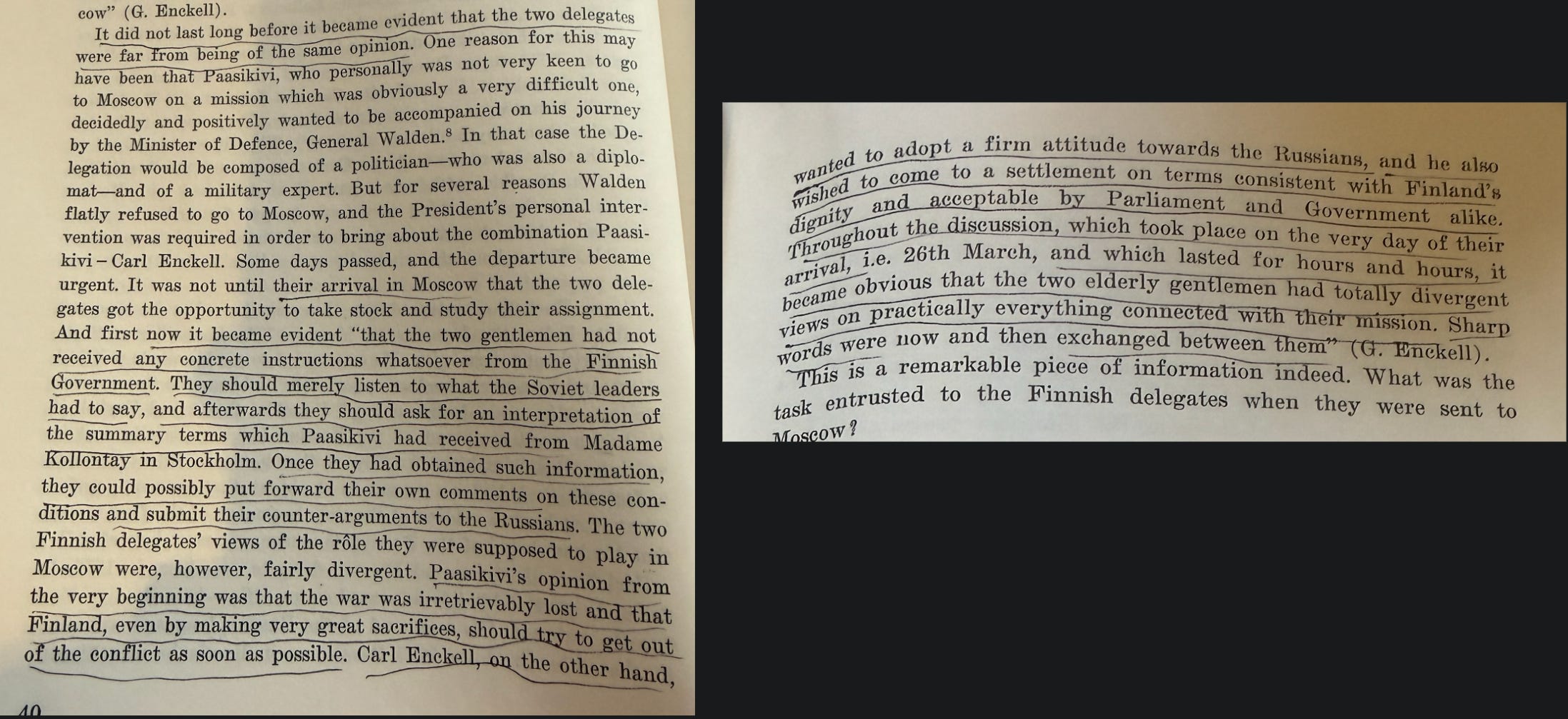
It did not last long before it became evident that the two delegates were far from being of the same opinion … It was not until their arrival in Moscow that the two delegates got the opportunity to take stock and study their assignment … Now it came evident “that the two gentlemen had not received any concrete instructions whatsoever from the Finnish Government. They should merely listen to what the Soviet leaders had to say, and afterwards they should ask for an interpretation of the summary terms which Paasikivi had received in Stockholm. Once they had obtained such information, they could possibly put forward their own comments and submit their counter-arguments to the Russians.
The two Finnish delegates’ views of the role they were supposed to play in Moscow were, however, fairly divergent. Paasikivi’s opinion [resembling Witkoff’s] from the very beginning was that the war was irretrievably lost and that Finland, even by making very great sacrifices, should try to get out of the conflict as soon as possible. Carl Enckell, on the other hand [like Kellogg], wanted to adopt a firm attitude towards the Russians, and he also wished to come to a settlement on terms consistent with Finland’s dignity and acceptable by Parliament and Government alike. Throughout the discussion, which took place on the very day of their arrival, and which lasted for hours and hours, it became obvious that the two elderly gentlemen had totally divergent views on practically everything connected with their mission. Sharp words were exchanged between them.”
23) The two factions drove for very different outcomes:
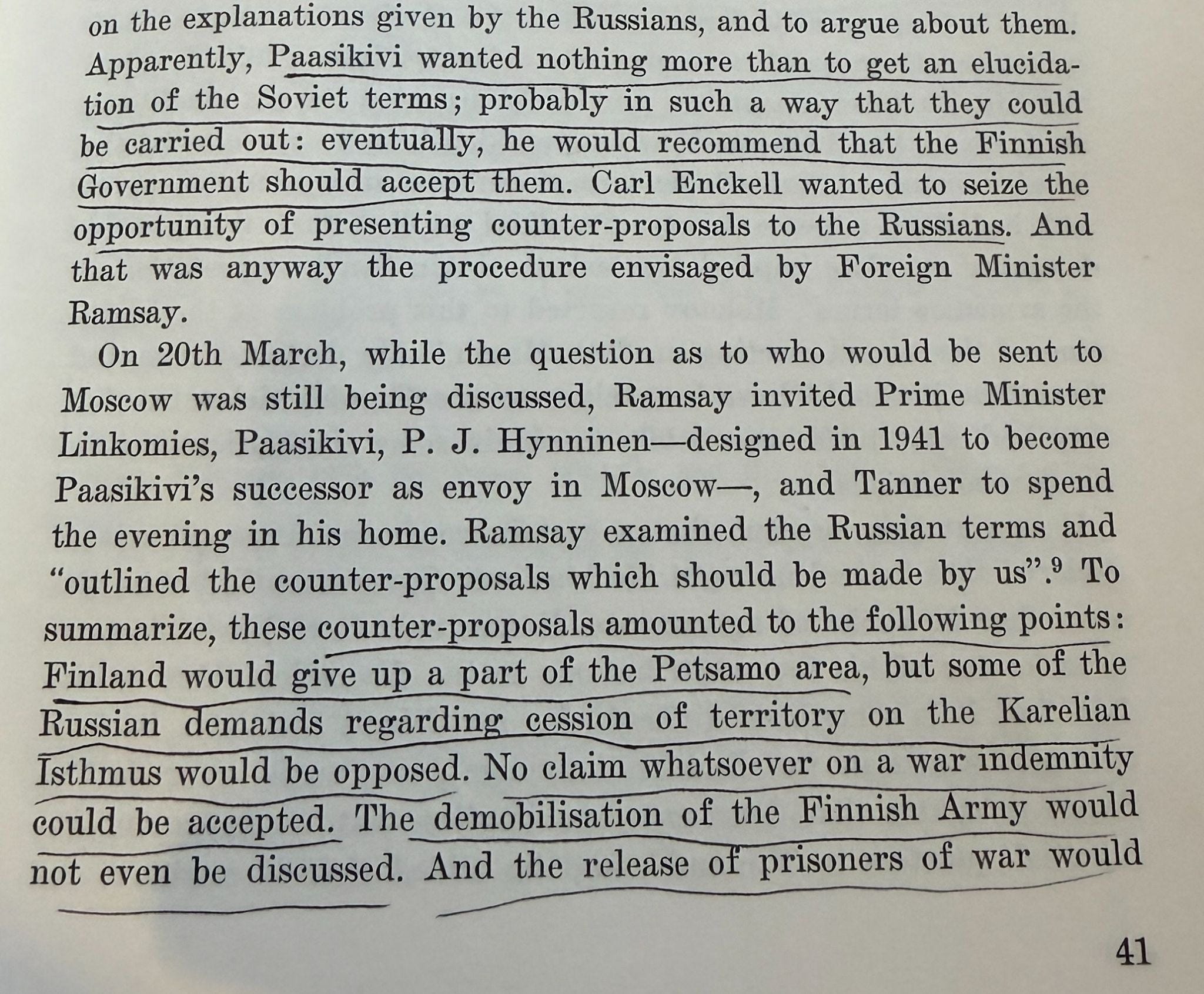
Paasikivi [analogous to Witkoff] wanted nothing more than to get an elucidation of the Soviet terms; probably in such a way that they could be carried out: eventually, he would recommend that the Finnish Government should accept them. Carl Enckell [analogous to Kellogg] wanted to seize the opportunity of presenting counter-proposals to the Russians. And that was anyway the procedure envisaged by Foreign Minister Ramsay [analogous in this specific instance to Secretary Rubio].
Ramsay examined the Russian terms and “outlined the counter-proposals which should be made by us”. To summarize, these counter-proposals amounted to the following points: Finland would give up a part of the Petsamo area, but some of the Russian demands regarding cession of territory on the Karelian Isthmus [equivalent to the Donbas] would be opposed. No claim whatsoever on a war indemnity could be accepted. The demobilization of the Finnish Army would not even be discussed.
These counter-proposals are very reminiscent of Kellogg’s June 2025 term sheet (that Russia seemingly rejected out of hand).
24) Paasikivi: “Finland always made concessions too late”:
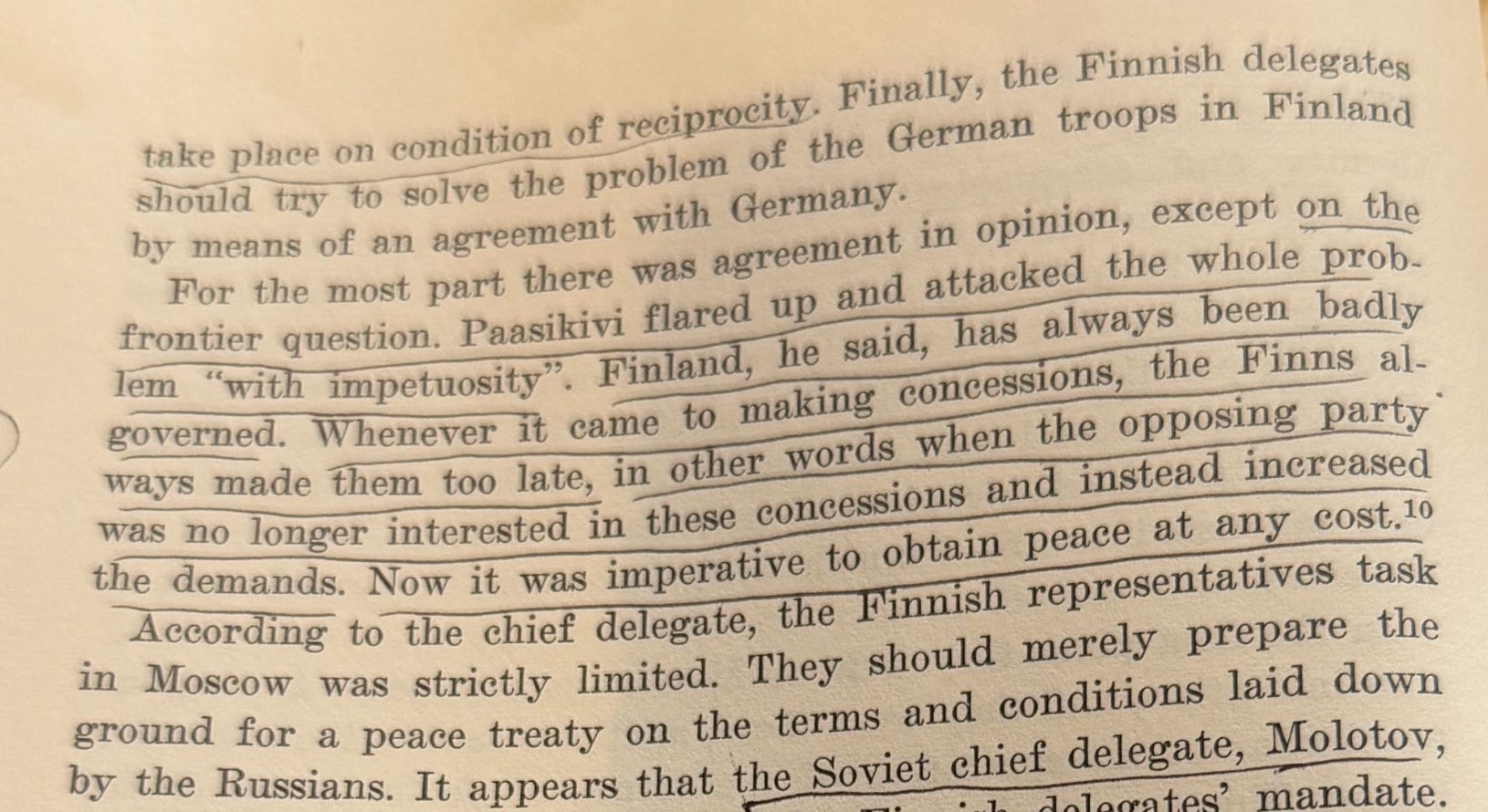
On the frontier question, Paasikivi flared up and attacked the whole problem “with impetuosity”. Finland, he said, has always been badly governed. Whenever it came to making concessions, the Finns always made them too late, in other words when the opposing party was no longer interested in these concessions and instead increased the demands. Now it was imperative to obtain peace at any cost.
According to the chief delegate [Paasikivi], the Finnish representatives’ task in Moscow was strictly limited. They should merely prepare the ground for a peace treaty on the terms and conditions laid down by the Russians.
25) Molotov: “Are you here as private citizens?”
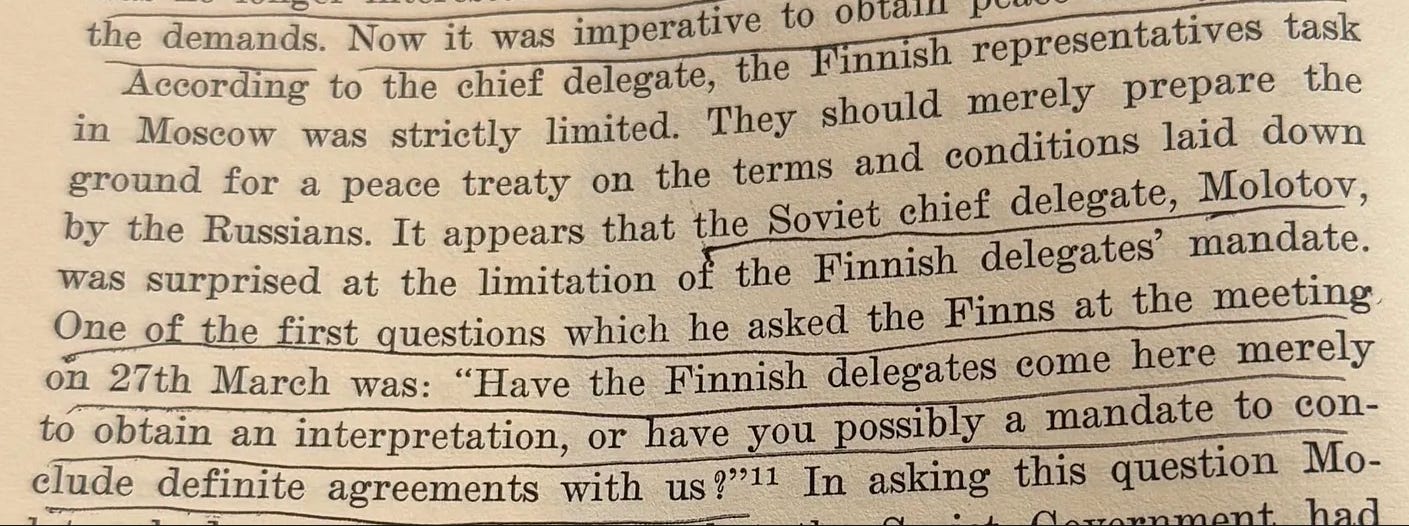

The Soviet chief delegate [and Foreign Minister], Molotov … One of the first questions he asked the Finns at the meeting was: “Have the Finnish delegates come here merely to obtain an interpretation, or have you possibly a mandate to conclude definite agreements with us?”
“But surely you have not come here as private citizens only?”
President Trump isn’t the only figure to utilize private citizens as envoys.
26) Letter from a diplomat:
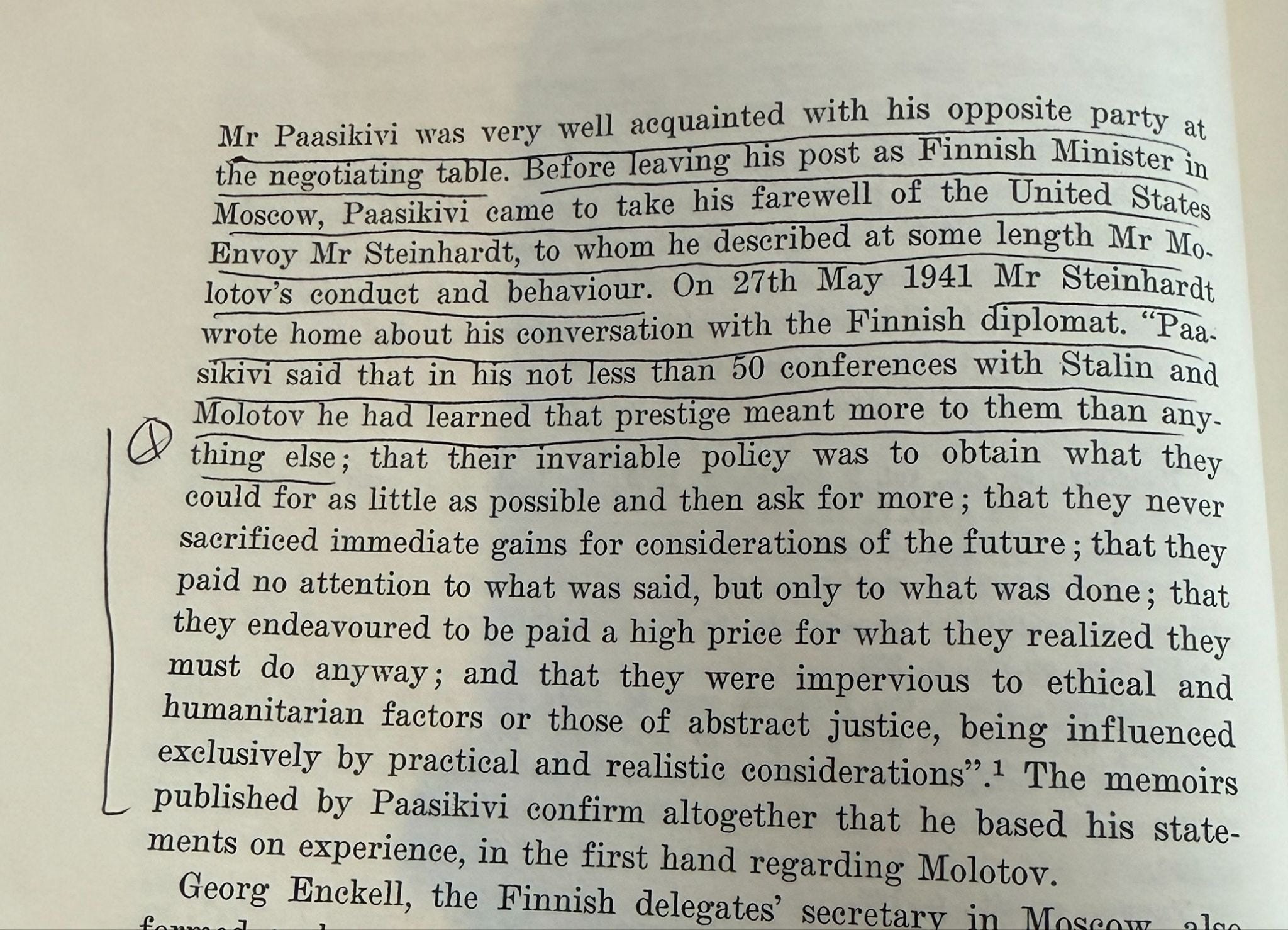
Mr Paasikivi was very well acquainted with his opposite party at the negotiating table. Before leaving his post as Finnish Minister in Moscow [in 1941], Paasikivi came to the farewell of the United States Envoy Mr Steinhardt, to whom he described at some length Mr Molotov’s conduct and behavior. Mr Steinhardt wrote home about his conversation with the Finnish diplomat. “Paasikivi said that in his not less than 50 conferences with Stalin and Molotov he had learned that prestige meant more to them than anything else; that their invariable policy was to obtain what they could for as little as possible and then ask for more; that they never sacrificed immediate gains for considerations of the future; that they paid no attention to what was said, but only to what was done; that they endeavored to be paid a high price for what they realized they must do anyway; and that they were impervious to ethical and humanitarian factors or those of abstract justice, being influenced exclusively by practical and realistic considerations.”
27) The two sides couldn’t reconcile sequencing:
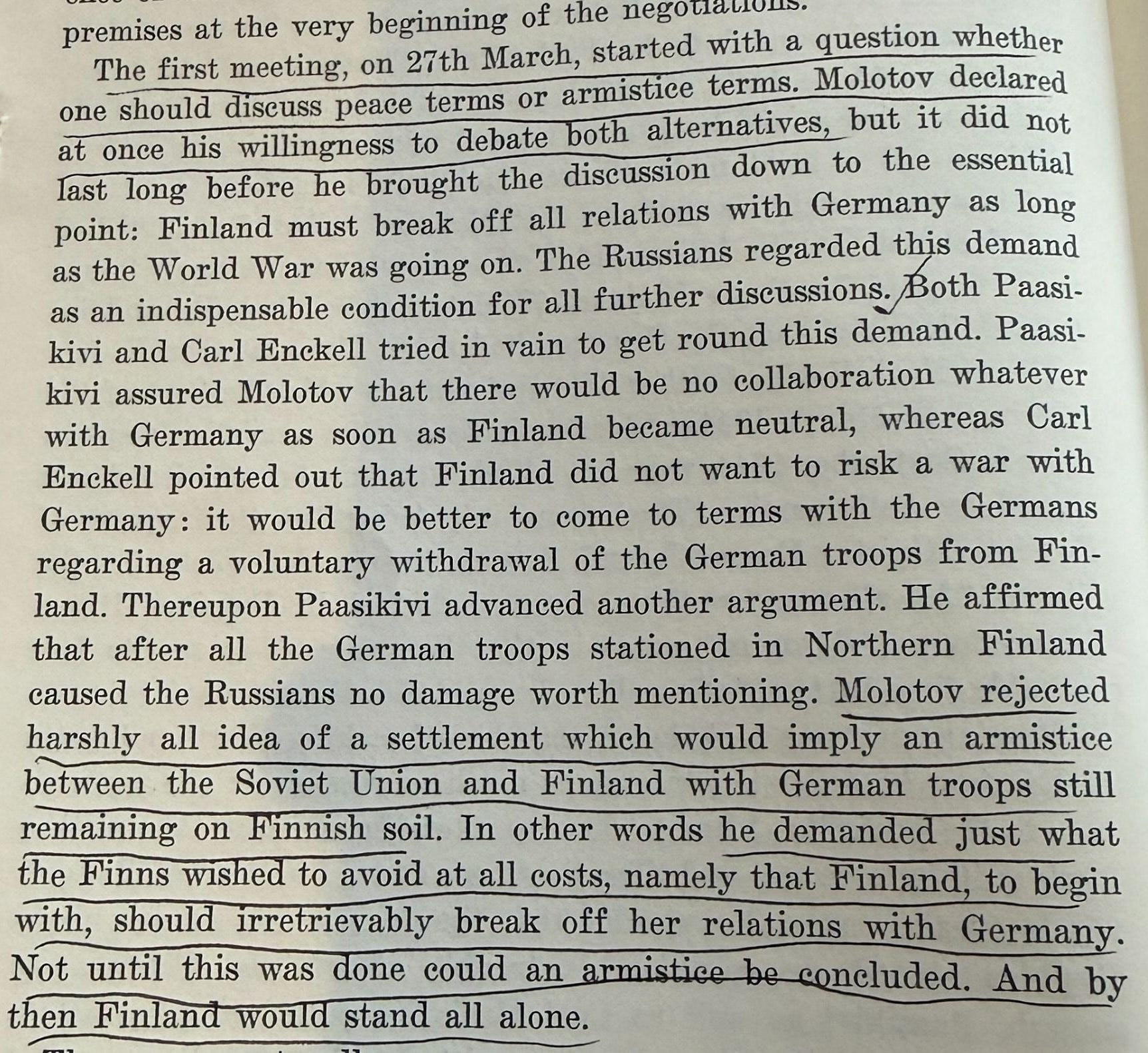
The first meeting started with a question whether one should discuss peace terms or armistice terms. Molotov declared at once his willingness to debate both alternatives, but it did not last long before he brought the discussion down to the essential point: Finland must break off all relations with Germany [today I imagine the equivalent: Ukrainian forces to withdraw from the Donbas and Ukraine to renounce any path to NATO membership] … The Russians regarded this demand as an indispensable condition for all further discussions. Both Paasikivi and Enckell tried in vain to get round this demand.
Molotov rejected harshly all idea of a settlement which would imply an armistice between the Soviet Union and Finland with German troops still remaining on Finnish soil. In other words he demanded just what the Finns wished to avoid at all costs … Not until this was done could an armistice be concluded. And by then Finland would stand all alone.
28) The Soviet mindset was Finland is already defeated:
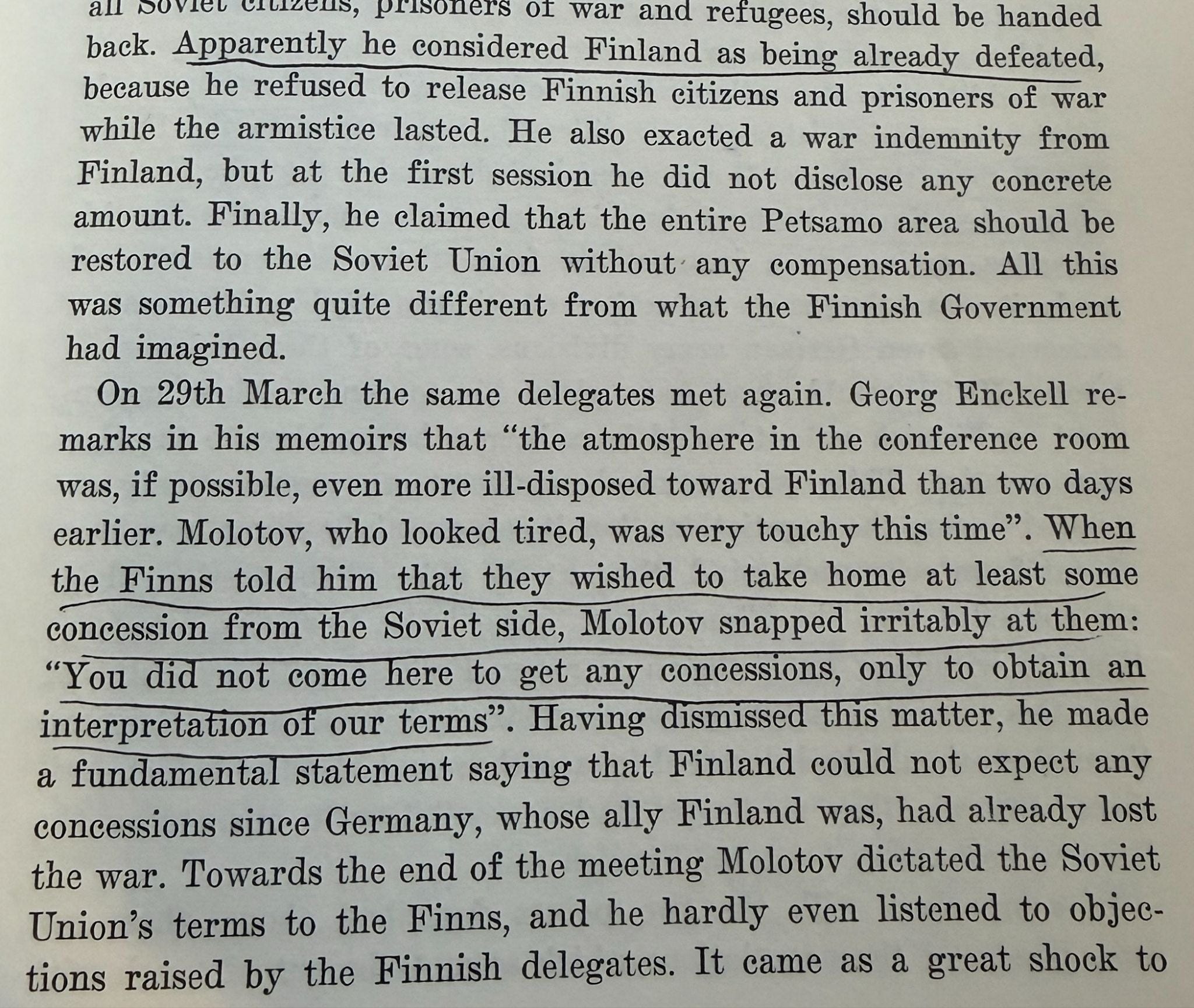
Apparently he [Molotov] considered Finland as being already defeated … All this was something quite different from what the Finnish Government had imagined … When the Finns told Molotov that they wished to take home at least some concession from the Soviet side, Molotov snapped irritably at them: “You did not come here to get any concessions, only to obtain an interpretation of our terms.” … he made a fundamental statement saying that Finland could not expect any concessions since Germany, whose ally Finland was, had already lost the war.” Towards the end of the meeting Molotov dictated the Soviet Union’s terms to the Finns, and he hardly even listened to objections raised by the Finnish delegates. It came as a great shock.
The actual dialogue from this part of negotiations…
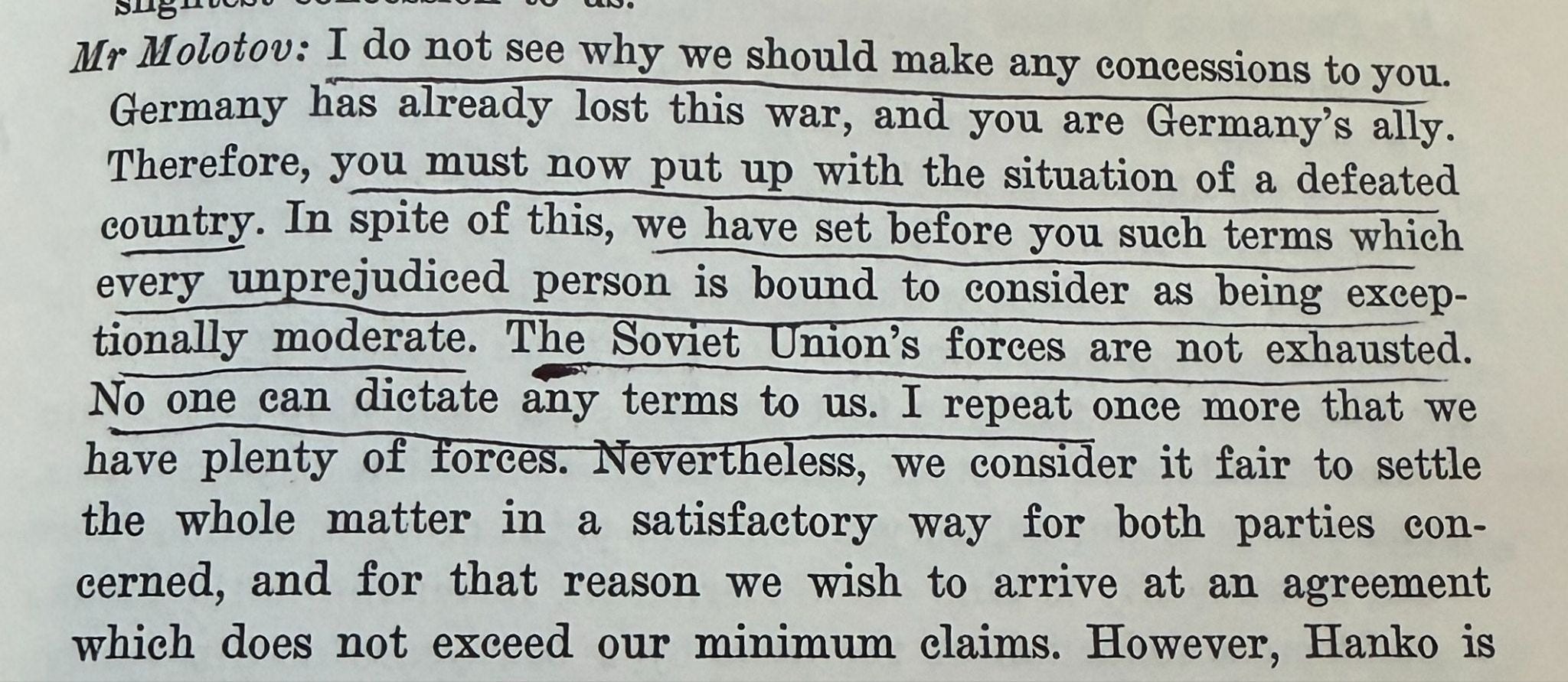
Molotov: I do not see why we should make any concessions to you. Germany has already lost this war, and you are Germany’s ally. Therefore, you must now put up with the situation of a defeated country. In spite of this, we have set before you such terms which every unprejudiced person is bound to consider as being exceptionally moderate. The Soviet Union’s forces are not exhausted. No one can dictate any terms to us. I repeat once more that we have plenty of forces.
29) The Finns, however, did drive two concessions:
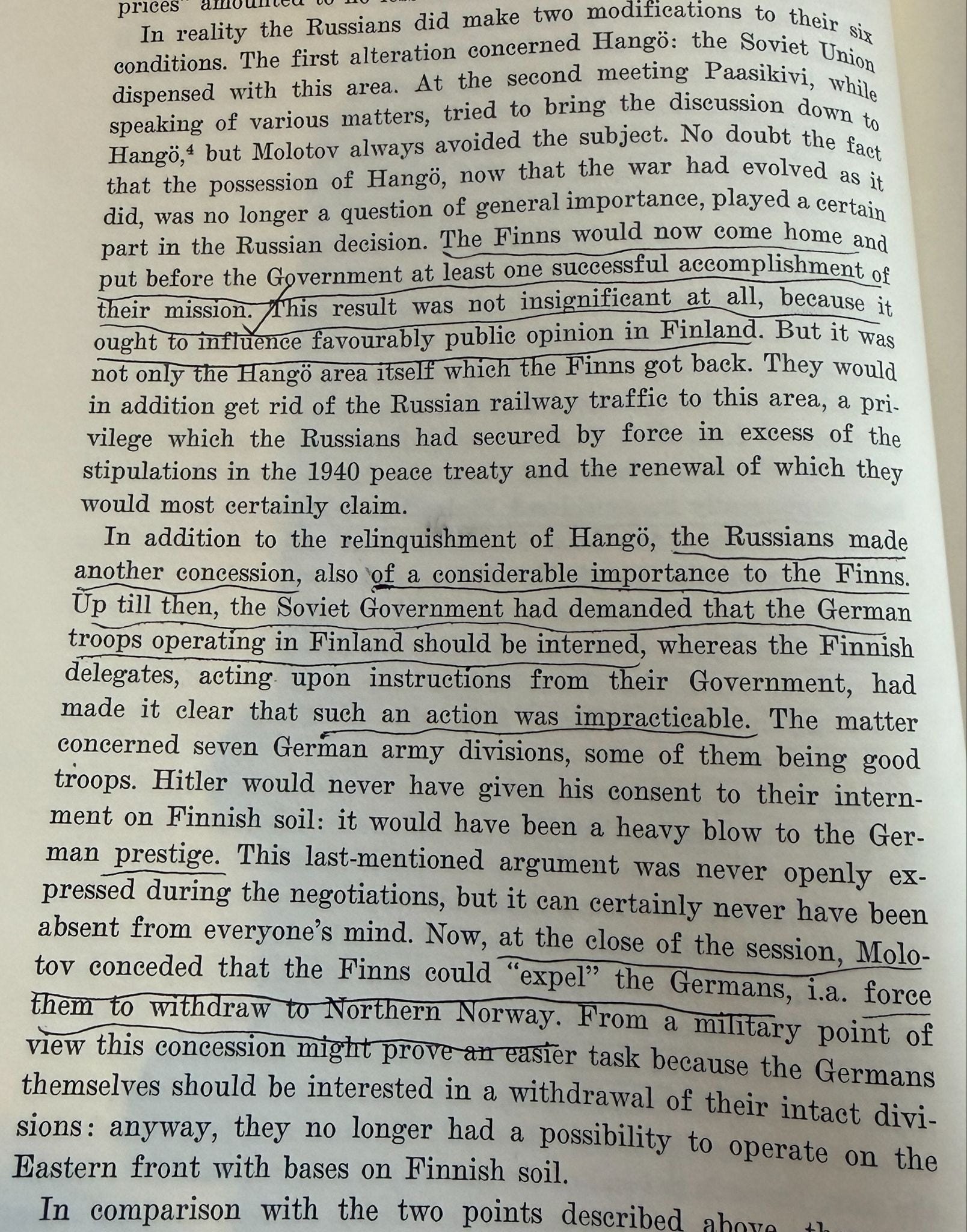
In reality the Russians did make two modifications to their six conditions. The first alteration concerned Hangö [a south-western Finnish port]: the Soviet Union dispensed with this area … No doubt the fact that the possession of Hangö, now that the war had evolved as it did, was no longer a question of general importance, played a certain part in the Russian decision. The Finns would now come home and put before the Government at least one successful accomplishment of their mission. This result was not insignificant at all, because it ought to influence favorably public opinion in Finland. [So we see that the Finnish envoys really were looking for things they could use to sell an agreement at home.]
The Russians made another concession, also of a considerable importance to the Finns. Up till then, the Soviet Government had demanded that the German troops operating in Finland should be interned [meaning: captured, disarmed, and put into camps until the end of the war], whereas the Finnish delegates, acting upon instructions from their Government, had made it clear that such an action was impractical. The matter concerned seven German army divisions [~200,000 troops total], some of them being good troops.
…At the close of the session, Molotov conceded that the Finns could “expel” the Germans, i.e. force them to withdraw to Northern Norway [instead]. From a military point of view this concession might prove an easier task because the Germans themselves should be interested in a withdrawal of their intact divisions.
This latter point was a sizeable concession – on the Soviets’ #1 agreement condition. US negotiators should perhaps take some solace: the Soviets were capable of concessions, despite their firmness. Perhaps Russia’s leadership might be today.
[When driven to leave in late 1944, the German soldiers ended up destroying much of Northern Finland on their way out – the 200-day “Lapland War”, a scorched-earth German retreat, destroying Finnish bridges, roads and rail lines – demonstrating the sensitivity of handling them.]
30) The Finns returned to Helsinki with an outline armistice agreement. Note in this photo the simplicity of 7 numbered points:
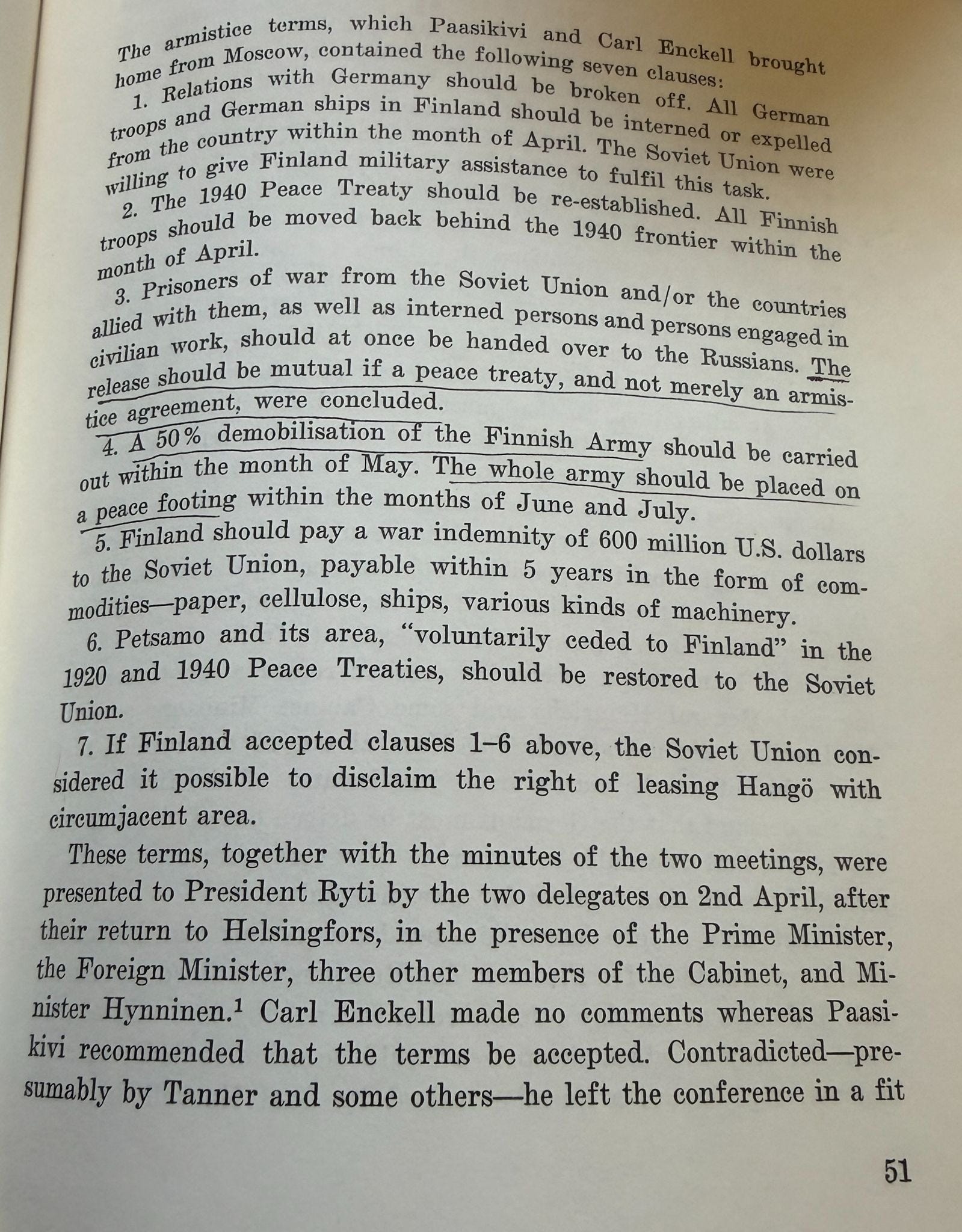
Notably:
4. A 50% demobilization of the Finnish Army should be carried out within the month of May. The whole army should be placed on a peace footing within the months of June and July. [We come onto demobilization much more below – it was contentious.]
7. If Finland accepted clauses 1–6 above, the Soviet Union considered it possible to disclaim the right of leasing Hangö with circumjacent area. [The Soviets sequencing things such that their other terms had to be accepted first before concessions could be considered.]
These terms, together with the minutes of the two meetings, were presented to President Ryti [of Finland] by the two delegates … in the presence of the Prime Minister, the Foreign Minister, three other members of the Cabinet … Enckell made no comments whereas Paasikivi recommended that the terms be accepted.
31) The terms were much harsher than the Finnish government had expected:
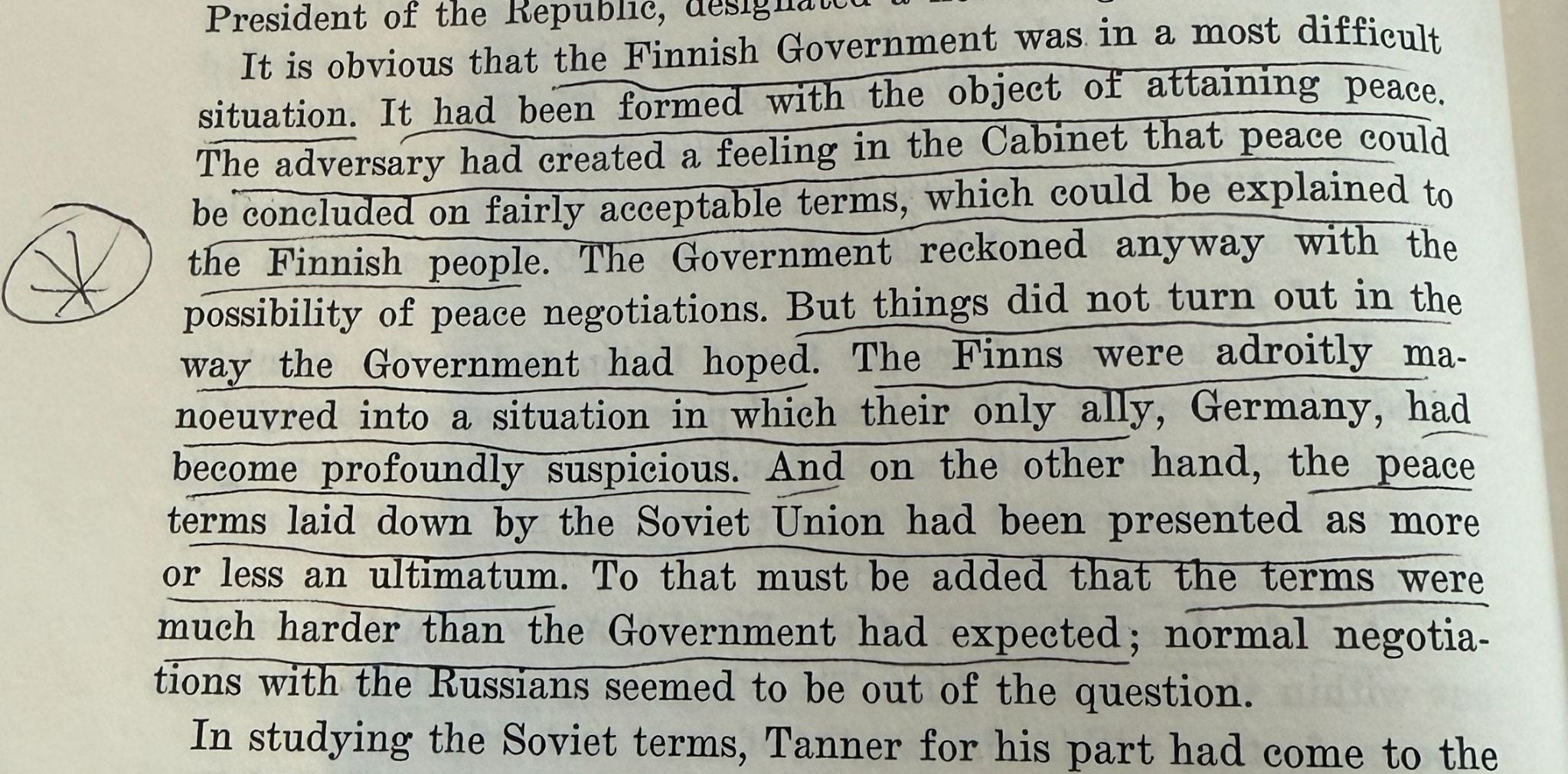
The Finnish Government … had been formed with the object of attaining peace [as Zelensky’s government in 2019 originally was]. The adversary had created a feeling in the [Finnish] Cabinet that peace could be concluded on fairly acceptable terms, which could be explained to the Finnish people … But things did not turn out in the way the Government had hoped. The Finns were adroitly maneuvered into a situation in which their only ally [Germany] had become profoundly suspicious. And … the peace terms laid down by the Soviet Union had been presented as more or less an ultimatum … the terms were much harder than the Government had expected; normal negotiations with the Russians seemed to be out of the question.
32) Demobilization and territory were the biggest sticking points:

Ramsay [Finland’s Foreign Minister] told the German Minister that the Finns considered the demobilization of their army as the hardest condition and the cession of Karelia as the hardest but one.
33) Finland unanimously rejected the terms and broke off talks:
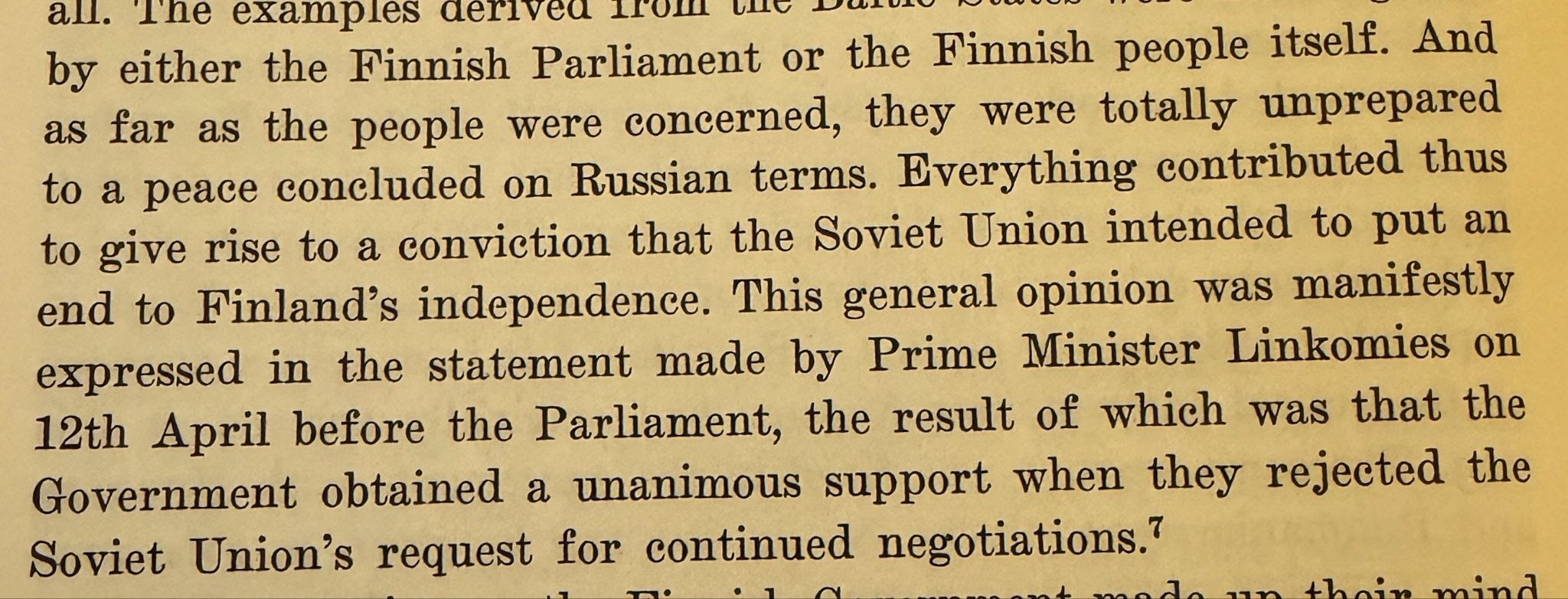
As far as the people were concerned, they were totally unprepared for a peace concluded on Russian terms. Everything contributed thus to give rise to a conviction that the Soviet Union intended to put an end to Finland’s independence … the Government obtained a unanimous support when they rejected the Soviet Union’s request for continued negotiations.
34) A massive Soviet offensive followed, driving Finland to implore to come back to the negotiating table three months later. This seems predictable today if Ukraine cannot be persuaded to go along with US-negotiated terms:
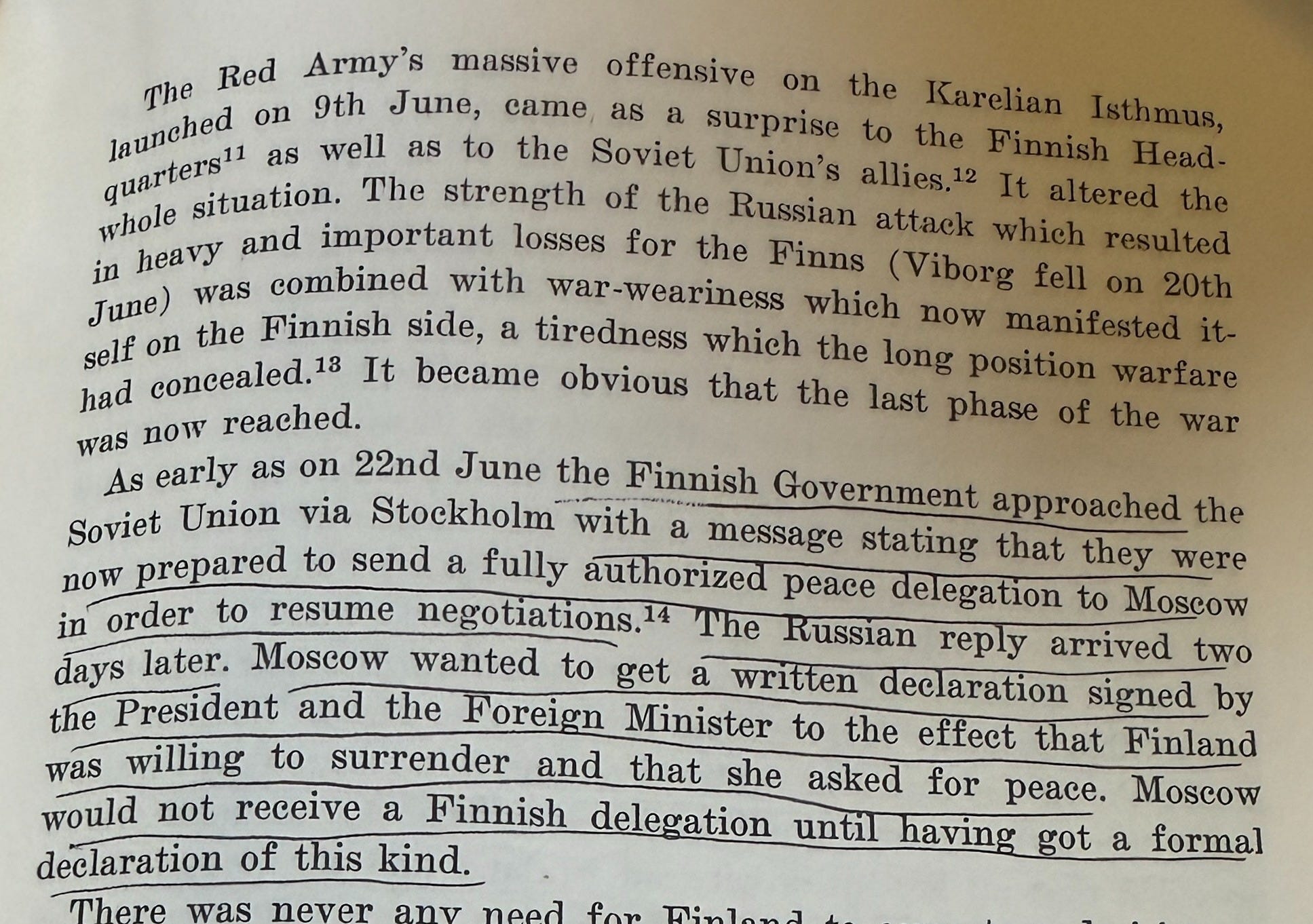
The Red Army’s massive offensive on the Karelian Isthmus [equivalent to the Donbas] came as a surprise to the Finnish Headquarters as well as to the Soviet Union’s allies. It altered the whole situation. The strength of the Russian attack which resulted in heavy and important losses for the Finns was combined with a war-weariness which now manifested itself on the Finnish side, a tiredness which the long position warfare had concealed. It became obvious that the last phrase of the war was now reached.
As early on as June [1944], the Finnish Government approached the Soviet Union with a message stating that they were now prepared to send a fully authorized peace delegation to Moscow in order to resume negotiations. The Russian reply arrived two days later. Moscow wanted to get a written declaration signed by the President and the Foreign Minister to the effect that Finland was willing to surrender and that she asked for peace. Moscow would not receive a Finnish delegation until having got a formal declaration of this kind.
35) Unexpectedly, Finland’s ally (Germany) militarily backed up Finland:
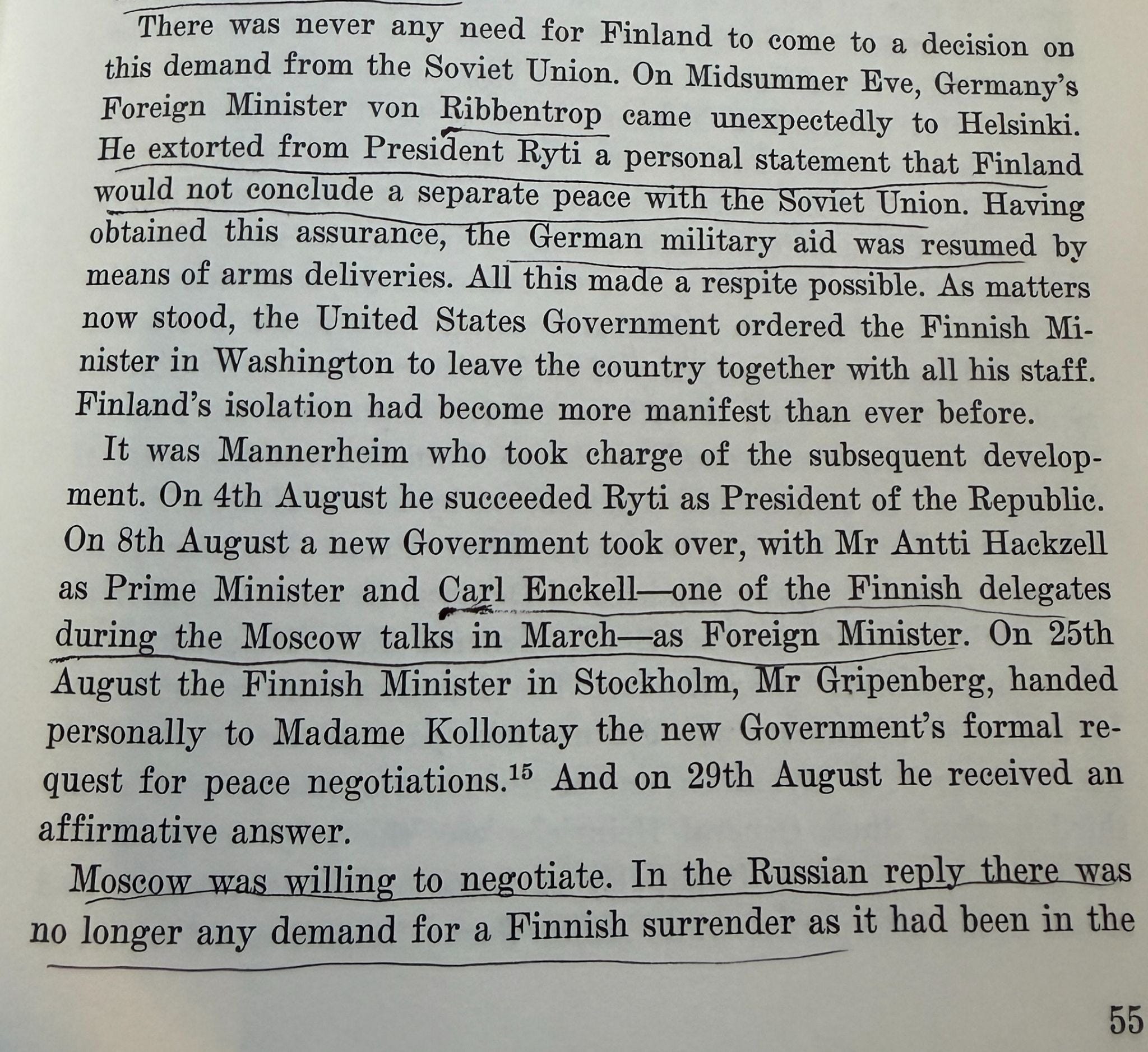
There was never any need for Finland to come to a decision on this demand … On Midsummer Eve [June 24], Germany’s Foreign Minister von Ribbentrop came unexpectedly to Helsinki … the German military aid was resumed by means of arms deliveries. All this made a respite possible.
Mannerheim [new Finnish President] took charge of the subsequent development. On 4th August he succeeded Ryti as President [note: this was done by an exceptional parliamentary procedure, not an election, due to the war].
… [By late August 1944, being militarily fortified] Moscow was willing to negotiate. In the Russian reply there was no longer any demand for a Finnish surrender as it had been.
36) Finland then agreed to withdraw troops and give up requested territory in Karelia:
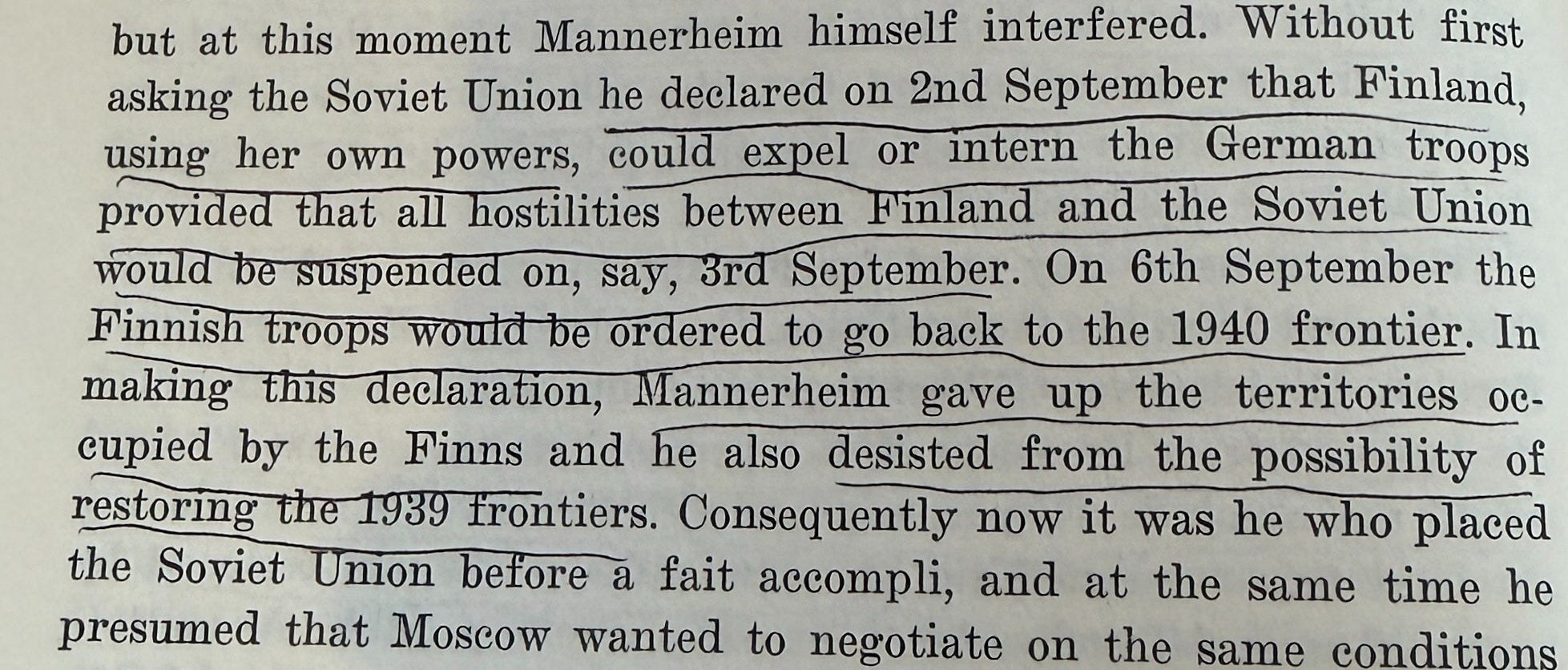
Mannerheim [the new Finnish President], without first asking the Soviet Union, declared on 2nd September [1944] that Finland, using her own powers, could expel or intern the German troops provided that all hostilities between Finland and the Soviet Union would be suspended on, say, 3rd September. [And this is immediately after Germany has just helped them.] On 6th September the Finnish troops would be ordered [by Finnish military leadership] to go back to the 1940 frontier [the equivalent of Russia’s territorial demand to Ukraine today]. In making this declaration, Mannerheim gave up the territories occupied by the Finns and he also desisted from the possibility of restoring the 1939 frontiers.
37) The resulting second round of talks reached a fast conclusion:
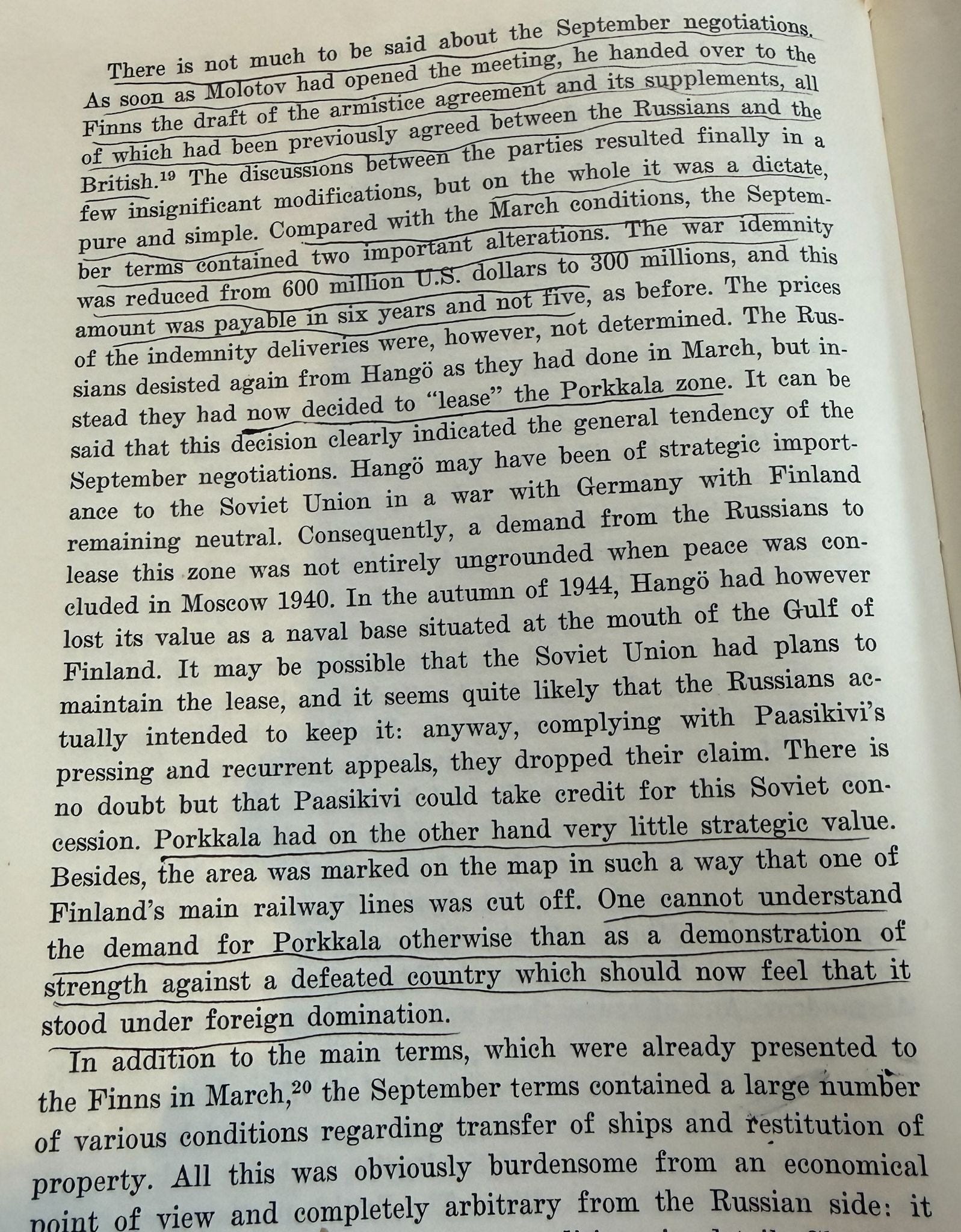
There is not much to be said about the September [1944] negotiations. As soon as Molotov had opened the meeting, he handed over to the Finns the draft of the armistice agreement and its supplements, all of which had been previously agreed between the Russians and the British [the two at this moment, allies]. The discussions between the parties resulted finally in a few insignificant modifications, but on the whole it was a dictate, pure and simple. Compared with the March conditions, the September terms contained two important alterations. The war indemnity was reduced … The Russians desisted again from Hangö as they had done in March, but instead they had now decided to “lease” the Porkkala zone [another port in the south near Helsinki].
Porkkala had very little strategic value. One cannot understand the demand other than as a demonstration of strength against a defeated country which should now feel that it stood under foreign domination.
In addition to the main terms, which were already presented to the Finns in March, the September terms contained a large number of various conditions regarding transfer of ships and restitution of property. All this was obviously burdensome from an economical point of view and completely arbitrary from the Russian side.
38) The negotiating mood was now different. “Brutality formed part of Molotov’s negotiating technique”:
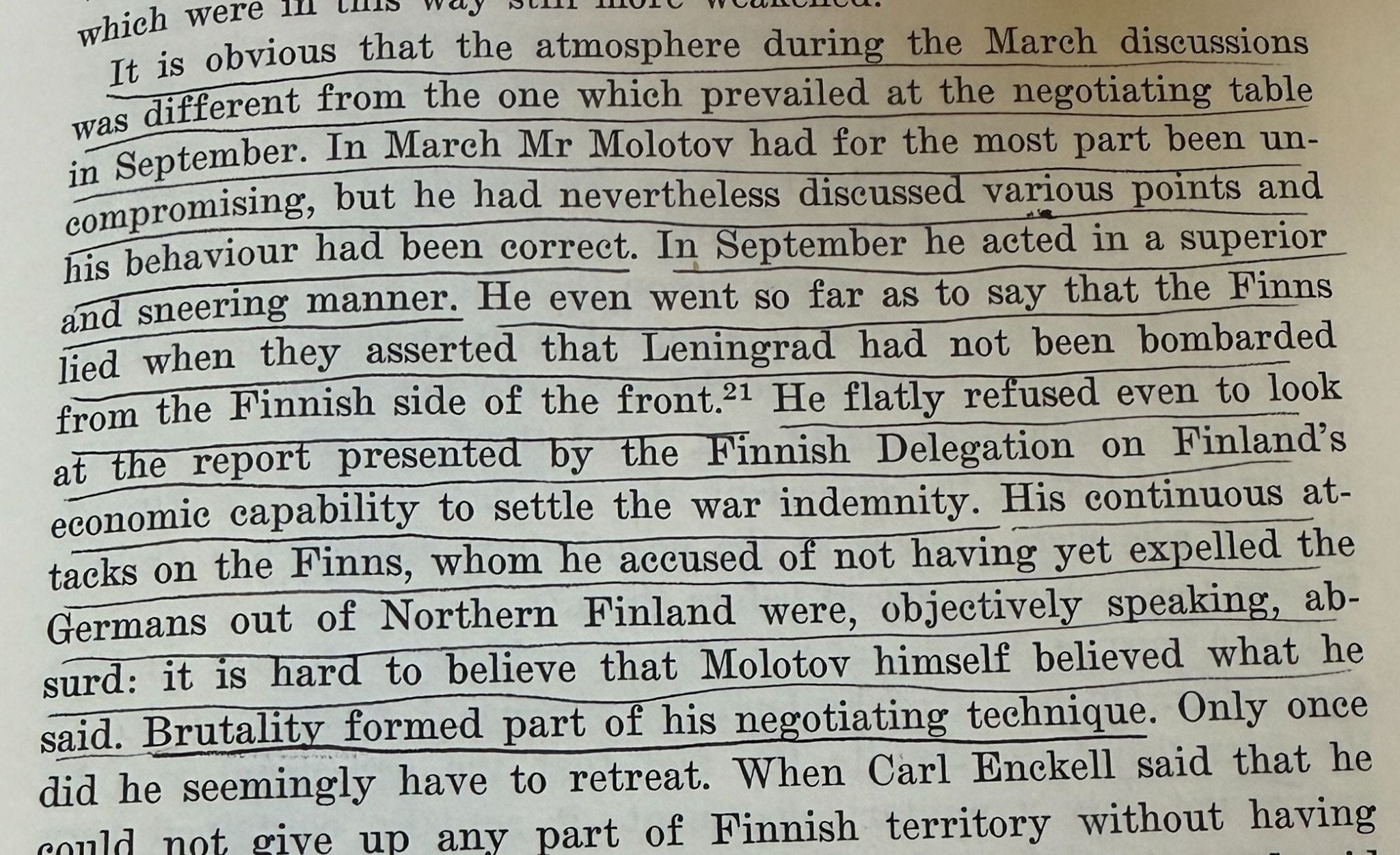
It is obvious that the atmosphere during the March [1944] discussions was different from the one which prevailed at the negotiating table in September. In March Mr Molotov had for the most part been uncompromising, but he had nevertheless discussed various points and his behavior had been correct. In September he acted in a superior and sneering manner. He even went so far as to say that the Finns lied when they asserted that Leningrad had not been bombarded from the Finnish side of the front. He flatly refused even to look at the report presented by the Finnish Delegation on Finland’s economic capability to settle the war indemnity. His continuous attacks on the Finns, whom he accused of not having yet expelled the Germans out of Northern Finland were, objectively speaking, absurd: it is hard to believe that Molotov himself believed what he said. Brutality formed part of his negotiating technique.
The passage referenced of Molotov dismissing a report:
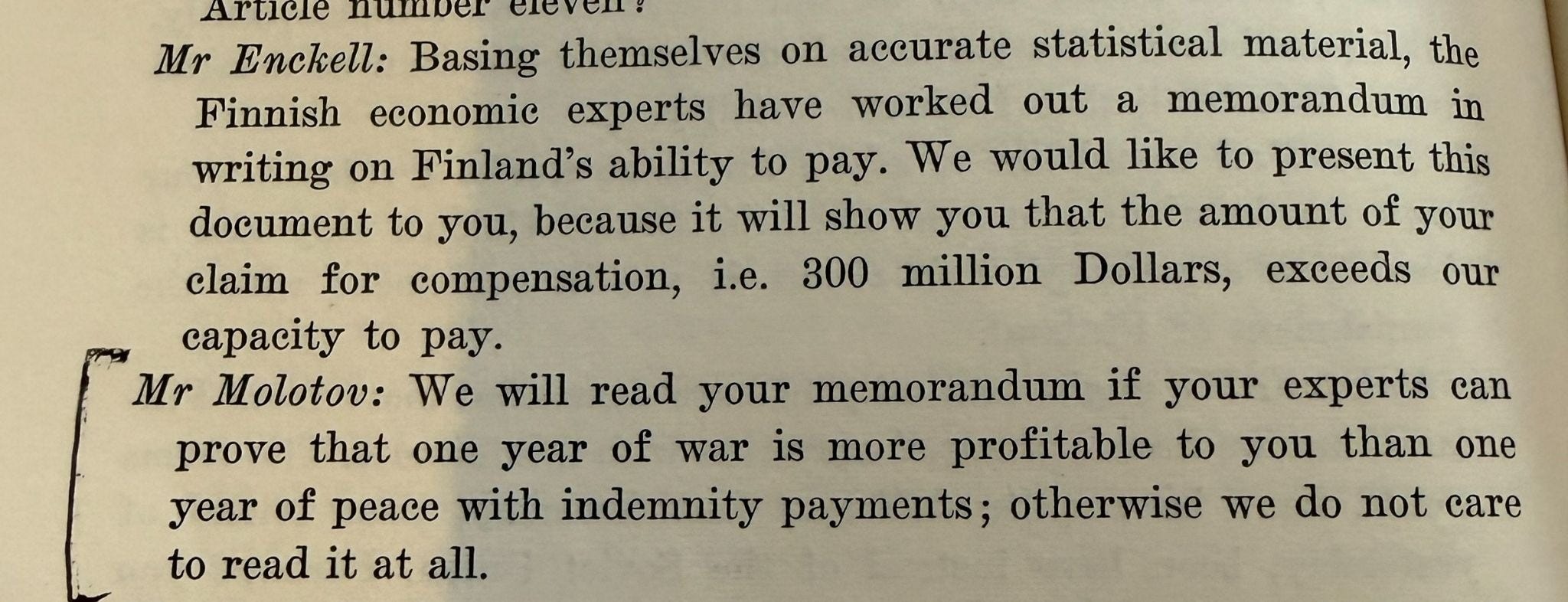
Enckell [Finnish Foreign Minister]: The Finnish economic experts have worked out a memorandum in writing on Finland’s ability to pay. We would like to present this document to you, because it will show you that the amount of your claim for compensation exceeds our capacity to pay.
Molotov: We will read your memorandum if your experts can prove that one year of war is more profitable to you than one year of peace with indemnity payments; otherwise we do not care to read it at all.
39) The reason was: Molotov had personally gotten the blame for the March talks falling apart:
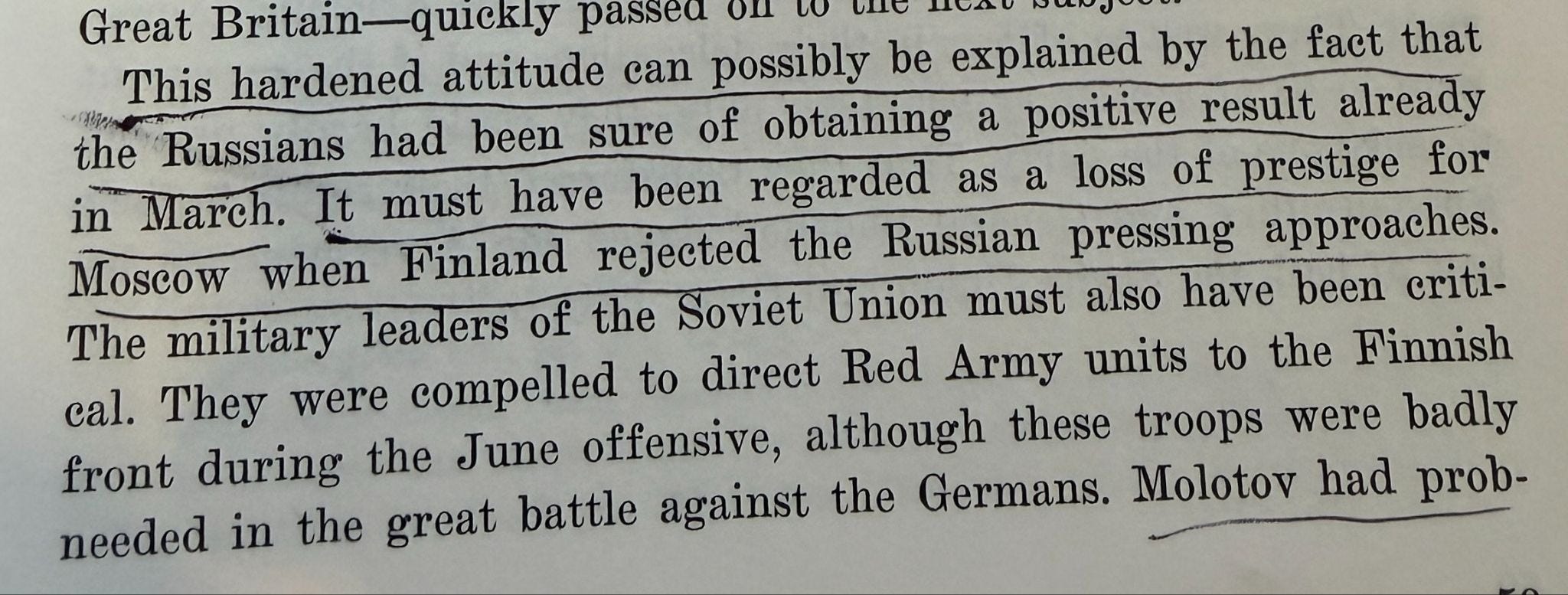
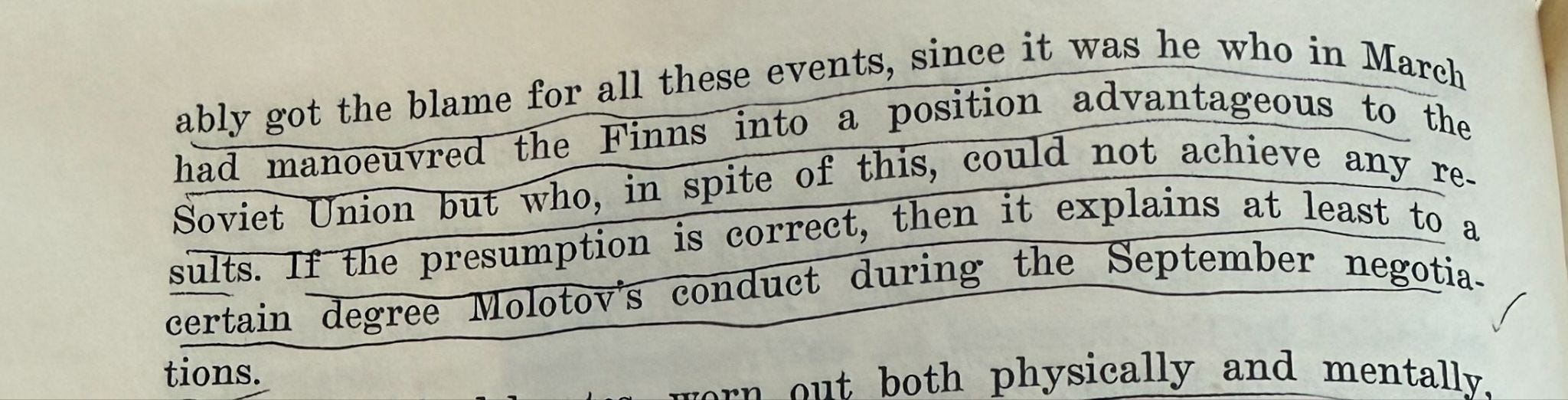
This hardened attitude can possibly be explained by the fact that the Russians had been sure of obtaining a positive result already in March. It must have been regarded as a loss of prestige for Moscow when Finland rejected the Russian pressing approaches. The military leaders of the Soviet Union must also have been critical … Molotov had probably got the blame for all these events, since it was he who in March had maneuvered the Finns into a position advantageous to the Soviet Union but who, in spite of this, could not achieve any results. If the presumption is correct, then it explains at least to a certain degree Molotov’s conduct during the September negotiations.
In November 2025, in the run-up to slated further talks between Presidents Trump and Putin, Foreign Minister Lavrov had a phone call with Secretary Rubio in which it was reported that Lavrov was implacable. (There’s mixed reporting on the call. I’m not entirely sure the truth of this.) The suggestion of talks in Budapest fell apart, and Lavrov wasn’t seen in meetings with Putin for several weeks. Could something similar have happened?
40) Despite Molotov’s harsh tone, the Finns had little option but to accept:
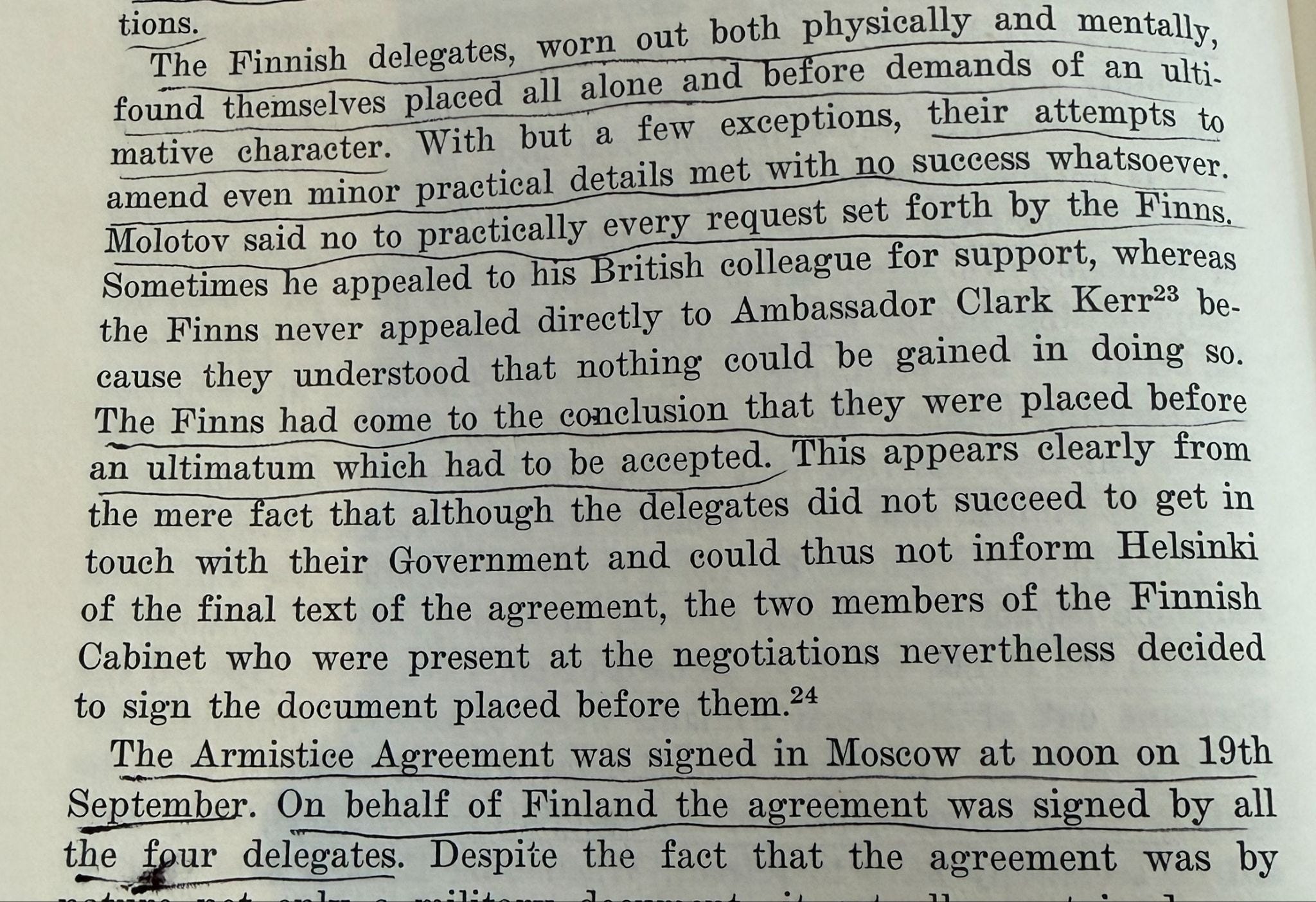
The Finnish delegates, worn out both physically and mentally, found themselves placed all alone and before demands of an ultimative character … their attempts to amend even minor practical details met with no success whatsoever. Molotov said no to practically every request set forth by the Finns … The Finns had come to the conclusion that they were placed before an ultimatum which had to be accepted … the delegates did not succeed to get in touch with their Government and could thus not inform Helsinki of the final text of the agreement, [but] the two members of the Finnish Cabinet who were present at the negotiations nevertheless decided to sign the document placed before them.
The Armistice Agreement was signed in Moscow at noon on 19th September [1944]. On behalf of Finland the agreement was signed by all the four delegates.
This last point is very interesting. My read of it is in having four Finns sign the document (two of whom were Cabinet members), this spread the load of responsibility, so no individual would be singled out as an appeaser. It’s perhaps how an administration in a very weak position can demonstrate unanimity – in an instance in which no single figure would be willing alone to sign onto such terms.
41) Molotov, the first go around, had pushed too hard:
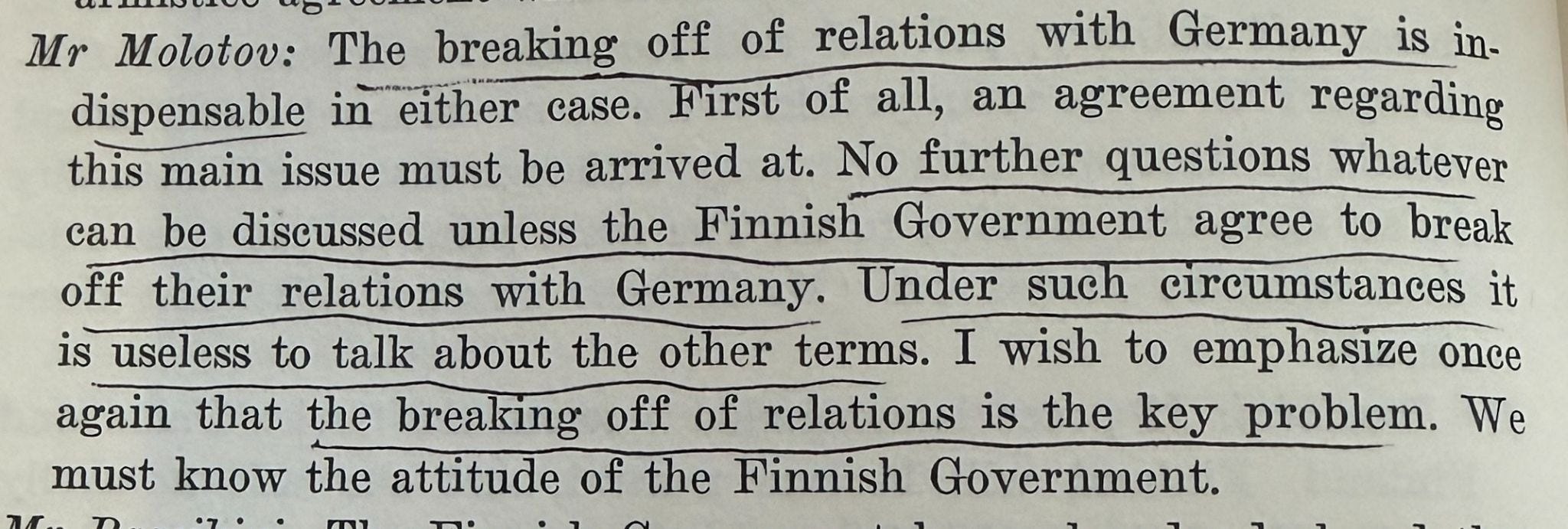
Mr Molotov: The breaking off of relations with Germany is indispensable … No further questions whatever can be discussed unless the Finnish Government agree to break off their relations with Germany. Under such circumstances it is useless to talk about the other terms … the breaking off of relations [between Finland and Germany] is the key problem.
His inflexibility meant that domestically the Finns simply couldn’t agree to continue talking.
42) The sides got stuck on sequencing.
In my reading of the dialogue, with the benefit of hindsight, the logical sequence would have been: 1) Armistice, 2) Finland right away expels German troops, 3) Full peace agreement.
But Molotov was adamant the order had to be: 1) Finland expels troops, 2) Armistice.
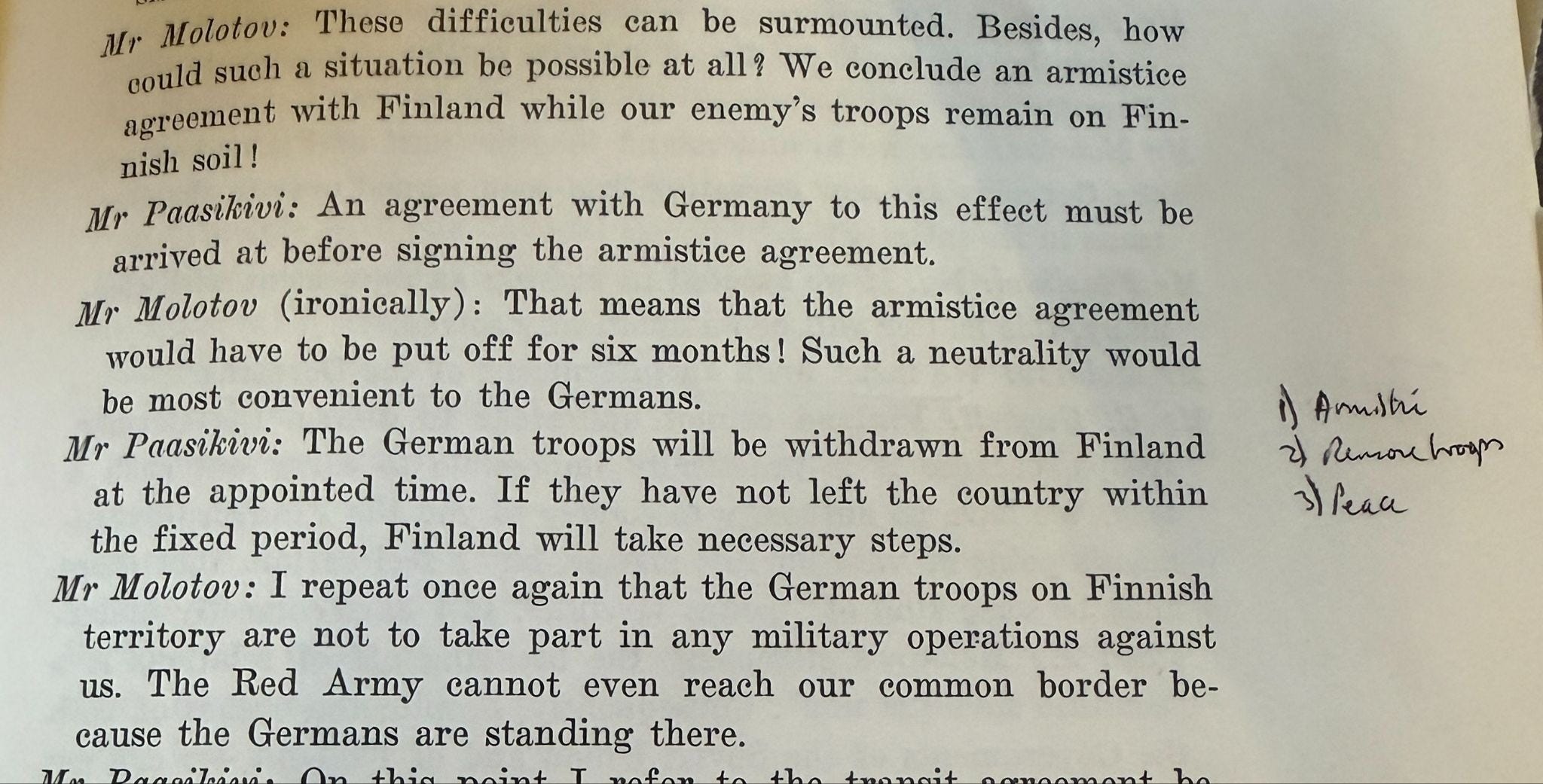
Molotov: How could such a situation be possible at all? We conclude an armistice agreement with Finland while our enemy’s troops remain on Finnish soil!
Paasikivi: An agreement with Germany to this effect must be arrived at before signing the armistice agreement.
Molotov, ironically: That means that the armistice agreement would have to be put off for six months! Such a neutrality would be most convenient to the Germans.
The two sides, in these March negotiations, couldn’t reconcile the sequencing. And the talks fell apart.
Today regarding the Donbas, various sides appear to be arguing either:
a) (Russia) Full withdrawal from the Donbas, then a ceasefire
b) (Ukraine) Freeze the line of control where it is
Few people seem to be arguing: c) immediate armistice (with agreement Ukraine will subsequently withdraw), then withdrawal from Donbas, then a full peace agreement. This history suggests that’s likely the ultimate outcome.
43) Adamant as they appear, it is possible to get Soviets/Russians to make a few concessions, even when they have the militarily dominant upper hand:

Molotov: We insist upon an internment of the Germans.
Enckell: Finland cannot undertake to disarm the German troops, because it is practically impossible to carry out such a task.

Molotov: No, no, it is not a question of voluntary withdrawal, but instead of their internment. It means that their weapons are to be taken away from them and that they are to be interned in camps until the end of the war.
But Molotov by the end of the March talks conceded that German troops could merely be expelled from Finland (not captured and disarmed). That was a big concession.
Molotov’s ardent language had been:
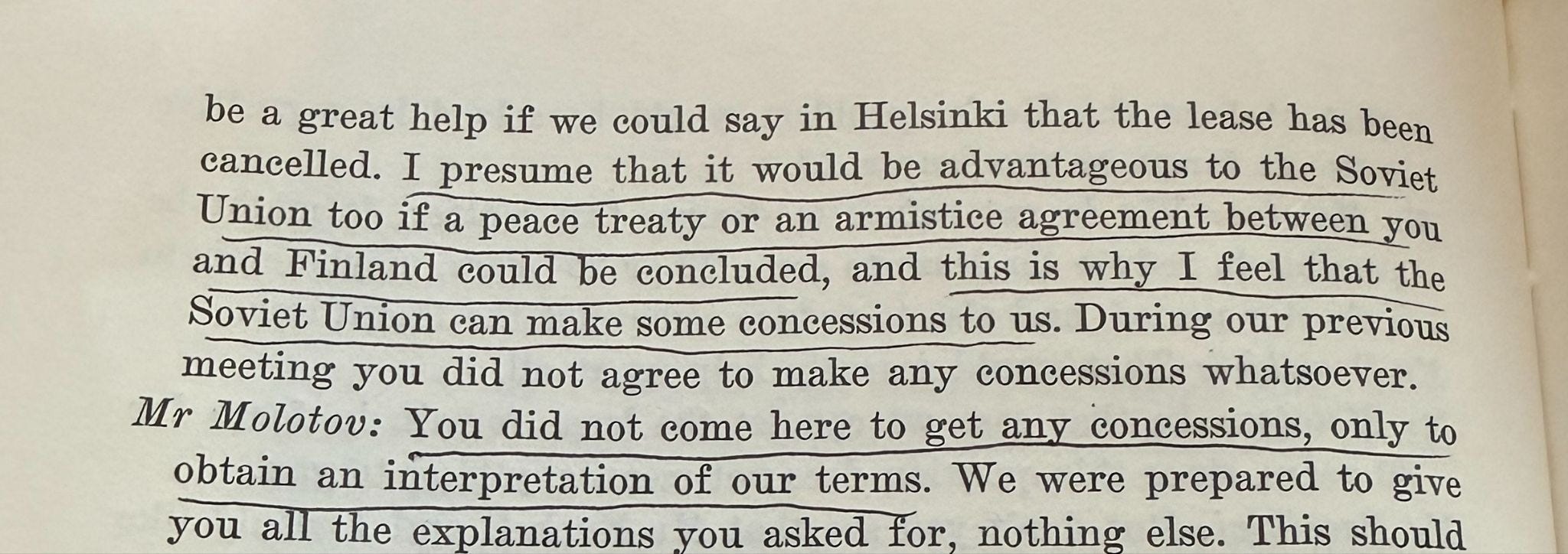
Molotov: You did not come here to get any concessions, only to obtain an interpretation of our terms. We were prepared to give you all the explanations you asked for, nothing else.
Important: Molotov made this concession on internment immediately following a two-hour interval in the talks. This isn’t explicitly said in the book, or anywhere I can find online, but, the talks having taken place in Moscow, it’s reasonable to infer that Molotov consulted directly with Stalin during this break, and that Stalin agreed to (perhaps even suggested) a concession on expelling the troops if “internment” was going to be a roadblock. It seems clear Molotov (as Foreign Minister) did not have the authority to make this concession himself.
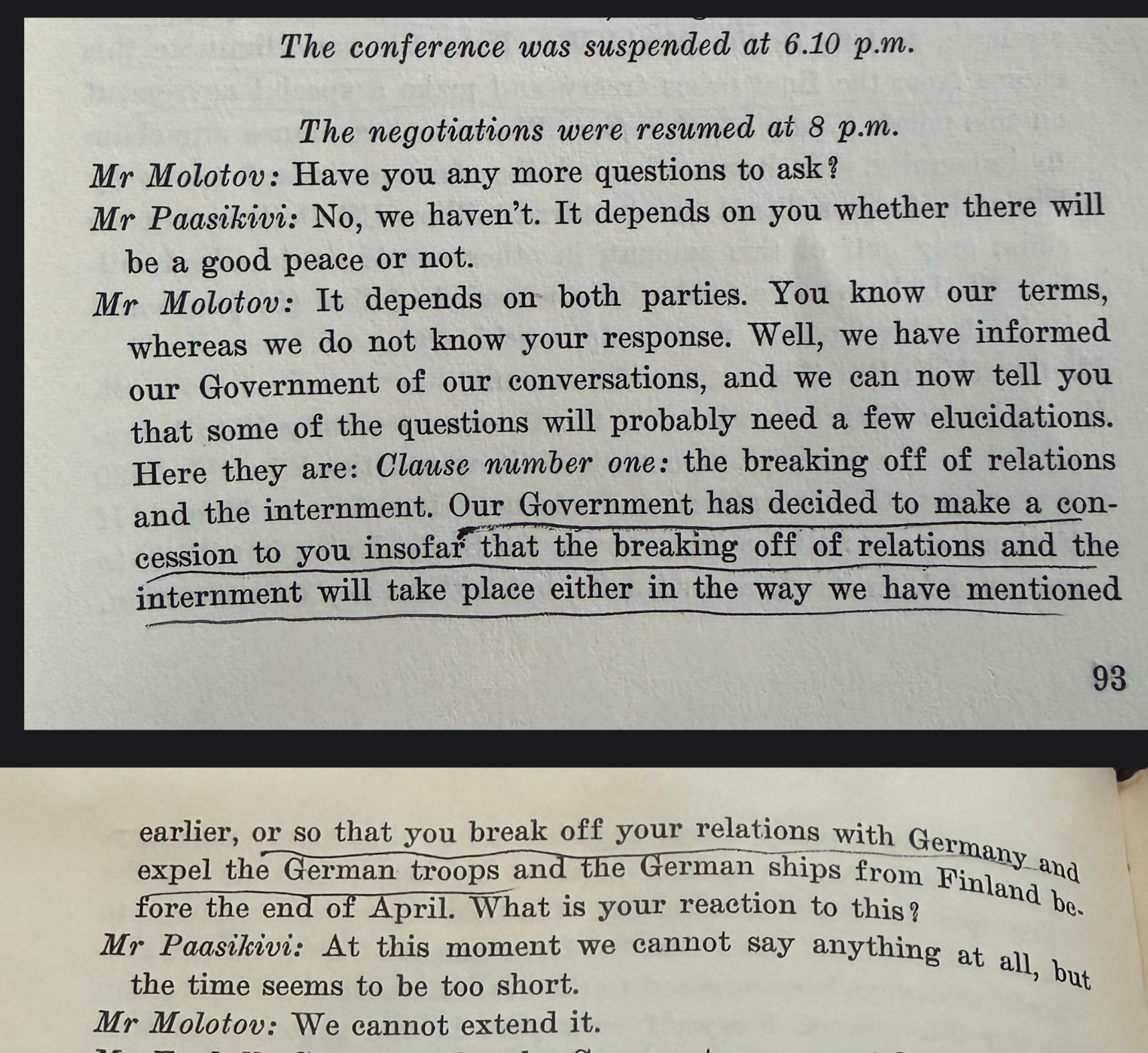
The conference was suspended at 6.10 p.m.
The negotiations resumed at 8 p.m.
[Almost immediately] Molotov: Our Government has decided to make a concession to you insofar that the breaking off of relations and the internment will take place either in the way we have mentioned, or so that you break off your relations with Germany and expel the German troops … What is your reaction to this?
From all prior dialogue, this seemed highly unlikely.
But it’s a point Trump makes himself in Art of the Deal – often, to get concessions, you need to go to the very top:
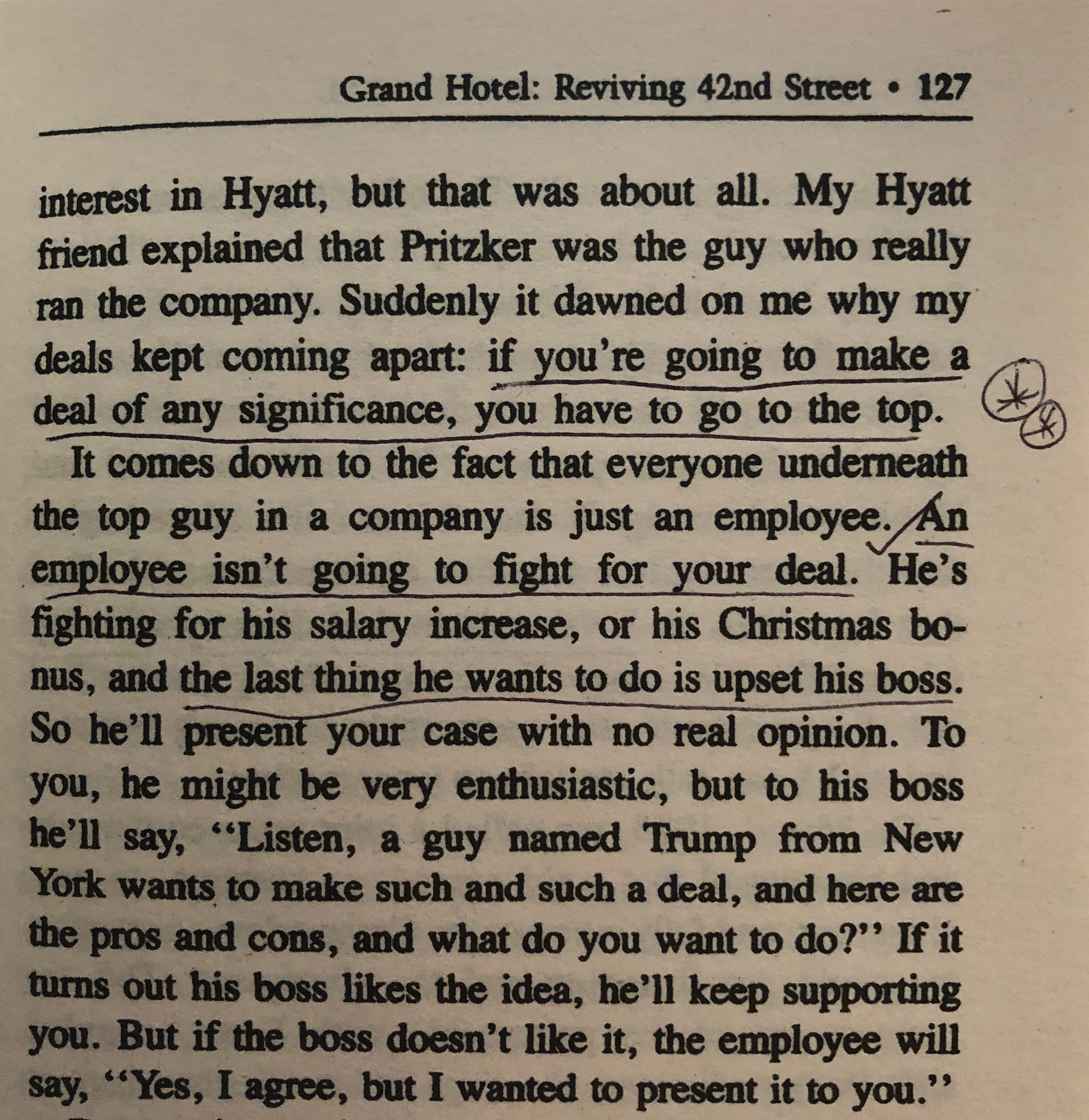
Trump, 1987: Suddenly it dawned on me why my deals kept coming apart: if you’re going to make a deal of any significance, you have to go to the top. It comes down to the fact that everyone underneath the top guy in a company is just an employee. An employee isn’t going to fight for your deal … the last thing he wants to do is upset his boss. So he’ll present your case with no real opinion.
Also, the wording Molotov uses is interesting. He doesn’t say “we’ve changed our offer”. It’s rather: you can now choose either what we were saying before, or this new alternative. This cautious wording is captured in the resulting term sheet:
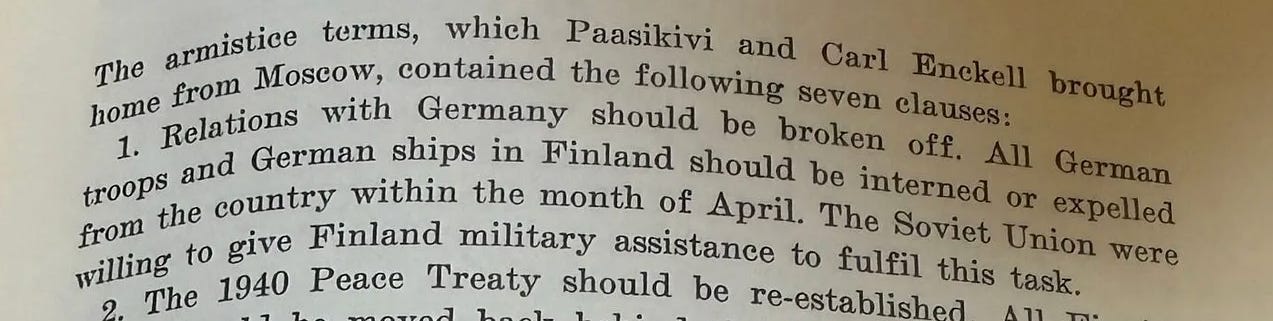
All German troops should be interned or expelled from the country.
The Soviets know the Germans are all going to be expelled, and none interned, but they limit the degree to which it’s perceived to be a concession.
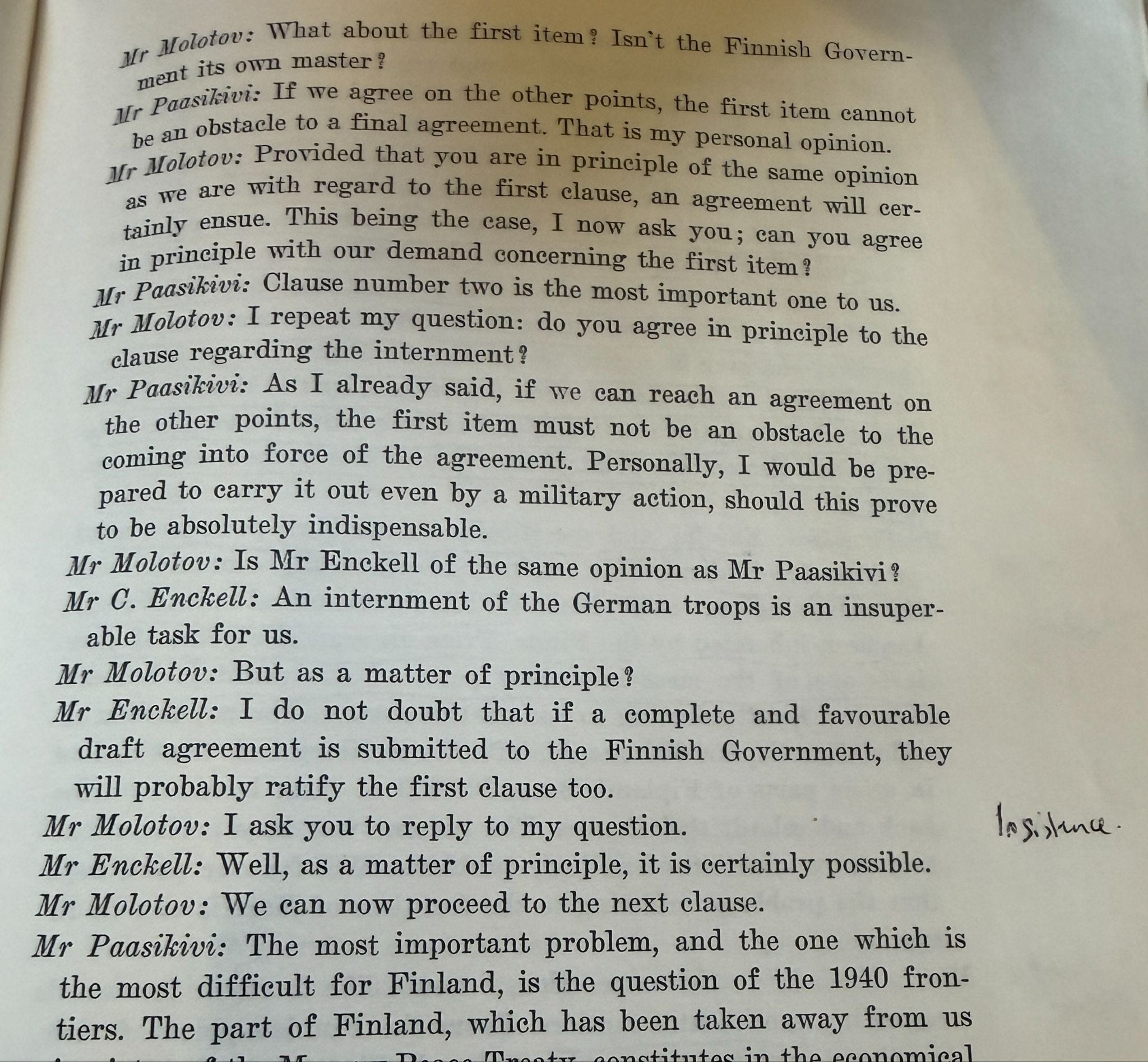
44) Here – Molotov man-handling the Finnish delegation with his insistence. I won’t type out all the text for this, but read the photo if you’re curious to see how Molotov kept bringing the conversation back to his essential question – and verifying the answer with all delegates present:
45) Soviets were annoyed at past negotiation offers being spurned:
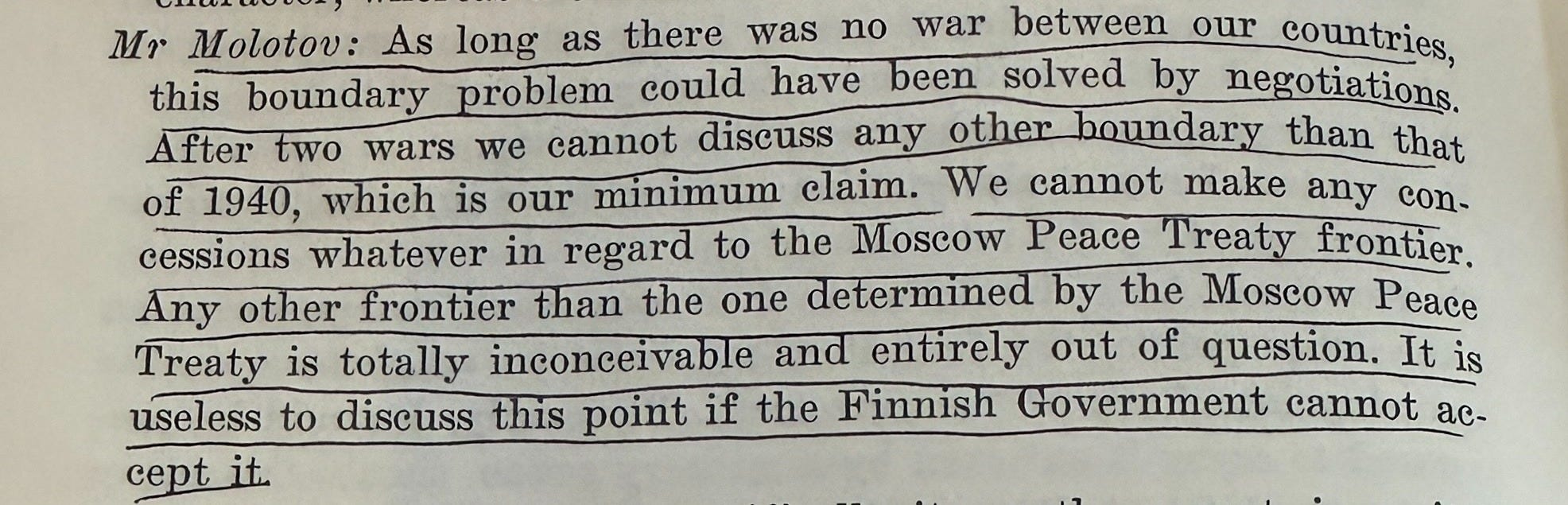
Molotov: As long as there was no war between our countries, this boundary problem could have been solved by negotiations. After two wars we cannot discuss any other boundary than that of 1940, which is our minimum claim. We cannot make any concessions whatever in regard to the Moscow Peace Treaty frontier. Any other frontier than the one determined by the Moscow Peace Treaty is totally inconceivable and entirely out of the question. It is useless to discuss this point if the Finnish Government cannot accept it.
I can very much imagine the Russian leadership saying this today. (Why didn’t you agree in Istanbul in April 2022? You’d have had a much better border, and avoided the war almost altogether.)
Finland having stepped away from earlier diplomacy gets referred to many, many times throughout the talks:
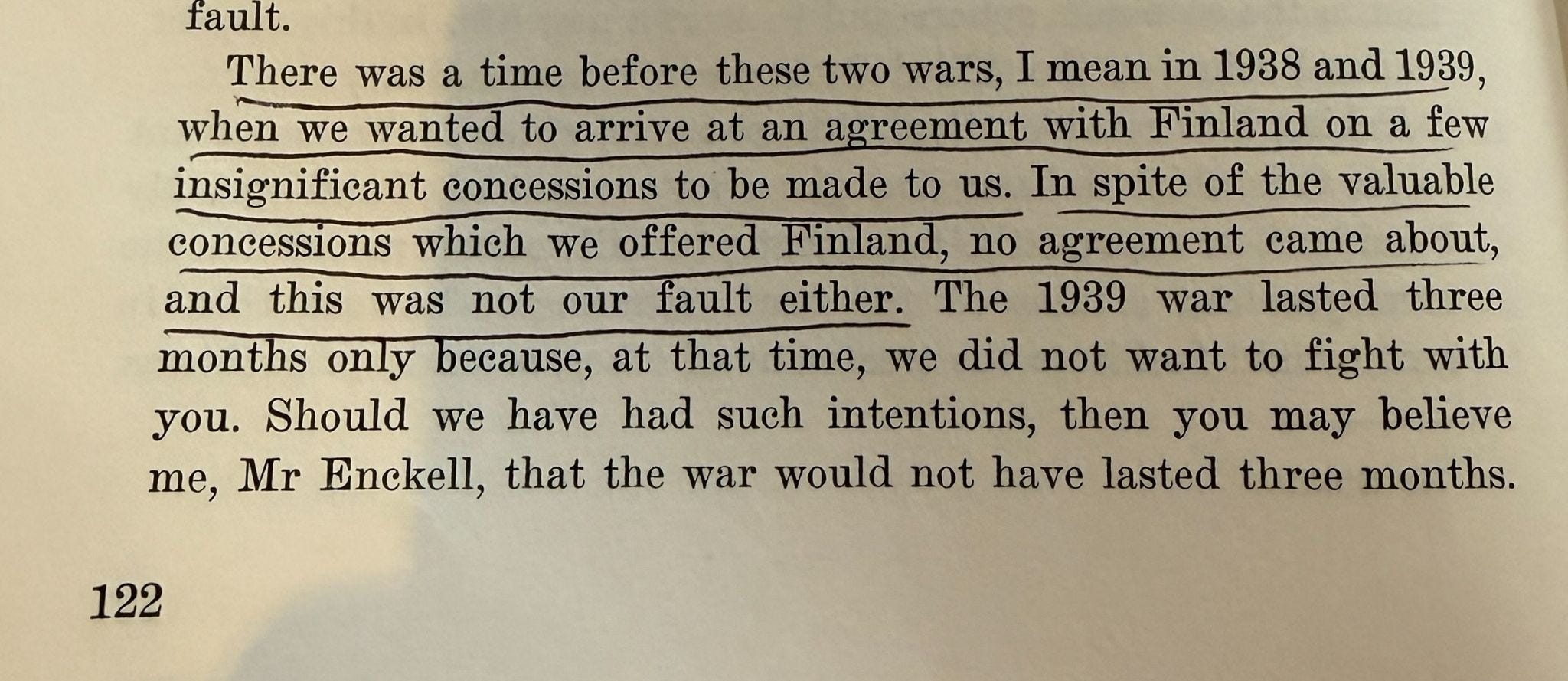
Molotov: There was a time before these two wars, I mean in 1938 and 1939, when we wanted to arrive at an agreement with Finland on a few insignificant concessions to be made to us. In spite of the valuable concessions which we offered Finland, no agreement came about, and this was not our fault either.
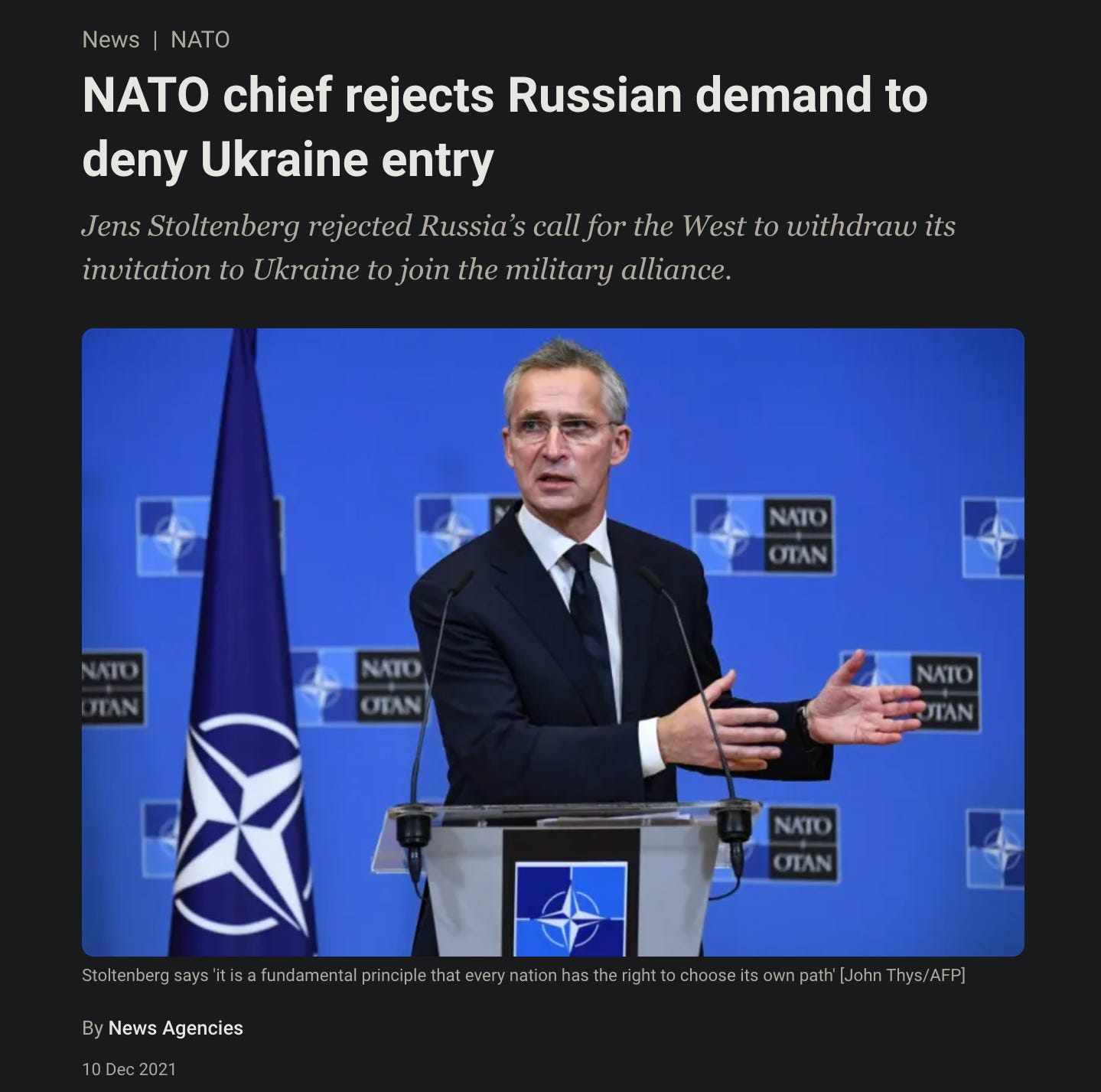
(Possible equivalent today: Why didn’t NATO just renounce Ukraine joining in December 2021?)
46) Molotov further castigating Finland for walking away from the March 1944 talks (which feels like where we are in the analogy with Ukraine today), prolonging the war another five months:
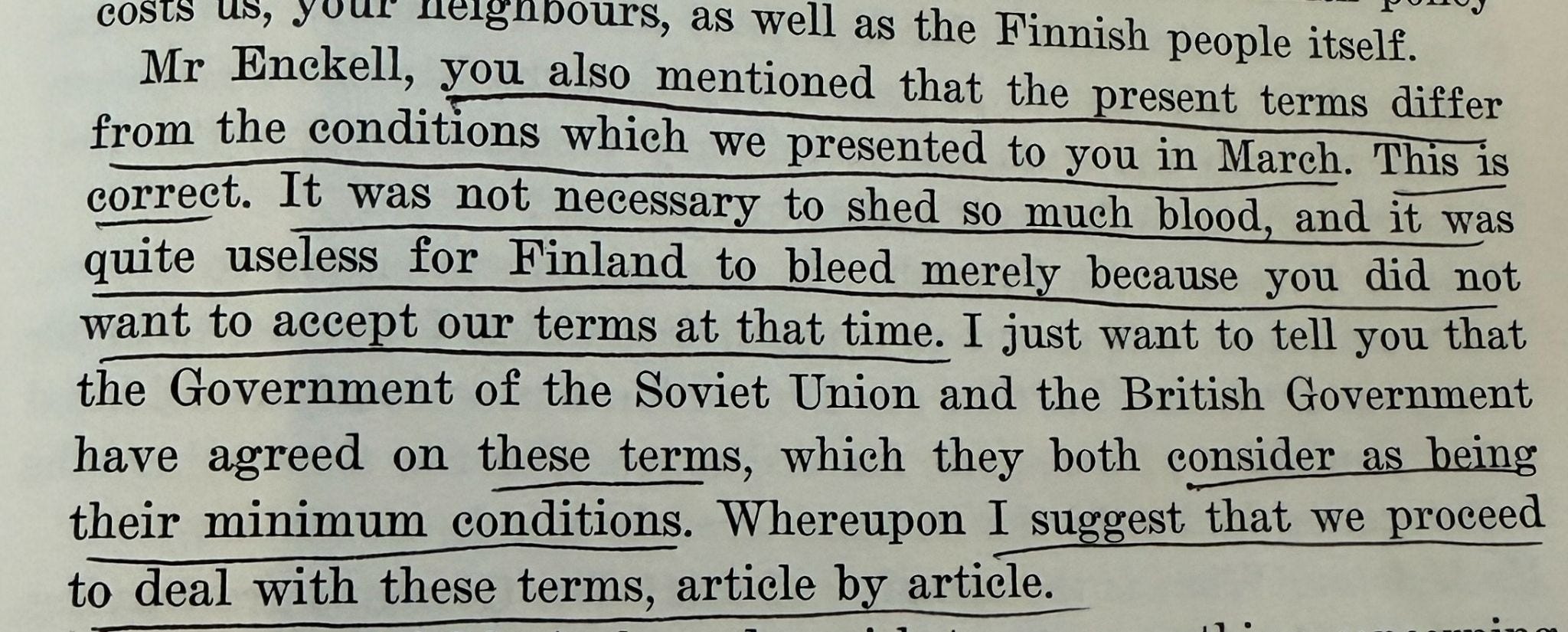
Molotov: Mr Enckell, you also mentioned that the present terms differ from the conditions which we presented to you in March. This is correct. It was not necessary to shed so much blood, and it was quite useless for Finland to bleed merely because you did not want to accept our terms at that time.
47) Again: Karelia is very resemblant of the Donbas:
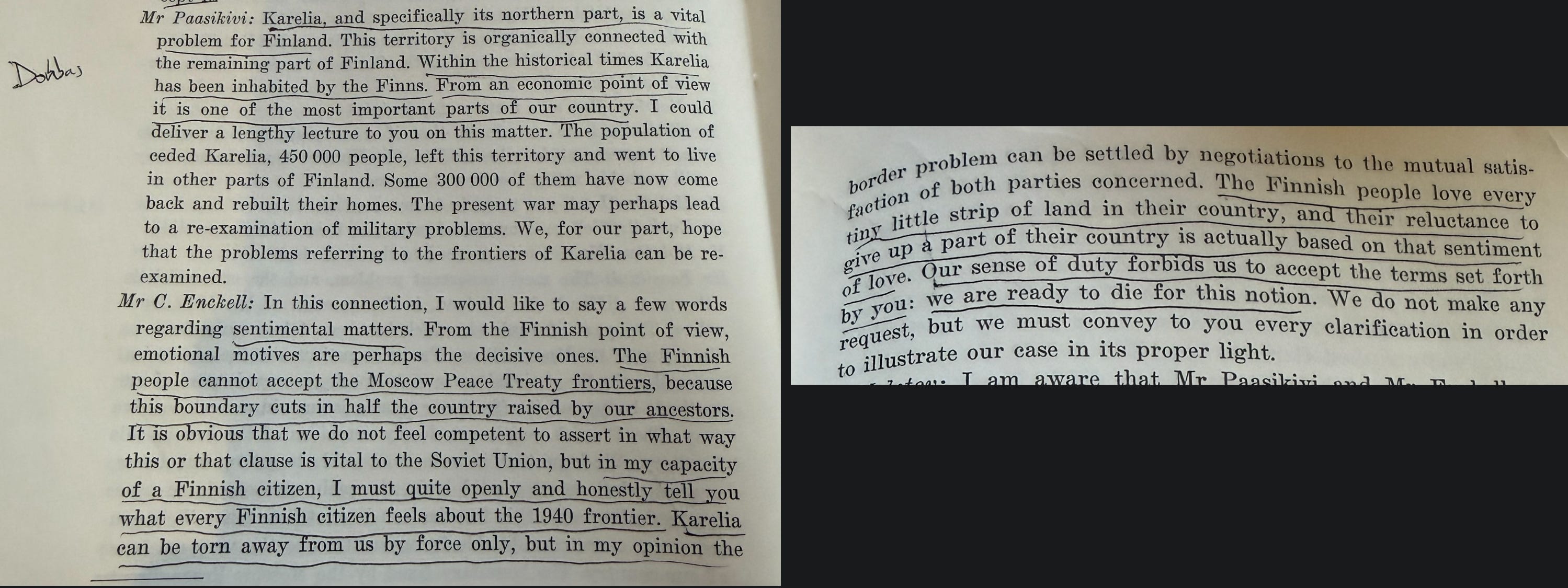
Paasikivi: Karelia, specifically its northern part, is a vital problem for Finland. This territory is organically connected with the remaining part of Finland. Within historical times Karelia has been inhabited by the Finns. From an economic point of view it is one of the most important parts of our country. I could deliver a lengthy lecture to you on this matter.
Enckell: I would like to say a few words regarding sentimental matters. From the Finnish point of view, emotional motives are perhaps the decisive ones. The Finnish people cannot accept the Moscow Peace Treaty frontiers because this boundary cuts in half the country raised by our ancestors … In my capacity of a Finnish citizen, I must quite openly and honestly tell you what every Finnish citizen feels about the 1940 frontier. Karelia can be torn away from us by force only … The Finnish people love every tiny little strip of land in their country, and their reluctance to give up a part of their country is actually based on that sentiment of love. Our sense of duty forbids us to accept the terms set forth by you: we are ready to die for this notion.
But in September 1944, after the further massive Soviet offensive, Finland ultimately did withdraw from Karelia.
48) Demonstration that the other side lives in another reality, with a different history:
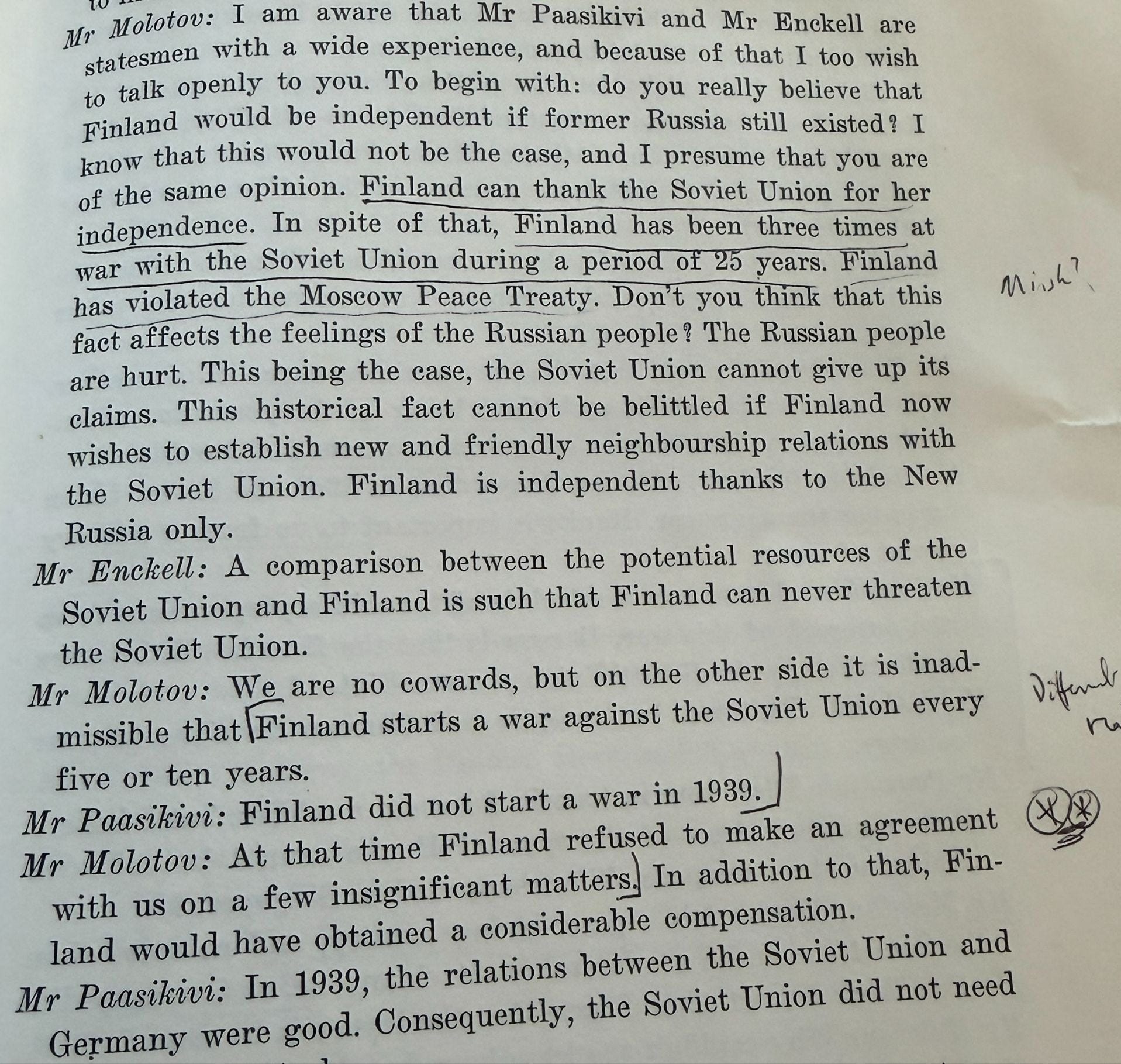
Molotov: Finland can thank the Soviet Union for her independence … Finland has been three times at war with the Soviet Union during a period of 25 years. Finland has violated the Moscow Peace Treaty [as Russia from its perception argues Ukraine has violated the Minsk Accords]. Don’t you think that this fact affects the feelings of the Russian people? The Russian people are hurt … Finland is independent thanks to the New Russia only.
Molotov: Finland starts a war against the Soviet Union every five or ten years.
Paasikivi: Finland did not start a war in 1939.
Molotov: At that time Finland refused to make an agreement with us on a few insignificant matters.
This last point, though it would leave the majority of people in the West incredulous, is equivalent to commencing war from their perspective.
Without my endorsing this, Russia today argues: Ukraine started this war. Putin just on Friday: “After we’ve been deceived, and after the Minsk agreements have not been implemented, we were forced to use military force to finish the war that began by the Kyiv regime with the support of the Western powers.”
Very similar language and perspective in these two instances.
Continuing:
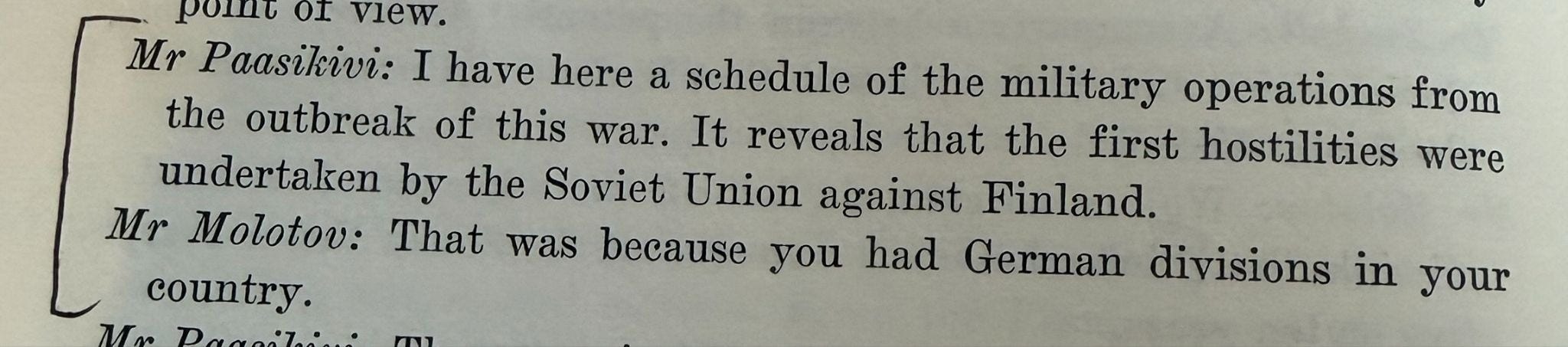
Paasikivi: I have here a schedule of the military operations from the outbreak of this war. It reveals that the first hostilities were undertaken by the Soviet Union against Finland.
Molotov: That was because you had German divisions in your country.
In this instance Molotov had a point. If you’re housing 200,000 Nazi German troops on your territory, any objective observer can say a preemptive attack is justified.
49) Severe terms will be presented as “moderate”:
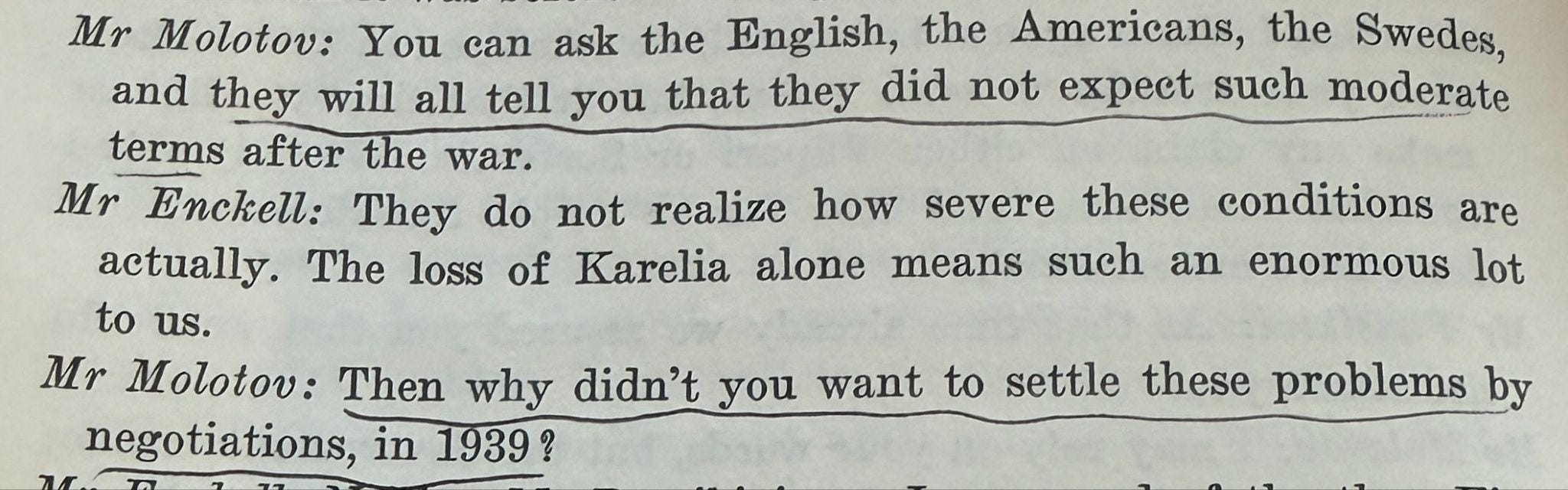
Molotov: You can ask the English, the Americans, the Swedes, and they will all tell you that they did not expect such moderate terms after the war.
Enckell: They do not realize how severe these conditions are actually. The loss of Karelia alone means such an enormous lot to us.
Molotov: Then why didn’t you want to settle these problems by negotiation, in 1939? [Again, Russia today: Why didn’t you want to settle these problems by negotiation in April 2022?]
50) Emotional appeals from the smaller side that don’t really go anywhere:

Enckell: We hope that the mighty Soviet Union will show magnanimity towards our smaller country.

Enckell: The Soviet Union must have comprehension for our standpoint too. Finland fought desperately, without any hope of success, against an overwhelming superiority.
Molotov: I am quite willing to admit that you have fought bravely.
51) The two sides debating demobilization of Finland:
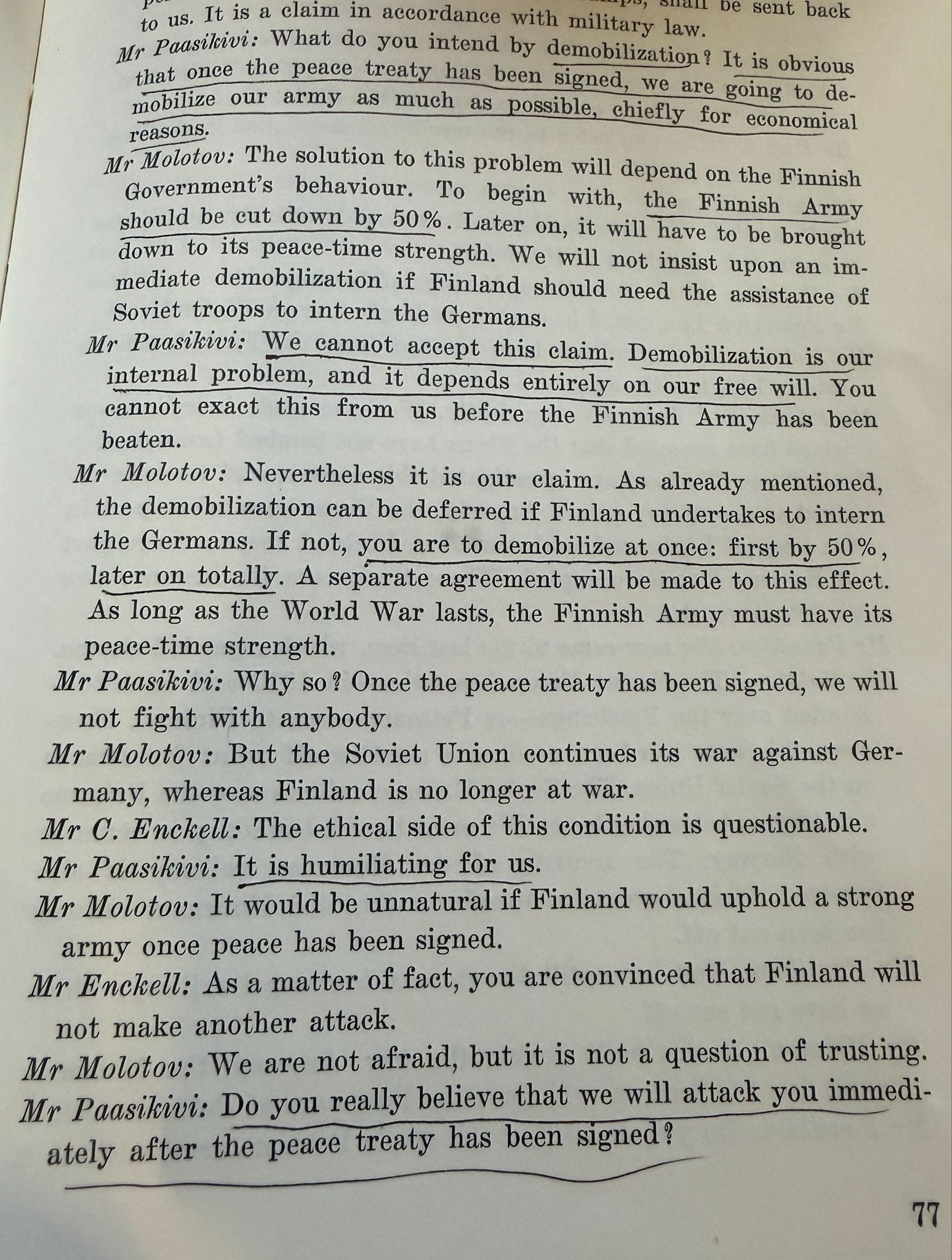
Paasikivi: What do you intend by demobilization? It is obvious that once the peace treaty has been signed, we are going to demobilize our army as much as possible, chiefly for economical reasons.
Molotov: The Finnish Army should be cut down by 50%. Later on, it will have to be brought down to its peace-time strength.
Paasikivi: We cannot accept this claim. Demobilization is our internal problem, and it depends entirely on our free will. You cannot exact this from us before the Finnish Army has been beaten.
Molotov: You are to demobilize at once: first by 50%, later on totally. A separate agreement will be made to this effect.
Paasikivi: It is humiliating for us. [This is interesting. Not “We will be left defenseless.” But this is humiliating. That’s not the objection from Finland I would have imagined.] Do you really believe that we will attack you immediately after the peace treaty has been signed?

Molotov: Our security policy demands the demobilization of the Finnish armed forces. Every single soldier in the Red Army would surely wonder why the Finnish Army remains as strong after the peace as it was before.
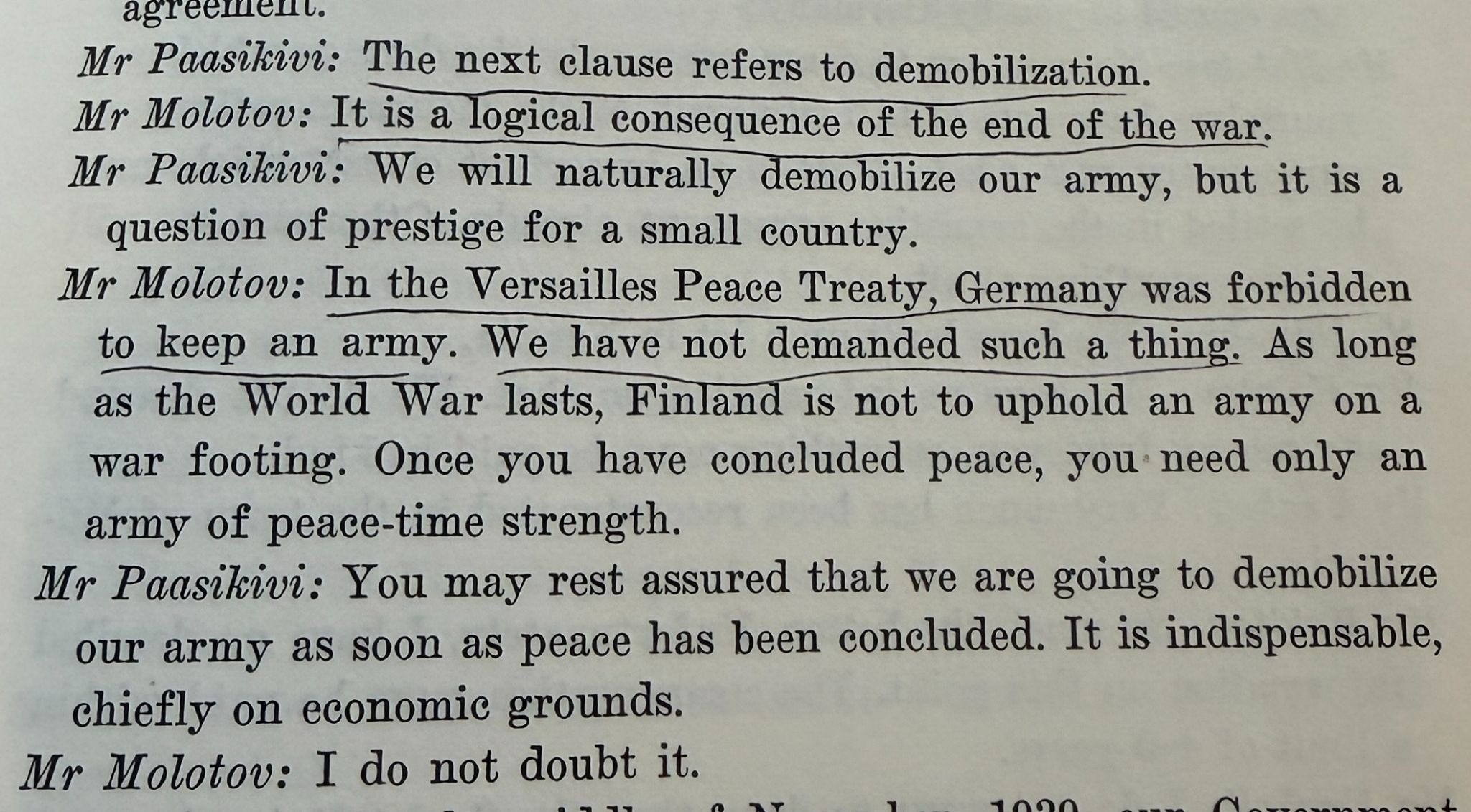
Paasikivi: We will naturally demobilize our army, but it is a question of prestige for a small army. [Again: this being a question of prestige would not have been obvious to me.]
Molotov: In the Versailles Peace Treaty, Germany was forbidden to keep an army. We have not demanded such a thing.
Crucial: To make demobilization more palatable, the two sides made it a separate side agreement:
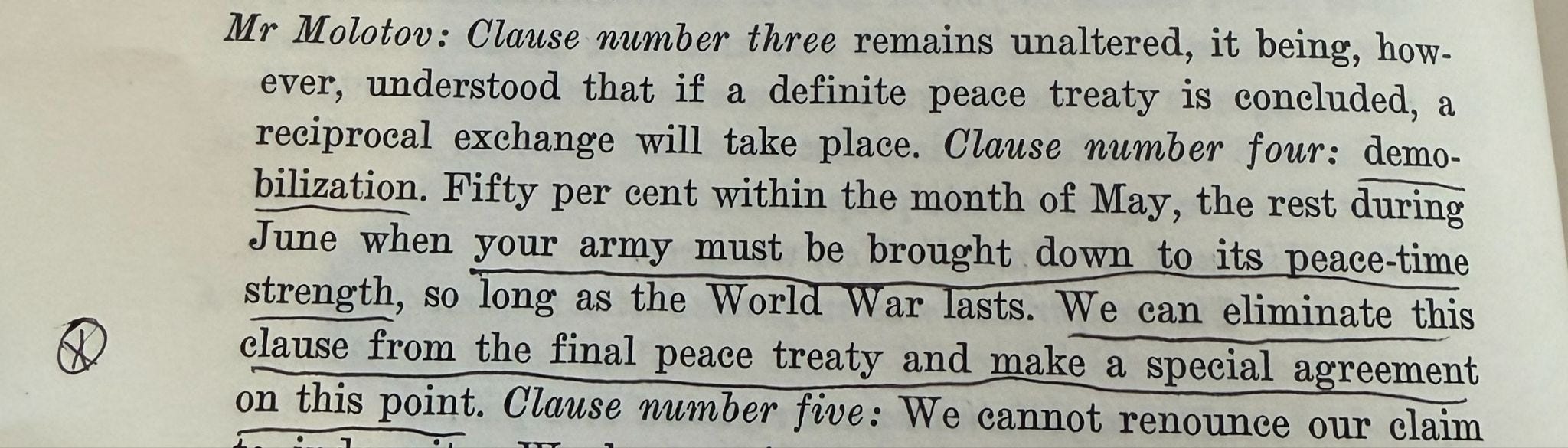
Molotov: Demobilization – We can eliminate this clause from the final peace treaty and make a special agreement on this point.
52) “Many kinds of neutrality.” I thought this a fascinating line from Molotov – also fitting Ukraine-Russia talks today:

Molotov: We both know that according to international law there are many kinds of neutrality.
53) Withdrawal was to be conducted in four stages:
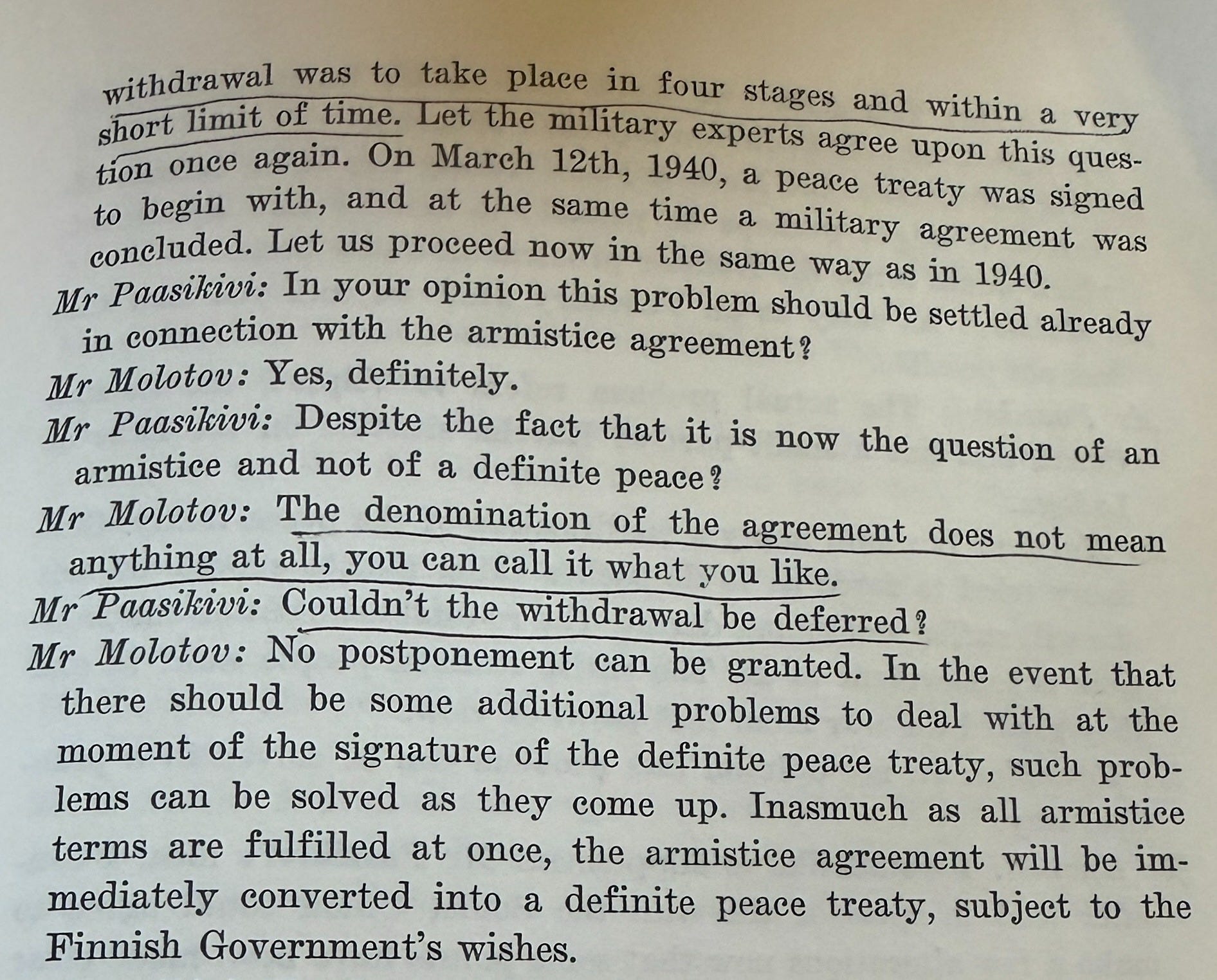
Molotov: Withdrawal was to take place in four stages and within a very short limit of time. Let the military experts agree upon this question once again. In 1940 a peace treaty was signed to begin with, and at the same time a military agreement was concluded. Let us proceed now in the same way as in 1940.
Molotov: The denomination of the agreement (armistice or a definite peace) does not mean anything at all, you can call it what you like.
54) Prestige also flowed through to the territorial discussion and concession:
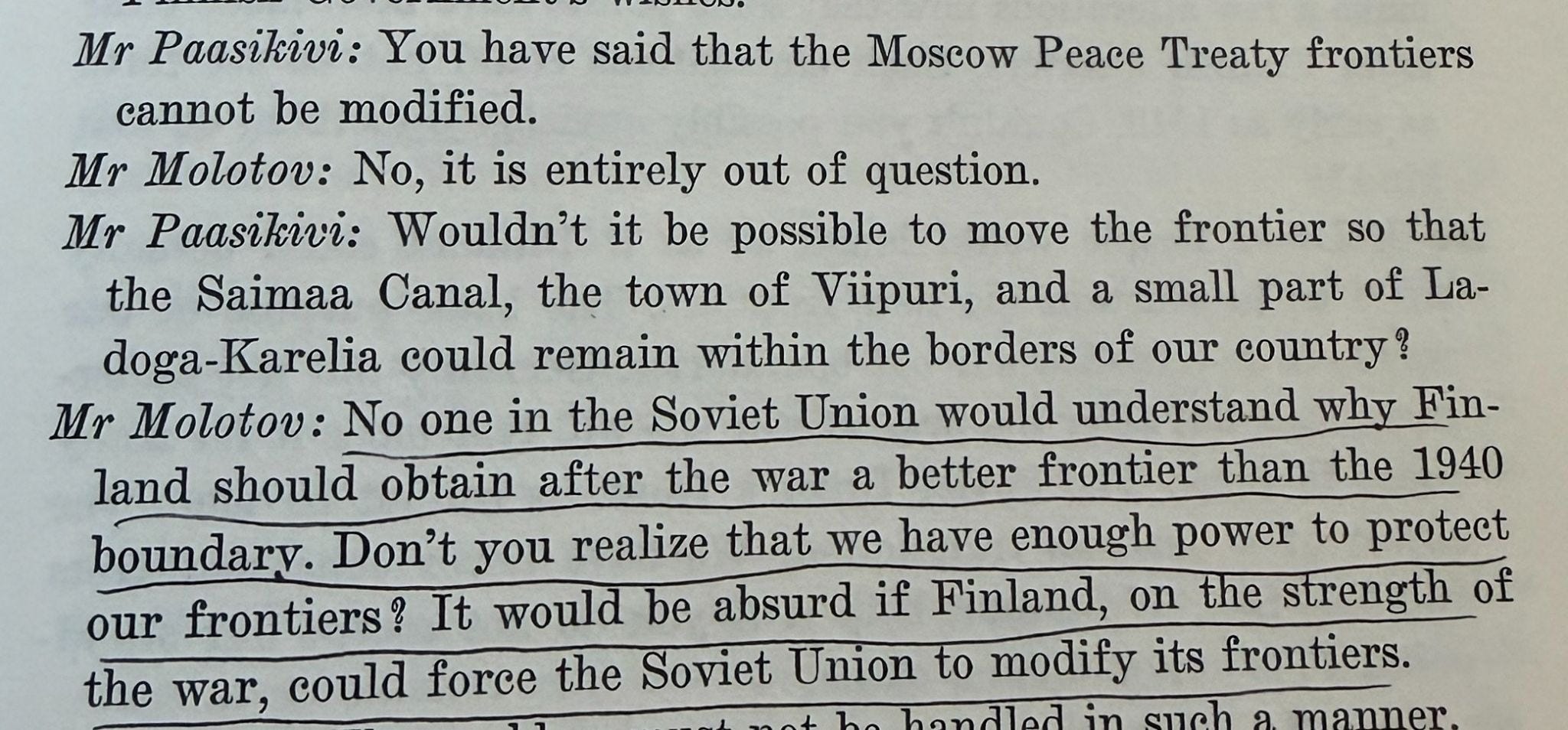
In response to Finland making a small face-saving request on territory – which Molotov reacts to as if it’s an affront…
Molotov: No one in the Soviet Union would understand why Finland should obtain after the war a better frontier than the 1940 boundary. Don’t you realize that we have enough power to protect our frontiers? It would be absurd if Finland, on the strength of the war, could force the Soviet Union to modify its frontiers.
(And the territory Putin is requesting today he considers already “Russia’s frontier”.)
55) At the resumption of talks in September 1944, the Soviets held back documents for an in-person delegation:
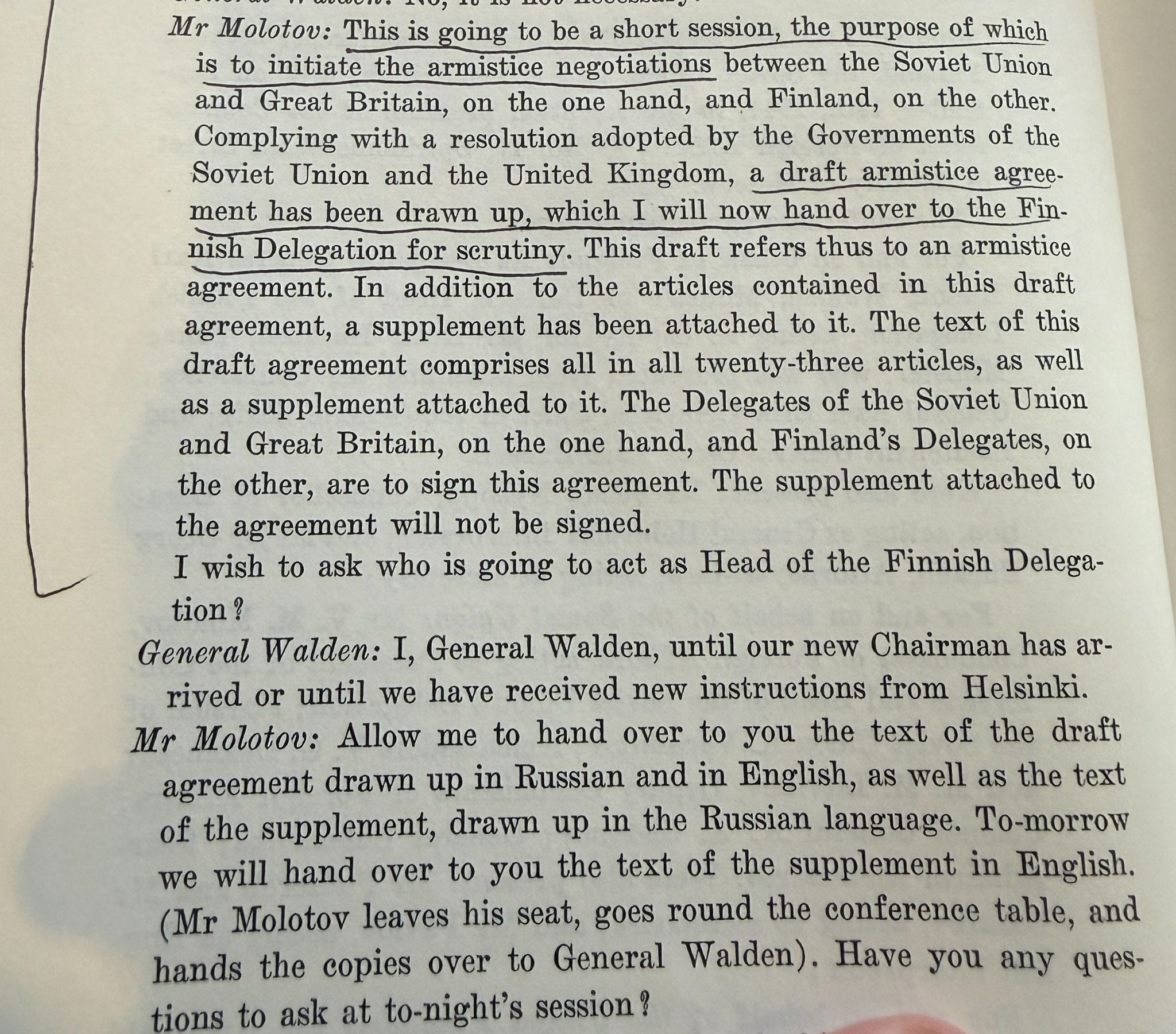
Molotov: This is going to be a short session, the purpose of which is to initiate the [second round of] armistice negotiations … a draft armistice agreement has been drawn up, which I will now hand over to the Finnish Delegation for scrutiny … In addition to the articles contained in this draft agreement, a supplement has been attached to it. The text of this draft agreement comprises all in all twenty-three articles, as well as a supplement attached to it … Finland’s Delegates are to sign this agreement. The supplement attached to the agreement will not be signed.
A few negotiating principles generally…
56) Molotov presided over talks with great clarity:
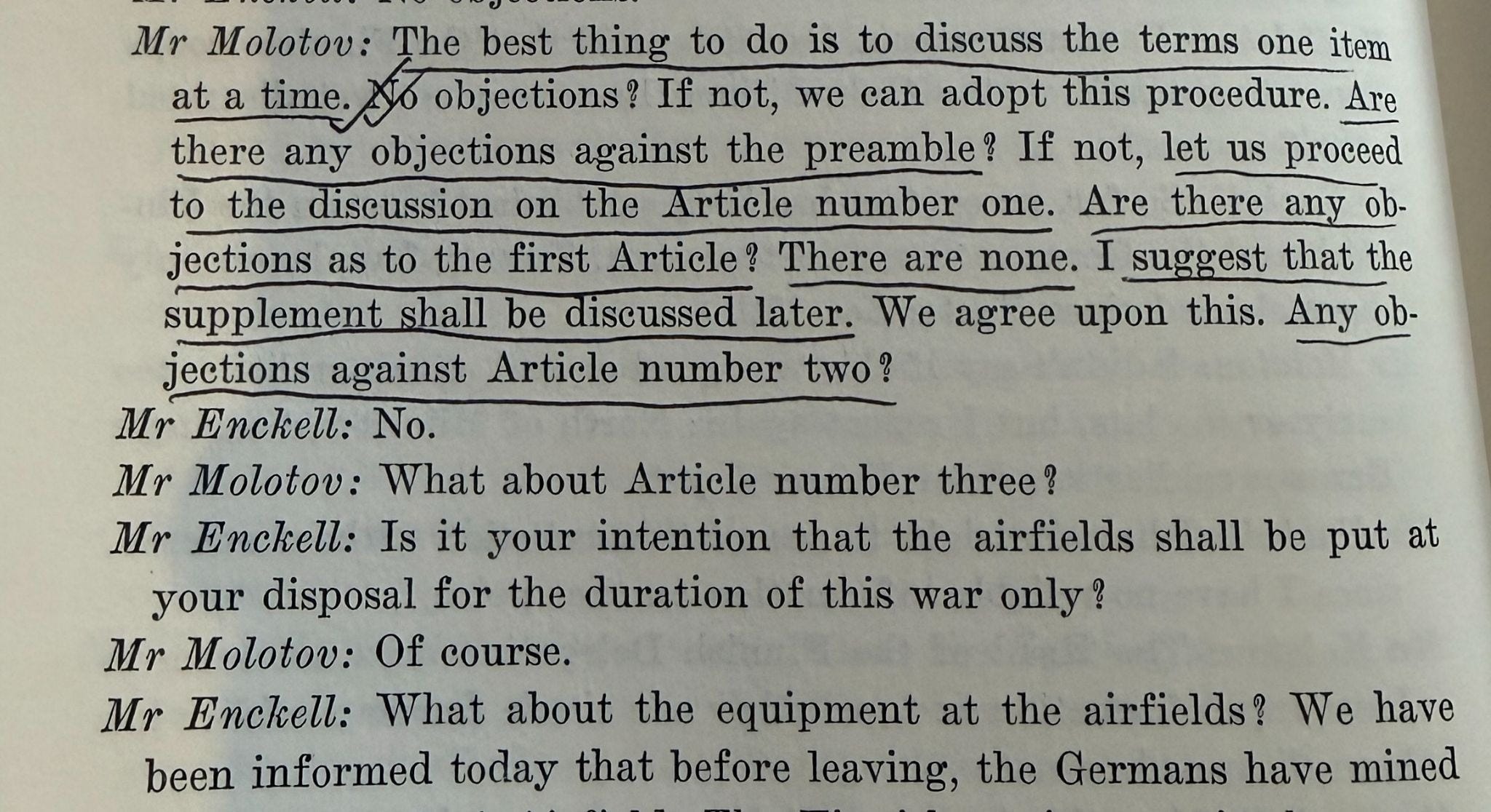
Molotov: The best thing to do is to discuss the terms one item at a time. No objections? If not, we can adopt this procedure. Are there any objections against the preamble? If not, let us proceed to the discussion on the Article number one. Are there any objections as to the first Article? There are none. I suggest that the supplement shall be discussed later. We agree upon this. Any objections against Article number two? What about Article number three?…
57) Molotov cracked the whip when things looked like they might slow:
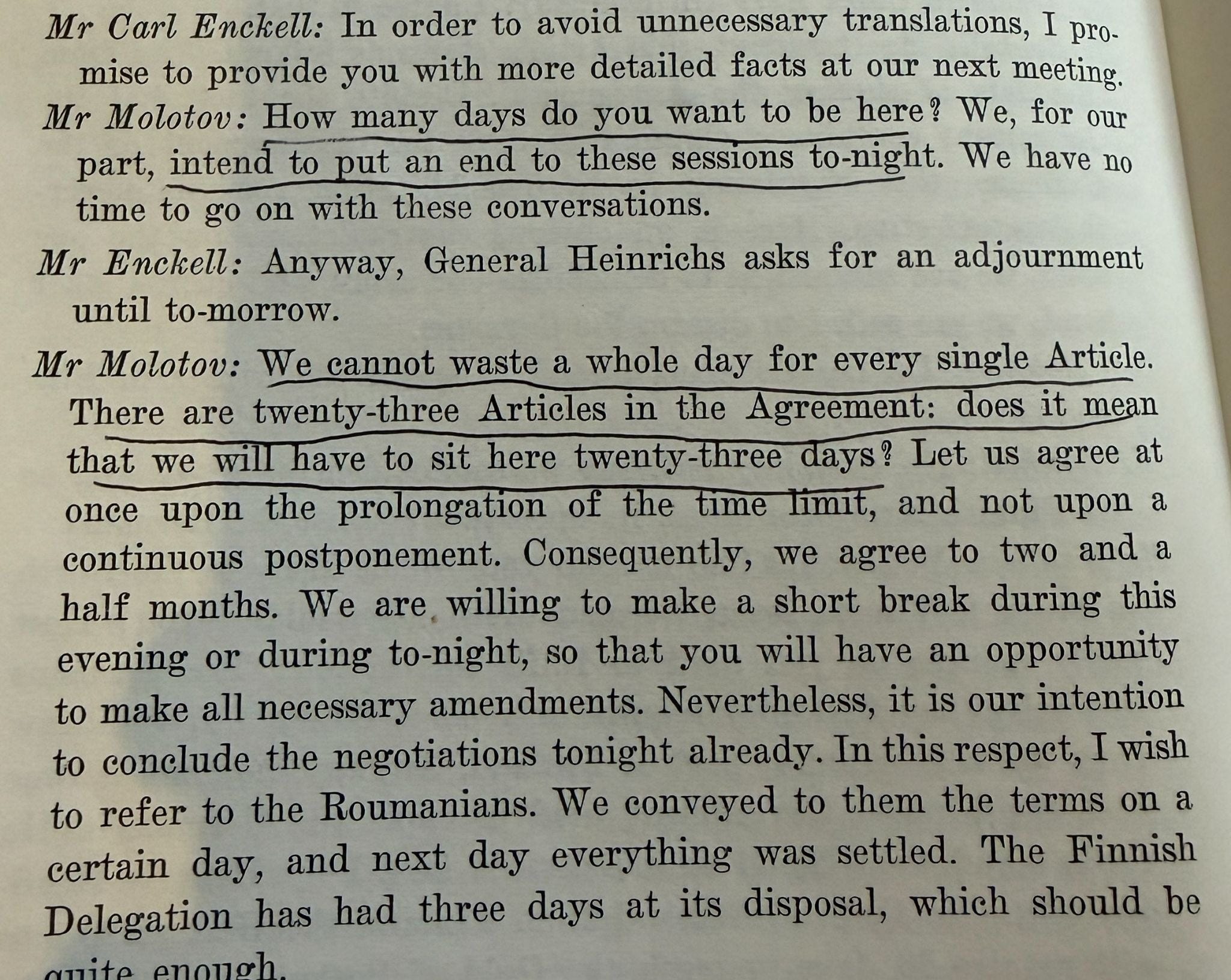
Enckell: I promise to provide you with more detailed facts at our next meeting.
Molotov: How many days do you want to be here? We, for our part, intend to put an end to these sessions tonight. We have no time to go on with these conversations.
Enckell: General Heinrichs asks for an adjournment until tomorrow.
Molotov: We cannot waste a whole day for every single Article. There are twenty-three Articles in the Agreement: does it mean that we will have to sit here twenty-three days? Let us agree at once … We are willing to make a short break during this evening or during tonight, so that you will have an opportunity to make all necessary amendments. Nevertheless, it is our intention to conclude the negotiations tonight already. In this respect, I wish to refer to the Romanians. We conveyed to them the terms on a certain day, and next day everything was settled. The Finnish Delegation has had three days at its disposal, which should be quite enough.
58) Molotov used Art of the Deal-like pressure – making time demands I can only assume he knew were unreasonable, but with unrelenting insistence to rein in talks faster:
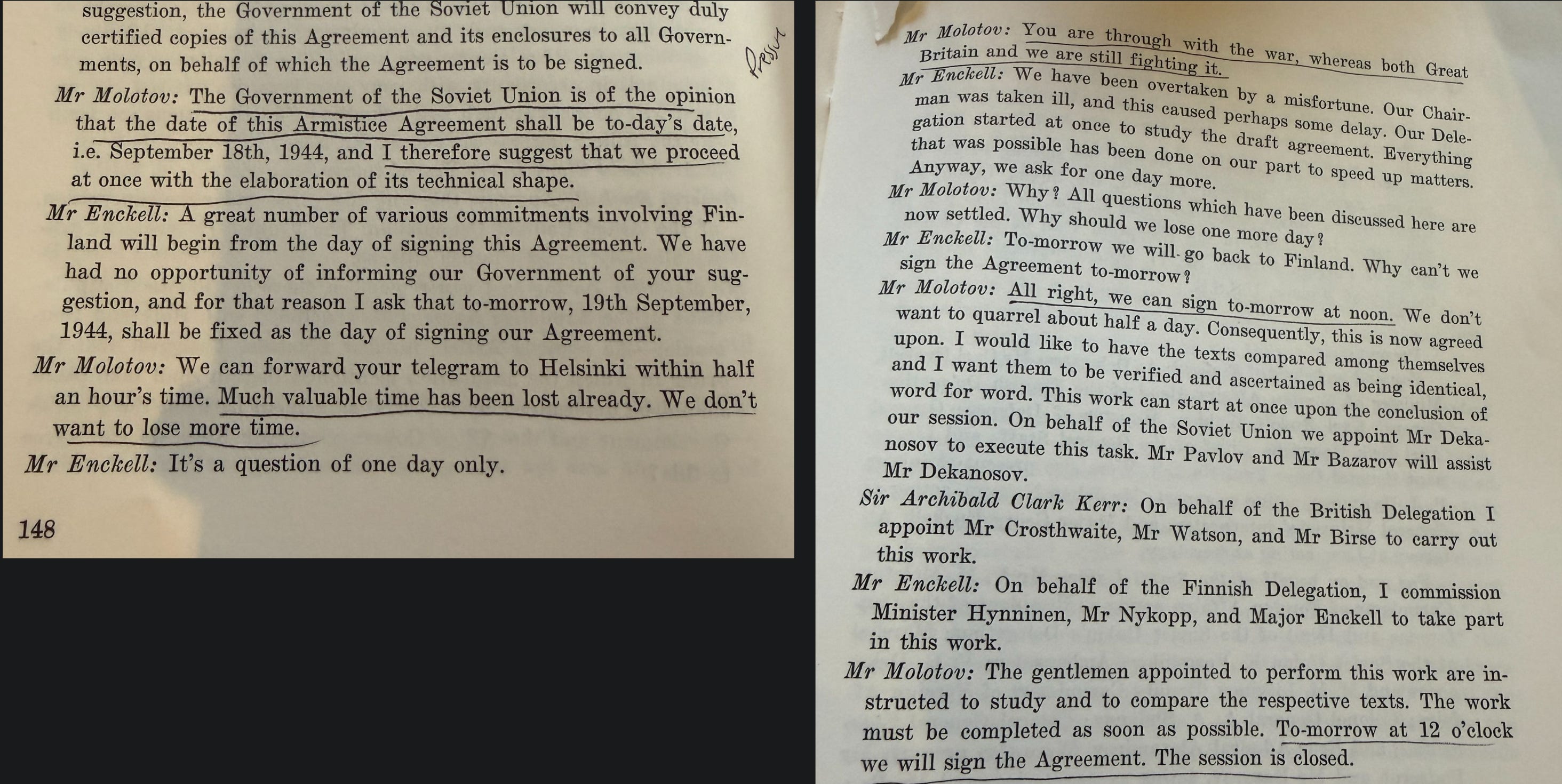
Molotov: The Government of the Soviet Union is of the opinion that the date of this Armistice Agreement shall be today’s date … and I therefore suggest that we proceed at once with the elaboration of its technical shape.
Enckell: A great number of various commitments involving Finland will begin from the day of signing this Agreement. We have had no opportunity of informing our Government of your suggestion, and for that reason I ask that tomorrow shall be fixed as the day of signing our Agreement.
Molotov: We can forward your telegram to Helsinki within half an hour’s time. Much valuable time has been lost already. We don’t want to lose more time.
Enckell: It’s a question of one day only.
Molotov: You are through with the war, whereas both Great Britain and we are still fighting it.
Enckell: Our Delegation started at once to study the draft agreement. Everything that was possible has been done on our part to speed up matters. Anyway, we ask for one day more.
Molotov: Why? All questions which have been discussed here are now settled. Why should we lose one more day?
Enckell: Why can’t we sign the Agreement tomorrow?
Molotov: All right, we can sign tomorrow at noon. We don’t want to quarrel about half a day.
This is vastly faster than I got the impression the Finnish delegation had had any intention of signing.
In the same vein, this was funny:
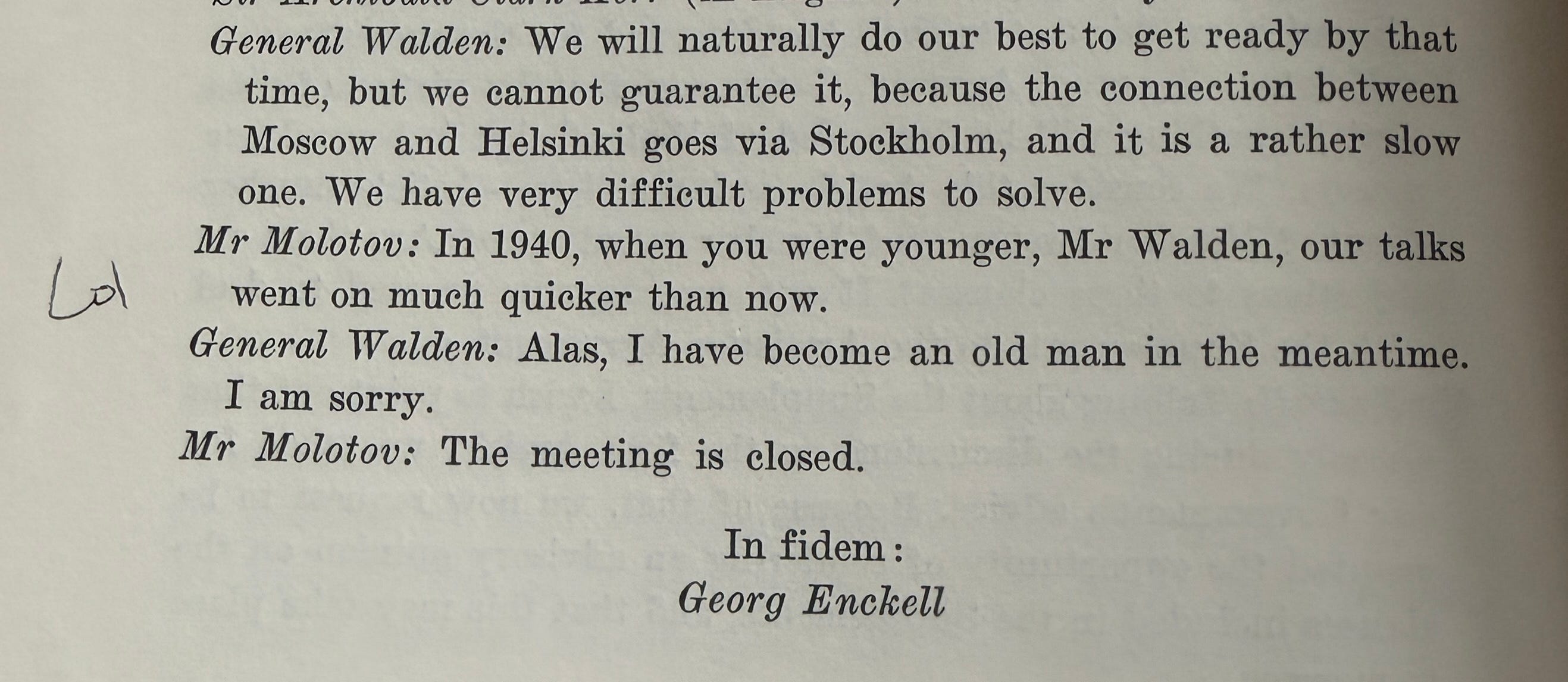
Molotov: In 1940, when you were younger, Mr Walden, our talks went on much quicker than now.
General Walden: Alas, I have become an old man in the meantime. I am sorry.
If this analogy is fitting for Ukraine – and I consider it likely is – we are now right at the equivalent of the end of the March 1944 talks. Ukraine perhaps is about to reject terms (because of territorial demands), and if it does, Ukraine will pay the consequence of another Russian summer offensive, four years into a war.
The Finnish envoy Paasikivi reminds me in places of Ambassador Steve Witkoff. In the earlier March 1944 talks, Paasikivi was considered by many to be an “appeaser”, so much so that he wasn’t selected again for the further resumption of talks in September:
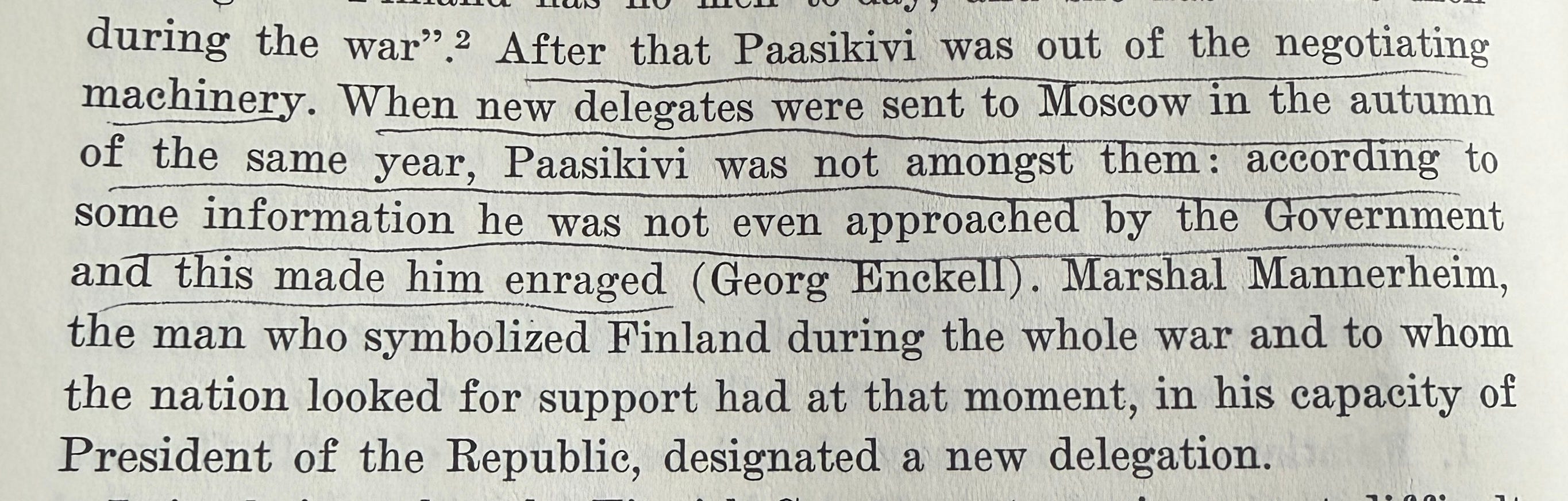
But Paasikivi’s stance was in short time massively vindicated! And it was because the Finns hadn’t heeded Paasikivi’s warnings that they, five months later, had to suck up even worse terms. This came to be recognized, and by September 1944 Paasikivi was drawn out of semi-retirement to become Finnish Prime Minister. The political system then required a Prime Minister whose credibility rested precisely on advocating peace with Moscow, and on having treated the Soviet Union as a great power whose security concerns had to be accommodated.
What’s even more incredible: from November 1945 to February 1946, Finnish leaders were subsequently held responsible for Finland’s actions in the Continuation War, and the former Foreign Minister Henrik Ramsay (amongst others) was sentenced to two years and six months in prison. President Ryti was sentenced to 10 years in prison. Key figures were considered responsible for influencing Finland’s wartime decisions and preventing an earlier peace, pursuing hardline policies that contributed to unnecessary prolongation of the war.
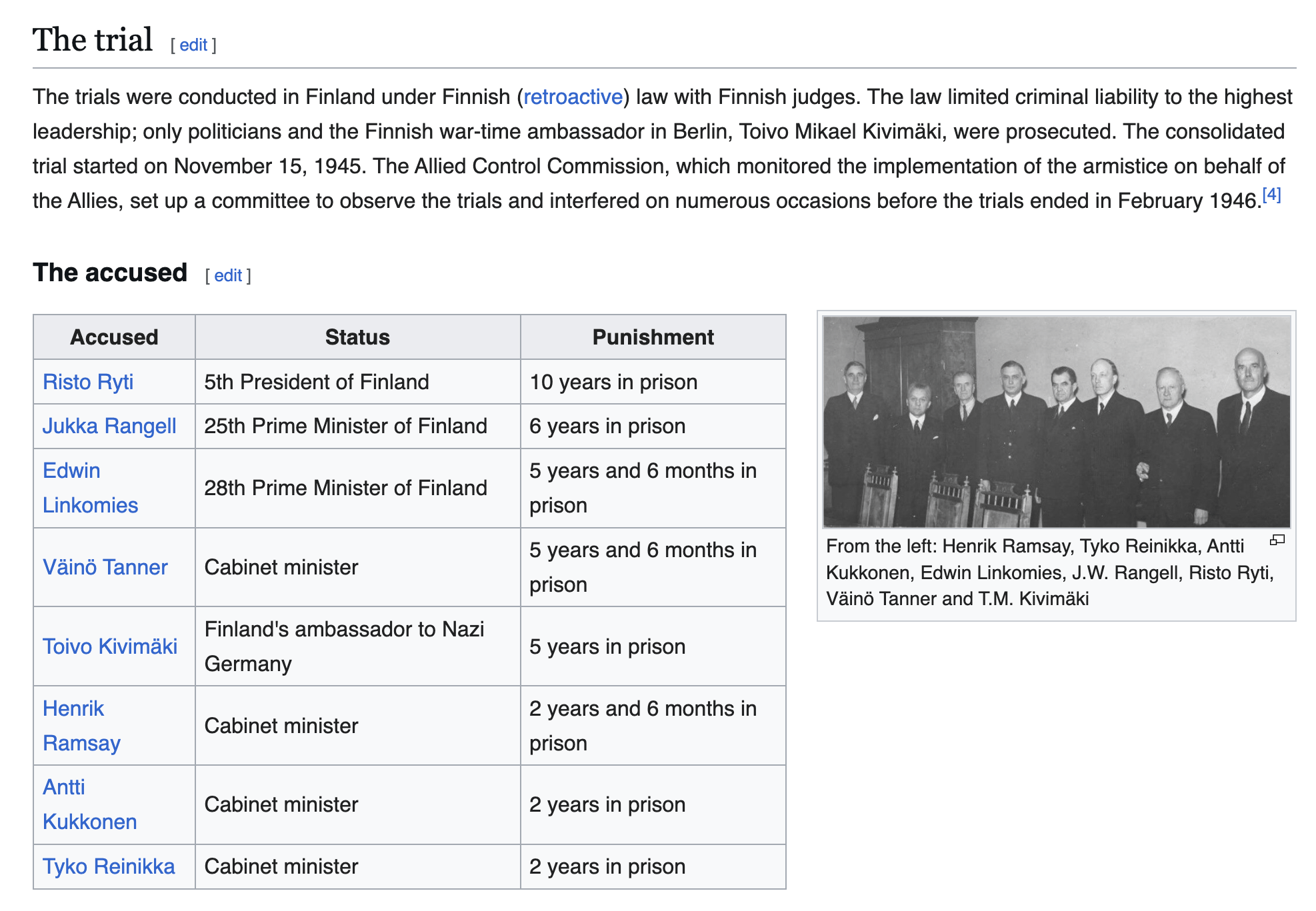
The lack of public support for the proceedings led to the Finnish government paroling and pardoning the defendants, though several did serve prison time.
*
In November 2025, Ambassador Witkoff said during a panel discussion with Bret Baier at the America Business Forum in Miami:
Witkoff: We had to convince Hamas that those hostages were no longer as asset for them. Those hostages had become a liability … I think that was the inflection point that led to the deal. I think the same thing is going to happen at some point in Russia-Ukraine. Both sides will get to a place where they understand that solving that conflict kinetically is bad for them long-term ... It should be solved diplomatically.
Baier: As you’re sitting at that table, you’re trying to get something they both agree on, you’re trying to take the conversation…
Witkoff: And give them examples – historical context about why to do things like that. Why compromise might at this moment be the smart thing to do.
This 1944 Finnish example here is a cautionary tale the US negotiating team could offer to Ukrainian leadership today. If Ukraine doesn’t go along with the terms on offer – including a territorial withdrawal – there’s surely going to be another massive Russian offensive, right as Ukraine is war-weary, in all likelihood leading Ukraine to come back to the table in five months’ time with only yet-harsher terms.
In March 1944 there was no strong ally able to offer Finland a robust security guarantee. Had there been, perhaps the territorial concessions Paasikivi had argued for could have been made palatable domestically.
The literal application of this history today would be: i) Armistice – with agreement Ukraine will subsequently withdraw, ii) Withdrawal from Donbas, iii) Then a full peace agreement.
If Ukraine doesn’t see the rhyme in history it’s stepping into, I fear we’re doomed to history repeating itself: another five months of devastating fighting, for ever-worsening terms. Let’s hope US envoys can put history to good effect.
No posts
Comments
Nothing yet. Say the first thing.
Sign in to join the conversation.