
Yesterday The Telegraph reported:
The United States is poised to recognise Russia’s control over Crimea and other occupied Ukrainian territories to secure a deal to end the war.
The Telegraph understands that Donald Trump has sent his peace envoy Steve Witkoff and son-in-law Jared Kushner to make the direct offer to Vladimir Putin in Moscow.
Washington’s apparent offer of recognition has caused concern amongst its European allies, who have repeatedly ruled out backing a peace deal that condones borders being redrawn by force.
Before he resigned, Mr Yermak, who negotiated the latest peace plan, said: “Not a single sane person today would sign a document to give up territory.”
If accurate, I think there’s some chance this comes off. As I wrote in August:
Option A: Deadline on US Article 5 security guarantee offer
Accept Russia’s terms for territory – or thereabouts
The offer of a US security guarantee to expire in one week if Ukraine does not accept
Ukraine cedes territory
But receives a robust US (and Europe) Article 5 Mutual Defense Treaty, ratified by the US Senate, for the ~80% of what remains – that Ukrainians have fought valiantly to preserve
Of all options, I think right now this is the most likely. It would be deeply unpopular throughout Europe and in the UK, though it would stop the war – in an enduring way.
And the US has suggested it’s game for such a Senate-ratified security guarantee in the past few days. Axios:
“My proposal is to forget about the 28 points,” Yermak said, with a rare smile. “Life changes so quickly that now I think it’s in the past. This is great, that our partners support us and listen us and are working to make a plan which will be acceptable for Ukraine.”
‘Yermak said the security guarantees would be “legally binding,” and that there had been “positive reaction” from the U.S. side to the idea of enshrining them in a formal treaty. The level of optimism projected by both the U.S. and Ukraine is staggering.
(Yermak, Zelensky’s chief-of-staff, having to resign yesterday likely doesn’t change this.)
But if such a compromise doesn’t come off – and the question of territory seems unsolvable – what could a last-ditch creative middle ground look like?
We’ve looked at the history of two examples from the past 50 years of territorial disputes being resolved diplomatically…
From my colleague Sang-Hwa Lee – drawing on Our Man, George Packer’s biography of Richard Holbrooke – a look at the fraught negotiations that led to the 1995 Dayton Accords, settling the brutal Bosnian War.
Here, too, talks very nearly fell apart on multiple occasions because of the seemingly intractable question of land. One gets a sense of the resilience and perseverance a diplomat ought to have:
Izetbegović, the Bosnian President: “It is not a just peace. But my people need peace.”
Share video on X: https://x.com/sanghwa_m_lee/status/1992931877045317852
Drawing on the book Treaty for a Lost City by C. L. Lim, I look at Margaret Thatcher’s 1984 negotiations with Deng Xiaoping that struck an “innovative” agreement to avoid hot war, and laid the ground for the peaceful (though imperfect) handover of Hong Kong.
While a notably different backdrop, Deng’s insistence of gaining full control of the entire territory is eerily similar to Putin’s today. The negotiations themselves share a likeness:
“A remarkable agreement given that the Chinese could just have walked into Hong Kong.” - Charles Powell, Thatcher’s foreign affairs adviser (and brother of Jonathan Powell, current British National Security Adviser)
Share video on X: https://x.com/EdwardMDruce/status/1994689453139386858
What could this look like in the Ukrainian context? Perhaps something like:
Russia gets immediate de jure recognition of Crimea;
Russia gets de facto control of Donetsk, Luhansk, and to the front line in Kherson and Zaporizhzhia;
This territory will become de jure Russian in 30 years – fully internationally recognized – so long as Russia demonstrates good behavior and no further aggression;
Call the new border line “the 47th parallel” to demonstrate President Trump (and his successors) are invested in its long-term defense.
That Ukraine’s Deputy Foreign Minister Sergiy Kyslytsya retweeted Yermak’s interview yesterday in The Atlantic (“Not a single sane person today would sign a document to give up territory”) suggests this sentiment is widely shared in Ukraine – in spite of all diplomatic progress made in Geneva.
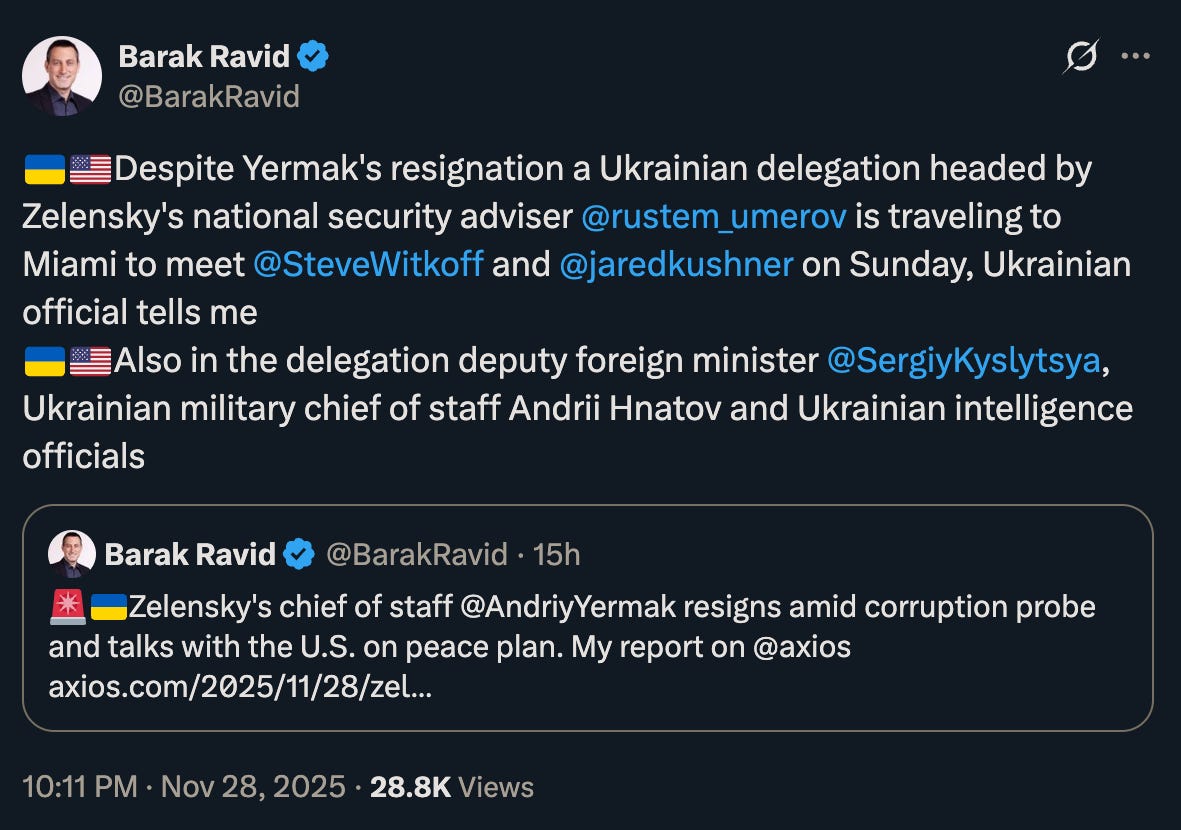
Kyslytsya will reportedly be part of the Ukrainian delegation heading to Miami this weekend to meet with Steve Witkoff and Jared Kushner before the Americans travel to Moscow to meet Putin next week:
*
Right now we’re intently following all that’s unfolding with Ukraine-Russia-US diplomacy, but if we were to do a podcast on diplomatic history in the New Year, it would be this kind of thing.
If you watch either of the above videos, please let us know your feedback…
No posts
Comments
Nothing yet. Say the first thing.
Sign in to join the conversation.