
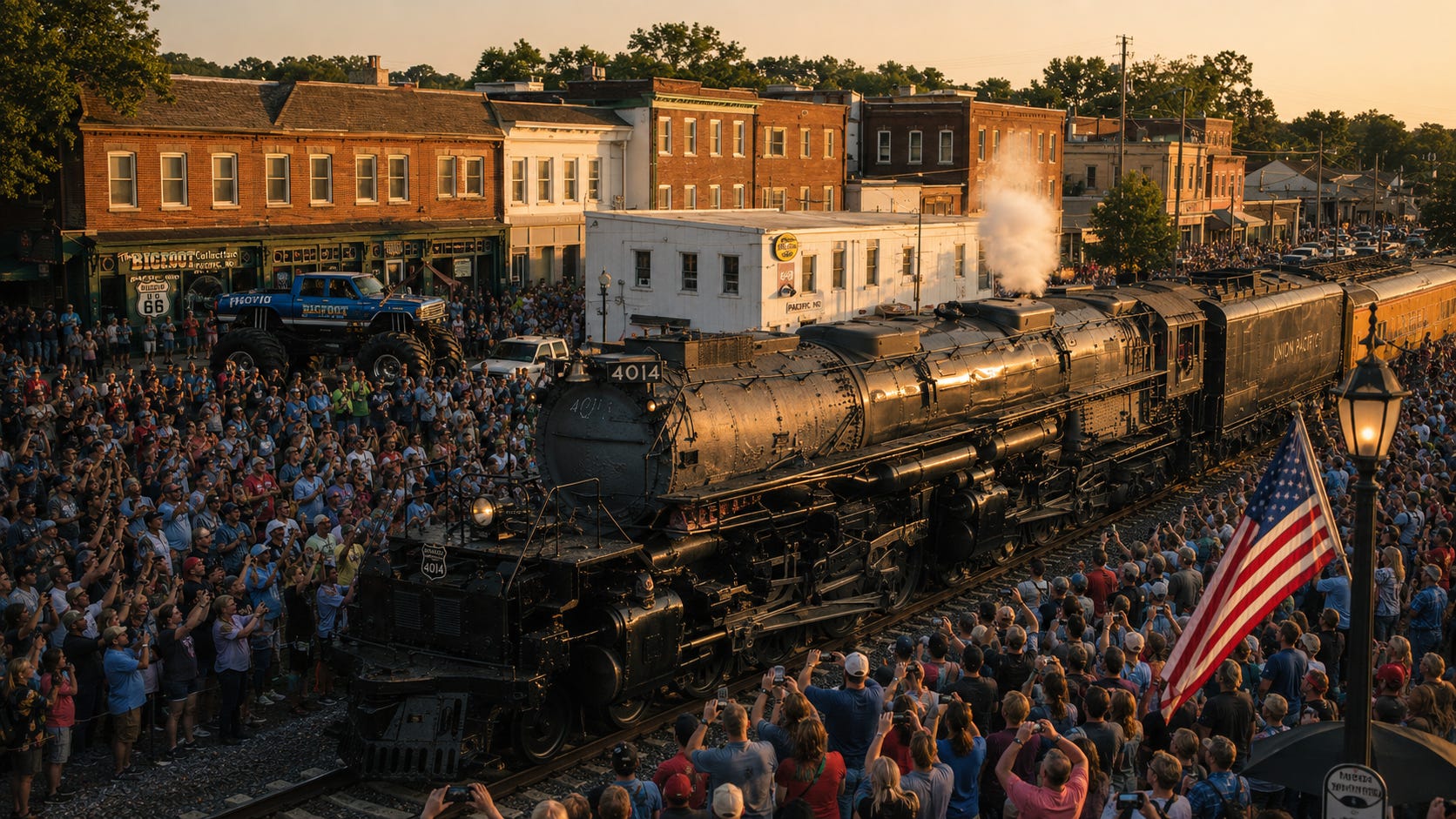
This week, a proposed data center project in my hometown of Pacific, Missouri, was put on hold.
That caught my attention.
Not because I had already formed a strong opinion about the project itself, but because after more than forty years supporting critical infrastructure, government, and military organizations, I found myself looking at the debate through a familiar lens: resilience, continuity, security, and what happens when systems we depend on are placed under real pressure.
So I started broadening the aperture.
Pretty quickly, I discovered that the objections aren’t frivolous.
Communities are asking serious questions about electricity consumption, water use, noise, land use, infrastructure costs, utility rates, and whether the promised economic benefits actually justify the burden placed on the surrounding area.
Those are fair questions.
In fact, they’re questions we should be asking.
But the further I sank into the issue, the more I began to think that we’re framing the entire debate way too narrowly.
We keep talking about data centers as though the central question is whether another large industrial building should be constructed somewhere.
I don’t think that’s the real question at all.
I think we’re beginning a much larger national conversation about where America will place its computing capacity, how we will power it, how geographically concentrated we are willing to let that infrastructure become, and how resilient the systems underneath an increasingly digital economy need to be.
In other words, the data center debate isn’t really about data centers.
It’s about what kind of infrastructure America intends to build for the next fifty years.
None of this makes the local concerns any less important.
Modern data centers can require extraordinary amounts of electricity. Depending on their design, cooling systems can place significant demands on water resources. They require land, high capacity transmission, network connectivity, roads, emergency services, and substantial supporting infrastructure.
A community considering one of these projects has every right to ask:
What will this mean for us?
Who pays for the infrastructure?
Will our electric bills go up?
How much water will it consume?
How many permanent jobs will actually be created?
What happens to nearby property?
What happens if the projections are wrong?
Those aren’t anti-technology questions. They’re governance questions and engineering questions.
And they’re exactly the kinds of questions communities should ask before making consequential infrastructure decisions.
What concerns me is when the discussion stops there with a harrumph.
An individual community understandably sees a proposed data center through the lens of local impact. But increasingly, the United States also has to look at the same facility through another lens: national capability.
Every generation builds infrastructure that eventually becomes so fundamental that future generations barely notice it.
The railroad. The electrical grid. The interstate highway system. The telephone network. Commercial aviation. The Internet.
None of those systems were ultimately important because America needed more tracks, wires, pavement, airports, or server rooms.
They mattered because of what they made possible.
They changed where businesses could operate, where people could live, how goods moved, how military logistics functioned, how people communicated, and how economic opportunity was distributed geographically.
In several cases, infrastructure built primarily for civilian purposes also became enormously important to national security.
We may be standing precisely at another one of those moments.
Artificial intelligence and large-scale computing are no longer emerging capabilities. They are already becoming integral to the operation of the American economy.
Healthcare increasingly relies on AI-assisted diagnostics and research. Manufacturers use it to optimize production and supply chains. Financial institutions depend on it for fraud detection, risk management, and customer services. Energy companies use it to balance generation and demand. Transportation systems, scientific research, government, and national defense all rely on growing levels of AI-enabled capability.
The question is no longer whether artificial intelligence will become part of our critical infrastructure.
It already is.
The real question is how we build the computing and energy infrastructure that will support it over the coming decades.
Much of today’s discussion asks:
Should we build more data centers?
That question assumes the primary decision is about real estate.
I’m increasingly convinced that the more important questions are about architecture, concentration, and accountability.
Some of the concerns dominating the debate are already beginning to produce concrete policy answers. Power is a good example.
On July 23, 2025, President Trump signed Executive Order 14318, Accelerating Federal Permitting of Data Center Infrastructure. The order explicitly treated large AI data centers and the energy infrastructure that supports them, including high voltage transmission, substations, natural gas infrastructure, nuclear equipment, geothermal equipment, and other dispatchable generation, as part of the same strategic infrastructure buildout.
That approach became much more explicit on March 4, 2026, with the Ratepayer Protection Pledge. Under that initiative, leading hyperscalers and AI companies committed to “build, bring, or buy” the new generation required for their data centers, pay for the new delivery infrastructure needed to serve them, negotiate separate rate structures, and cover those costs whether or not they ultimately consume all of the power brought online for them. The stated objective is straightforward: the extraordinary new electrical demand associated with data center growth should not simply be shifted onto ordinary residential and business ratepayers.
The policy goes one step further. Participating companies are also expected to coordinate with grid operators and, where practical, make backup generation available during scarcity events to help strengthen local grid resilience. By July 23, 2026, the White House reported that the pledge had expanded to more than 200 additional utilities, developers, cooperatives, and states.
That doesn’t make the power question disappear. It changes the question.
We now have specific commitments on the table. The issue increasingly becomes whether those commitments are actually delivered, whether the promised generation and transmission capacity gets built, whether ratepayers remain protected, and whether the infrastructure ultimately contributes to the broader resilience promised when these projects are approved.
In other words, part of this debate is moving from policy formation to accountability and follow-through.
If new generation has been promised, was it actually built? If additional transmission capacity was part of the agreement, who verifies that it was delivered? If ratepayers were supposed to be protected, are they? If a facility develops substantial generation and storage capacity of its own, can some of that capability strengthen the surrounding grid during periods of stress?
This is where the debate, in my view, needs to mature from objection and promise into accountability and follow-through, with state and local governments working in coordination so that individual project decisions also serve the long-term interests of the broader region.
The same principle should apply more broadly. Where America’s computing capacity resides matters. So does how much of it we concentrate in a handful of regions, what infrastructure developers commit to bringing with them, and whether those commitments ultimately produce measurable resilience for the communities hosting these facilities.
This infrastructure is already essential to the economy, government, and national security. What AI and advanced computing are doing is dramatically increasing the load, the consequences of disruption, and the urgency of modernizing an electrical system that was never designed for this level of concentrated digital demand.
That makes resilience no longer a future consideration. It is a present requirement. We should be asking whether the next generation of compute and power infrastructure is being designed to continue operating through natural disasters, major grid failures, cyberattacks, and periods of geopolitical instability, while also helping drive the long overdue evolution of the grid itself.
At that point, we are no longer simply debating whether a data center consumes too much power.
We are asking whether we are building the infrastructure correctly and whether we are willing to hold everyone involved accountable for what was promised.
Perhaps most importantly, computing power has become strategically important to the functioning of the country. It only makes sense to design the supporting power infrastructure for maximum resilience from the beginning.
That means thinking beyond a single data center project.
It means planning and distributing compute geographically. It means reducing dependence on a small number of major power plants and transmission corridors. It means placing generation closer to the loads it serves, creating more regional redundancy, and designing systems that can continue operating when parts of the larger grid are disrupted.
From my perspective, this is simply sound critical infrastructure design.
If we already know we need substantially more compute and substantially more power, then we have an opportunity to build both in a way that makes the country harder to disrupt.
Much of America’s electrical architecture was built around a model that is now roughly a century old: large, centralized generating stations moving electricity across extensive transmission and distribution networks to wherever demand happens to be.
That model built an extraordinary country. But the demands we are placing on it are changing dramatically.
Perhaps this is the moment to do more than simply add load to the system we inherited.
If we are about to invest enormous amounts of capital in new computing capacity and the generation required to support it, why not use that investment to modernize the architecture at the same time? We can distribute generation closer to demand, spread critical compute geographically, create regional redundancy, and reduce the consequences of losing any single plant, transmission corridor, or concentration of infrastructure.
We have to build more capacity anyway.
It seems to me that this is precisely the time to build it differently.
That is a very different way to look at the data center buildout. It is not just about meeting demand. It is an opportunity to strengthen the architecture underneath the nation itself.
One of the recurring lessons of modern infrastructure is uncomfortable:
Efficiency and resilience are not always the same thing.
Highly concentrated systems can be extraordinarily efficient until something goes wrong.
We learned that with global supply chains. We learned it with semiconductor manufacturing. We continue to learn it in cybersecurity.
Anyone who has worked around operational resilience eventually discovers the same principle: a system optimized entirely around normal operations can become remarkably fragile when conditions stop being normal.
Compute and the underlying power infrastructure deserve the same scrutiny.
Today, significant portions of America’s digital capability are concentrated in a relatively small number of geographic hubs and within a handful of dominant infrastructure providers.
That makes economic sense. Density creates efficiencies. Large facilities benefit from economies of scale. Fiber routes, specialized labor, existing power infrastructure, tax incentives, and established cloud regions naturally attract additional development.
But concentration also creates consequence.
A regional power disruption is no longer simply a regional power problem if critical computing infrastructure depends upon it.
A major natural disaster affecting a technology corridor can have consequences thousands of miles away.
A physical or cyberattack against critical infrastructure becomes substantially more consequential when the systems being attacked are highly concentrated.
As artificial intelligence becomes embedded in essential services, concentration risk stops being merely an IT architecture problem. It becomes an economic resilience problem and, eventually, a national security problem.
That should influence how we design what comes next.
There is another way to think about the coming expansion.
Rather than viewing data centers simply as enormous consumers competing for limited public resources, we should start thinking about them as components of a broader national infrastructure strategy.
That means distributing compute geographically and building new power generation alongside it rather than forcing every new facility into the same centralized model. Major infrastructure consumers should help fund the generation, transmission, storage, and resilience capabilities their demand requires. At the same time, regional computing capacity can be developed closer to the industries, research institutions, government functions, healthcare systems, and critical services that increasingly depend on it.
The facilities themselves should be designed from the outset for redundancy, survivability, cybersecurity, physical security, and operational continuity. Where practical, their supporting power systems should do more than serve the data center alone. They should be capable of contributing excess capacity or resilience back into the surrounding electrical ecosystem.
The opportunity is much larger than simply finding enough electricity to run artificial intelligence.
We are going to spend enormous amounts of capital expanding both compute and power capacity. The real question is whether we use that investment merely to satisfy new demand or use it to strengthen the country at the same time.
Done poorly, massive data center growth could absolutely strain communities and electrical systems.
Done intelligently, the same investment could help distribute economic development, increase domestic computing capacity, create skilled employment, stimulate new generation, reduce geographic concentration risk, and strengthen national resilience.
That is why the details matter so much.
Which brings me back to the question that started this for me.
What should a town like Pacific, Missouri, do when a major data center proposal arrives?
I don’t think the answer should automatically be yes, and I don’t think the answer should automatically be no.
The better answer is probably to ask a more demanding question: what is the project actually bringing with it?
A community should look beyond the immediate construction cycle and the headline investment number. If a data center is going to consume substantial power, how much new generation and supporting infrastructure is it helping create? If it is going to occupy significant land, what lasting economic activity will remain? Beyond temporary construction jobs, will it leave behind a stronger technical workforce, a broader tax base, improved infrastructure, and a business ecosystem that continues to create value?
The same scrutiny should apply to ratepayer protection, resilience, and long term commitments. Communities should understand what happens to residential utility costs, what capabilities are being added to strengthen local infrastructure, and what obligations remain in place twenty or thirty years from now.
That, to me, is a much more productive way to evaluate these projects than trying to decide whether data centers are inherently good or bad.
They are infrastructure.
What matters is what we require them to contribute, how well those commitments are enforced, and whether we build them in a way that leaves the community and the country stronger than before.
Reasonable people can disagree about where data centers belong, how they should be powered, what incentives they should receive, and what safeguards should accompany their construction. Those are legitimate debates.
Artificial intelligence and advanced computing are now foundational infrastructure for the American economy. Our standard, then, should be higher than simply asking whether another project can be built or whether the existing grid can absorb it.
We should be asking whether these investments strengthen the communities hosting them, add the power and infrastructure they require, distribute national capability more intelligently, and improve resilience rather than create new concentrations of risk.
We are going to need more compute. We are going to need more power. And we are going to invest enormous amounts of capital building both.
Simply squeezing that new demand into an infrastructure architecture designed for a previous era seems like a remarkably limited ambition.
Perhaps the better question is not:
How many more data centers can the grid support?
Perhaps it is:
What should America’s compute and power infrastructure look like if we designed the two together?
If we are going to build it anyway, we should build it to make the country stronger.
No posts
Comments
Nothing yet. Say the first thing.
Sign in to join the conversation.