
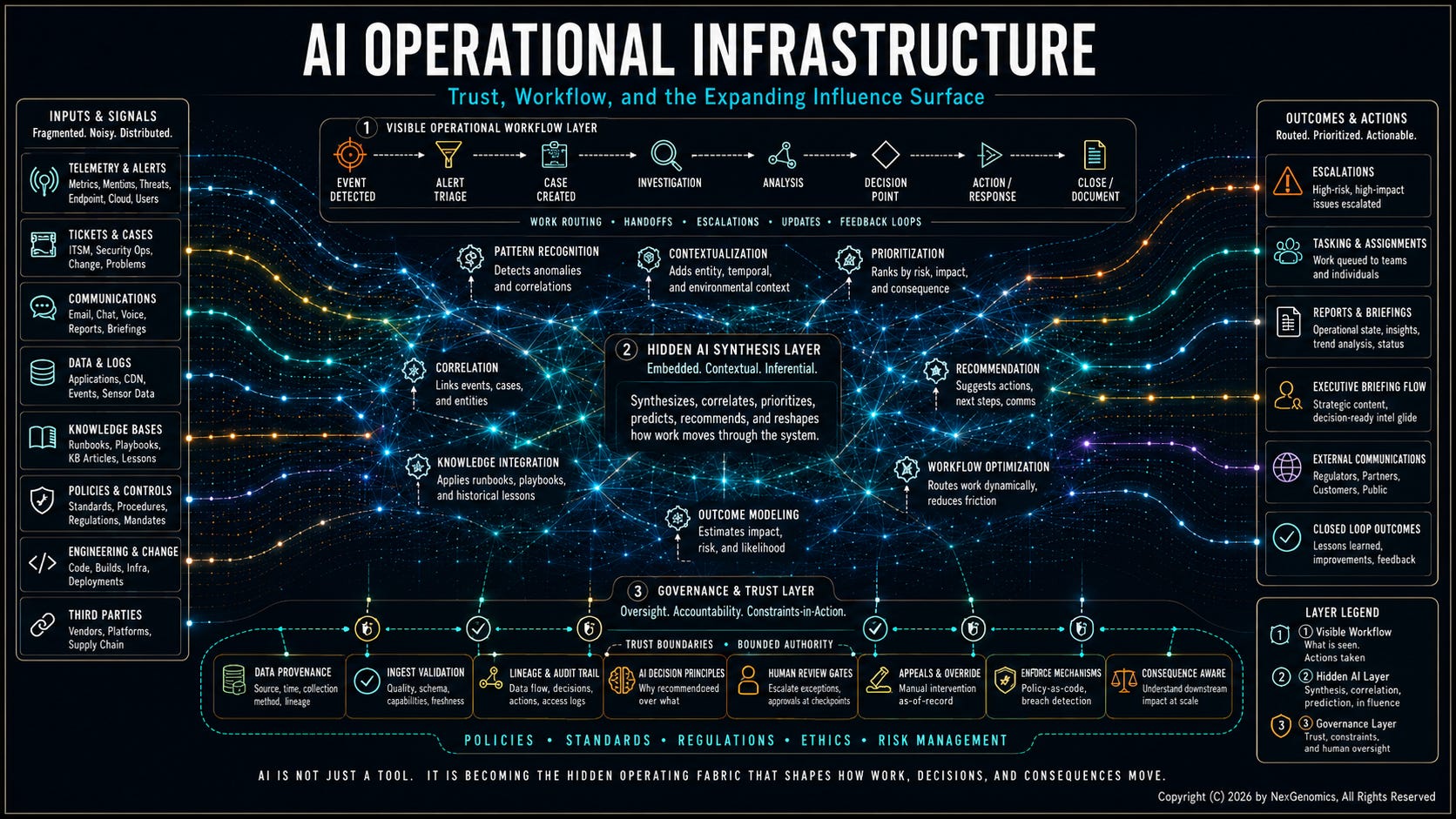
In the first article, I argued that the operational picture was always broader than the network.
That point matters because many organizations are now repeating a familiar pattern with artificial intelligence. They are treating AI as a tool category when, in practice, it is beginning to behave like infrastructure.
Not infrastructure in the traditional sense of servers, networks, platforms, or cloud environments. AI is becoming a layer of synthesis, prioritization, workflow direction, and decision support that increasingly shapes how work moves through an organization.
That shift is subtle. It rarely arrives as a formal operating model. It usually begins with a pilot, a workflow enhancement, a knowledge assistant, a summarization tool, or a model embedded into an existing platform. At first, the organization may see productivity improvement. Reports become easier to draft. Alerts become easier to summarize. Tickets become easier to classify. Recommendations arrive faster. Patterns become easier to see.
Those are useful capabilities. They are also the early signs of operational dependency.
Once AI begins shaping what people see, what they prioritize, what they escalate, and what they believe to be correlated, it is no longer merely a tool. It has entered the operational fabric of the organization.
That’s where the governance problem begins.
Most technology adoption begins with the language of tooling. A tool helps a person perform a task. It remains bounded by the user’s intent, the user’s judgment, and the user’s understanding of the work being performed.
AI does not always remain in that neat category.
When AI summarizes, it selects what matters. When it prioritizes, it influences order of attention. When it correlates, it implies relationship. When it recommends, it introduces directional pressure. When it scores confidence, it shapes human confidence. When it orchestrates workflow, it changes how decisions move.
None of these functions necessarily grant AI formal authority. Yet each can influence operational outcomes.
That is why the distinction between authority and influence matters.
Authority Surface describes the formalized decision rights and operational control boundaries within an organization. It asks who is allowed to decide, who is allowed to act, who accepts risk, and who owns the consequence.
Influence Surface describes the less visible layer where synthesized recommendations, prioritization logic, orchestration rules, confidence scoring, and contextual outputs begin shaping human judgment and operational behavior.
The challenge is that influence surfaces often expand before the organization realizes they exist.
AI adoption rarely pauses to ask where influence begins, where it ends, how it is governed, or how it should be constrained. The result is a quiet form of operational gravity. Work begins to bend around the outputs of the system.
People follow the summary because it is convenient. They accept the prioritization because it appears rational. They defer to the recommendation because it seems informed enough to trust. They rely on the correlation because it arrives with context they did not have time to build themselves.
Over time, the system becomes part of how the organization orients itself.
That’s how infrastructure behaves.
Organizations often miss this transition because they associate infrastructure with technical deployment. They look for servers, networks, identity systems, databases, or managed platforms. If the AI capability appears as an application feature, workflow add-on, or embedded assistant, it may not be treated as infrastructure.
But infrastructure is not defined only by where it runs. It is also defined by what depends on it.
If people depend on a system to understand conditions, establish priorities, coordinate response, justify action, or communicate status, that system has become operational infrastructure in practice.
In cybersecurity, we learned this lesson through SOC tooling. A SIEM might start as a log aggregation platform, but once analysts, incident responders, auditors, executives, and risk teams depend on it for operational awareness, it becomes part of the operating model. SOAR platforms begin as workflow automation, but over time they encode assumptions about escalation, classification, response, and timing. Case management systems begin as recordkeeping, but they become evidence structure, accountability trail, and management visibility.
The same pattern is emerging with AI, only faster and less visibly.
AI systems can sit across knowledge bases, ticketing systems, alert streams, operational data, policy repositories, email, engineering records, customer systems, and executive reporting. Their outputs may influence many different groups at once without any single group fully owning the governance model.
That creates a distributed influence system.
The AI may not own the decision. It may not execute the action. It may not approve the risk. Yet it can shape how each of those functions is understood.
That is enough to matter.
Operational dependency does not always announce itself.
Teams may begin by using AI to save time. Then they begin to use it to reduce ambiguity. Then they use it to prepare recommendations. Then they use it to explain conditions to leadership. Eventually, the organization’s decision flow assumes the AI-generated synthesis will be available.
At that point, the dependency has formed.
This matters because invisible dependencies create governance gaps. Leaders may believe human judgment remains fully intact because a human still approves the decision. But the human may be approving a decision shaped by synthesis they did not independently verify, confidence levels they did not calibrate, source context they did not inspect, and omitted uncertainty they did not see.
That does not make the AI wrong. It makes the operating model incomplete.
In consequential environments, incomplete operating models matter. A cybersecurity recommendation can change access, disrupt operations, trigger customer communication, influence disclosure timing, or shift executive attention. An operational recommendation in industrial, healthcare, logistics, financial, or infrastructure environments can affect safety margins, production continuity, service availability, regulatory exposure, and public trust.
The more consequential the environment, the less acceptable it becomes to treat AI influence as a convenience layer.
If AI is shaping operational understanding, then its influence should be visible, bounded, observable, and governed.
One of the more subtle shifts in AI adoption is the movement from answer generation to workflow formation.
Early AI use cases often focused on producing content: drafting text, summarizing material, extracting information, or answering questions. Those use cases are relatively easy to understand because the output is visible.
The next phase is different.
AI is beginning to organize work. It can triage inputs, assign urgency, correlate events, recommend next steps, route tasks, draft executive summaries, prepare customer responses, identify policy conflicts, and suggest mitigation options.
This changes the nature of governance.
A generated paragraph can be reviewed. A workflow influence may be harder to see. It may show up as a ticket that was escalated, a condition that was de-emphasized, a risk that was categorized as acceptable, or a recommendation that framed the available choices before a leader ever saw the underlying facts.
The human remains in the loop, but the loop has already been shaped.
This is why simplistic governance language becomes insufficient. Saying that a person approves the final decision does not answer the more important operational questions.
What information was selected for that person?
What was excluded?
What confidence was implied?
What sources were weighted?
What uncertainty was preserved?
What alternatives were suppressed by the workflow?
What authority did the person believe they were exercising?
What influence shaped that belief?
These are governance questions, but they are also architecture questions. They ask whether the organization can see how AI participates in operational judgment.
Traditional trust boundaries often focus on access, identity, network segmentation, application permissions, and data protection. Those remain important. But AI introduces a trust boundary around synthesis itself.
The issue isn’t only who can access data. It’s also how data is combined, interpreted, summarized, scored, and transformed into operational guidance.
That’s a meaningful shift.
A trusted AI environment must protect data confidentiality, but confidentiality alone is not sufficient. It must also preserve context, support provenance, constrain orchestration, expose decision lineage, and make uncertainty visible. It must allow organizations to understand not only what the model produced, but what operational role that output played.
Did the AI inform a human?
Did it prioritize work?
Did it recommend action?
Did it trigger escalation?
Did it alter the way risk was framed?
Did it shape executive understanding?
These distinctions matter because each one occupies a different position on the influence surface.
A summary that helps a user read faster may carry limited operational consequence. A recommendation that changes incident priority, delays a response, accelerates containment, or shifts leadership attention carries more consequence. A workflow orchestration that routes decisions across multiple teams carries even more.
Trust boundaries should reflect that progression.
Many AI governance discussions still sit at the policy layer. They focus on acceptable use, data handling, model selection, review requirements, and risk categories. These are necessary, but they are not enough.
Operational AI governance must also be architectural.
The organization needs to understand where AI touches workflows, what decisions it influences, what data it synthesizes, what confidence it asserts, what authority it appears to support, and what evidence remains available after the decision is made.
That requires more than policy acknowledgement. It requires design.
It requires governed ingestion, controlled synthesis, tenant isolation, bounded agent authority, evidence preservation, operational observability, and escalation structures that reflect consequence.
It also requires humility.
AI can help organizations see patterns they could not otherwise see. It can reduce cognitive load, surface weak signals, and help teams connect fragmented operational context. Those capabilities are valuable. The problem is not that AI participates in operational work. The problem is allowing it to participate without a mature understanding of the influence it creates.
That is the uncomfortable middle ground many organizations now occupy.
They are not handing AI formal authority, but they are allowing AI to shape judgment. They are not treating AI as operational infrastructure, but teams are beginning to depend on it. They are not building governance visibility at the same speed they are building AI-enabled workflows.
That gap will define the next phase of operational AI risk.
The answer is not to slow innovation for its own sake. It is not to reject AI in consequential environments. It is not to pretend human review automatically resolves the problem.
The answer is to treat operational AI as a governed synthesis layer.
That means asking practical questions early.
Where does AI influence operational understanding?
Which workflows now depend on AI-generated synthesis?
Which recommendations can alter urgency, priority, escalation, or action?
Where does confidence come from?
What evidence supports the synthesis?
What uncertainty is retained?
What happens when AI-generated guidance conflicts with operator experience, engineering context, policy, or business pressure?
Who owns the consequence when AI-shaped judgment contributes to a decision?
These questions do not belong only to data science teams. They belong to operations, cybersecurity, legal, risk, engineering, compliance, and executive leadership.
That is because the influence surface is not contained inside the model. It emerges where model output meets operational decision-making.
AI is quietly becoming operational infrastructure because organizations are allowing it to shape the flow of work before they fully recognize the operating model being created.
That does not make AI adoption reckless. It makes the moment important.
We are entering a phase where the central question is no longer simply whether AI can produce useful outputs. It can. The more important question is whether organizations can govern the influence those outputs create.
The operational picture was always broader than the network. AI is expanding it again, into synthesis, prioritization, recommendation, orchestration, and decision gravity.
That expansion will require a more mature governance vocabulary.
Authority tells us who is allowed to decide.
Influence tells us what shaped the decision before authority was exercised.
Trust tells us whether the organization can rely on that process under pressure.
The organizations that understand this distinction early will be better positioned to use AI responsibly in consequential environments. They will not merely adopt AI tools. They will design trustworthy operational infrastructure around them.
That distinction may become one of the defining governance challenges of the next decade.
And it leads directly to the next question in this series:
What happens when influence exceeds governance visibility?
No posts
Comments
Nothing yet. Say the first thing.
Sign in to join the conversation.