
Airborne Ventures · March 2026
I take distribution seriously as a moat. Accept the premise: platform value scales with reach, switching costs accumulate as users habituate, and early movers compound faster than challengers can replicate. Microsoft Teams absorbed Slack on exactly this logic — not by building a better product, but by bundling distribution into an ecosystem enterprises were already locked into.
So: does distribution work as a moat in B2B AI?
Run the DocuSign test. Open an AI orchestration layer and instruct it to send a contract for signature. It works. The document gets sent. Now ask what DocuSign contributed that HelloSign, PandaDoc, or a direct Acrobat API call couldn’t have provided identically. When AI agents can route to any compliant e-signature API, the workflow layer abstracts away the provider. DocuSign still processes the transaction — but it has been quietly demoted from platform to commodity vendor, competing on price beneath an orchestration layer it does not control.
Now run the JusBrasil test. Ask for the voting pattern of a specific federal judge in pharmaceutical tax disputes, with statistical confidence intervals on future rulings. The AI calls JusBrasil — not because of a sales contract, but because JusBrasil is the only entity that has collected 130 million Brazilian judicial decisions since 2008. The call is not a matter of convenience. It is a matter of irreplaceability.
The cleanest diagnostic for defensibility in the age of AI orchestration: is your company called because it is convenient, or because nothing else can answer the question?
Companies in the first category are at risk of AI abstraction. Companies in the second become more valuable as AI proliferates — because every new AI system needs their data and cannot substitute it.
Tomasz Tunguz articulated the shift in February 2026: in AI, distribution is king — but skills are seizing the crown. Skills encode institutional knowledge in executable form. They tell an agent which APIs to call, what format to use, how to handle edge cases. You don’t learn an interface. You acquire a capability.
The top MCP aggregator has 81,000 GitHub stars. Enterprises are beginning to provision capabilities, not applications. An FP&A team receives a skill that pulls from their ERP and formats reports in the CFO’s preferred structure — no training, no documentation. Every platform shift compresses the distance between user and value.
The skills era doesn’t destroy moats. It clarifies which ones were real. A tool in a browser tab is easily replaced by a skill that does the same job. A system embedded in clinical workflows, in fiscal compliance chains, in fleet operations — that requires a governance decision to remove, not a procurement conversation.
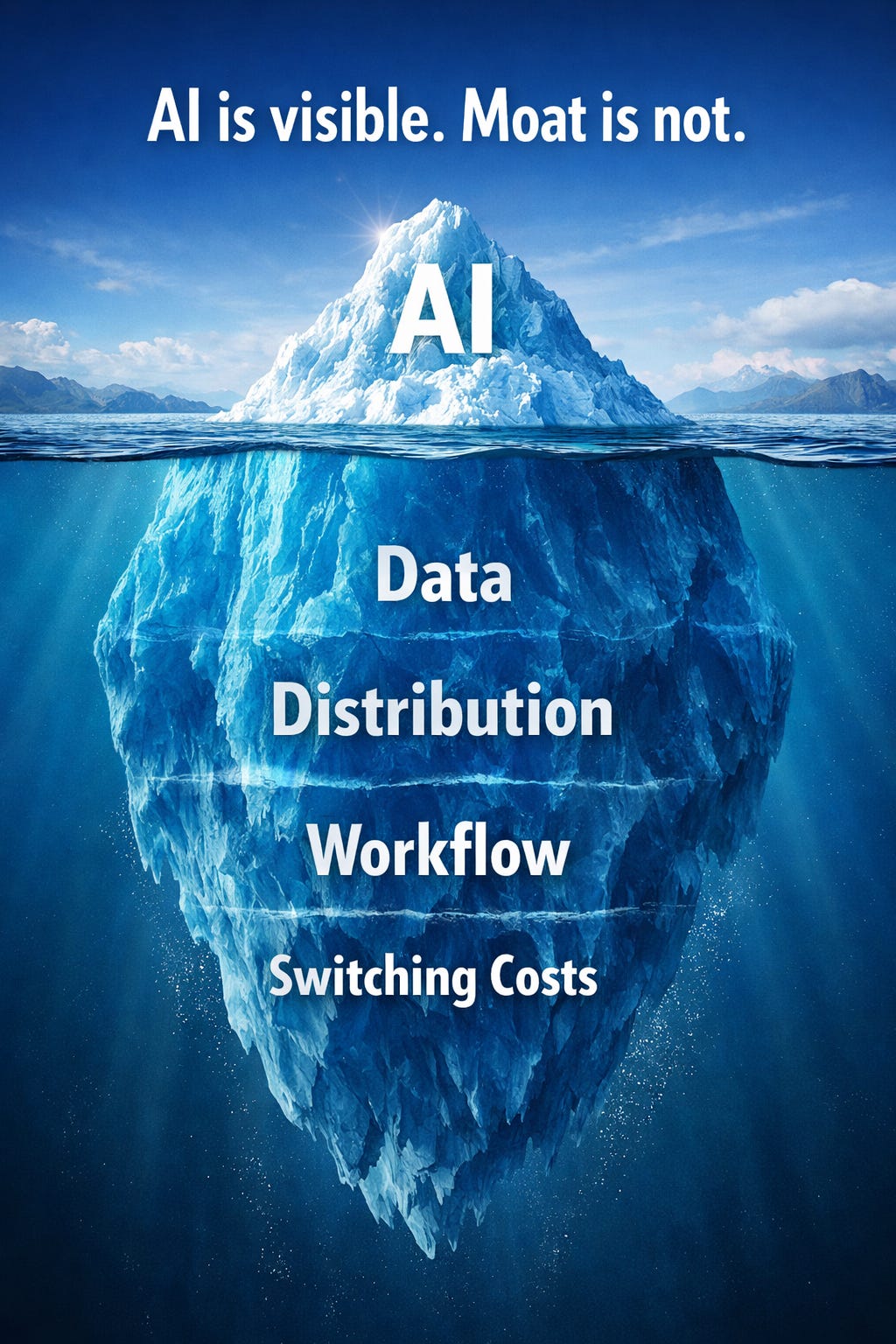
Strip away the noise — the AI capability arms race, the distribution narratives, the wrapper valuations. Four structural conditions predict which software companies hold value as AI commoditizes everything around them.
You don’t need all four. But one alone is rarely enough, two is precarious, and each additional condition compounds the others. Three is where structural resilience begins. Four is where the gap becomes permanent.
I. Regulatory complexity as a permanent barrier
Brazil has edited 363,779 tax norms since 1988 — nearly two per working hour. Healthcare requires navigating ANVISA software classification, CFM telemedicine mandates, ANS interoperability standards, and sensitive data protocols simultaneously. For software built around this complexity, each new regulation is not a burden — it is a moat that regenerates. Global foundation models can learn English law from the internet. They cannot learn 30 years of Brazilian fiscal jurisprudence from synthetic data.
II. Proprietary data — continuous, not archival
The synthetic data argument blunts many data moat narratives: if you can generate training data cheaply, static datasets lose their edge. This critique lands squarely on archives. It fails against data that is continuous, contextual, and embedded in regulated workflows where errors carry legal consequences.
ROIT AI’s 2.1 billion mapped tax scenarios, updated with each new regulation. Tesla’s 160 billion video frames added daily from 7 million vehicles. Data is defensible when collected continuously in real time, embedded in regulated workflows, combined with domain expertise, and part of a flywheel where use improves the product. Outside these conditions, data moats are far more fragile than investors typically assume.
III. Workflow integration that is structural, not convenient
There is a useful distinction between tools that live in tabs and systems that live in APIs. Tabs are closed. APIs embedded in operational infrastructure require deliberate unwinding.
Doutor.AI’s integration into Rede D’Or — Latin America’s largest private hospital network — is embedded in clinical workflows, trained on the documentation patterns of that specific network, and accountable to care quality metrics. Removal is a clinical governance decision, not a procurement one. Rabbot delivers fault signatures days before a vehicle stops: for logistics operators, that is not a feature enhancement — it is the core operational capability. When you remove it, you lose the predictive layer your maintenance scheduling runs on.
IV. The flywheel: where use compounds into structural advantage
TOTVS has 70,000+ clients whose management data, accumulated over decades, now powers a B2B AI foundation model. Each new client strengthens the model’s understanding of Brazilian regulatory complexity. Nubank has captured 46% of all Open Finance data requests in Brazil — 7.4 billion — feeding credit models with 30,000+ data points per customer. Open Finance didn’t destroy Nubank’s moat. It weaponized it.
Zenvia went public as “Latin America’s leading cloud-based CX platform.” Its market cap oscillates between US$20–40 million. The CFO has described its CPaaS segment as commoditized, with periodic pricing pressure. The story is not one of execution failure. It is one of structural position: messaging infrastructure is a workflow layer AI orchestrators can call from any provider. Early mover advantage in a commodity category produces a temporary premium, not a durable one.
Kavak reached an US$8.7 billion valuation in 2021. A 75% haircut followed. The marketplace for used cars, even in structurally inefficient LatAm markets, is replicable. Capital invested in brand and expansion without workflow lock-in is capital invested in sand.
Jasper fell from a US$1.5 billion valuation to a 53% revenue collapse when ChatGPT launched a product matching its core functionality.
The question that survives all of this: if the foundation model provider launches a vertical product tomorrow, does this company still exist? The answer is yes only when the four conditions above apply. Without them, distribution is a head start, not a finish line.
In Brazil and Latin America, the regulatory environment is not an obstacle to this thesis. It is the thesis. The fiscal complexity of 460,000+ tax norms, the healthcare compliance stack, the agricultural traceability demands of the EU Deforestation Regulation — each creates a structural moat that global foundation models cannot shortcut. The local context that a model trained on the global internet cannot easily learn is exactly where durable software value lives.
The companies we are most interested in are those where the AI capability and the data moat are the same thing — where more use means better data, better data means better decisions, and better decisions create switching costs that grow over time. You cannot synthesize 15 years of Brazilian fiscal compliance decisions. You cannot replicate 18 years of tropical soil data from a dataset trained on Northern Hemisphere agriculture.
The moat isn’t the AI. The moat is what the AI knows that no one else can teach it.
Eduardo Küpper is Managing Partner at Airborne Ventures, a pre-Series A fund focused on B2B AI, fintech, and digital health in Latin America. airborne.ventures · eduardo@airborne.ventures
Thanks for reading The Briefing Room! This post is public so feel free to share it.
Comments
Nothing yet. Say the first thing.
Sign in to join the conversation.