
Talking to my fellow GPs about how we operate/manage our fund structure, we always go get to “Why you didn’t just charged management fee upfront?). And every time, I cringe at the value destruction they're casually proposing. It is true that it is a simpler is way easier to sell and manage the fund. Who wins or loses the most?
But is it worth? Here's the uncomfortable truth: upfront management fees desalign. At best LPs pay and don’t use, at worst it can wipes 15-30% of LP returns compared to annual ‘pay as you go’ structures.
Not 1-2%. Not rounding error territory. We're talking about systematic value that are left on the table that compounds over time, and gets worse with better performance.
TL;DR? Click here. All others tune in while you read it!
“Ten thousand people, maybe more.
People talking without speaking,
People hearing without listening”
The Tale of Twin Models
Let me show you two supposedly "equivalent" fund structures, both charging the same 2% annual management fee on a $100 commitment:
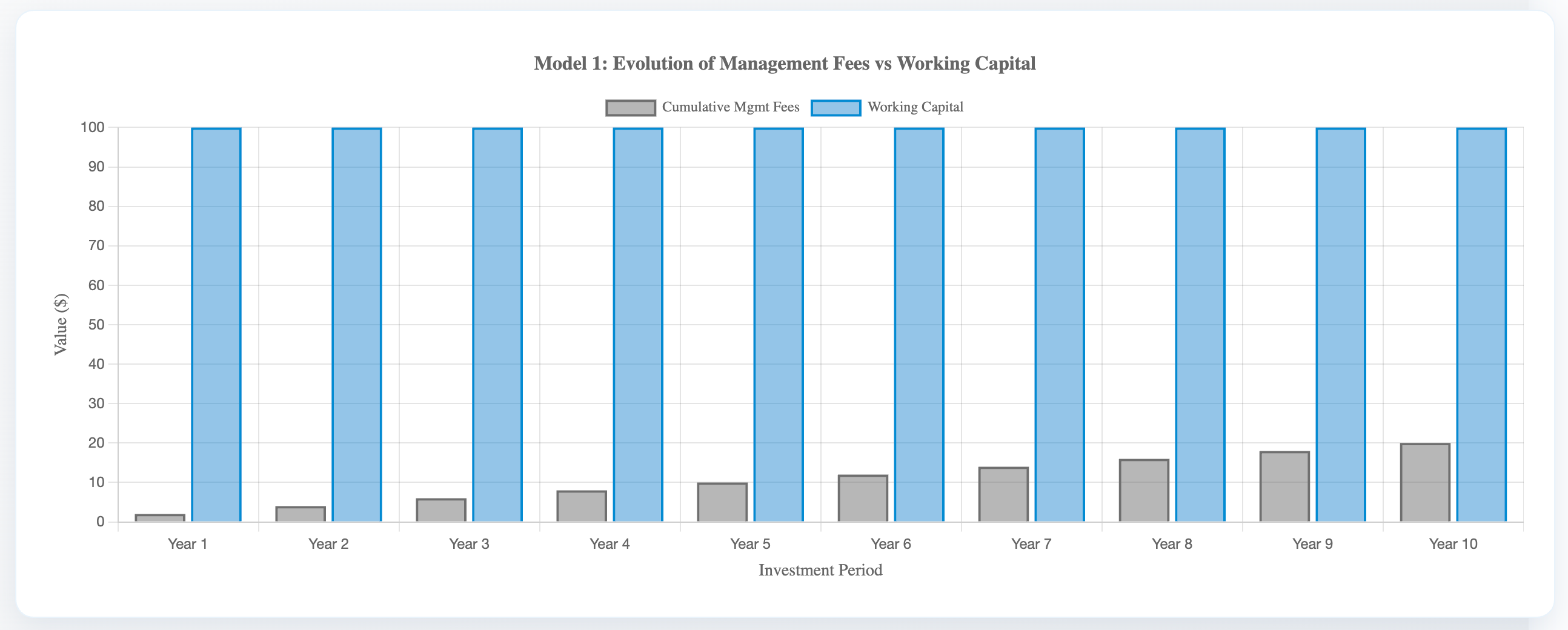
Model 1 (Annual Capital Calls):
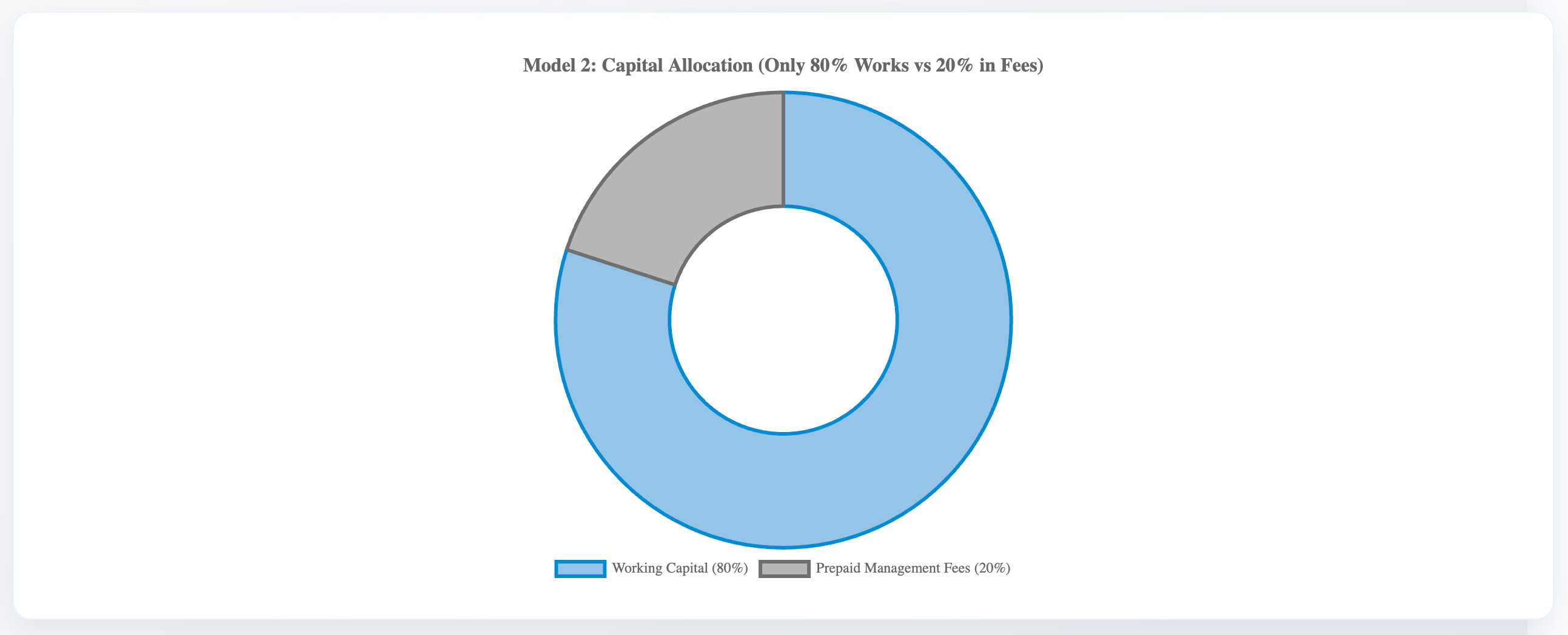
Model 2 (Upfront Fees):
"Same fees, same returns, right?" Wrong. (Even if you gross-up in model 2 instead of hurting dollars at work, but I’ll keep gross-down as it is the most commonly seen.)
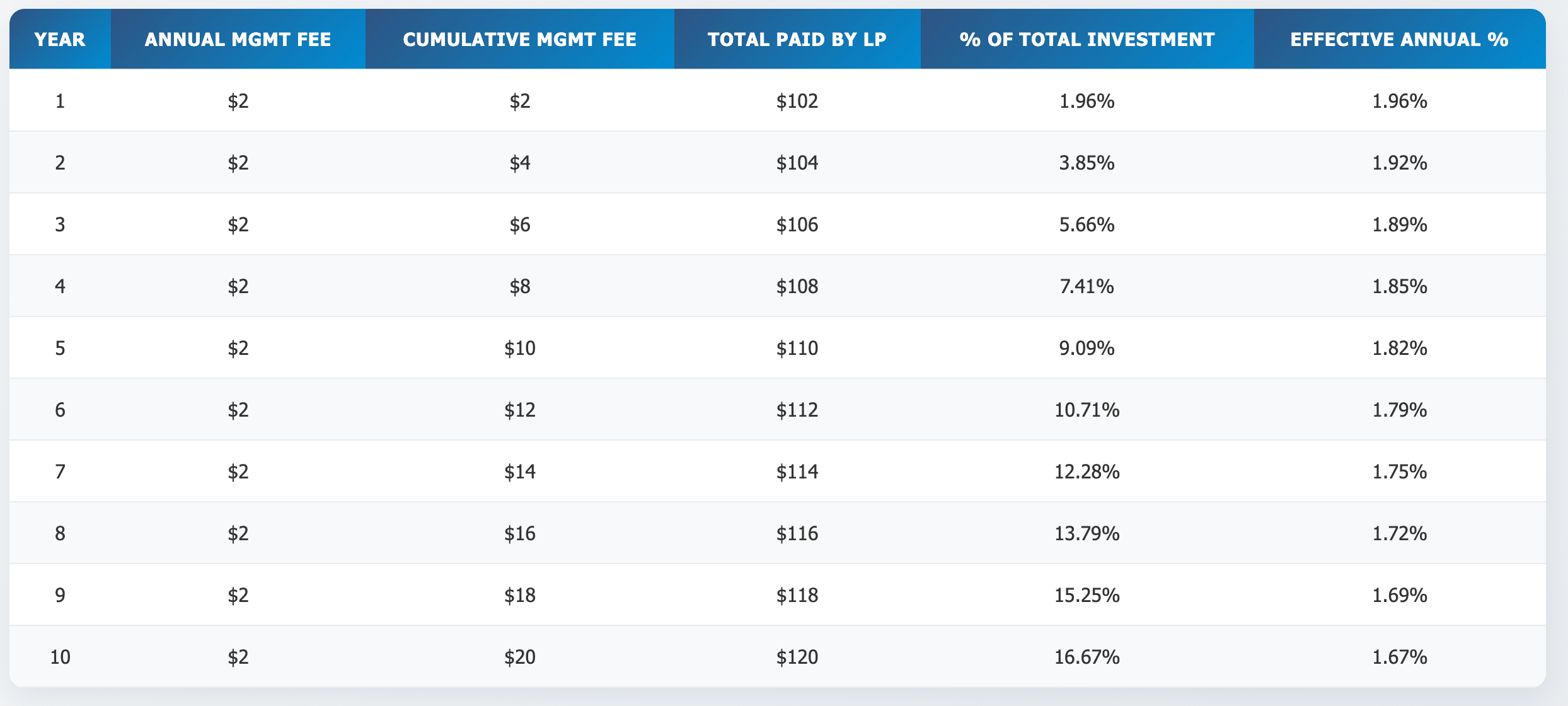

Reality: It's Not Even Close
Capital Efficiency Insight:
Notice how the effective annual percentage decreases over time in the annual model - from 1.96% in year 1 to 1.67% in year 10, totaling 18,06% instead of 20%. This creates a natural "discount" for longer-term investments and better aligns GP incentives with LP outcomes.
Scenario 1: The 5x Exit (Year 5)
You are happy, your portfolio company exits at 5x the invested capital.
Model 1:
$100 invested → $500 exit value
Management fees paid: $10 (5 years × $2)
Carry on $390 gain: $78 (20%)
LP receives: $422
TVPI: 3.84x | IRR: 30.8%
Model 2:
$80 invested → $400 exit value
Management fees already paid: $20
Carry on $300 gain: $60 (20%)
LP receives: $340
TVPI: 3.40x | IRR: 27.8%
The sting: LP loses $82 in absolute returns. That's 0.44x TVPI and 300 basis points of IRR. On a $100 investment. For the GP the difference is not that much $88 vs $80, but on first case it os highly skewed with carry and over time, which means that success is paramount.
Scenario 2: The 10x Exit (Year 7)
Same company, better outcome. 😍
Model 1:
$100 invested → $1,000 exit value
Management fees paid: $14 (7 years × $2)
Carry on $886 gain: $177 (20%)
LP receives: $823
TVPI: 7.22x | IRR: 34.8%
Model 2:
$80 invested → $800 exit value
Management fees already paid: $20
Carry on $700 gain: $140 (20%)
LP receives: $660
TVPI: 6.60x | IRR: 32.2%
The damage: LP loses $163 in absolute returns. That's 0.62x TVPI and 260 basis points of IRR, given LPs can defer costs. The GP starts to see the difference $191 vs $160.
Notice the pattern? The better the performance, the bigger the penalty for upfront structures.
Here's what every GP knows but won't tell you: only 80% of your commitment actually works to generate venture returns in upfront structures.
That other 20%? It gets locked into covering GP salaries, office rent, and legal fees. Zero venture upside. Zero multiple expansion. Zero alpha generation.
The math is actually simple:
Model 1: 100% of capital generating venture returns
Model 2: 80% of capital generating venture returns
Efficiency gap: 25% less working capital (80 vs 100)
In venture capital, where the entire game is maximizing returns on deployed capital, this difference should matter a lot.
"But the administrative burden of annual fees is just too burdensome!"
True, but this is actually the job the GP signed for. Board meeting, reports, helping out with biz development, intros, accounting, tax planning, etc. and this happen ALONG the investment, not only in you write the check.
I've seen GPs spend more time debating office events and what lifestyle they should choose than they would managing annual fee structures. Im still to see someone who doesn’t get paid years to keep putting effort onto something, specially on the financial market. This isn't operational efficiency. This is operational theater.
Here's the deeper issue: upfront structures fundamentally misalign GP and LP interests.
Annual structure alignment:
GPs earn fees as they deploy and manage capital
Strong incentive to deploy efficiently and add value
Fee earning tied to actual fund activity
GP success directly correlates with LP success
Upfront structure misalignment:
GPs get paid regardless of deployment speed
Fee earning disconnected from value creation
GP convenience prioritized over LP returns (Some LPs also prefer this convenience…)
The Counter-Arguments
"Default risk is real with annual structures"
That is true and that can be burdensome. However if the papers were done right many mitigators and incentives to comply will help. Blind pool Funds feel the same pain and they survive. You're solving for a lower probability event by creating a guaranteed value destruction.
"LPs prefer the simplicity"
Most sophisticated LP prefers losing 15-30% of their returns for "simplicity." This is GP preference, specially because its easier to sell to LPs. Real LPs want maximum returns on their capital. Period.
"It's market standard"
Market standards can be wrong. And its also very common to see things that are not common depending on who reaps the reward. The entire venture industry operated on handshake deals and club memberships for decades. Progress happens when someone challenges comfortable assumptions with uncomfortable math.
"The difference is immaterial"
$163 lost returns on every $100 invested. 0.62x TVPI difference. 260 basis points IRR gap. On a $10M fund, that's $16.3M in destroyed LP value. If $16.3M per fund is immaterial, you're in the wrong business.
Let me summarize the mathematical reality with painful clarity:
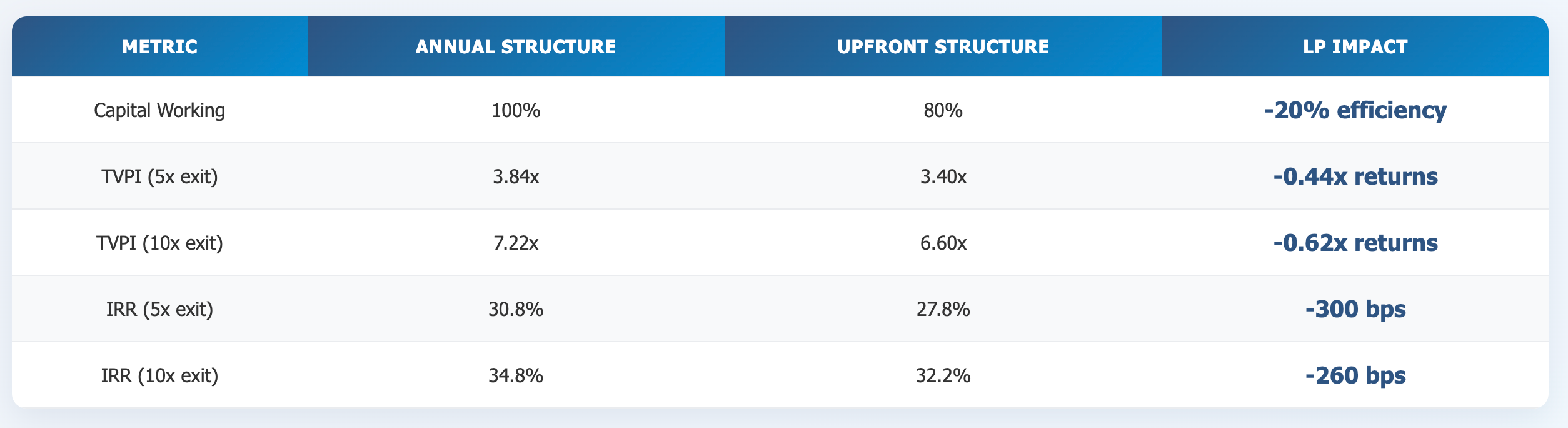
Doubts? Just run the numbers! Here you can get more detail.
The moment you choose upfront structures, you guarantee your LPs will receive lower returns than an equivalent annual structure. The only variables are how much lower and whether you'll acknowledge the math.
Every decision in venture capital should be evaluated through one lens: does this materially improve LP returns? Upfront management fees fail this test spectacularly.
In a business where we obsess over basis points of carry and fine-tune fee calculations to the third decimal, leaving a lot of carry (yes, GPs also loose) seems not a good deal for me. I choose to make my life slightly harder so my LPs' (which I am one of them) returns can be significantly better. Because at the end of the day, venture capital isn't about GP convenience. It's about generating exceptional returns on LP capital.
For LPs reading this: The next time a GP pitches upfront management fees as "equivalent" to annual structures, ask them to show you the mathematical impact on your returns. If they can't or won't run these numbers, that tells you everything you need to know about their priorities.
For GPs reading this: Challenge yourself to prioritize LP returns over administrative convenience. Your LPs aren't paying you management fees for simplicity. They're paying you to maximize their capital appreciation. Act like it.
The uncomfortable truth is often the most valuable truth. Now you know the math. What will you do with it?
Comments
Nothing yet. Say the first thing.
Sign in to join the conversation.