

A flurry of reports and TV programmes have recently emerged revealing that the education system is failing the ‘white working class’.
The most detailed report to date ‘The Independent Inquiry into White Working-Class Outcomes’ has just been published. This blog is a critical appraisal of it. The inquiry Panel, though supposedly ‘independent’, is made up, apart from Estelle Morris, of the great and good in the current ‘blob’ who have been running the system since the Gove reforms. There are no teacher trade unions represented, only Headteacher ones, no local authority officers and no academics who have been critical of the Gove project. Five members are directly connected to academy trusts and one of the two the co-Chairs heads up a large MAT.
Who are the White Working Class?
The report fails to define the group they are reporting on. It asks the DFE to come up with a definition of the group so that more accurate data can be collected and better interventions by schools planned. Some of the data in the report uses the market research created ‘C2DE’ definition but this includes relatively well-off earners such as plumbers. Most of the time it reverts to white British children eligible for free school meals. This group is defined as being in severe poverty with a family income of below £7,400. The report rightly points out that this is of limited use but because ‘this is the only socioeconomic data available to school leaders’ they continue to use it.
The argument for focusing on the ‘white working class’ is mainly based on data showing that white British pupils eligible for free school meals are among the lowest attainers in the FSM eligibility group. 26% of the whole FSM group achieve grade 5 in English and Maths compared with 54% of non-disadvantaged pupils. This is a major concern, but consideration of it has now been overtaken by a desire to divide the disadvantaged.
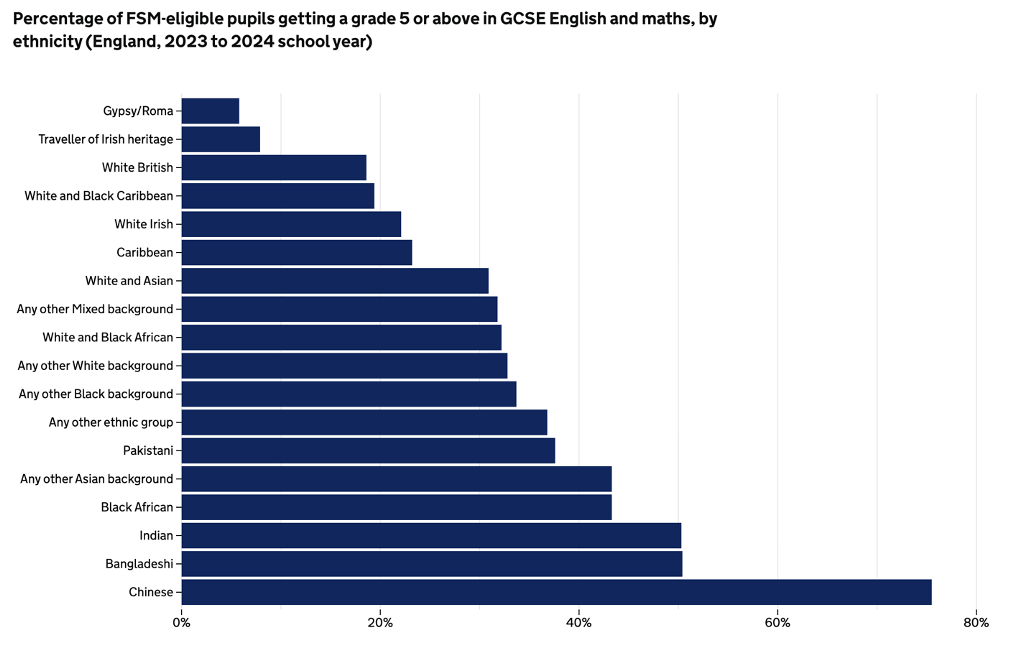
.Above from DFE.
I do not have time here to theorise about why ethnic groups perform so differently only to point out that they vary in size considerably. The report could have done this exercise. Looking at the chart though, the main jump in attainment appears after the Caribbean children bar. Their attainment is only 4% higher than white British children but they are not considered by the inquiry.
There are several mainly white areas of England, which have suffered from rapid economic decline and intergenerational poverty. These areas experience low educational attainment. The report avoids ‘white working class’ pupil focus groups from our more cosmopolitan cities and our more affluent rural areas and focuses on the North East, Cornwall and Knowsley. It is important to inquire into why outcomes are so low in these areas. I find myself though agreeing with a Teach First comment quoted in the report.
‘The contexts differ, but the underlying attainment gap linked to poverty is present across all groups…poverty must remain the primary lens through which disadvantage is understood.’
Try as it might the Inquiry is not really into the educational outcomes of the hard to define ‘white working class’ but more about the impact of unrelenting poverty on education in ex-industrial areas of the country.
Barriers to Achievement
The report accepts that schools alone cannot shift the dial but what is the report saying about what schools can do to be part of strong communities and respond to the excellent qualitative commentary the report has compiled? It is worth remembering at this point that the membership of the inquiry panel have either been uncritical of the education reforms since 2010 or have been directly involved in their implementation. The report starts by identifying barriers to achievement:
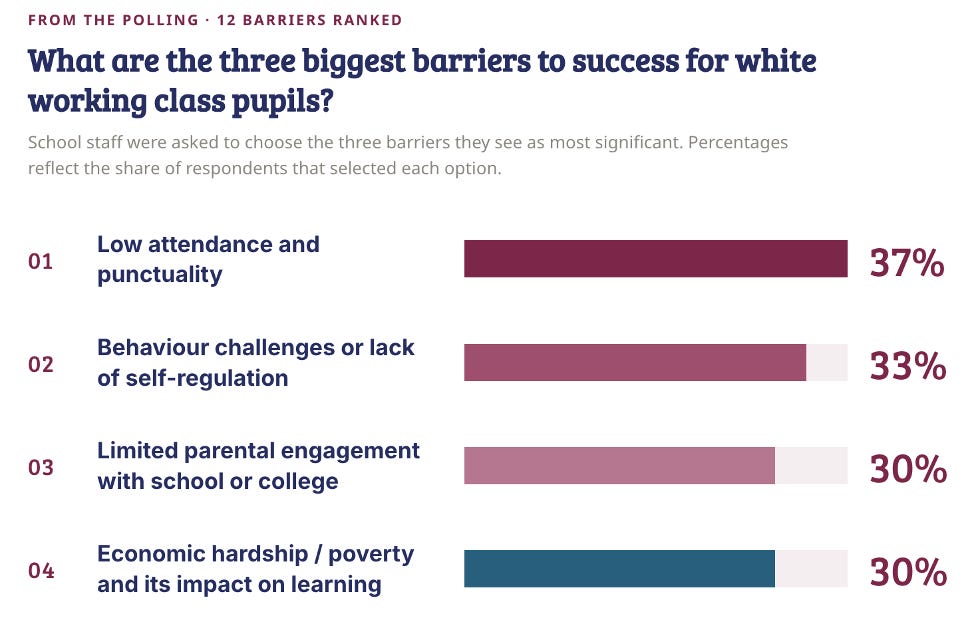
The three highest ‘barriers’ it appears, according to schools, tend to be laid at the door of the working-class families themselves. The report does not question why children and families are reacting in this way. Could it be that the curriculum, tests, and over-zealous behaviour regimes are at least part of the cause?
Two comments from the report from parents:-
[School] is horrendous. I actually went there and I wouldn’t send my kids there now…They were taken over by a company called the [Multi Academy Trust] and they’ve brought in some ridiculous stuff…my son got put into [detention] for helping his friend…he tried to explain to the teacher and that was put down as talking back.
He’s been suspended thirteen times since he started in September…It’s not even discipline, it’s nitpicking. Stupid little things from not having his shirt tucked in, to having no tie, having no pen…It just seems like a detention camp as opposed to a school.
Given ‘behaviour’ has been identified as a barrier to achievement you might expect a recommendation relating to the rigid militaristic approach of some academies. This issue is not tackled by the report.
Curriculum and Assessment
Hyman’s report ‘Inside the Mind of a Young NEET’ refers to how the curriculum is designed for the university route alone and this has been echoed recently by Andy Burnham. Whilst around only 8% of school leavers last year went to Russell group universities (including the private sector) the current curriculum and assessment regime is mainly conceived to prepare and select young people for that next step. One would expect the report to point this out given how few children from the ‘white working class’ make it to university, and that conversely they want opportunities to succeed in their own communities.
Despite comments like this from their focus groups -
‘The idea that somebody down in London has put together a curriculum because a tiny, tiny minority of people go to Oxford, it’s an absolute nonsense.
The gentrification of education has just made things 100% worse.
It appeals to the people who have that set of values.
the report takes the opposite view. Instead, it doubles down on the status quo and assumes how the curriculum is delivered by teachers is the problem, not the curriculum itself.
‘All pupils should have access to a well-designed, knowledge-rich curriculum that provides a strong academic foundation and expands opportunity. Evidence suggests that, in many schools serving white working-class communities, the challenge is not the curriculum itself, but ensuring that it is delivered in ways that are consistently engaging, meaningful and accessible for pupils’
The report is vague and even contradictory as it recommends high quality, meaningful vocational and applied pathways at Key Stage 4. The problem with ‘pathways’ is that they can result in labelling and constraining pupils. However, the report then goes on to mention ‘options’.
‘Any expansion of vocational and applied options should complement, rather than replace, strong academic expectations for all pupils.’
Given the already crowded nature of the curriculum, how vocational options can be just added is not explained.
If you’ve got more going on, and people put the most pressure they can on you at one point in your life and its meant to determine where your life goes from that point, you are not going to be able to focus on anything at all. It’s got nothing to do with intelligence. Its got everything to do with the fact that if your head is never quiet, the information just won’t sit.
Girl from Clacton ‘Inside the Mind of a Young NEET’
Unlike, the report from Peter Hyman ‘Inside the Mind of a Young NEET’ which pulls no punches when it explains the damage to well-being the current assessment regime inflicts on working class young people, this inquiry report does not mention it at all.
Schools in their communities
Given who makes up the panel, it is surprising that one of the recommendations for ‘schools and trusts’ is to reposition ‘education as a shared endeavour between schools and families’. The recommendation is an admission that trusts have failed in their task to develop and maintain such a partnership.
‘Schools and trusts should be expected and supported to develop more relational approaches to family engagement, building on the positive examples of this in the system. This could include more effective use of parents’ evenings, earlier and more consistent communication with families, and greater outreach beyond the school gate.’
But the above is not about sharing and listening as the charity Children Northeast practises in its poverty proofing project. Instead, it’s about communicating what schools are doing more effectively. Unsurprisingly the inquiry found ;-
Despite the increasing role that schools play in supporting pupils and families, the research suggests that many white working-class communities do not experience schools as central, trusted institutions within their local areas.
These deindustrialised areas of England were the among first under Blair to have struggling schools replaced by academies, which were meant to be the answer to poor education outcomes. Now with over 80% of secondary schools converting to academies and more becoming members of trusts, whose headquarters could be the other side of the country, this finding is unsurprising. Elected governors have been removed; local community representatives have no say in the running of local schools and complaints procedures are notoriously opaque. This inquiry is tacitly admitting that after years of increasing academisation, the policy has failed to build trust with alienated communities or raise educational outcomes in them.
Conclusion
Sharing good practice, more sure start style centres, funding quality enrichment programmes, programmes for reading and oracy, sorting out apprenticeships and more emphasis on vocational education are all tweaks to an existing system which I would support.
However, this report falls woefully short and prefers to lay the blame for poor outcomes at the door of the communities themselves and teachers. Trusts who control most schools now are not appraised and the panel do not seem able to point to one which is demonstrating strong practice in this area. Furthermore, the report fails to properly identify the group it is dealing with and sometimes does not respond to the often-devastating comments from its sources. The attainment gap between disadvantaged pupils and others is growing yet the Gove/Gibb legacy of semi-privatised academies, a knowledge rich curriculum and high stakes assessment is apparently blameless.
Andy Burnham, these are not the recommendations for the radical education reform you are looking for. Please look beyond the hand wringing of these people, most of whom are at least partly responsible for the alienation of working-class kids from our education system, to more fundamental reform.
No posts
Comments
Nothing yet. Say the first thing.
Sign in to join the conversation.