
This week, OpenAI announced that an internal reasoning model had disproved Erdős’s long-standing unit-distance conjecture — a central part of the planar unit-distance problem, first posed in 1946.
The mathematicians who checked the work were direct. Noga Alon, Professor of Mathematics at Princeton, called it “an outstanding achievement.” Fields Medallist Tim Gowers, Combinatorics chair at the Collège de France, wrote that if a human had written the paper and submitted it to the Annals of Mathematics, he would have recommended acceptance without hesitation. Jacob Tsimerman of the University of Toronto put the model’s edge plainly: it can play for longer and in more treacherous waters than mathematicians without getting overwhelmed.
The model didn’t summon a new kind of cognition. It applied known tools from algebraic number theory — Golod-Shafarevich theory, infinite class field towers — with more patience than a human could sustain. Sophisticated, elegant, recognisably mathematical. And once explained, comprehensible.
Which puts the result inside an older question.
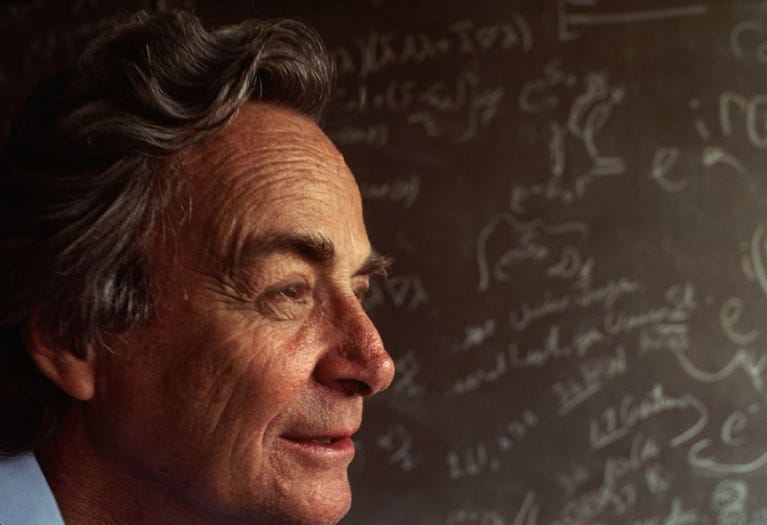
In his 1985 autobiography Enigmas of Chance, the mathematician Mark Kac reached for a distinction that has stuck. He was writing about Richard Feynman, whom he had known at Cornell.
There are two kinds of geniuses: the "ordinary" and the "magicians." An ordinary genius is a fellow that you and I would be just as good as, if we were only many times better. There is no mystery as to how his mind works. Once we understand what he has done, we feel certain that we, too, could have done it. It is different with the magicians. They are, to use mathematical jargon, in the orthogonal complement of where we are and the working of their minds is for all intents and purposes incomprehensible. Even after we understand what they have done, the process by which they have done it is completely dark. … Richard Feynman is a magician of the highest caliber.
Some are commensurable with us. Others remain unaccountable, even with the trick laid bare.
Which kind of genius is AI?
In Machines of Loving Grace, Dario Amodei sketches a scenario: a country of geniuses in a datacenter — millions of model instances smarter than a Nobel laureate, running at ten to a hundred times human speed. From it he argues that fifty to a hundred years of biomedical progress could be compressed into five to ten.
AI is an ordinary genius. Not a magician.
The scaling laws are not dark. They are the most ordinary thing in the world — more data, more compute, more capability, on predictable curves. The argument those curves invite is that no rung of cognition the model occupies is qualitatively beyond us. The gap is quantitative — speed, memory, parallelism.
Economic activity is the crystallisation of knowledge into matter and decision. A pencil embodies forestry, mining, chemistry, manufacturing. A drug embodies biology, chemistry, clinical practice, regulation.
The computation required to produce anything complex exceeds what any one mind can hold. To work around that, we built distributed systems—specialists, teams, committees, firms.
Look at any knowledge-intensive industry and you see the same architecture. Investment management has analysts, credit desks, regional teams, investment committees. Law firms have practice areas and partners. R&D organisations have departments and review panels.
These structures are workarounds for a constraint—the visible footprint of a shortage. There has never been enough ordinary genius to go around.
Ordinary genius at scale dissolves those workarounds. Three questions follow.
Where has the limit on what one mind can hold forced work into serial handoffs? AI now brings analytical capability directly to the object of work—the patient record, the legal brief, the engineering drawing—rather than routing it through serial expert review. The bottleneck dissolves.
Where has the cost of integrating across domains kept synergisation rare and meeting-bound? Where five or six domains were combined laboriously through meetings, AI can hold dozens at once. Synergy becomes the default, not the special case.
Where has the cost of analysis made coverage a triage decision rather than a quality decision? Oncology clusters around common tumour types. Investment coverage clusters around the largest few thousand securities. Legal precedent gets sampled rather than read exhaustively. When the cost of competent analysis collapses, the question shifts from what can we afford to cover? to what should we cover?
The reason Amodei thinks the twenty-first century can be compressed by ten times is the same reason every knowledge industry’s specialists, silos, and committees can be redesigned. What looked like a bottleneck — the patience to do the analysis, the connection-making across domains, the sheer attention required to read everything that mattered — was a shortage of ordinary genius. AI removes it.
But Kac’s distinction cuts both ways. If AI is the ordinary genius, the magician’s role does not vanish. It is left for us.
The magic is judgement, determination, empathy — being human. It is the reading of context the data cannot capture. The conviction that holds through a decade of contrary evidence because the causal model is sound. The empathy that moves people when argument alone cannot. The leap that reorganises a field from outside, made by someone who looked at the same numbers as everyone else and saw something no one had seen.
Lord Kelvin had declared heavier-than-air flight impossible. The Wright brothers, finding that accepted calculations did not match their glider tests, built their own wind tunnel and generated the aerodynamic data that made the 1903 Flyer possible. The magic was not ignoring evidence — it was refusing to treat inherited data as final. No extrapolation from what was known in 1902 would have predicted success. That took a leap.
As ordinary genius becomes abundant, the human part does not become obsolete. It becomes more visible. More valuable. More clearly the thing only people supply.
The architecture changes around it. The magic does not.
The future Amodei describes does not require us to summon a god. It requires us to manufacture, at scale, the kind of mind we already understand—and to redesign around the dissolving constraint.
That is an ordinary project, in Kac’s sense.
It is also the project that frees us for the work only people can do.
The ordinary genius is what we are building. The magic is what it is for.
No posts
Comments
Nothing yet. Say the first thing.
Sign in to join the conversation.