
Last month, Scotland lost a legendary fiddle performer and teacher, Aonghas Grant. (He used to go by Angus, but being a Gaelic speaker, he has in recent decades preferred the Gaelic spelling.) Back in the 1970s, Tom Anderson, Shetland fiddler and leader of the revival of traditional Shetland music, selected Aonghas Grant as the best fiddler to teach the Highland fiddle style in a new summer Scottish fiddling course at the University of Stirling. In addition to Shetland and Highland styles, the Northeast Scottish style was also taught. This is the style most commonly known from J.S. Skinner, Hector MacAndrew and other important players.
That fiddling course in Stirling was apparently the first time Aonghas taught fiddle, but he warmed quickly to the task, and over the years, generously taught hundreds of fiddlers the Highland fiddle style. It’s said that he never took a penny for the lessons. He was content to earn a living first as a shepherd, then in forestry, where he maintained Highland walking paths.
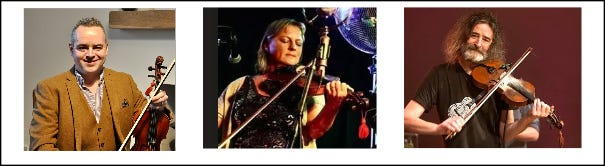
Whenever a fiddle student of his gained a certain level of proficiency, Aonghas would award them a red wool tassel to hang from the scroll of their fiddle. If you look closely, you can see that tassel in the photos below of some of his best students — Allan Hendrson, a founding member of Blazin Fiddles; Eilidh Shaw, who performs often with her guitarist husband Ross Martin and has been a member of the Poozies; and Aonghas’s son Angus R. Grant, the fiddler with Shooglenifty, who was replaced by Eilidh Shaw a couple of years after his untimely death in 2016.
In our music & walking tours to the Highlands, I was grateful to have Aonghas join us in Glenfinnan, not far from his home in Fort William. He would play and talk about the tunes and Highland culture, and then have lunch with us at the Glenfinnan House Hotel on Loch Shiel. One day, as he thought about what to play for us, Aonghas pointed out the window and said he was going to play a tune written in 1712 by a woman “who lived on that hill over there.” This was what was so special about our trips — to hear great musicians in context, in areas where they lived and knew how the music connected to the local culture that thrived amid the landscape we walked through. I often reflected that if Aonghas or other musicians we enjoyed had played their music in America, everyone would have appreciated hearing a fine Scottish fiddler, but how many listeners would have a clear sense of the area the player came from and the people who lived there and wrote, played, and enjoyed the tunes?
It’s been four years since the last time Aonghas joined us to play tunes for and with us, tell stories, and have a nice lunch at Glenfinnan House Hotel. He was 90 years old then, and told me he was happy to do it “as long as he was on this side of the grass.” It is sad that we will no longer be graced by his stories, tunes, and wit, but we can celebrate his long and full musical life.
On our music & walking trips, I generally tried to feature some of the legendary older musicians when I could, so that our travelers could get a chance to meet and hear them while they were still with us. You can read about our visit with Aonghas in Glenfinnan at this link. Another elder tradition bearer that we got to visit was Duncan Mackinnon from the island of Berneray, off the coast of North Uist. You can read about our visit to him in his kitchen in my article about our visit to Berneray. He, like Aonghas, made it into his 90s but passed away this year, just two months before Aonghas. A Uist newspaper tribute to Duncan Mackinnon commented that “Gaeldom has lost one of its last great traditional singers, storytellers, local historians and genealogists.” (To view over 100 archived articles, make sure you’re a paid subscriber by clicking the button below.)
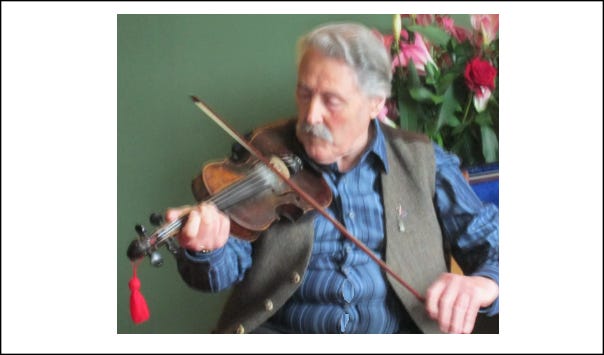
Above is a shot of Aonghas Grant playing fiddle — well, it’s not a professional photo, but one I took while he played for our group. And it’s not backwards — he played “left-handed,” as do a small number of other fiddlers and violinists, based on whatever violin was available to them when they were growing up; it doesn’t mean they’re actually left-handed, just that they play the instrument on other side from how it’s usually played.
Aonghas’s first violin was given him when he was 13, by an uncle. He apparently picked up a pipe tune on his fiddle the very first day, and never stopped.
Last weekend, one week after his funeral, I had the opportunity to tell an audience about, and play something in honor of, Aonghas Grant. This was at the Boston Scottish Fiddle Orchestra’s annual gala performance, where I was honored to be this year’s guest soloist. It was a celebration of the Orchestra’s tenth anniversary under the leadership of my son Neil, and also the 45th year of the Boston Scottish Fiddle Club, which I directed from its founding in 1981 to 1999. So it was a special moment to perform there with Neil on piano.
The tune I played in Aonghas’s honor was the Lament for MacCrimmon, an 18th-century tune written by a piper named MacCrimmon for himself, as he had the (correct) premonition that he would not return from an upcoming confrontation with another clan. The reason I selected this tune was that back in 1982, I had transcribed Grant’s captivating and unusual rendition of the tune, and played that version for the listeners, after telling them a bit about him. The stories behind the tunes form an important part of the fiddle tradition, and give us a way to honor, celebrate, and inform through music.
Below is a video in which Aonghas plays a tune he wrote for a burn (stream) in the Highlands, but first he discusses his own life and music just a bit. It’s partly in Gaelic (with English subtitles) and partly in English (with Gaelic subtitles). He mentions that his father spoke Gaelic but his mother, who was from Edinburgh, didn’t. Enjoy!
Comments
Nothing yet. Say the first thing.
Sign in to join the conversation.