
XRP has been facing sustained selling pressure, but the latest Rich List data reveals an important development beneath the price action. The number of wallets holding at least one million XRP has continued to increase while XRP’s market cap has declined substantially, demonstrating that large holders are accumulating or consolidating positions, while retail is panicking. At the same time, the latest distribution data reveals exactly how much XRP an account needs to enter the top 10%, top 5%, top 1%, and even top 0.01% of XRP wallets. The number required to enter the top 10% may has changed again.
The number of addresses holding at least one million XRP increased by 32 over in just three months, rising from approximately 2,006 to 2,038 wallets. During approximately the same period, XRP’s market cap declined by around 29%. That divergence deserves attention because periods of falling prices can provide useful information about how ownership is changing underneath the surface. While smaller wallets are clearly selling XRP and losing faith in the ecosystem, the increasing number of million-XRP addresses indicates that Financial Institutions are accumulating large sums.
The first principle to understand is that market price and ownership concentration measure two different things. Price reflects the level at which marginal buyers and sellers are currently willing to transact, whereas the distribution of XRP across wallets shows where the existing supply is being held. A declining price therefore does not automatically imply that every category of holder is reducing exposure. Selling pressure can come from one segment of the market while another segment absorbs that supply, which is precisely why wallet distribution becomes particularly useful during corrections. If the number of million-XRP wallets is increasing while the asset loses market capitalization, the data is consistent with large holders accumulating or consolidating substantial XRP positions during weakness.
There is an important limitation that should be established before drawing stronger conclusions. An XRP Ledger address is not equivalent to an individual investor, because one person can control several addresses while exchanges, custodians, funds, companies and other institutions can maintain multiple wallets for operational or security purposes. The increase from approximately 2,006 to 2,038 million-XRP addresses therefore does not prove that 32 new investors independently purchased at least one million XRP. What the data does establish is narrower but still relevant: more addresses now contain balances of at least one million XRP despite a significant deterioration in XRP’s market valuation.
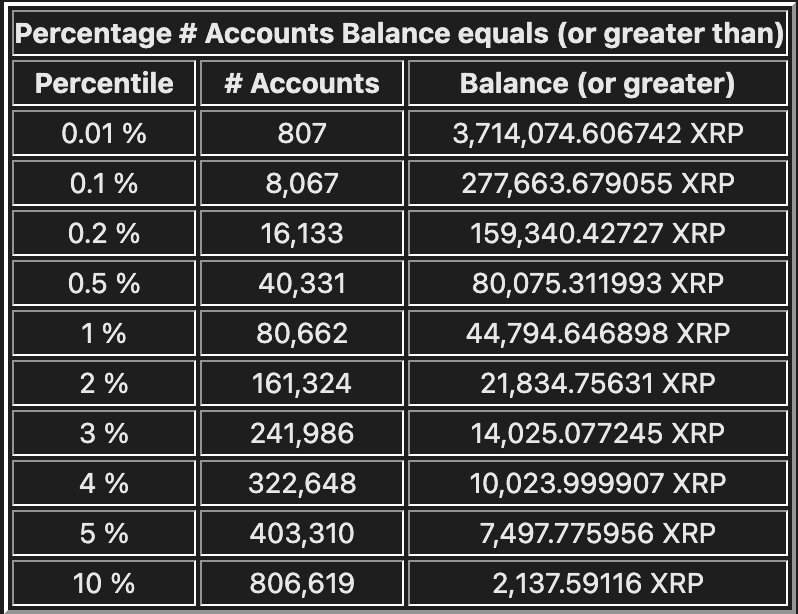
The broader XRP Rich List provides additional context for understanding how ownership is distributed across the network. According to the latest figures, an account requires approximately 2,138 XRP to rank within the top 10% of XRP accounts. Moving higher becomes progressively more difficult, with approximately 7,497 XRP required for the top 5%, 21,824 XRP for the top 2%, and 44,743 XRP for the top 1%.
At the extreme end of the distribution, the numbers become considerably larger. An account needs approximately 275,031 XRP to reach the top 0.1%, while entering the top 0.01% requires approximately 3.69 million XRP. The progression illustrates how rapidly the distribution narrows as account balances increase.
These figures should again be interpreted as account statistics rather than a ranking of unique individuals. An exchange can control multiple accounts containing assets belonging to thousands of customers, while an individual holder can distribute XRP across several wallets. Nevertheless, the distribution remains useful for understanding the relative size of a particular XRP balance within the ledger itself.
The Rich List thresholds provide a better framework for understanding what a one-million-XRP wallet actually represents. One million XRP is more than twenty-two times the balance currently required to rank within the top 1% of XRP accounts, and approximately 468 times the amount required to enter the top 10%. An address crossing the one-million-XRP level therefore represents a very large concentration of tokens relative to the overwhelming majority of accounts.
This is precisely why the increase in million-XRP addresses deserves attention. We are not discussing wallets moving from 1,000 XRP to 2,000 XRP, where relatively modest capital could materially change the distribution. Crossing the one-million-XRP threshold requires a substantial balance, which means an increase in the number of accounts above that level represents a meaningful change in the upper end of the XRP ownership distribution. When this occurs during a period in which the broader market valuation is falling, the divergence becomes particularly interesting.
Every XRP sold must ultimately be acquired by another participant, but the important question is where that supply is moving. If smaller or more price-sensitive holders are selling while the number of very large wallets increases, at least some of the available supply appears to be migrating toward addresses capable of maintaining substantial positions.
This does not guarantee that those entities possess superior information, nor does it establish that XRP has reached a market bottom. Large investors can make incorrect decisions just as smaller investors can, and some movements between wallets may reflect custody restructuring rather than genuine market purchases. Nevertheless, accumulation during weakness generally provides more useful information than accumulation during rapidly rising markets because buyers are increasing or maintaining exposure while prevailing price momentum remains unfavorable.
The distinction matters because markets frequently transfer assets between participants with different time horizons. A holder concerned primarily with the next several weeks may sell during a correction, while another participant with a multi-year investment horizon may consider the same decline an opportunity to increase exposure. The price records the transaction, but the Rich List can help reveal how the resulting ownership structure is changing.
The Rich List should therefore never be treated as a short-term price indicator. XRP can continue falling even while large wallets accumulate because markets clear at the margin, and aggressive selling can push prices lower when immediate demand is insufficient at existing levels. Large holders may also accumulate gradually precisely because they expect volatility to continue and have no requirement to identify the exact market bottom.
Their behavior consequently tells us more about changes in supply ownership than about where XRP will trade tomorrow, next week, or next month. The relevant observation is that declining prices have not prevented the population of million-XRP addresses from expanding. If the same trend continues through an extended correction, it would provide stronger evidence that substantial holders are systematically absorbing supply rather than reacting to short-term price movements.
The numbers become especially interesting when viewed through the mathematics of XRP ownership. There are approximately 806,422 accounts inside the top 10%, approximately 80,643 accounts inside the top 1%, roughly 8,065 accounts inside the top 0.1%, and only 807 accounts above the approximately 3.69 million XRP threshold required for the top 0.01%.
The distribution therefore narrows extremely quickly as balances increase. Moving from the top 10% to the top 1% requires increasing a balance from approximately 2,138 XRP to 44,743 XRP, while moving from the top 1% into the top 0.1% requires more than 275,000 XRP. Reaching the top 0.01% requires several million XRP.
When discussing future adoption, that matters because XRP has a finite maximum supply of 100 billion tokens, while the amount practically available for purchase at any particular moment is considerably smaller than the theoretical maximum supply. Those coins can be held in long-term wallets, controlled by institutions, placed under custody, held on exchanges, lost, reserved for operational purposes, or otherwise unavailable at a given market price. Market liquidity therefore depends on the quantity owners are actually willing to sell rather than simply the headline supply number.
Comments
Nothing yet. Say the first thing.
Sign in to join the conversation.