
Modern communication has reached a point where information can travel across the globe almost instantly. An email sent from New York reaches Tokyo in milliseconds, a video call connects continents with minimal delay, and billions of messages are exchanged every day without users considering the infrastructure that makes it possible. Money, however, continues to move according to a very different standard. International bank transfers frequently require several business days to settle, involve multiple intermediaries, generate substantial fees, and offer limited transparency to both institutions and customers. This contrast between the speed of information and the speed of value transfer reveals one of the largest remaining inefficiencies in the global financial system. While communication infrastructure has evolved dramatically over the past several decades, much of the world’s payment infrastructure continues to rely on systems originally designed long before the internet became a central part of everyday life.
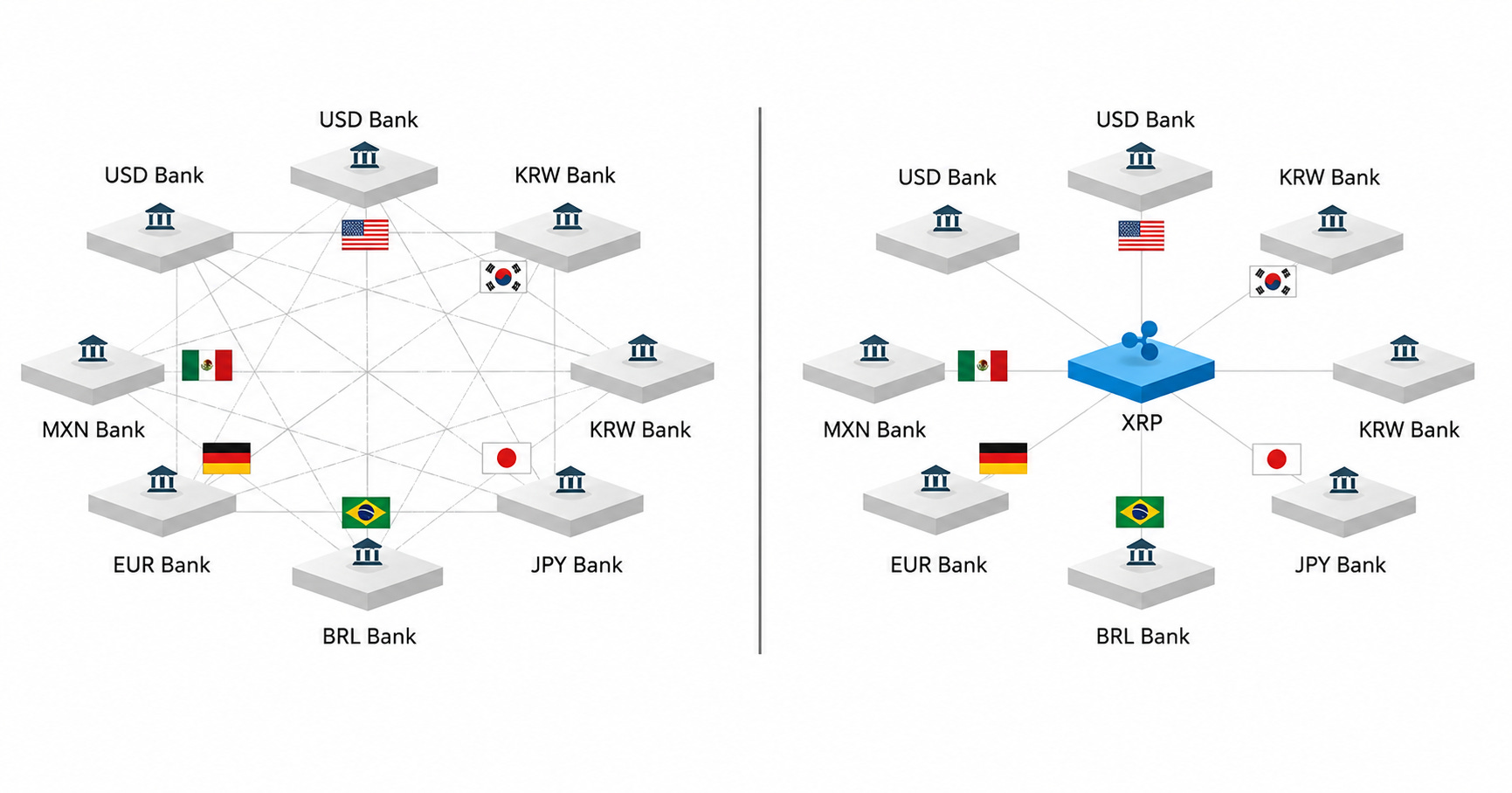
The reason this inefficiency persists is not because banks lack technology or because international payments are inherently impossible to process quickly. Instead, the financial system was built around a network of correspondent banking relationships that require institutions to maintain pre-funded accounts around the world, commonly known as nostro and vostro accounts. These accounts exist so banks can fulfill payment obligations in foreign currencies without waiting for funds to arrive after each transaction. Although the system has functioned for decades, it requires enormous amounts of capital to remain idle purely for settlement purposes. Capital that could otherwise finance businesses, expand lending, or improve institutional liquidity instead remains locked inside dormant accounts supporting legacy infrastructure. This trapped liquidity reaches into the tens of trillions of dollars, making it not simply an operational inconvenience but a structural inefficiency with meaningful economic consequences.
This is the problem XRPL was created to address. It is not just a cryptocurrency but part of a private financial technology company that develops payment infrastructure for banks, payment providers, and financial institutions. Ripple objective is not to replace the banking system but to modernize the mechanisms through which value moves between participants. Rather than focusing on consumer applications, Ripple has spent years building enterprise software intended to reduce settlement times, lower operational costs, and simplify cross-border transactions. Its products have evolved over time, but the underlying objective has remained consistent: replacing fragmented payment processes with infrastructure capable of settling transactions within seconds instead of days.
Understanding Ripple also requires distinguishing the company from XRP, a distinction that is frequently misunderstood even within cryptocurrency markets. Ripple is a corporation that develops financial products, while XRP is the native digital asset of the XRP Ledger, an open-source public blockchain. Although Ripple uses XRP within some of its payment solutions, the ledger itself operates independently of the company and can continue functioning regardless of Ripple’s future. This separation resembles the relationship between software built on the internet and the internet protocol itself. Individual companies may create products that utilize the protocol, but the protocol does not depend on any single company for its existence.
The technical characteristics of XRP were designed specifically for payment settlement rather than for serving as a store of value. Transactions generally settle within a few seconds, transaction costs remain extremely low, and the network consumes relatively little energy compared with proof-of-work systems. XRP can function as a bridge asset between two fiat currencies. Instead of maintaining separate pools of capital across multiple jurisdictions, a financial institution can convert one currency into XRP, transfer that value almost instantly, and convert it into another currency on the receiving side. When implemented at scale, this process reduces the need for pre-funded accounts while improving capital efficiency throughout the banking system.
Ripple’s strategy has also differed from many blockchain projects by concentrating on regulatory compliance and institutional partnerships rather than consumer speculation. The company has spent years working with banks, payment providers, and central bank initiatives while expanding its global presence through enterprise relationships. Strategic partnerships with leading global financial institutions, including the IMF, BIS, and WEF, are expected to accelerate XRP adoption worldwide, they demonstrate that Ripple has pursued integration within the existing financial system rather than attempting to bypass it entirely. From an institutional perspective, gradual adoption is generally more realistic than sudden disruption because financial infrastructure changes only after satisfying regulatory, operational, The XRP Ledger has been one of the most battle-tested blockchains in operation since 2012. In over 14 years, it has experienced only two significant network outages, resulting in an uptime of well over 99.99%.

This institutional positioning explains why XRP is completely different from every other digital assets. Much of the cryptocurrency market remains driven primarily by speculation, narrative cycles, and investor sentiment. Projects often achieve substantial valuations before establishing sustainable commercial demand. XRP, by contrast, was designed around a clearly identifiable economic function: facilitating efficient settlement between financial institutions. XRP solves a problem that already exists and has existed for decades. From an investment standpoint, this creates a thesis based not exclusively on future technological possibilities but on improving an identifiable inefficiency within existing financial markets.
🔒 Unlock to Continue Reading the Full XRP Reprice Thesis
Comments
Nothing yet. Say the first thing.
Sign in to join the conversation.