
中文版往下翻👇
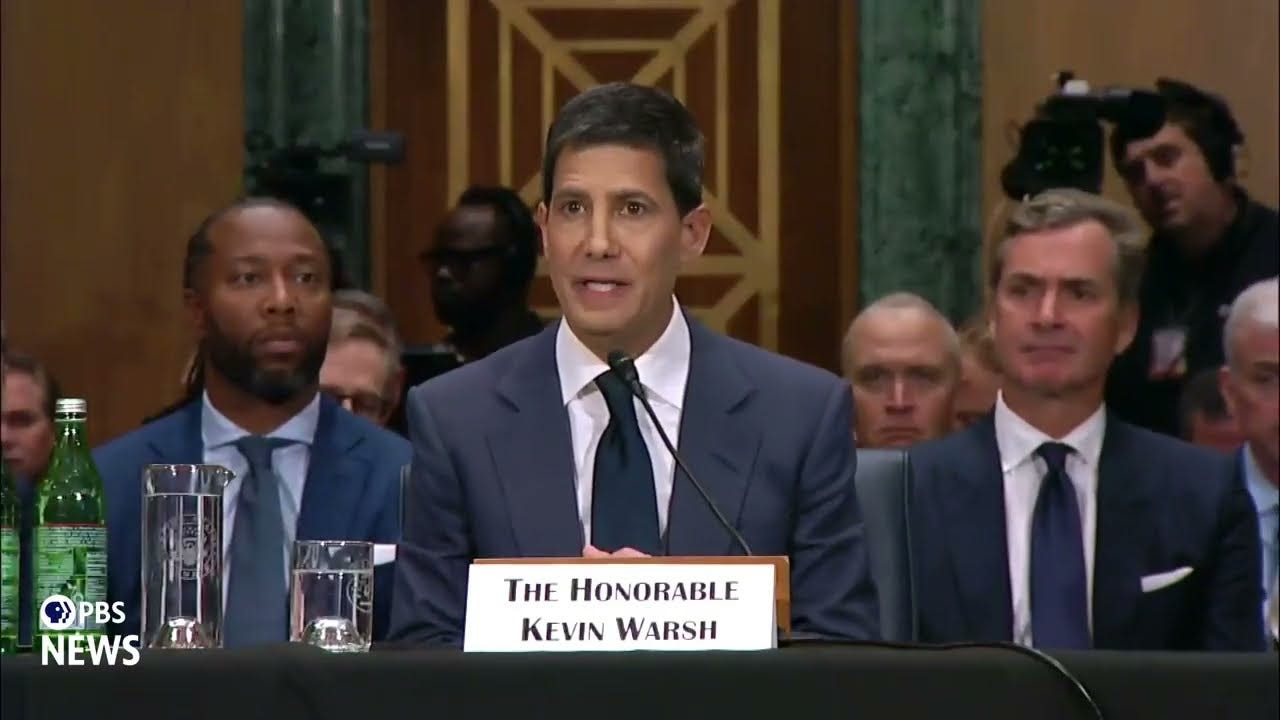
On July 14, 2026, the new Federal Reserve chairman, Kevin Warsh, testified before Congress for the first time. Buried in his answers was a sentence most people missed. Asked about the Fed’s giant bond portfolio, he acknowledged that:
In crises like 2008 and 2020, central banks, “by design, do step into markets to create a fair price”.
By design.
Here is my verdict, up front: The United States is converting its stock market from an economic scoreboard into a political institution. A market that is not allowed to fall. Not a market that never drops — a market that grinds upward, suffers sudden 10%+ corrections, and then gets rescued. Every time.
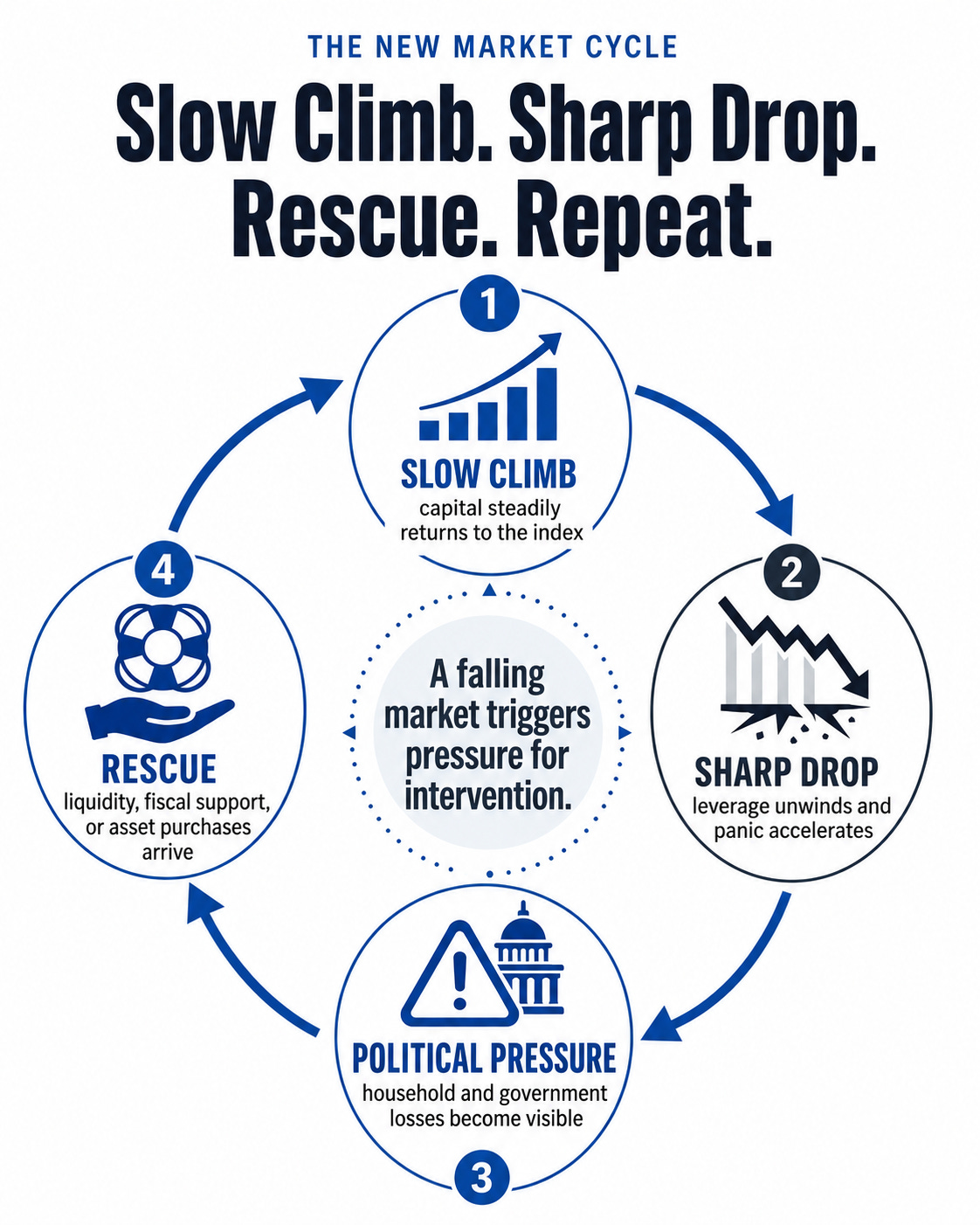
In one sentence: Slow Climb, Sharp Drop, Rescue, Repeat. That’s the New Physics of the U.S. Stock Market.
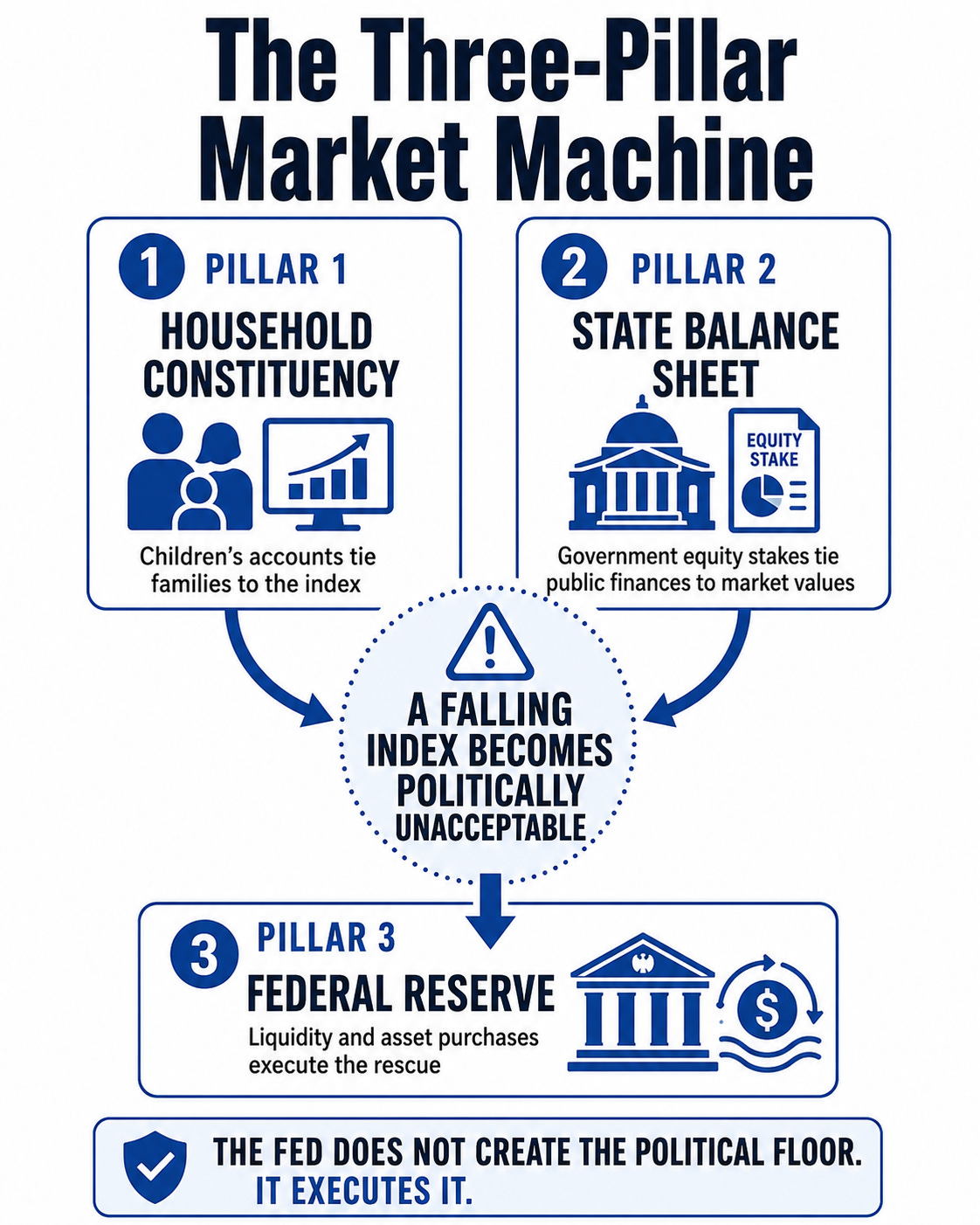
The machine has three pillars, and the Federal Reserve is the least important one. The Fed is the effect, not the cause. The cause is two quiet changes: Washington gave every American baby a stock portfolio, and Washington began buying shares in America’s biggest companies. Once you see those two, the next bailout stops being a possibility and becomes a schedule.
If you're wondering how we have come to this point, I recommend you read this article. A month ago, I said out loud, “There will be rate cuts and money printing,” and I explained why:
What does a baby’s savings account have to do with the stock market?
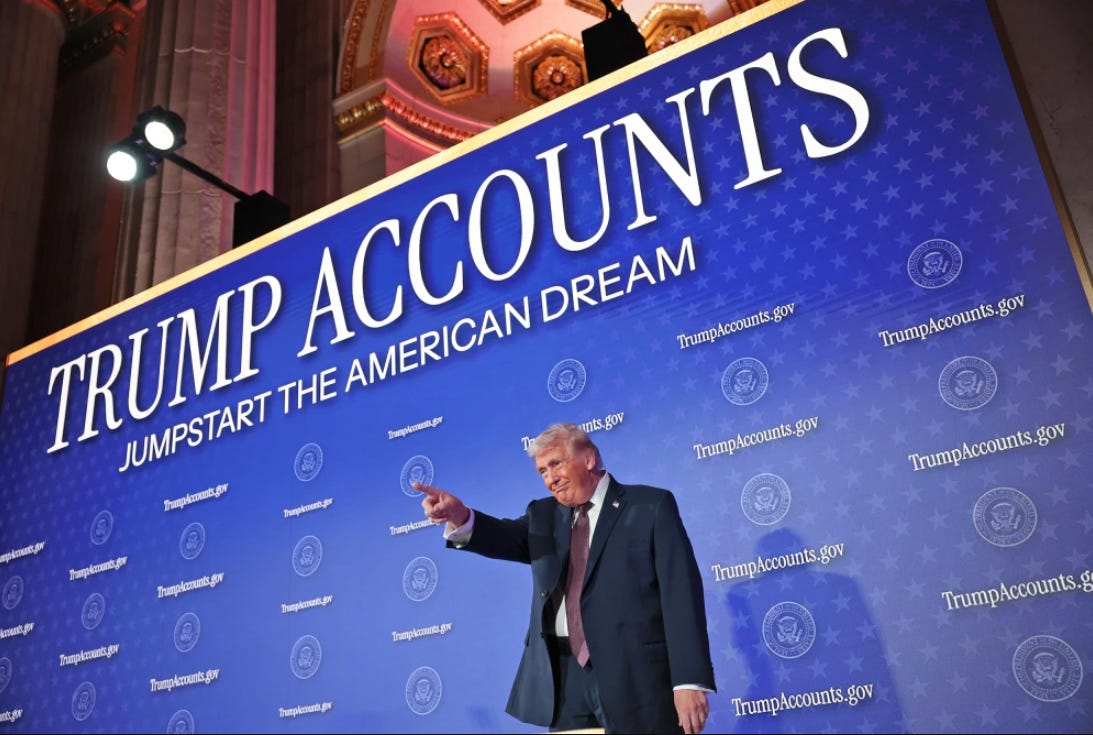
The “Trump Accounts” mechanics are simple:
The federal government deposits $1,000 for every eligible American baby born from 2025 through 2028, and the money must be invested in low-cost U.S. stock index funds.
Follow the chain. The government seeds the account → the law parks the money in stock index funds → so every newborn’s starting wealth is now tied to the S&P 500 by federal statute.
The account follows the child until age 18, is locked the entire time; at 18, it converts into a regular retirement account — a traditional IRA — that the child controls.
Anyone can help fill it: parents, grandparents, friends, and employers can together add up to $5,000 a year per child, simply with the QR code.
The money is not parked vaguely “in stocks” — it is automatically invested in a State Street fund that tracks the S&P 500 SPY 0.00%↑ . Growth compounds tax-deferred until withdrawal, like an IRA. And the delivery system is a smartphone app built for the Treasury by Robinhood and the Bank of New York.
On launch day, it hit No. 1 in the App Store’s finance category and climbed into the top four of all apps in America, behind only the AI chatbots.
By the official July 4 launch, President Trump rang the stock exchange’s opening bell from the Oval Office — more than 6 million accounts were already open.
Read that list again as a system, not as features.
A federal account → locked to the S&P 500 → topped up by the whole family through a QR code → checked daily on a phone → held by a child for 18 years. Washington didn’t just give kids money. It installed the stock market on every family’s phone and tied a generation’s childhood to the index.
Corporations noticed. Micron, the memory-chip maker, pledged $250 million to Trump Accounts. The day Trump posted “Thank you Micron!” on Truth Social, the stock jumped nine points. Trump’s own 2025 financial disclosure shows he personally holds between $1.67 million and $6.65 million of Micron stock.
The Dell family pledged $250 to each of 25 million children, and SpaceX’s president, Gwynne Shotwell, announced a gift of SpaceX stock to the accounts of more than 2 million kids. Donations to the program are now political currency, and the market prices them instantly.
Now think about what this does to a bear market.
Before, a crash was a Wall Street problem. Now, a crash means the government watching the savings of millions of children shrink — savings it created, seeded, and pointed at the stock market by law.
Chain again: children’s wealth is in stocks by statute → a falling market destroys children’s savings in public → no politician in either party survives that → preventing bear markets becomes a political mandate.
For a hundred years, the stock market had investors. Now it has a constituency. That is the regime change, and it happened without a single headline calling it what it is. And this is the first pillar.
Why is the government owning pieces of Intel, IBM, and OpenAI?
Because the second pillar is the state becoming a shareholder.
The facts, in order. In August 2025, the U.S. government invested $8.9 billion in Intel and took roughly a 10% stake. This spring, it announced equity stakes in nine quantum-computing companies in a single move, including IBM. And this month, the Financial Times reported that OpenAI is discussing handing the government a 5% stake, while Sam Altman pitches a plan for all major AI labs to put 5% of their equity into a sovereign-wealth-style fund — a plan he has discussed directly with Trump, Treasury Secretary Bessent, and Commerce Secretary Lutnick. And the next one is very likely going to be Micron.
The state owns shares → falling stock prices now punch a hole in the state’s own balance sheet → the referee has become a player. A government that owns the winners cannot let the index lose. Industrial policy and market policy are merging into one policy.
What happens when a stock the government owns crashes 25% in a day?
We just found out. It happened yesterday.
On July 14 — the same day Warsh testified — IBM 0.00%↑ had the worst day in its 115-year history. The company pre-announced a weak second quarter, and the stock fell 25.2%, wiping out about $67 billion in value and beating its previous record from Black Monday, 1987. The cause was ordinary business: customers shifted their technology budgets away from IBM’s software and mainframes toward AI hardware.
Here is what makes it more than an earnings story. Less than two months earlier, on May 21, the Commerce Department agreed to take a minority, non-controlling equity stake in IBM as part of a $1 billion quantum-computing award — the largest of the nine stakes announced that day. And the government’s blessing had lifted the price on the way in: IBM stock rose more than 4.6% the morning the stake was announced.
Yesterday, the state’s newest holding lost a quarter of its value in one session. This is the first live test of the new system — the first sharp loss on the government’s own portfolio.
Now notice what the rest of the market did. While IBM collapsed, the S&P 500 rose 0.5%. That is the machine working exactly as designed. The system does not protect individual stocks. It protects the index. Single names are allowed to burn, for a while; the aggregate is not (Again, sharp corrections are still going to happen).
So here is my forecast:
IBM will not be left on the floor. It will grind back — slowly, unevenly — because the government now has skin in the game and several quiet ways to help.
Watch these potential events:
More federal money into Anderon, the quantum foundry IBM is building with the Commerce Department in Albany, New York — the White House was still soliciting proposals when the program launched.
New federal contracts, because the government is not just IBM’s shareholder, it is IBM’s biggest potential customer.
A presidential endorsement, which we already know moves prices — Micron jumped nine points on a single thank-you post.
And the Micron playbook itself: if IBM pledges money to Trump Accounts, expect praise from the top and a pop in the stock.
None of this will be called a rescue. It will be called industrial policy, procurement, or patriotism.
And if IBM stays on the floor for a long time while the index keeps climbing, that tells you something just as useful: the floor sits under the S&P 500, not under any single ticker. Either way, the pattern to watch is the one this entire article is about: slow climb, sharp drop, rescue, repeat.
Yesterday was the sharp drop. Set a reminder.
What happens when the next Lehman Brothers shows up?
The Fed steps in. But notice the order of causes: the Fed is the third pillar, downstream of the first two. The effect, not the cause.
Warsh is an interesting messenger for this. He was a Fed governor from 2006 to 2011 — inside the building for the entire 2008 rescue, working alongside Bernanke and the Treasury. In this week’s hearings, he insisted the Fed should stay out of the fiscal policy business and worried out loud that its bond holdings are too large. He also offered a memory from 2008 that doubles as a preview: the Treasury secretary and the Fed chairman often had to work in tandem, he told lawmakers, and in crisis times it is hard to distinguish exactly where one’s responsibilities end and the other’s begin.
Then he stated his doctrine on the Fed’s portfolio, and it is the quiet part said out loud:
Keep the balance sheet small in normal times — and expand it in times of crisis to keep markets functioning.
Read that twice. He has already told you what the balance sheet does in an emergency.
Here is the entire history lesson in one sentence:
Every crisis expands what the Fed is willing to buy — government bonds always, mortgage bonds in 2008, corporate bonds in 2020. Stocks are the only rung left on the ladder, and Japan already climbed it: the Bank of Japan bought stock funds for over a decade and became the largest single owner of Japanese equities.
To be precise: there is no official plan, and no credible report, that the Fed will buy US stocks. There doesn’t need to be. Walk the chain one more time.
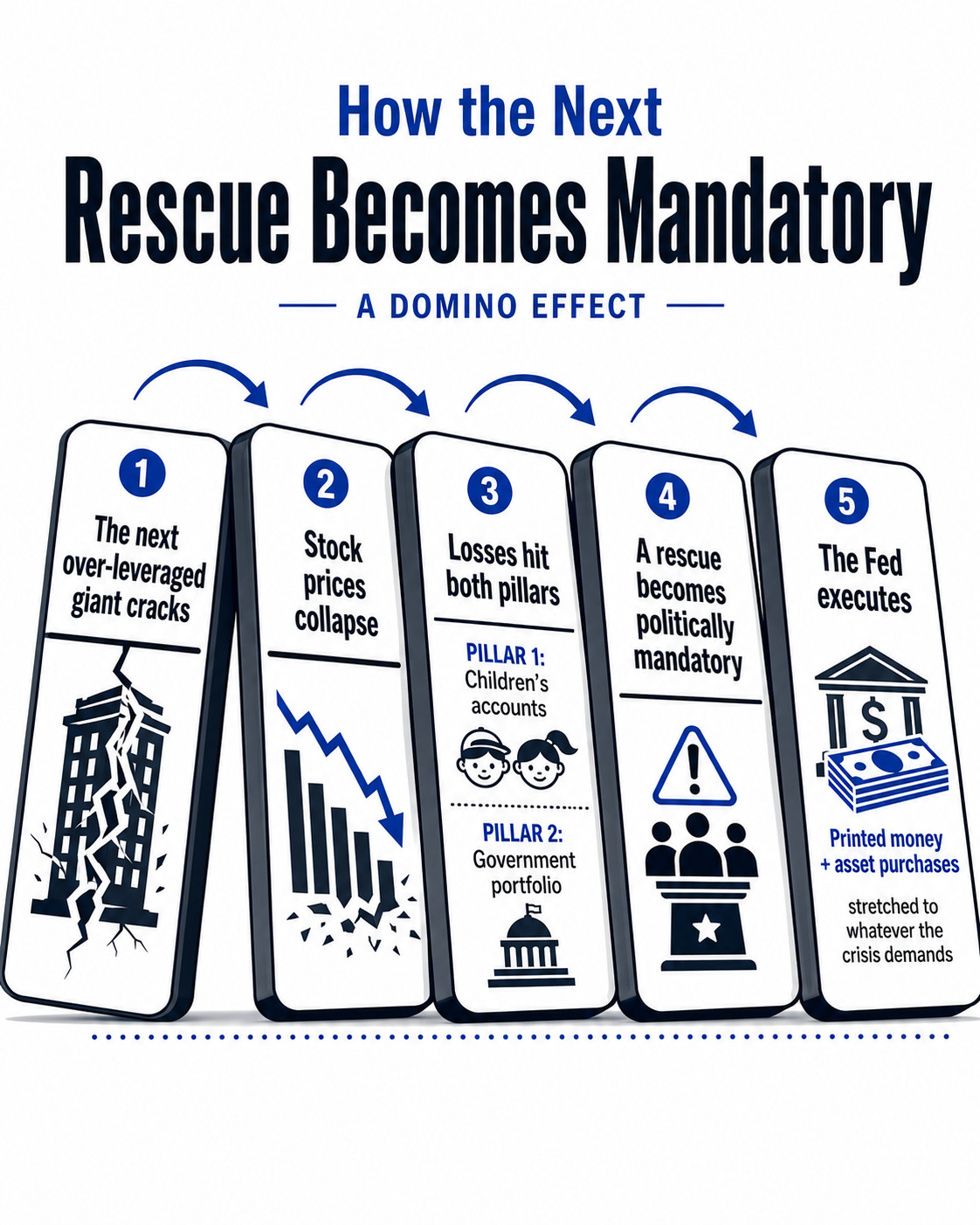
The next over-leveraged giant cracks → stock prices collapse → the crash hits millions of children’s accounts (Pillar 1) and the government’s own portfolio (Pillar 2) → a rescue becomes politically mandatory → the Fed executes with the only tools it has: printed money and asset purchases, stretched to whatever the crisis demands.
In 2008 they rescued the banks and were hated for it. Next time they will be rescuing the children’s accounts and the nation’s own holdings — and they will be applauded for it.
That is why the next bailout will be bigger and faster than 2008. The aftermath will look familiar too: a flood of new money, a floor of cheap assets, and the people holding cash buying the dip that the rescue created.
What should you actually do with this?
Comments
Nothing yet. Say the first thing.
Sign in to join the conversation.