

SharonAI ($SHAZ) is an Australian neocloud delivering sovereign AI compute for Australia and the Asia-Pacific region, built on Nvidia reference architecture.
CEO James Manning founded the company together with two colleagues from his previous company, Mawson Infrastructure ($MIGI). Mawson was a bitcoin miner that built more than 100 modular data centers and roughly 200 MW of powered capacity across the US. On February 2026, SharonAI completed its Nasdaq listing, raising $125 million in its U.S. initial public offering at $30.00 per share
April 30, 2026: the Bleecker Street Research short report (Source). The firm published a short thesis targeting the CEO’s history at his prior company, the credibility of the anchor customer, and the financing structure.
June 29, 2026: Situational Awareness disclosed ownership of 19.9% (Source). Leopold Aschenbrenner’s fund anchored SharonAI’s oversubscribed $1.6 billion strategic financing, which closed on June 22. That 19.9% is the maximum ownership allowed in the round. Crossing 10% made the fund a statutory insider, so every subsequent trade must be disclosed within two business days.
July 1, 2026: Nvidia named SharonAI one of two launch partners for Nvidia’s new revenue-sharing model (Source). This secured up to 40,000 Nvidia GB300 GPUs under a six-year agreement, in which Nvidia provides a minimum revenue guarantee. In exchange for the backstop, Nvidia shares a portion of the neocloud’s revenue earned above the backstop pricing level.
July 5, 2026: Anthropic was revealed to be seeking 1.4 GW of compute capacity in Australia, based on a tender it sent to various operators (Source). That is more than 10 times SharonAI’s entire 132 MW plan. Even if Anthropic does not choose SharonAI, it would still lead to a repricing of the Australian GPU market.
July 16, 2026: SharonAI Announces US$1.32 Billion five-year cloud computing service agreement with a global AI lab (Source). In the same announcement, the company also raised its deployment target to 62,000 Nvidia GPUs by mid-2027.
After these five events, SharonAI presents one of the most interesting risk-reward profiles in the neocloud sector.
For the first time, we know how SharonAI will acquire the three biggest unknowns for a new neocloud: chips, power, and financing.
Recent developments have both derisked the story and raised the upside. Yet with the short report still hanging over the stock, the market is pricing SharonAI for failure.
In the coming months, SharonAI has several major catalysts:
Deployment (H2 2026 onward)
GB300 deployment begins in the second half of 2026, and each energization and cluster milestone further derisks the plan.
Revenue (from Q3 2026)
First revenue from the $1.25 billion ESDS agreement is guided to Q3 2026, followed by the $950 million May agreement across Q3 and Q4, and the $1.32 billion New Zealand agreement across Q1 and Q2 2027. This one matters twice over: ESDS is the exact counterparty the short report accused of being unable to pay, a company with reported revenue of $39.9 million committing to payments averaging $250 million a year. ESDS payments actually arriving on schedule would resolve the central risk the short report raises. The reported revenue line rising from $294K per quarter to a real number is the single most important print of the year.
Demand resolution
After the U.S. government ordered Anthropic to take down Fable, governments around the world have renewed interest in sovereign compute: a live demonstration that models and infrastructure controlled by a foreign jurisdiction can be switched off without appeal. A resolution of demand around Anthropic’s rumoured 1.4 GW Australian requirement would bring pricing visibility into Australia’s cost per MW of sovereign compute, and SharonAI benefits from the squeeze whether or not it wins the deal.
Short-report resolution
We believe this resolves in the company’s favour, for a simple reason: Nvidia does not select a company as one of only two launch partners for a flagship new business model in which Nvidia takes on the risk, providing a $4.88 billion backstop, without significant trust; and Leopold Aschenbrenner does not put roughly $555 million, a large slice of his fund, into a company without proper due diligence on its founders. His stake is structurally committed whether or not it was intended that way: a 19.9% holder is a statutory insider whose every trade prints publicly within two business days, so there is no quiet exit.
Over the coming months, SharonAI transforms from a risky neocloud with a CEO under litigation into a vendor-financed, institutionally underwritten sovereign compute utility for Asia-Pacific, with roughly $3.5 billion of contracted customer revenue and the fleet to serve it.
The following is our own scoring system, based on our own research, worldview, and biases.
Its primary purpose is to create an objective way of comparing companies across the factors that matter most to us.
A score of 5/5 means excellent. For quality factors, it means the company is elite. For risk factors, it means we see little to no risk.
A score of 1/5 means unacceptable. For quality factors, it means the company is weak or completely replaceable. For risk factors, it means the risk is so high that we would usually eliminate the stock before even considering it.
We rate SharonAI’s moat 2/5. The company has:
Minimal process power, as we believe the CEO’s experience in Bitcoin mining transfers only loosely to operating a high-performance computing data center
No proprietary technology, being a neocloud built on Nvidia reference architecture
No scale economies at 132 MW of capacity, compared to 1 GW+ suppliers
Weak branding, as a new company with a CEO under litigation
Low switching costs, as a bare-metal provider
But one moat that does matter right now is allocation scarcity. Within Australia, SharonAI holds the only publicly disclosed GB300 allocation of its size among non-hyperscaler suppliers. Otherwise, its moat would be a 1/5.
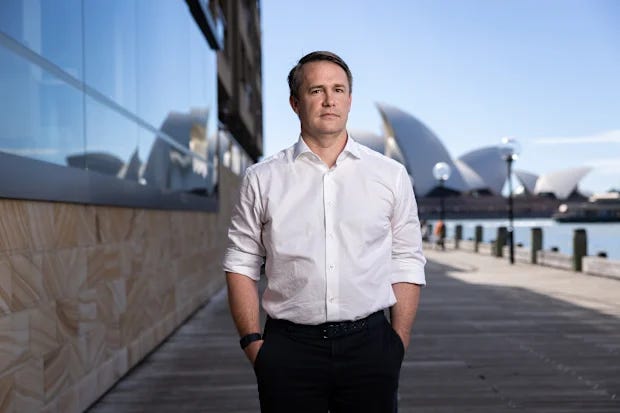
We rate SharonAI’s management 2/5. CEO James Manning’s prior company, Mawson Infrastructure, has publicly accused him of self-dealing, in litigation that remains active, and Bleecker Street’s short thesis is built around that history.
At SharonAI itself, the filings disclosed a related-party consulting arrangement paying Manning Group Pty Ltd, a Manning-linked entity, AUD $334,500 per year for advisory and development services on top of his executive compensation. That agreement was in place at listing and was terminated in April 2026. But the fact that it existed at all echoes the exact pattern the Mawson allegations describe.
That said, Nvidia selected this company as one of two global launch partners for its capacity program. Situational Awareness invested roughly $555 million and disclosed 19.9% beneficial ownership with the short report already public. Oaktree-led institutional credit participated in the convertible program. The April termination of the consulting agreement is itself a governance-positive act. And Manning’s operating record is real, which we cover under execution risk.
Without any information about the litigation, we can’t know whether the allegations have merit. What we can see is that sophisticated counterparties continue to commit capital after reading the same short report we did. Until a court ruling or a completed buildout settles the question, we limit the score to 2/5.
We rate SharonAI’s alignment 4/5, and this is one of the strongest sections of the story.
From CEO Manning’s Form 3 filed at listing: approximately 1.32 million Class A shares held directly and indirectly, plus 45,447 shares of Class B Super Common Stock, plus RSUs. At $44.98, the Class A stake alone is worth roughly $59 million. His CEO base salary is AUD $200,000, roughly USD $130,000, per the January 2026 appointment 8-K.
That is an equity stake worth on the order of 450x his base salary. By our ratio test (we want to see at least 50x), this is among the strongest CEO alignments we have measured anywhere.
And it is not just the CEO. The Forms 3 show a matched founder trio: COO Andrew Leece holds roughly 1.40 million Class A shares (about $63 million), and Head of Corporate Development Nicholas Hughes-Jones roughly 1.25 million (about $56 million), each with exactly the same 45,447-share block of Class B Super Common as Manning. Together the three hold about 4 million Class A shares, roughly $178 million and about 13% of the effective share count, all from before the listing.
The reason this is not a 5/5 is a combination of the following:
The founders’ Class B shares carry extra votes, so the three of them control the company’s votes far beyond what their share of the economics justifies. This is usually not an issue, until you consider the next point.
The Manning Group consulting deal (a side fee SharonAI paid to the CEO’s private entity, now ended) showed that owning a lot of stock does not by itself guarantee a CEO acts in all shareholders’ interests.
Outside the three founders, almost nobody has their own money in the stock. The CFO holds a respectable ~89,000 shares, about $4 million, but the CTO, the General Counsel, and every independent board member own zero purchased shares, only grants the company gave them. That last one matters most: the board exists to keep the founders in check, and for a company whose main bear case is governance, a board with none of its own money at risk is a weak watchdog.
We rate SharonAI’s execution risk 2/5. This is where the thesis will be won or lost.
Going from $294,014 of quarterly revenue to 62,000 deployed GPUs in four to five quarters is a company-creation event: site energization, DSX-scale cluster deployment, customer onboarding, and enterprise SLA operations.
The majority of execution risk can be broken down into three parts: chips, power, and construction.
Chips
Putting the announcements together, the fleet is secured: 40,000 GB300s under the six-year Nvidia agreement, 8,000 B300s for the ESDS cluster ordered through WWT, and the remainder of the 62,000 target procured directly against the May and July customer contracts. Allocation of frontier silicon is the scarcest resource in this market, and SharonAI’s is contractually committed by Nvidia itself.
Power
On power, the numbers stack up as follows: 132 MW of total AI factory capacity guided, of which 116 MW, 88% of the entire plan, is already contracted to end customers, with the Nvidia agreement underpinning 72 MW of the buildout.
How much is energized and connected today is not separately disclosed; based on the legacy fleet in Equinix SY3/SY5 in Sydney and NEXTDC M3 in Melbourne, we estimate low single-digit MW, which means the gap between connected and guided is the whole story of the next four quarters.
Crucially, SharonAI does not build greenfield sites; it deploys into established third-party data centers (Equinix, multiple NEXTDC facilities, and now a facility in New Zealand), so the grid connections, substations, and cooling are the landlords’ solved problem, not SharonAI’s.
Construction
Based on current progress, the first clusters are energizing now: ESDS revenue is guided to Q3 2026, which means racks are being deployed as this is written, with the May contract following across Q3 and Q4 and New Zealand across Q1 and Q2 2027.
Deploying into operating data centers is rack-and-integrate work, not construction from the ground up, and it is the one part of this business the CEO has provably done before: at Mawson he built more than 100 modular data centers and roughly 200 MW of powered capacity.
But since this is the least proven of the three, a company with no track record will carry an execution risk score of 2/5 until key delivery milestones are met. But every energization milestone over the next two quarters moves the score toward a 5.
We rate SharonAI’s financial risk 3/5, though the buildout is likely fully funded.
Start with what has been raised in 2026: the $125 million IPO in February, $350 million of convertible notes in May, the oversubscribed $1.6 billion strategic financing that closed June 22, and $74 million from the Texas joint venture sale. That is roughly $2.15 billion gross.
Now for the costs. In just the last two months there has been a wide range of estimates for the current cost of building 1 GW of compute. Chamath Palihapitiya has mentioned a cost of $100 billion on the All-In podcast. Epoch AI estimates $38 billion. Orennia estimates $60 billion.
What most estimates agree on is that 70-80% of upfront costs are associated with Nvidia GPUs. The remaining 20-30% is mostly comprised of data center shells, power infrastructure, and cooling. SharonAI leases from Equinix and NEXTDC, so that capex belongs to the landlords and gets paid through rent as revenue flows.
40,000 of the 62,000 GPUs are supplied through NVIDIA’s revenue-share fleet. For our estimates, we assume all costs associated with those GPUs are funded by the loan taken against NVIDIA’s $4.88 billion backstop.
The main costs to estimate, then, are for the remaining fleet of 22,000 GPUs, plus networking, storage, and integration across the fleet:
8,000 GPUs are confirmed B300s for the ESDS cluster. The cost of an 8-GPU rack at the time of announcement was around $550,000, according to Reuters (Source). So the estimated cost for this fleet is $550 million.
7,000 GPUs are unconfirmed. We predict them to be B300s. The count is the residual from the previous guidance of 55,000 chips. This deal was signed before SharonAI’s GB300 agreement existed, so the chips had to come from what the company could already buy, likely the same WWT channel that supplied the ESDS B300s. So the estimated cost for this fleet is $480 million.
Another 7,000 GPUs are unconfirmed. For cost estimation we will be conservative and assume they are the more newer, expensive GB300s instead of B300s. The count is based on the deployment target rising from 55,000 to 62,000 with this announcement. The type is based on four factors: the customer is an AI lab, and labs buy frontier rack-scale silicon, not air-cooled enterprise boxes; the Q1-Q2 2027 deployment window is exactly the GB300 volume ramp; the company describes the build as its first AI factory, Nvidia’s DSX language for GB300 NVL deployments; and nobody designs a new 2027 site around the previous generation. Estimated pricing for a 72 GPU rack of GB300s is $3.7 - $4 million (Source). So using the top end of the range, a fleet of 7,000 GPUs will cost $400 million.
This brings the total cost of GPUs to $1.43 billion. For the remaining networking, storage, and integration costs, we build bottom-up again:
Network fabric typically runs 10 to 15% of GPU capex, so $188-282 million.
Storage is disclosed: the 600 PB VAST agreement, roughly $100 million at scale flash pricing.
Integration and commissioning at 3 to 5% of hardware, so $56-94 million.
CPU and management nodes at 2-3% of fleet cost, so $38-56 million.
Colocation deposits with pre-revenue rent: 132 MW at ~$130-180/kW/month ≈ $17-24M/month, so around $100-150 million in deposits.
The total for non-GPU costs is roughly $482 to $682 million. Combined with the GPU costs of $1.43 billion, this yields a total buildout cost of $1.912 billion to $2.112 billion.
The bottom line is roughly $2.15 billion raised against around $2 billion of SharonAI-funded costs. With early revenue recycling for the final tranche of the 132 MW, or expanded Nvidia credit support, it is likely that the buildout is fully funded.
That said, there may be one more raise in the near term, as guidance expanded from 55,000 to 62,000 GPUs in the recent announcement without any explanation for financing. In case that raise is dilutive, dilution uncertainty is what limits the score from becoming a 4/5.
We rate SharonAI’s technology risk 5/5.
This is Nvidia’s stack, end to end: DSX reference architecture, GB300 systems, VAST storage, deployed with Nvidia’s own program support. Nothing needs to be invented or proven, and the vendor whose reputation rides on the reference design is contractually inside the buildout. Whether this team can operate it is a real question, but it is an execution question, and we have already accounted for it there. We do not double-count risks. The technology itself carries little to no risk. 5/5.
We rate SharonAI’s exogenous risk 4/5. These are the forces outside management’s control.
Chip supply. The entire plan depends on Nvidia and TSMC delivering GB300s on schedule, and on components like HBM memory and substrates staying available. A delivery slip of two quarters pushes revenue out by the same amount, and SharonAI controls none of it.
U.S. export policy. This one cuts both ways. The Fable takedown is the tailwind: it made sovereign compute a government priority worldwide, and Australia, as a close U.S. ally, sits on the right side of American chip export rules. But the same episode proved Washington can change the rules overnight. SharonAI’s customers add a wrinkle: ESDS is an Indian company, and U.S. rules increasingly govern not just where advanced chips go but whose workloads they serve. A tightening of those rules could complicate exactly the cross-border contracts SharonAI has signed.
Power prices. Australia has some of the most expensive electricity in the developed world, and 132 MW running around the clock is a large bill. The grid connections are the landlords’ problem, but the power price flows through to SharonAI’s operating cost and its customers’ willingness to pay.
That being said, these exogenous risks are observed throughout the entire AI supply chain. The key dependence on Nvidia GB300 delivery is the main factor limiting this from a 5/5.
Comments
Nothing yet. Say the first thing.
Sign in to join the conversation.