
Author: Daniel Koss
Reviewed by: Babyfolio, Alasdair Mann
Q2 2026 was by far the best quarter Nebius has ever reported. For me, it was a 10/10.
My main takeaway: the economics of Nebius’ AI cloud business have now been validated. Not just as viable. Not just as good. They are shaping up to be absolutely fantastic.
Going into this quarter, there was still a legitimate debate around what the economics of this business would ultimately look like. I think Q2 removed a lot of that uncertainty. Demand is not simply strong, it is still accelerating and massively outpacing available supply. And this is happening before truly useful end-to-end AI agents are even here!
That supply-demand imbalance is now translating directly into dreamlike business conditions. Pricing is going up. Margins are going up. Contract economics are improving. Customers are making huge prepayments. Nebius can increasingly choose which customers it wants to serve, how long it wants to commit capacity for, and at what price. Q2 deals reached $20–25M of annual revenue per MW, short-term deals are reaching $40–50M+, and Nebius says it could already sell its entire planned 2027 capacity today.
What makes this even more impressive is that every part of the organization seems to be executing at an extremely high level.
The product team is not only delivering what the market needs today, but positioning Nebius for what comes next across inference, agents, open models and GPUs. The sales team is exploiting the supply-constrained market instead of blindly locking up capacity years in advance. The infrastructure team is expanding aggressively enough to capture the opportunity while still staying within what Nebius can realistically execute. And even the finance team is finding increasingly creative ways to fund that growth through customer prepayments, asset-backed financing and other sources of capital.
The more I watch this company execute, the more visionary the original strategy looks. Nebius has created an unusually powerful combination of downside protection and upside optionality: secure attractive long-term contracts where they help finance the buildout, while deliberately keeping enough capacity available to capture dramatically higher economics when the market offers them.
Strategically, this is already looking like a masterclass. Right place, right time, right team.
It is time to rebuild my Nebius 2027 price target from the ground up.
In this section I’m literally just going to list all my notes, facts, insights and data points that were dropped in the call and across all the released documents that I personally find relevant, and add my commentary.
Warning upfront: There was a lot. Like, really, A LOT.
The bullet points are the facts.
The “→” arrows are my personal, subjective interpretations and comments.
Q2 group revenue reached $582.3M, up 454% YoY and 46% QoQ.
→ We’re obviously still in hypergrowth. This is obvious, but still important to mention because it implies we need to pick the appropriate metrics to value the business. For example, measuring Nebius on P/E or EV/EBITDA makes zero sense right now, in my view.Nebius AI cloud revenue reached $574.9M, up 514% YoY.
Nebius AI cloud generated approximately 98% of group revenue in Q2.
→ In other words, that is essentially the entire business right now.Annualized run-rate revenue reached $3.0B at the end of June, up 598% YoY and 56% QoQ from $1.9B at the end of Q1.
Revenue growth was driven by new capacity, higher utilization, improved infrastructure efficiency, Token Factory, and acquisitions.
Nebius said it once again sold out capacity essentially as fast as it brought it online.
Group adjusted EBITDA reached $236.2M, versus $129.5M in Q1 and a $21M loss a year ago.
Group adjusted EBITDA margin reached 41%, up from 32% in Q1.
→ This metric will improve with scale. This is one of the most obvious economies-of-scale businesses in the world. That’s why they want to be a “hyperscaler.”Nebius AI cloud itself generated $285.7M of adjusted EBITDA at a 49.7% margin.
→ If you believe all generations of GPUs will be sold at higher prices and for longer than market consensus or the 2-3 year bear thesis assumes, this business is going to print profits.Management said the gap between AI cloud margins and group margins primarily reflects continued investment in Avride and TripleTen.
Management sees a path to further margin expansion in 2027 and beyond.
→ Scale + value-added services/products + a growing disconnect between supply & demand = higher prices + higher efficiency that can be captured as margins.Capacity coming online from Nebius-owned data centers is expected to begin improving margins in the second half of 2027.
Asset-light revenue, Token Factory and recent acquisitions are already contributing positively to margins.
Cost of revenue fell to 23% of revenue, versus 29% a year ago, showing operating leverage as capacity scales.
Product development expense was $191M, but included $115.9M of non-recurring expense related to the Eigen AI acquisition.
→ Absolute baby number in the context of how much more profitable this will make Nebius at scale. Insanely high-ROI acquisition, demonstrating the value Nebius can extract from M&A by seeing demand and great teams building on its platform. It also implies that teams wanting to get acquired by Nebius could use their usage and metrics, which become visible to Nebius, as their main arguments to merge. I expect to see more such acquisitions, as they simply make a ton of sense.SG&A fell from 65% of revenue to 30% YoY despite absolute spending increasing.
→ Scaling.D&A was $259.7M, equivalent to 45% of revenue, down from 72% a year ago.
Nebius now depreciates server and network equipment over five years, up from four years prior to 2026.
Q2 share-based compensation was $102.5M and H1 SBC was $137.8M.
Q2 interest expense was $119.1M, with H1 interest expense of $182.8M.
Nebius reiterated all 2026 guidance.
2026 year-end ARR guidance remains $7B-$9B.
→ Given the new, much higher revenue/MW, I interpret this number as what they’ll achieve if Vineland is delayed into 2027. If Vineland comes online in 2026, you can expect them to crush this target. BUT, it no longer matters. The long-term upside is so high, and they’ve made it clear that Vineland is very likely to work out just fine, that this is short-term noise. Even if Vineland were completely cancelled, I think it just simply doesn’t matter in the grand scheme of things when they will bring 1 GW+ online per year for the next 5 years... Yes, it’s annoying, but they will simply invest resources elsewhere, where they are welcome.2026 group revenue guidance remains $3.0B-$3.4B.
2026 group adjusted EBITDA margin guidance remains approximately 40%.
2026 CapEx guidance remains $20B-$25B.
→ This was very surprising. They either anticipated all the price increases perfectly or simply have so many attractive non-dilutive alternatives to raise capital. This quarter would’ve given them every right in the book to increase CapEx, as they demonstrated the ROI will be huge.Most of Nebius’ 2026 capacity is still coming online in the second half of the year.
Capacity deployed late in Q2 is expected to begin generating revenue in Q3.
Management said the Q2 deals at >$20M/MW should begin coming online from late Q4 onward and can serve as a baseline for pricing in early 2027.
→ So don’t assume $20M/MW for 2026 yet.Management will provide formal 2027 guidance later this year.
→ My gut feeling (before running any numbers!) is $20B+ ARR, with actual results hitting $25B ARR. I’m saying gut feeling because the rational approach would, of course, be to look at their financials and estimate what they can charge per MW x capacity, then deduct some for execution challenges and typical delays, and then lower it a bit more to make sure they hit guidance.But even though Arkady is highly intelligent and studied mathematics, so we can assume he’s quite a rational person, I do believe he’s got that founder fire inside of him, which at times might make him very aggressive and pushy when it comes to hitting very high numbers that even his team considers unrealistic.
I believe he will simply set the target high for cultural reasons, to demand excellence, and to push his team via a stretch target. I’m also speaking as a former founder here.
My simplistic view here is this: If 2026 ARR comes in at, let’s estimate, $10B ARR, I would want to at least double that to $20B ARR, simply because I wanna double. I don’t want double-digit growth. So I will push the team toward the goal I want, even if it seems slightly out of reach, simply because that’s what I want, end of story. Then we’ll figure out how it’s possible. Then we’ll run the numbers.
I understand this seems alien to analysts on Wall Street or conservative investors, but I believe this is the DNA of the winning companies in tech & AI. They are all secretly madmen with ridiculously high ambitions who love the game and the hustle. They push because they like pushing and because they like this self-inflicted pressure.
Nebius’ disclosed 2026 base ACV was approximately $12M/MW.
Q2 core AI cloud deals repriced to more than $20M of ACV per MW.
The four landmark Q2 deals generated $20M-$25M of ACV per MW.
That means the new core contracts are generating roughly 2x the ACV/MW of the 2026 base.
Even older-generation GPU pricing increased by more than 30% versus Q1.
Nebius sees a pricing opportunity of $40M-$50M/MW for short-duration capacity, with management saying pricing can sometimes go above that range.
One of these premium short-term deals has already been signed.
These short-duration contracts are generally three to six months.
They target customers with acute, time-sensitive requirements such as major training runs or reinforcement-learning/post-training sprints.
Customers are paying the premium specifically for speed, reliability and certainty of access.
Management said the market currently has several buyers for every GPU.
Nebius’ first capacity auction cleared at the highest Blackwell price Nebius has ever achieved.
The auction price was 15% above Nebius’ previous record price.
It was also 20% above Nebius’ existing Blackwell sales pipeline pricing.
The winning bidder intends to participate in future auctions.
→ Good to know they don’t feel like they got screwed. I think it’s important that all the bottleneck suppliers in the AI buildout maintain fair practices and don’t squeeze clients to the point where they feel taken advantage of.Nebius is using only a small portion of capacity for auctions and short-term deals to discover real-time market pricing.
Management expects those discoveries to influence pricing, packaging and future contract negotiations across the broader business.
→ Smart way to quickly gauge demand in this insanely fast-moving industry. This was something I really wanted to hear. Now we know their pricing is dynamic. This was a big issue for me before. We all knew demand was growing faster than supply, but why didn’t the pricing reflect that? This would imply there’s no pricing power. Now they strongly dismantled this argument, and we got exactly the proof we needed. Great!Q2 deals have an estimated payback period of just 1 year and 10 months, including associated CapEx and operating costs.
That compares with Nebius’ previous two-to-three-year payback period.
Management described the >$20M/MW deals as having less than a two-year payback.
Roughly 70% of Q2 deals included upfront customer prepayments, an all-time high.
→ This is obviously insane and absolutely fantastic for a capital-hungry business like Nebius. Some people don’t seem to understand why this is such a big deal. Getting prepayments allows them to dilute less (= higher returns for investors) while maintaining the same spending levels they intended to achieve their growth targets.Those prepayments cover approximately 50%-60% of the associated CapEx.
→ This might sound crazy, but if these dynamics continue (and we have no reason to assume they won’t), then we might get to a point where Nebius almost demands 100% prepayment from customers to accept additional buildout projects. I’m talking to some fuel cell insiders, and they are telling me that fuel cell providers currently have so much demand that they only accept insanely simple, huge projects with easy conditions and ridiculous margins. The industry is basically at a point where suppliers say, “Only if you give me dream conditions am I willing to move at all, because my alternatives are already great.”Management wants to increase that CapEx coverage even further going forward.
→ As mentioned above, they aren’t secretive about this. Their ideal scenario and dream case would be close to 100% prepayments. Could you imagine the implications? Downside protection with massive upside potential. Investing does not get more asymmetric than this.
Nebius closed four landmark AI cloud contracts in Q2.
The four contracts averaged more than $1B of TCV each.
Q2 TCV increased nearly 4x QoQ.
TCV from new customers increased more than 9x QoQ.
Nebius has more than $40B of committed customer backlog/commitments.
→ this is actually one of the most meaningless metrics to me, even though it sounds great on paper, because I believe they could easily get it to $1T, yes $1T. What matters is how much capacity they can bring online, how fast, at what cost and at what price they can sell it. Any metric for demand in my book is only useful as reassurance for the people who aren’t already 100% sold on the idea that AI demand will explode for many years to come. Directionally it’s of course still great and more demand implies higher prices.The majority of the new Q2 deals are tied to capacity arriving in late 2026 and will contribute primarily to 2027 revenue.
→ Very important to understand. This means you should not expect them to be reflected in earnings for the next 9 months (Q1 2027 earnings…).Nebius says it could sell its entire planned 2027 capacity today at the economics achieved in Q2.
→ super important, this obviously means that they expect higher prices and we can take these rates as our stable and highly secured base assumption with additional upside.It is deliberately not doing so because management believes future pricing can be even better.
Core AI cloud contracts are generally one to three years.
Premium short-term contracts are generally three to six months.
Long-term contracts with investment-grade customers are deliberately used to provide contracted cash flows against which Nebius can finance infrastructure.
Nebius has tactically shortened how far in advance it sells capacity, because selling closer to deployment has produced better pricing.
→ I’m super happy they take the higher risk / higher reward approach, as this is the one I believe will perform much better. The downside is of course IF the bears for whatever reason were right and prices would collapse, in theory, they could end up selling much lower and don’t have the same downside protection as they would if they just sold at today’s prices for years to come. Again, I think this is clearly the right decision. This is such a strong supplier’s market that I however do believe they can get away with both downside pricing protection via floor price AND the right to sell at higher prices to other customers. Maybe the lesser evil to pick is to also give customers a price cap to protect them against their downside (buying at 3x higher prices).When evaluating deals, management optimizes across customer, price, payment structure, duration and deal size, rather than simply maximizing $/MW.
→ this is why it’s so important to have people like Arkady in your management team. You can NOT understand your room for negotiating without understanding the Tech itself. It’s not possible. The technology, development and Economics of it all are all very tightly connected. You need to understand it. That’s also a reason why I personally for example prefer investing in i.e. Nebius over Photonics companies. I understand Cloud metrics and have been a user of all big hyperscaler clouds with my own startups. I do NOT personally understand Photonics on a deeply technical level and this objectively makes it harder for me to truly evaluate what’s going on. With Cloud businesses I would go out on a limb and say that I can tell the quality of the Cloud with high accuracy by literally looking at their landing page. The UX and attention to detail is already a great predictor of how the Developer experience and technical capabilities will be.After customer considerations, management ranks commercial terms in the order of price, upfront prepayment, then duration.
Nebius intends to allocate 2027 capacity across both mid-term and premium short-term contracts rather than locking everything up years in advance.
All four landmark wins were competitive wins, not inbound deals.
→ this is very important. Nebius wins through competency, NOT because “Demand is so big customers go to everyone”. This is really, really important to know that Nebius will outperform the sector! It is why I believe they will outperform in both good and bad times. At the end of the day execution matters even more in hot than in cold industries, because the stakes are so much bigger.Each of the four customers already had another compute supplier, in some cases a hyperscaler, before choosing Nebius.
→ I believe most customers come from AWS and CoreWeave. AWS is the fattest cow to milk and CoreWeave the most comparable choice for customers who want a faster, better cloud, are willing to take slightly more risk in favor of pricing and speed. Those customers should rationally compare CoreWeave and Nebius and alternatives.Management identified scale, performance and reliability as the main competitive differentiators.
→ performance and reliability are bullish as they speak to process moats.Customers validated Nebius through hands-on POCs before signing.
Several of these customers are already discussing post-training and inference workloads with Nebius.
All four are already discussing additional capacity and next-generation chips, including Vera Rubin, with Nebius.
Nebius’ sales pipeline itself accelerated again in Q2 and contains multiple additional opportunities above $1B.
Higgsfield, one of Nebius’ earliest AI cloud customers, has expanded its usage by more than 20x since its initial contract.
→ a lot of Nebius’ growth from here will come from customers simply growing on top of Nebius. One underrated aspect of Cloud businesses that new investors into this category might not realize is that as a Cloud business you can literally grow 20-30% without signing any new customers, just by picking your customers intelligently. Pick those customers where you see moats and fast growth and their usage = your billing grows.
Nebius raised its year-end 2026 contracted-power target from >4 GW to 5 GW.
→ Honestly, this metric also means nothing to me. I don’t care about paper capacity. I’m sure you can get as much of it as you want. Obviously, the question is the quality of it, and I trust that when Nebius talks about contracted power, this is different from a lot of companies that have “excess power” that looks insanely valuable on paper but will not get built out quickly and isn’t funded. In other words, I hold Nebius accountable to the same level of scrutiny as every other company. I just have more trust that they will deliver, based on their track record of doing exactly that.Contracted power is not the same thing as connected or revenue-generating power.
Management expects almost all of that 5 GW to come online over roughly the following 2 to 3.5 years.
→ Now THAT is impressive. It’s directly tied to an execution target that can’t be faked.Nebius plans to begin deploying more than 1 GW of new capacity per year starting in 2027.
→ That’s $25B ARR PER YEAR, at current prices.Management explicitly said Nebius will deploy significantly more capacity in 2027 than in 2026.
Nebius still expects to finish 2026 with 800 MW to 1 GW of connected power.
That 800 MW-1 GW of connected power should become economically active progressively through the first half of 2027.
Management stressed that connected power does not immediately equal revenue. After connection, Nebius still needs to commission the facility, build the network and clusters, deploy the platform and onboard customers.
That process can create a several-month lag between connected power and revenue generation.
Nebius has already secured access to hundreds of megawatts of behind-the-meter generation.
The Bloom Energy partnership is being used to unlock and accelerate sites where grid power would otherwise constrain deployment.
Nebius added contracted sites in the UK, Estonia and Finland during Q2.
Construction is underway at multiple Nebius-owned AI factories in the US.
Capacity supporting the second Meta agreement remains on track to come online in early 2027.
Nebius has delivered all Microsoft capacity tranches due to date, including two during the month preceding the shareholder letter.
The vast majority of Nebius’ cloud contracts allow it to deliver capacity within a region rather than at one specific site, reducing dependency on individual projects.
Management’s infrastructure strategy is explicitly to build capacity ahead of demand and preserve unallocated supply rather than pre-sell everything.
Vineland remains part of Nebius’ 2026 connected-power plan, not a 2027 project.
→ If we’re adding 1 + 1 together here, they say it’s still planned to be connected power, but they don’t say monetized yet. That implies to me that while there are real short-term challenges and annoying delays, it’s not a big deal, because it will go live in the near future and it’s NOT included in the $7-9B ARR in my read. So they can hit that target even if Vineland were delayed. I think this is a very important point for traders! If you want to investigate this further, you could expect short-term volatility around a potential Vineland delay that creates FUD and a decent potential correction. If uninformed people just read the headline numbers, they could quickly come to the conclusion: 300 MW missing from the 800 MW-1 GW target → 30% miss, and I could imagine an up to 30% correction. If that were to happen, you could buy that dip and expect a massive earnings beat the following quarter, as they remain on track everywhere and simply get a few days or weeks of delays, leading to some revenue misses but a potential big beat the following quarter. For long-term investors, this is noise. The delays will not lead to meaningful revenue differences in the long term at all.Management said the Vineland project remains on track despite the local public-hearing process.
Construction of the building itself was completed earlier this summer.
Engineering fit-out is progressing, Bloom fuel-cell deployment is expected to be fast, and management expects no significant impact on the project timeline from the power-source change.
Nebius has already received its first NVIDIA Vera Rubin NVL72 systems.
It is already validating compute, networking and orchestration across the full stack.
Management said the systems are producing the expected results in its labs.
The transition from Grace Blackwell to Vera Rubin is expected to be technically easier than the previous transition to Grace Blackwell.
Nebius expects to begin deploying Vera Rubin in late 2026 or early 2027.
Vera Rubin deployment is expected to continue throughout the entirety of 2027.
Nebius is already engaging customers for Vera Rubin capacity.
Nebius is also adding general-purpose CPU capacity, including NVIDIA Vera CPUs, because agentic orchestration, tool calling, memory and data preparation are becoming increasingly CPU-heavy.
Nebius launched its new asset-light partnership model in Q2.
Under the model, partners provide and finance the infrastructure while Nebius supplies its full-stack AI cloud software, system architecture and global go-to-market capability.
Nebius therefore converts partner-financed capacity into high-margin revenue with minimal capital outlay.
This gives Nebius a way to add capacity beyond what its own balance sheet can fund.
The model is possible because Nebius’ cloud platform can run on third-party infrastructure, not only infrastructure owned by Nebius.
Nebius has already received dozens of inquiries from potential asset-light partners with capital and infrastructure but without Nebius’ technology or go-to-market capabilities.
Management emphasized that the asset-light model is still very early, but said the initial signals are encouraging.
Despite being early, the asset-light model already contributed high-margin revenue in Q2.
Management expects asset-light revenue to represent an increasing share of revenue in 2027 and beyond and support higher margins.
→ This new model is essentially a call option on top of the existing and already great Nebius business, with the potential to add insanely high 90%+ margins on top.
Token Factory production inference workloads more than tripled in Q2.
A growing portion of those workloads are agentic workloads such as coding, search and customer-facing agents.
Nebius says agentic consumption scales with the complexity of the work performed rather than simply the number of users, because each task can generate many model calls.
Nebius is seeing training and inference increasingly converge, rather than functioning as isolated markets.
Reinforcement-learning rollouts, evaluations and synthetic-data generation are themselves creating additional inference demand.
Nebius therefore intends to monetize customers across the full lifecycle: training, post-training, inference and grounding.
Eigen AI and Clarifai have strengthened Nebius’ internal inference optimization and deployment capabilities.
Nebius’ GLM-5.2 implementation achieved full accuracy parity and among the fastest output speeds in independent benchmarking.
Tavily’s developer community grew from 1M in February to more than 2.5M by Q2.
Management expects high-value agentic and inference services to represent an increasing share of revenue while supporting even higher margins.
Aether 3.6 expanded Nebius’ enterprise functionality across developer experience, security, governance and storage.
Object-storage read speeds improved by 30%, while Shared Filesystem small-file operations became 3x faster.
Nebius expects more than $9B of customer prepayments during 2026.
→ This explains how they can build so much capacity with relatively little CapEx compared to others in the space. I’m actually surprised nobody ever asked why the public estimate is that you need $50B-$60B to build 1 GW, while Nebius guides for ‘only’ up to $25B. But even after taking prepayments and other financing methods into account, it seems they vastly outperform the industry when it comes to the costs they incur to build capacity. Another point supporting exceptional margins and outperformance against peers.Management’s stated funding hierarchy starts with operating cash flow.
The second source is customer prepayments, currently covering 50%-60% of associated CapEx.
The third major source is asset-backed debt secured against infrastructure and investment-grade contracted cash flows.
Nebius closed its first such facility for $775M in July.
The facility is priced at SOFR + 250 bps, which management described as roughly a mid-single-digit current financing cost.
The $775M facility is backed by deployed GPU infrastructure and cash flows from an investment-grade customer contract.
Management sees the asset-backed financing model as scalable and repeatable against its >$40B committed backlog.
→ They have so many options. Their backlog. Their GPUs. Their stakes in their subsidiaries. Dilution. It’s really up to them to compare all the options and just go for the best risk-reward. I trust them to run the numbers accurately and optimize very well for shareholders.Corporate-level debt represents another potential funding source.
Management described Nebius as currently having almost no corporate-level debt, while also carrying convertible and other debt on its balance sheet. The disclosed materials do not reconcile those two definitions directly.
Equity and equity-linked financing, including the ATM and potentially convertibles, remain available.
→ One big relief for shareholders is that dilution is still a part of the financing, but a much, much smaller part than we all initially anticipated!! This is a very underrated part of the bull case. Dilution is a massive return killer. You can always detect the bad investors quickly by dismissing dilution and not taking it into account in their valuation models. For example, when I post on X that Nebius will go to $1T and you read that when Nebius is at a $50B market cap, that does NOT imply a 20x return, because you need to adjust for dilution. Everyone in the comments who didn’t do that instantly outed themselves as noobs. No offense. In many X-favorite stocks, dilution will change returns by hundreds of %. It’s VERY important, not a detail.Management says its financing decisions explicitly optimize for cost of capital, limiting shareholder dilution and maintaining balance-sheet strength.
→ Translation: good for the company, good for profits, good for shareholders, BUT also important to minimize risk. For example, while dilution is bad for returns, it’s less risky than taking on huge amounts of debt. It’s not always 100% clear which option is ideal, and none of them are perfect.Management is also seeing growing interest in financing GPUs as standalone assets, which could create another funding pool.
Management said it is comfortable that it can fund 2027 and beyond under this diversified financing strategy.
Q2 operating cash flow was $2.246B.
H1 operating cash flow was $4.504B.
Q2 purchases of property, equipment and intangible assets totaled $5.657B.
H1 purchases of property, equipment and intangible assets totaled $8.130B.
Nebius ended Q2 with $8.042B of cash and cash equivalents.
It also held approximately $1.056B of restricted cash.
Property and equipment, net, reached $13.045B as of June 30.
Current debt stood at $46.7M.
Non-current debt stood at $8.499B.
Current deferred revenue was $979.4M.
Non-current deferred revenue was $4.996B.
Investments in non-marketable equity securities were carried at $1.607B.
Equity-method investments were carried at $13.8M.
Nebius had 271.855M issued and outstanding shares as of June 30.
That consisted of 238.400M Class A shares and 33.455M Class B shares.
This excludes 50.186M Class A treasury shares.
During Q2, Nebius sold 12.7M Class A shares through its ATM.
The weighted-average ATM sale price was $223.60/share.
The ATM generated approximately $2.8B of gross proceeds.
Another 12.3M shares remained available under the ATM as of June 30.
During H1 2026, Nebius also raised $4.3375B through convertible notes.
It raised another $2.0B through pre-funded warrants during H1.
The released materials here do not provide enough information to simply add the convertibles and warrants to the current share count, so they need to be handled separately when determining a 2027 diluted share assumption.
Nebius continues to own Avride and TripleTen, while AI cloud already generates approximately 98% of group revenue.
Avride’s autonomous fleet has nearly tripled since year-end 2025 and exceeded 200 vehicles in May.
→ I personally hope they sell this business, but I get the vibe that this is their baby and there’s an emotional attachment to it.Avride completed more than 1M autonomous miles in 2026 by the time of the report.
Avride surpassed 60,000 commercial Uber rides in Dallas.
Robot deliveries increased more than 3x YoY and exceeded 600,000 cumulative deliveries.
TripleTen continued expanding its enterprise B2B offering, while efficiency improvements and cost cuts improved segment financial performance.
Nebius continues to hold a significant minority stake in ClickHouse.
ClickHouse raised $400M in January 2026 at a reported valuation of approximately $15B.
→ I think ClickHouse could potentially be worth much, much more in the future. I would not be surprised if we see ClickHouse at a $100B valuation much faster than anyone anticipates. That means Nebius’ stake here could be worth a significant part of its current market cap. This is still an underrated form of downside protection for investors.Nebius also retains a significant equity stake in Toloka, although it no longer has voting control and therefore no longer consolidates Toloka.
Management says AI capacity demand continues to grow exponentially and that Nebius is now converting that demand into profitable contracted growth.
→ This sounds like they’re just talking their own book and trying to pump the stock, but the important insight here is this: it’s true, and the word “exponentially” is accurate rather than an exaggeration of reality.Arkady characterized the overall AI cloud market as moving from hundreds of billions of dollars toward potentially trillions.
He also said the market is adding tens of gigawatts per year, making Nebius’ planned >1 GW/year expansion large in absolute terms but relatively small compared with total market growth.
Nebius’ strategy is explicitly to build capacity before contracts but avoid pre-selling all of it, preserving exposure to rising spot/short-term economics.
→ Again, this suggests Arkady believes the supply/demand imbalance gets worse = better for Nebius, INCREASING their leverage in negotiations over time. This means that for the overall AI trade, we’re NOT at the peak, we’re very early. Pretty obvious to me and totally my opinion. Still great to hear that Nebius is building its entire company strategy around the exact same belief.Its multi-tenant cloud gives it the flexibility to allocate that uncommitted capacity among customers and contract structures as market conditions change.
The combination of owned infrastructure, colocated infrastructure and asset-light third-party infrastructure gives Nebius multiple different ways to scale capacity and capital intensity.
Management expects the mix to increasingly shift toward higher-margin software, inference, agentic and asset-light revenue on top of the underlying GPU infrastructure.
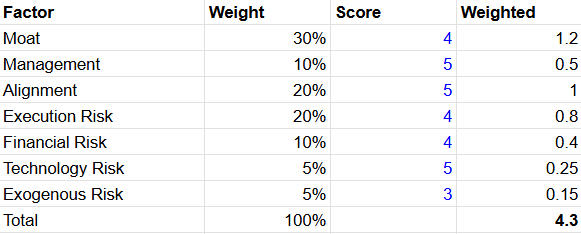
Important context: this is our own scoring system. It is based on our research, our worldview, our investing style, and our own biases.
It is not meant to be an objective truth or a universal rating system. It is simply a way for us to compare companies consistently across the factors that matter most to us.
A score of 5/5 means excellent. For quality factors, it means the company is elite. For risk factors, it means we see little to no risk.
A score of 1/5 means unacceptable. For quality factors, it means the company is weak or completely replaceable. For risk factors, it means the risk is so high that we would usually eliminate the stock before even considering it.
Nebius already has several meaningful competitive advantages.
The strongest today is Process Power. Nebius is demonstrating an ability to deploy infrastructure, optimize performance, onboard demanding customers and respond to them faster and more effectively than many larger competitors. Management specifically highlighted white-glove support, responsiveness, performance and reliability as key reasons customers choose Nebius, even when they already have access to hyperscalers.
Nebius is also beginning to develop meaningful Scale Economies. As capacity grows, fixed infrastructure, software, engineering and operating costs can be spread across a much larger revenue base, which should continue improving margins.
I also view Nebius’ exceptional human capital and technical talent as a scarce resource. Building a team capable of executing across infrastructure, cloud software, networking, AI workloads and financing at this speed is extremely difficult to replicate.
Finally, Nebius still has an element of Counter-Positioning versus hyperscalers such as AWS. Its willingness to provide more flexibility, faster decision-making, stronger customer support and more customized infrastructure makes it attractive to demanding AI customers that are poorly served by the traditional hyperscaler model.
Over time, I expect the moat to increasingly shift toward Scale Economies and potentially Network Economies as the platform and customer ecosystem grow.
Why not 5/5? Nebius is not unbeatable. Customers can still switch providers or multi-source compute. But replacing Nebius with an equally capable alternative is already becoming very difficult for rational customers, which makes 4/5 the appropriate score today.
Visionary, competent, honest and consistently executing.
They do what they say and say what they do. So far, the team is delivering across every important area: product, infrastructure, sales, financing and strategy.
For me, this is simply an exceptional management team. 5/5.
Extremely well aligned with shareholders.
The founder is also the CEO, has billions of dollars invested in Nebius stock, and the company represents the primary driver of his personal wealth. His financial outcome is therefore overwhelmingly tied to long-term shareholder value.
That also makes him naturally very sensitive to dilution, which helps explain Nebius’ focus on customer prepayments, asset-backed financing and other less-dilutive funding sources.
Very clear 5/5 for me.
I give Nebius a 4/5, meaning low execution risk. Not no risk, but low risk.
The plan is ambitious and complex, but the path forward is clear, known and achievable. The main reason I’m comfortable scoring it this highly is the exceptionally strong execution Nebius has delivered to date.
Vineland is the obvious argument for a lower score. It proves that permitting, local pushback and infrastructure delays are real. But I currently see Vineland more as an outlier and a learning experience than evidence that the broader execution model is broken.
A few things matter here:
Nebius already seems to build delays and execution challenges into its guidance and planning, rather than assuming everything goes perfectly.
The company is now much more aware of local political and community pushback, which is becoming an increasingly important constraint as AI infrastructure scales.
I think this is a very strong team that learns and adapts quickly, so I expect them to get better at navigating these issues over time.
Most importantly, Nebius is pursuing a highly diversified global buildout across multiple data centers, countries and regions in the US, Europe and Asia.
That geographic diversification gives them real strategic flexibility. If one location becomes harder, slower or more hostile to development, Nebius can redirect capital toward places where deployment is easier and local communities actually want the investment.
So I absolutely expect complications, delays and occasional project-level issues. But I do not think those make the overall plan unclear or unrealistic.
To me, the plan is difficult, but achievable, and Nebius has already earned a lot of trust through its execution track record.
That is why I land at 4/5.
If you do not share that trust in management, or you think Vineland is evidence of a broader structural execution problem rather than an outlier, I completely understand assigning a 3/5 or even lower.
I give Nebius a 4/5, meaning low financial risk.
The key distinction here is that I am not asking whether Nebius will dilute shareholders at all. Of course it will. I already account for that separately in the valuation model through my diluted share-count assumption.
So the risk I care about here is: Will Nebius need materially more external capital or dilution than I am already modeling?
Right now, I think that risk is low.
Nebius has a strong balance sheet, rapidly improving cash generation, and significant leverage when negotiating financing. It can fund growth through a mix of operating cash flow, customer prepayments, asset-backed financing, corporate debt and equity.
The trend is also moving in the right direction. Pricing per MW is increasing, customer prepayments are increasing, and management is explicitly trying to push prepayment coverage even higher. That should reduce the amount of external capital required for every incremental dollar of growth.
I also see very little risk of the company running into an existential financing problem. If anything, I expect Nebius to become increasingly profitable and able to raise capital on very attractive terms.
So for me, the remaining financial risk is mainly the possibility that dilution ends up higher than expected, not that the company cannot finance the buildout.
That is why I give it a 4/5.
Nebius’ core technology is already proven, deployed and operating at scale.
Customers are actively testing the platform through POCs, signing billion-dollar contracts, expanding workloads and choosing Nebius over existing suppliers. The technical challenge is now primarily about continuous optimization and scaling, not proving whether the underlying technology works.
For me, that makes this a 5/5.
I give Nebius a 3/5, meaning moderate exogenous risk.
This is one area where I think we have to stay cautious. Nebius, and especially the stock itself, remains highly exposed to macro cycles, trade disruptions, wars and geopolitical conflicts.
The most obvious concentration risk today is NVIDIA. NVIDIA is a close, trusted and extremely important partner for Nebius because its GPUs are the foundation of the cloud infrastructure Nebius is building.
That creates an indirect geopolitical dependency through the semiconductor supply chain, particularly given NVIDIA’s exposure to Taiwan and advanced chip manufacturing.
So even if Nebius executes perfectly internally, there are still external risks that management simply cannot control.
For me, that makes 3/5 the honest score. The structural AI tailwinds are extremely strong, but the business and the stock remain vulnerable to geopolitical and macro shocks.
Putting everything together, Nebius scores 4.30/5, or 86/100, in my framework.
That is an exceptionally high score.
The company combines a strong and improving moat, outstanding management, exceptional shareholder alignment and relatively low execution and financial risk. The main area where I remain more cautious is exogenous risk, particularly macro, geopolitical and semiconductor supply-chain exposure.
Overall, I view Nebius as a very high-quality business with an unusually attractive risk/reward profile.
I built this model from the bottom up.
I did not start with a price target and work backwards. I estimated ARR, monetized capacity, pricing, margins, dilution, portfolio value and the valuation multiple first.
The share price is the final output.
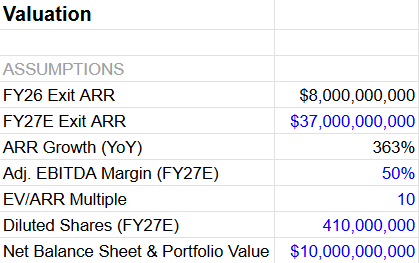
Management reaffirmed its $7B to $9B year-end ARR guidance, so I simply use the midpoint.
Pricing is improving fast, but potential Vineland timing issues could offset some of that benefit. We also learned that many of the new $20M - $25M / MW deals won’t be monetized until 2027. Until management raises guidance, $8B feels like the most reasonable assumption.
This is obviously the number that looks insane and you’re probably going “WTF?” right now.
But it is grounded in monetized capacity × actual contract economics.
Nebius expects 800 MW to 1 GW of connected power by YE26, with that capacity becoming economically active progressively through H1 2027. Management also plans to deploy more than 1 GW per year starting in 2027, while explicitly warning that connected capacity can take several months to become revenue-generating.
So I assume roughly 1.75 GW of actually monetized capacity by YE27, not total connected capacity.
I then split that capacity by economics:
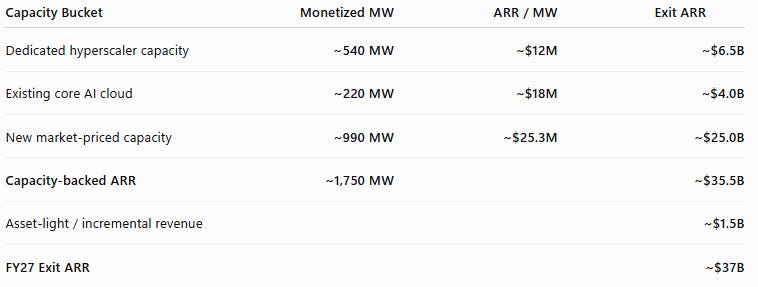
The ~540 MW hyperscaler estimate is an inference, not a disclosed number.
For new capacity, Q2 core deals reached $20M to $25M/MW, while short-term contracts are reaching $40M to $50M/MW and sometimes above. Most importantly, management said it could already sell its entire planned 2027 capacity today at Q2 economics, but is deliberately keeping some capacity uncommitted because it expects better pricing.
For the new capacity, I assume roughly:
87.5% at $22.5M/MW
12.5% at $45M/MW
That gives a blended ~$25.3M/MW.
So while $37B ARR sounds ridiculous, the individual assumptions required to get there really don’t.
Nebius AI cloud already generated a 49.7% adjusted EBITDA margin in Q2.
Management expects further margin expansion, with owned data centers beginning to improve economics in H2 2027 and higher-margin asset-light, inference and agentic revenue becoming more important.
So I assume 50%.
At $37B exit ARR, that implies roughly $18.5B of annualized exit-run-rate adjusted EBITDA.
I think 10x ARR is the most likely valuation if Nebius actually delivers these numbers.
The company deserves a discount versus asset-light software because the business requires enormous CapEx and continuous hardware reinvestment.
But if Nebius exits 2027 at $37B ARR, 363% growth and ~50% adjusted EBITDA margins, I also think a low multiple would be difficult to justify.
There will still be bulls arguing AI infrastructure remains structurally undersupplied and bears arguing the entire AI CapEx cycle is unsustainable.
10x feels like the most reasonable clearing multiple between those views.
It also equals roughly 20x exit-run-rate adjusted EBITDA, which does not look excessive for a company still growing anywhere near these rates.
Nebius had 271.9M shares outstanding at Q2, while additional dilution comes from warrants, convertibles, the remaining ATM, SBC and future financing.
I assume those to roughly look like this:
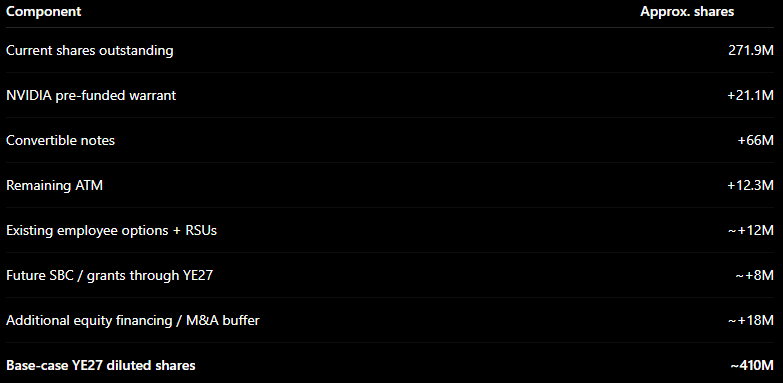
I therefore assume 410M diluted shares by YE27.
I add $10B for Nebius’ balance sheet and investments in ClickHouse, Avride, Toloka and TripleTen.
ClickHouse is the most important piece. It raised at approximately a $15B valuation in January 2026, and Nebius still owns a significant minority stake.
I think ClickHouse could reach $100B much faster than most investors expect, although my $10B portfolio assumption does not require that full outcome.
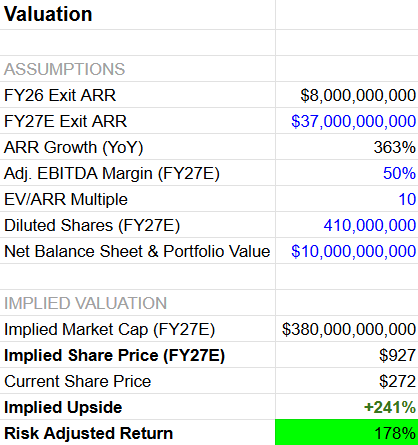
$37B FY27 Exit ARR
× 10x EV / ARR
= $370B enterprise value
+ $10B balance sheet and portfolio value
= $380B equity value
÷ 410M diluted shares
=
$927 per share
At today’s $272 share price, that implies:
+241% upside
Nebius scored 4.30/5 in my Quality & Risk framework.
I calculate risk-adjusted return as:
Expected Return × (Quality & Risk Score / 5)²
So:
241% × (4.3 / 5)² = 178%
That gives me:
At $272 today, I consider that an insanely attractive risk/reward. My final 2027 price target for Nebius is:
This article reflects our personal opinions and is provided for informational and educational purposes only. It does not constitute financial, investment, legal, or tax advice, nor a recommendation to buy, sell, or hold any security. We may hold positions in companies mentioned and may change these positions at any time without notice. Past performance is not indicative of future results, and investing involves risk, including the possible loss of principal. Always do your own research and make your own independent investment decisions.
No posts
Comments
Nothing yet. Say the first thing.
Sign in to join the conversation.