
When I moved to Orlando in 1995 to take a caricature job at Universal Studios, one of the first people I met was another caricature artist trying to get into the Walt Disney Feature Animation training program. I knew about the program. I also knew I couldn’t get into it.
Or at least I thought I couldn’t.
My understanding was that Disney only recruited from a handful of art schools. Seven, to be exact. I hadn’t attended any of them. But this artist told me something I hadn’t heard: the Florida studio was ramping up production on the studios first full feature Mulan, they needed a lot of artists, and the training program had been opened up to everyone.
That one conversation started a two-and-a-half-year journey of studying, drawing, building my skills, rebuilding my portfolio, submitting it, getting rejected, and then back to the literal drawing board to repeat the process again.
But that’s another story for another time.
This story is about a group of artists who were all working toward the same goal.
A couple of the caricature artists I worked with had attended the Ringling School of Art and Design, a school I’d actually been accepted to years earlier but couldn’t afford to attend.
They also had friends working at Disney Animation—among them was animator Aaron Blaise. Through those connections, they occasionally got their hands on some pretty cool stuff: like photocopies of Glen Keane’s figure drawings from Pocahontas, handouts given to Disney trainees, Glenn Vilppu’s legendary drawing manual. They got feedback on their portfolios from their Disney friends, too, and some were even invited to sit in on the private figure drawing sessions at the studio.
As you can imagine, to someone desperately trying to learn everything he could and improve his drawings enough to get into Disney, this stuff was gold. The internet was only just getting started around this time (you know, the “You’ve got mail” years), and you couldn’t simply go online and find this kind of material. Access to drawings and information like this was rare (unless you live in LA).
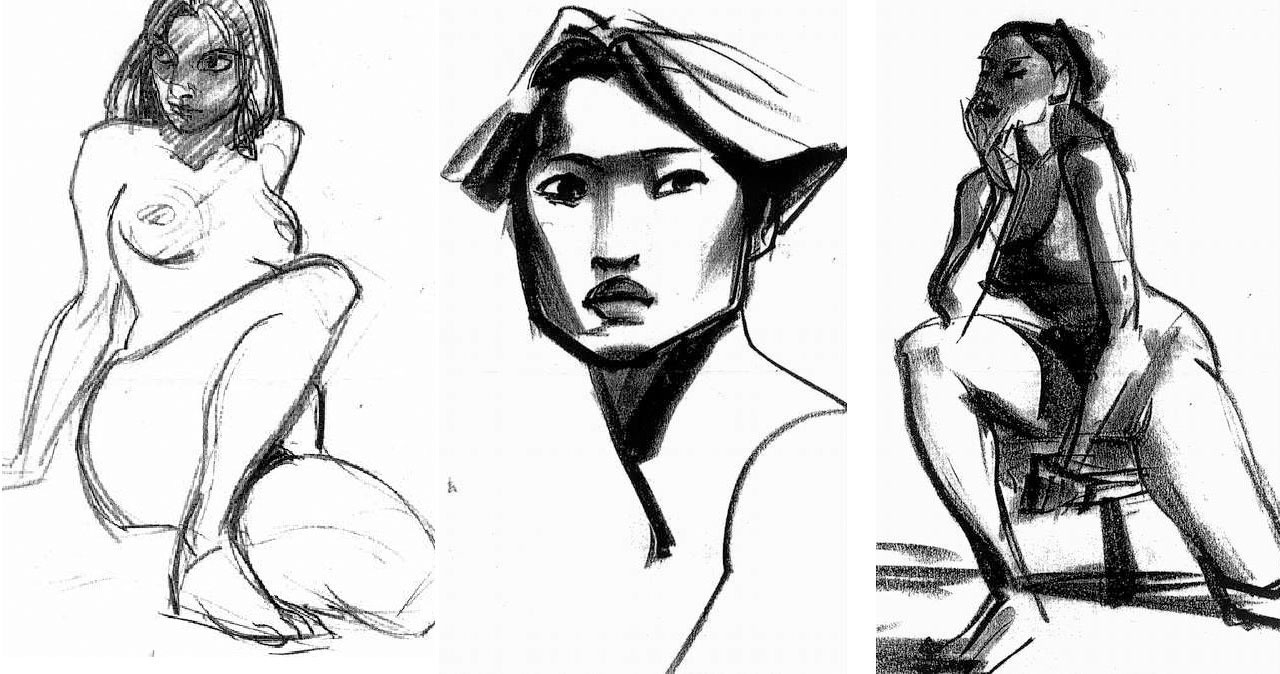
One day, while I wasn’t around, that artist I’d met on my first day brought in another batch of goodies. I don’t remember exactly what they were anymore. They may have been those amazing Glen Keane drawings. But someone who was there told me what happened next.
As the artist was passing copies around, he told the others: “Don’t share these with Eddie. He’s competition.”
And…that pretty much summed him up.
Unfortunately for him, one of the people he said this to wasn’t trying to get into Disney at all. He just loved cool art stuff. We called him “The Instigator” because he always seemed to enjoy stirring up a little drama between people, then sitting back to watch what happened.
You can probably guess what The Instigator did next.
He came straight over and told me.
I remember mostly shrugging it off. What else could I do? But that little incident stuck with me.
I’ve never understood the impulse to hoard knowledge. I’ve always figured the biggest obstacle I have isn’t other artists. It’s myself. Whenever I discovered something that made my drawings better, I wanted to tell somebody…anybody…EVERYBODY about it.
“Hey! Look at this book! These drawings are amazing!”
“Have you ever thought about drawing the pose this way?”
“Hey, look what happens when you do this.”
I’ve always loved talking about drawing almost as much as I’ve loved drawing. Sometimes more. And if I found something that helped me, why would I want to keep it a secret from anyone else?
A couple of those artists got into Disney before I did. Then, the following year, after a lot of blood, sweat, and tears trying to figure this stuff out on my own, I finally got the call. I’d been accepted into the Walt Disney Feature Animation training program.
And that, too, is another story I’ll tell another time.
But getting into Disney didn’t change me in one respect: I kept sharing what I was learning. I continued sitting in on figure drawing classes at Crealdé School of Art, mentoring other artists, and eventually teaching a class of my own. After class, I’d stand in the parking lot for hours talking with students about drawing.
I’m still known to do this. You just can’t shut me up.
Over the years, I’ve put some of those ideas into classes and workshops, and yes, I charge money for those. There’s value in organizing 35 years of mistakes, discoveries, traditions, and lessons into something another artist can actually use.
But I still give away an awful lot of it.
I can’t seem to help myself.
Which brings me to my next FREE workshop.
I’ve noticed a lot of artists struggle with the same problems with color.
They rely on overly saturated colors, darken everything with black, soften every edge with an airbrush, or choose colors one at a time without thinking about how they work together. The result is artwork that feels flat, muddy, or less convincing than the drawing deserves.
These are things I struggled with, too. Over the years, I’ve found a few ideas that made color much easier for me to understand.
So I’m going to share them.
On Tuesday, August 25, I’m teaching a FREE online workshop called Making Color Work.
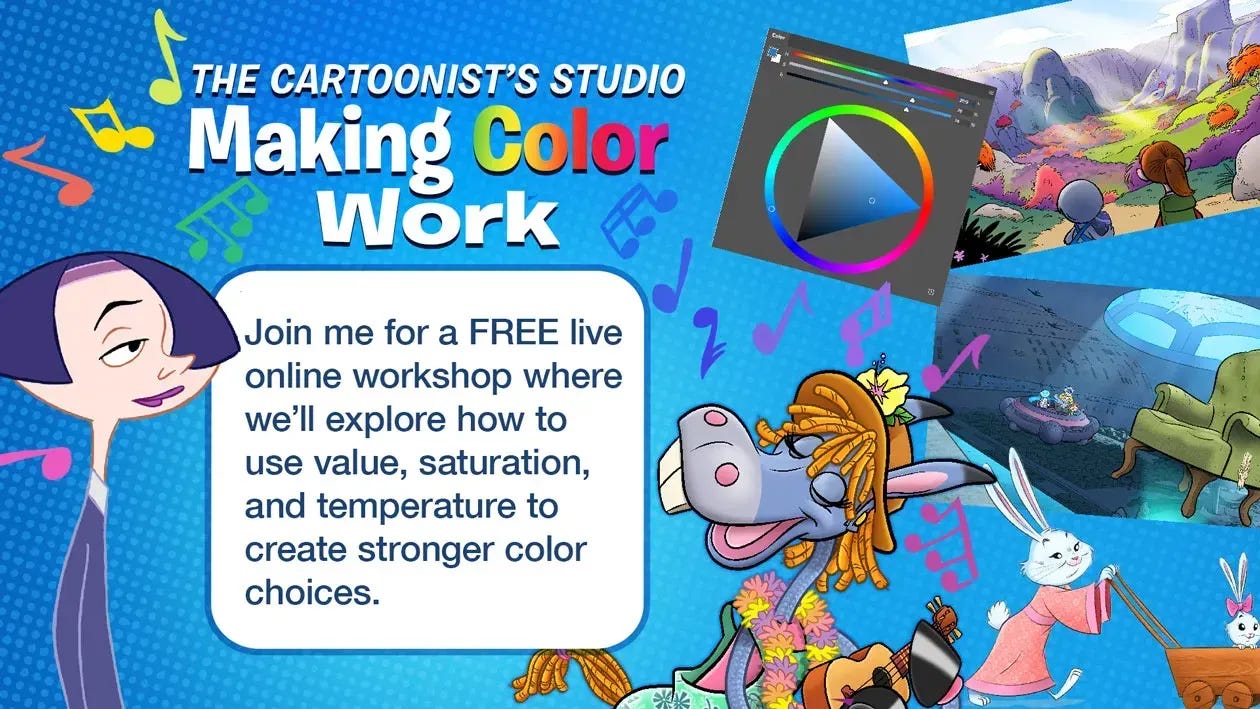
This isn’t going to be an academic lesson on color theory. We’re going to look at some practical ways to think about value, saturation, temperature, harmony, and contrast, and how they work together to make color feel richer, clearer, and more intentional.
Then I’ll do a demonstration and show you how I approach coloring digital artwork.
My hope is that you’ll come away looking at color a little differently, with some practical ideas you can immediately apply to your own illustrations, comics, and character designs.
And yes.
It’s free.
You can sign up here:
https://us06web.zoom.us/meeting/register/TXYzsji1TIOJzmPZWttqYA
I’m also teaching a six-week live course on Cartooning and Character Design, running September 1 through October 13.
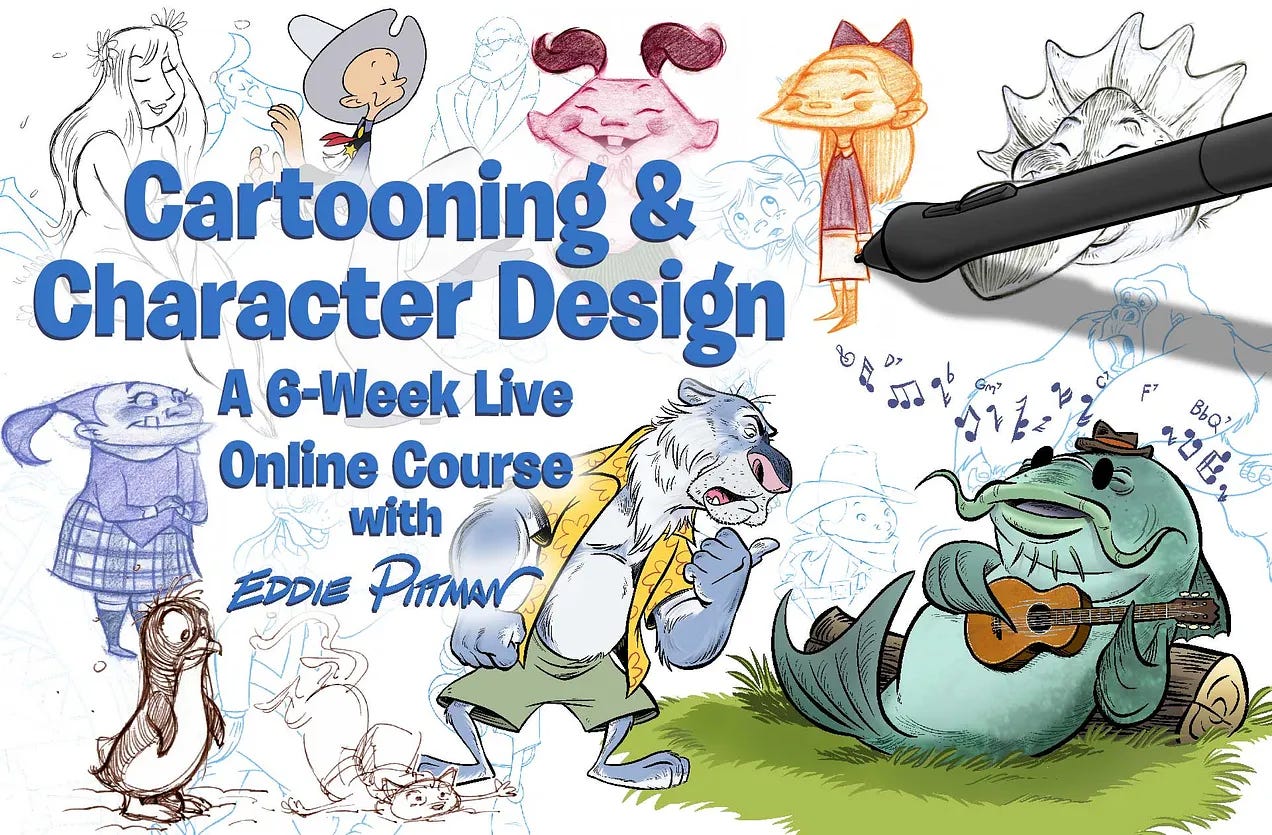
This is a paid class at $299 for the full six weeks, but this one goes much deeper. We’ll explore the fundamental ideas behind cartooning and character design: how we simplify, construct, pose, design, and ultimately create characters that feel like they have a life beyond the drawing.
And because it’s a small live class, I’ll be giving individual feedback to all the students along the way.
The class is limited to 15 students, ages 18 and older. You don’t have to be an advanced artist to take it. Whether you’ve been drawing for years or you’re still trying to figure out exactly what you’re doing, there should be something here for you.
You can find out more here:
https://www.thecartoonistsstudio.com/cartooning-character-design-fall-2026/
And there is lots more free stuff at my The Cartoonist’s Studio Substack
I’ve been doing this for 35 years and I’m still trying to figure out exactly what I’m doing.
But I’ve learned a few things along the way.
And if you learn something useful, share it with somebody.
Don’t worry.
They’re not the competition.
Thanks for reading Eddie Pittman: A Cartoonist's Odyssey! This post is public so please share it with your friends and neighbors.
No posts
Comments
Nothing yet. Say the first thing.
Sign in to join the conversation.