
This subject drives me crazy because so many people don’t grasp just how fragile our country is when it comes to our finances.
One of the easiest ways to understand the national debt is to compare it to a household budget.
Let’s start with the numbers.
The United States currently has about $40 trillion in debt. That’s already an astronomical number, but we continue adding to it every year. This year alone, we’re adding roughly $1.8 trillion. On top of that, we’re paying about $1 trillion a year just in interest.

Think about that for a moment. Every time you write a check to the U.S. government or money is withheld from your paycheck, about 25% of that is going toward paying the interest on our debt.
Now let’s look at the federal budget.
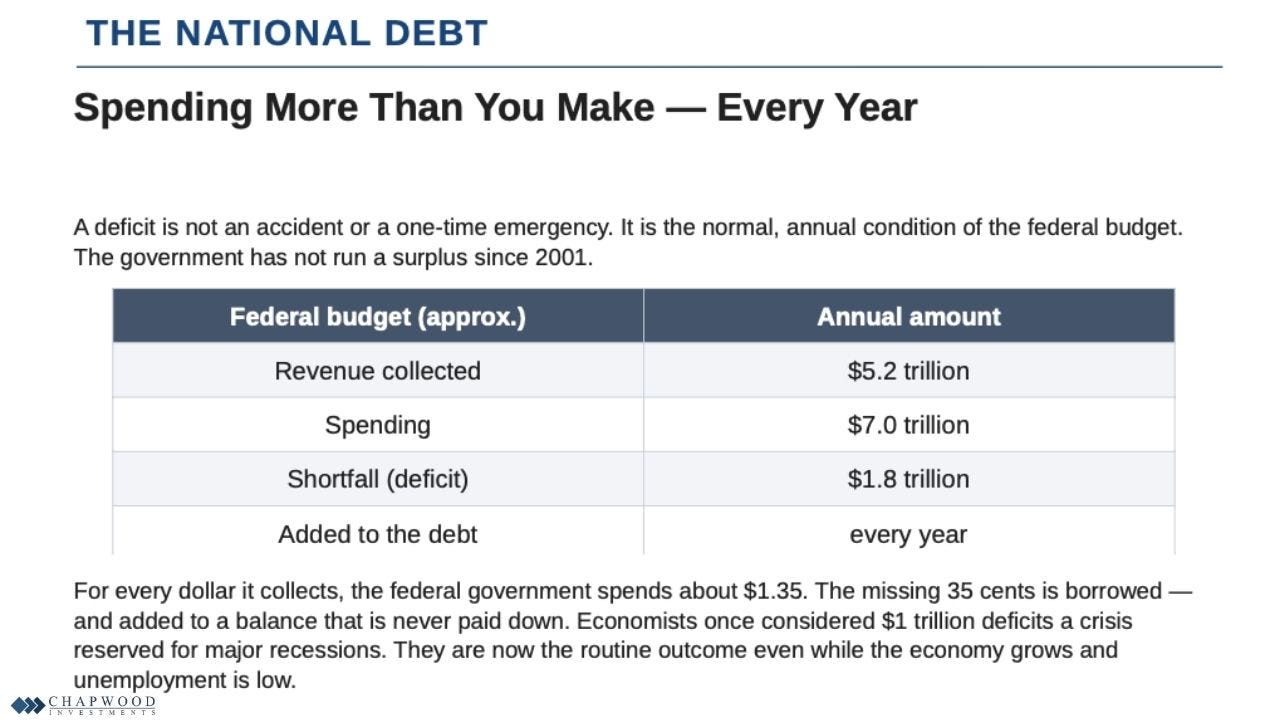
The U.S. government collects approximately $5.2 trillion each year in revenue, primarily through taxes. At the same time, it spends about $7 trillion annually. That leaves a shortfall of $1.8 trillion, which gets added to the national debt every single year.
Now compare that to a household.
Imagine earning $70,000 a year but spending $94,000. Every year, you put another $24,000 on a credit card that already has a balance of $532,000.

When you look at it that way, it’s unbelievable.
So why can’t we climb out of this at current rates?
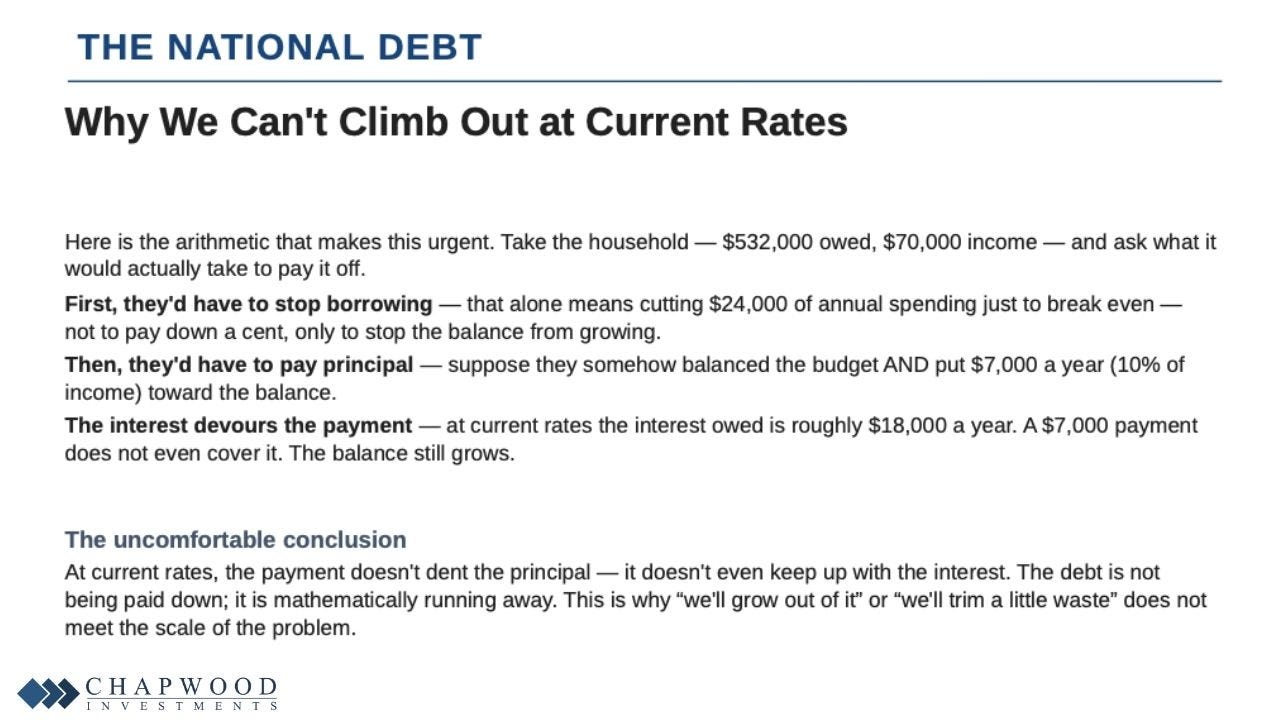
First, we’d have to stop borrowing altogether. That alone would require cutting the equivalent of $24,000 out of annual spending. Neither party, Democrats nor Republicans, seems willing to do that. Instead, we continue spending more and more money, which means we’ll continue paying more interest on an ever-growing debt.
Even if the budget were somehow balanced, we’d still have to pay down the principal.
Suppose we managed to put $7,000 a year toward paying off that balance. It really wouldn’t accomplish much because the interest alone is roughly $18,000 a year. A $7,000 payment doesn’t even cover the interest, so the balance continues to grow.
That’s why this concerns me so much.
It’s easy to see a new road, a new bridge, or improvements to existing infrastructure and simply think it’s a good thing. But all of that costs money, and that money comes at a price.
That price isn’t just something our children or grandchildren will deal with someday. It’s affecting us today because financing more debt ultimately requires printing more money, and that is inflationary.
We’re in a difficult financial situation, and I think it’s important that more people understand what these numbers really mean.
If you’d like me to analyze your portfolio, feel free to reach out. I’m always happy to take a look and help determine whether your portfolio is properly positioned and whether you’re taking more risk than your historical rate of return justifies.
Chapwood Investments, LLC, is a partner of Ethos Financial Group, LLC, a Securities and Exchange Commission-registered investment advisor. No mention, opinion, or omission of a particular security, index, derivative, or other instrument in this article constitutes an opinion on the suitability of any security. The information and data presented here were obtained from sources deemed reliable, but their accuracy and completeness are not guaranteed. At any given time, principals at Chapwood Investments, LLC may or may not have a financial interest in any or all of the securities or instruments discussed in this article. Guest contributors do not receive compensation and do not provide endorsements or testimonials. Past performance is not indicative of future results.
No posts
Comments
Nothing yet. Say the first thing.
Sign in to join the conversation.