
There is a simple way to understand one of the biggest imbalances in the Mexican economy: Look at where the country sells and where it buys. The geographic divide is immediately apparent. Mexico generates virtually all of its trade surplus in the Americas, primarily thanks to the U.S., while running a massive deficit with Asian economies.
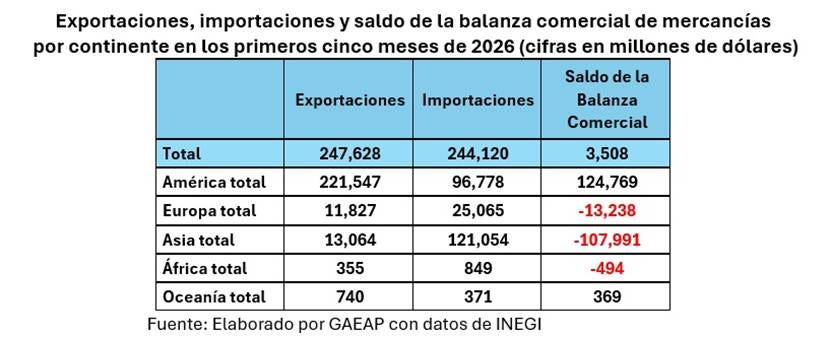
The numbers are striking. During the first five months of 2026, Mexico exported $247.628 billion in goods and imported $244.120 billion, producing a trade surplus of $3.508 billion. But behind that relatively balanced headline figure lies an enormous offset between regions. Mexico ran a $124.769 billion surplus with the Americas and a $107.991 billion deficit with Asia. It also posted a deficit with Europe, though a considerably smaller one, at $13.238 billion.
Put differently, Mexico buys massively from Asia and sells massively to the Americas. That trade structure isn’t new, nor is it necessarily negative in itself. In an economy like Mexico’s, deeply integrated into global value chains, it is perfectly normal to import components from one country, transform them in another and sell the finished product in a third. The real issue emerges when we ask how much value Mexico is adding to its exports, how dependent the country is on inputs from outside the region and, above all, how compatible this model will remain with the new direction of U.S. trade policy.
The concentration of trade becomes even more evident when we move from continents to individual countries. According to INEGI data, during the first five months of 2026 Mexico exported $205.439 billion in goods to the U.S. and imported $83.855 billion. The result was an extraordinary $121.585 billion surplus, while total bilateral trade reached $289.294 billion.
That means the overwhelming majority of Mexico’s enormous surplus with the Americas comes from the U.S. Mexico’s export model depends heavily on the American market, which helps explain why the USMCA review can’t be viewed as just another trade negotiation.
On the other side of the world, the picture is exactly the opposite. Mexico exported just $4.994 billion to China while importing $42.851 billion. The resulting deficit was $37.857 billion. For every dollar Mexico exported to China, it imported roughly $8.60.
And China alone doesn’t explain the magnitude of Mexico’s Asian imbalance.
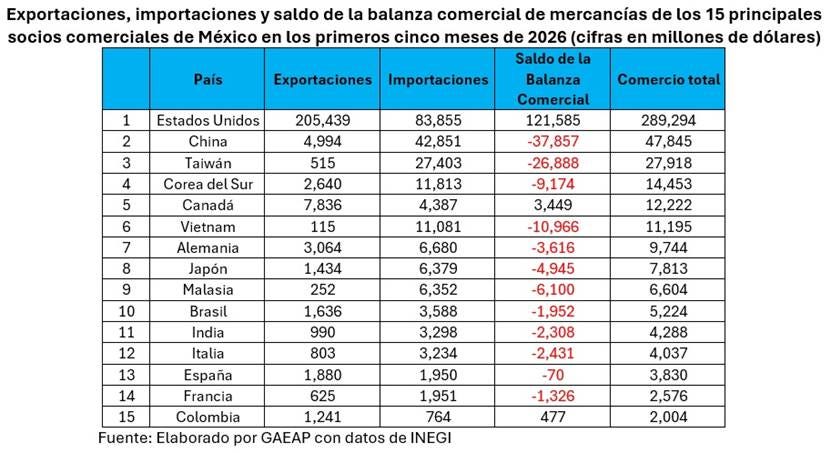
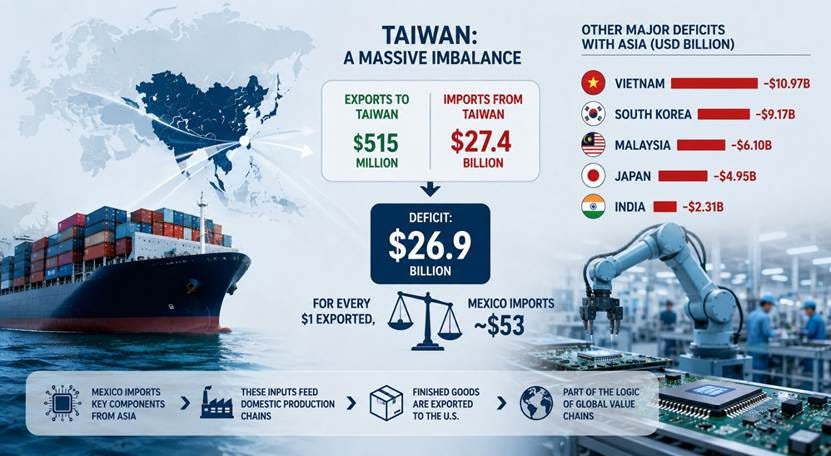
Perhaps the most eye-catching figures in the latest trade statistics are those involving Taiwan, Mexico’s new third-largest trading partner. During the first five months of 2025, Mexico exported just $515 million to Taiwan while importing $27.403 billion. The deficit reached $26.888 billion. In other words, for every dollar Mexico exported to Taiwan, it imported roughly $53.
Other sizable imbalances follow: Vietnam, with a deficit of $10.966 billion; South Korea, $9.174 billion; Malaysia, $6.100 billion; Japan, $4.945 billion; and India, $2.308 billion.
An important distinction is necessary here. A bilateral trade deficit doesn’t automatically signal an economic problem. Mexico imports enormous quantities of components, machinery, electronic equipment, semiconductors and other goods from Asia that are used by domestic industry. Some of those imports feed production chains that subsequently export to the U.S.
The composition of Chinese exports is also changing. China no longer competes only as a supplier of finished consumer goods. Increasingly, it is supplying the world’s factories themselves. According to an analysis by the McKinsey Global Institute cited by The Wall Street Journal, during the first five months of 2026 Chinese exports of intermediate goods rose 25% from a year earlier and capital-goods exports increased 12%, while consumer-goods exports grew just 4%. Mexico is also among the markets where Chinese manufacturers of machinery and industrial equipment are increasing sales.
That makes the question of how much Mexican content and value added is incorporated into the goods the country subsequently exports to the U.S. even more important.
All of this is part of the logic of global value chains. But this is precisely where the economic issue becomes a political one.
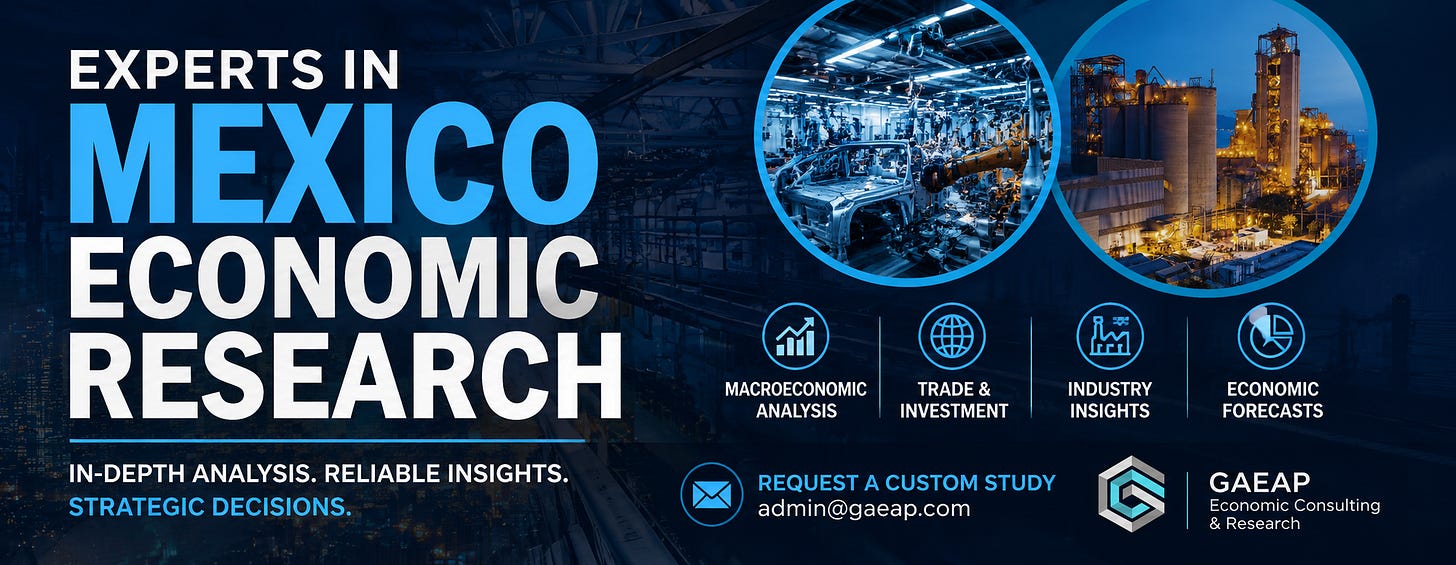
The U.S. didn’t enter the USMCA review simply asking how much trade takes place among the agreement’s three members. The question Washington has been raising is more fundamental: Who is really benefiting from North American integration?
In March, the U.S. and Mexico agreed that one objective of the discussions would be to ensure that the benefits of the USMCA accrue primarily to its members. That includes reducing dependence on imports from outside the region, strengthening rules of origin and increasing the security of North American supply chains.
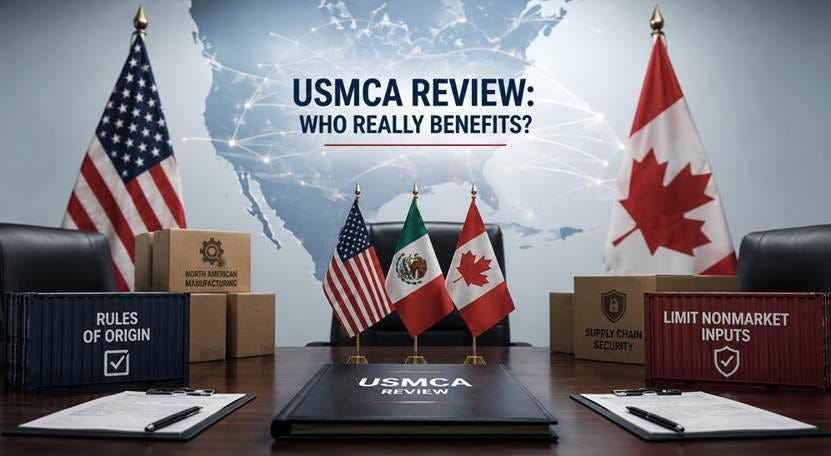
Days later, the approach became even more explicit. Technical teams began examining alternatives to increase manufacturing production and employment in the U.S. and Mexico while seeking to limit the use of inputs from economies with nonmarket practices within North American production chains.
Following the first round of bilateral negotiations, the U.S. Trade Representative directly raised the need to prevent “free-riding” by third countries—that is, economies outside the agreement benefiting from the preferences created by the USMCA. This, therefore, isn’t a hypothetical concern.
In July, during the third round of bilateral talks, U.S. Trade Representative Jamieson Greer again said one of the objectives was to close loopholes that allow nonmember countries to obtain those benefits. Following the talks, Mexico and the U.S. jointly emphasized the need to strengthen North American manufacturing and regional supply chains while confronting precisely this type of free-riding by third countries.
China isn’t always mentioned by name in those statements. But terms such as “nonmarket economies,” “nonmarket inputs,” “extra-regional dependence” and “free-riding by nonmembers” make Washington’s underlying concern perfectly clear.
An important misconception should be avoided. Mexico’s problem isn’t simply that it buys heavily from China, Taiwan, South Korea or Japan. If a Mexican company imports a Taiwanese semiconductor, adds engineering, software, domestic components, skilled labor and other processes in Mexico, and then exports a high-value-added product, that import can strengthen Mexico’s competitiveness.
That is why a $108 billion trade deficit with Asia doesn’t tell us how much Mexican value added is ultimately embedded in exports to the U.S. The tables presented here don’t allow us to make that calculation. What they do reveal is the enormous scale of Mexico’s dependence on Asia.
In just five months, Mexico imported $121.054 billion from Asia while exporting only $13.064 billion to the region. Purchases from Asia amounted to nearly half of all Mexican imports during that period. That inevitably puts the sourcing structure of Mexican industry at the center of the USMCA review.
The discussion, then, isn’t simply about where final assembly takes place. U.S. pressure is increasingly focused on what inputs a product contains, where those inputs were produced and how much of the supply chain truly belongs to North America. That could substantially change the incentives for producing in Mexico.
Thanks for reading ECONOMEX ! This post is public so feel free to share it.
We also need to be careful with the term “transshipment.” It doesn’t simply mean importing a Chinese component, transforming it in Mexico and subsequently exporting it to the U.S. If a company legally imports an input, carries out the necessary processes in Mexico and the finished product actually complies with the USMCA’s rules of origin, it can legitimately qualify for preferential treatment.
It is something entirely different to use Mexico to carry out minimal processes that don’t confer origin, repackage or relabel goods, modify invoices or documentation, misrepresent a product’s declared origin, or conduct other operations intended to evade tariffs applicable to Chinese goods.
And here there is an important new development. The White House has just identified Mexico as one of the countries used for the illegal transshipment of China-linked goods into the U.S. In its report The Great Transshipment Scam, the White House Office of Trade and Manufacturing Policy places Mexico among what it calls “diversified-scale leaders”—countries with large volumes of China-linked goods that also serve as major export platforms to the U.S.
The allegation is particularly sensitive because Mexico enjoys preferential access to the U.S. market under the USMCA. According to the U.S. analysis, Chinese goods can be shipped to third countries for light assembly, finishing, repackaging, labeling or even documentation changes without necessarily undergoing a substantial transformation that changes their true origin. They could then enter the U.S. appearing to originate in another country, thereby avoiding some or all of the tariffs applicable to Chinese goods.
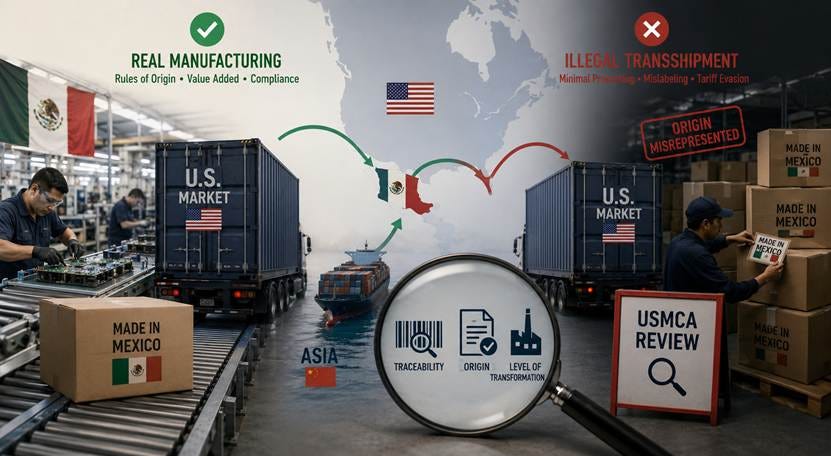
The report even specifically identifies the Guanajuato-Querétaro corridor as a potential concentration point for operations involving electric motors, generators, transformers and static converters. That is particularly significant because these are two of Mexico’s leading industrial states.
But here, too, we should avoid an unjustified generalization. The U.S. analysis itself acknowledges that rising exports from third countries don’t, by themselves, prove illegal transshipment. Some of those flows may perfectly well reflect new investment, legitimate production and genuine changes in global supply chains. The challenge is precisely to distinguish between real manufacturing taking place in Mexico and operations whose primary purpose is to artificially alter a product’s origin.
For Mexico, this significantly raises the stakes ahead of the USMCA review. The issue is no longer limited to U.S. concerns about Mexico’s dependence on Asian inputs. Washington is now putting the traceability, origin and degree of transformation of goods exported from Mexico to the U.S. directly under the microscope.
On top of everything already mentioned, another problem further complicates Mexico’s trade relationship with Asian economies: outright smuggling and the undervaluation of merchandise.
This is different from legitimate dependence on Asian imports. A company that legally imports a component, pays the corresponding taxes and complies with regulations is participating in formal trade.
Outright smuggling and the undervaluation of goods completely distort that competition. When merchandise enters the country without complying with customs procedures, or is declared at an artificially low price to reduce tariff payments, the importer gains an advantage that doesn’t come from productivity, technology or efficiency. It comes from illegality.
There is also a statistical problem: Some of those goods aren’t recorded at all, while others are recorded below their true value.
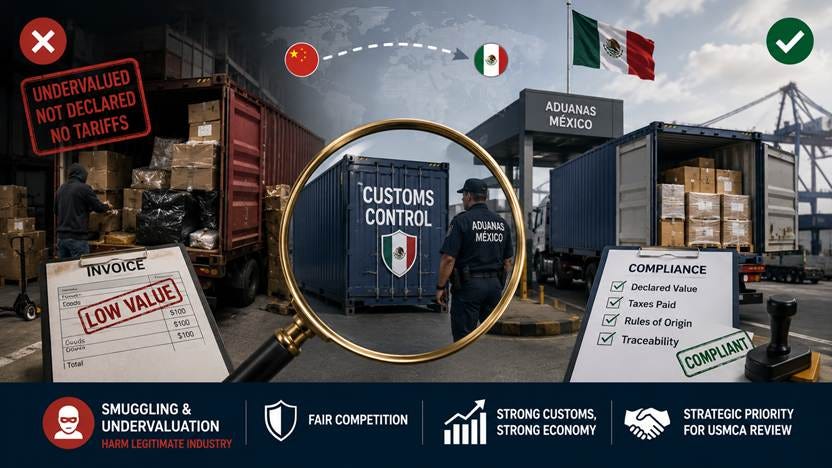
For that reason, Mexico’s effective trade deficit with Asia must be considerably larger than the $107.991 billion shown in the official figures for the first five months of 2026. We don’t know how much larger, but we do know that smuggling and undervaluation mean that a portion of trade isn’t properly reflected in the statistics.
This has two consequences. The first is obvious: It directly harms Mexican manufacturers that pay taxes, wages and social-security contributions and comply with applicable rules and regulations.
The second could prove even more important ahead of the USMCA review. At a time when the White House itself is identifying Mexico as one of the countries used for the illegal transshipment of China-linked goods, combating smuggling, undervaluation and origin manipulation becomes essential if Mexico is to demonstrate that it has reliable customs and can guarantee the traceability of goods entering the country before they are incorporated into North American production chains.
In the USMCA review process, where Washington is explicitly talking about economic security, rules of origin, extra-regional inputs and third-country exploitation of the agreement, the efficiency and credibility of Mexican customs is no longer merely a revenue issue.
It has become a strategic one.
The answer to this situation can’t simply be to shut out imports from Asia. Doing so would hurt many Mexican industries that depend on components that currently aren’t produced domestically in sufficient quantity, quality or at competitive prices. The challenge therefore requires a far more ambitious approach.
Mexico needs to use the USMCA review to increase regional content and, especially, the value added generated within the country. That means developing domestic suppliers, integrating more Mexican small and midsize businesses into value chains, attracting investment into higher-technology segments, strengthening strategic sectors, improving infrastructure and energy, aggressively combating smuggling and undervaluation, and creating conditions that make producing an input in Mexico more attractive than importing it from across the Pacific.
The scale of the challenge is clear in the numbers: In just five months, Mexico posted a $121.585 billion surplus with the U.S., alongside deficits of $37.857 billion with China and $26.888 billion with Taiwan.
Those figures don’t prove that Mexico is simply a transshipment hub. But they do show that Mexico is an economy that sells massively to the north while depending heavily on supplies from across the Pacific. And that is precisely one of the contradictions the U.S. wants to address in the USMCA review.
Mexico has an extraordinary opportunity in front of it. If North America wants to depend less on China and other extra-regional sources, someone will have to manufacture part of what the region currently imports from Asia. Mexico could become one of the biggest beneficiaries of that shift.
But achieving that will require more than importing, assembling and exporting. Mexico needs to manufacture more at home, bring more Mexican companies into production chains and capture a larger share of the value generated by North American trade.
That should be our strategy.
If you find this analysis useful, don’t stop at reading.
At ECONOMEX, we work every day to turn a complex environment into clear signals for decision-making. It isn’t about having more information, but about understanding what matters—and what doesn’t—before the market prices it in.
Become a Premium ECONOMEX subscriber and get the economic, financial and geopolitical analysis you need to anticipate risks, identify opportunities and make better decisions.
Alejandro Gómez Tamez
Director General, GAEAP
Follow me on X: @alejandrogomezt
Comments
Nothing yet. Say the first thing.
Sign in to join the conversation.