
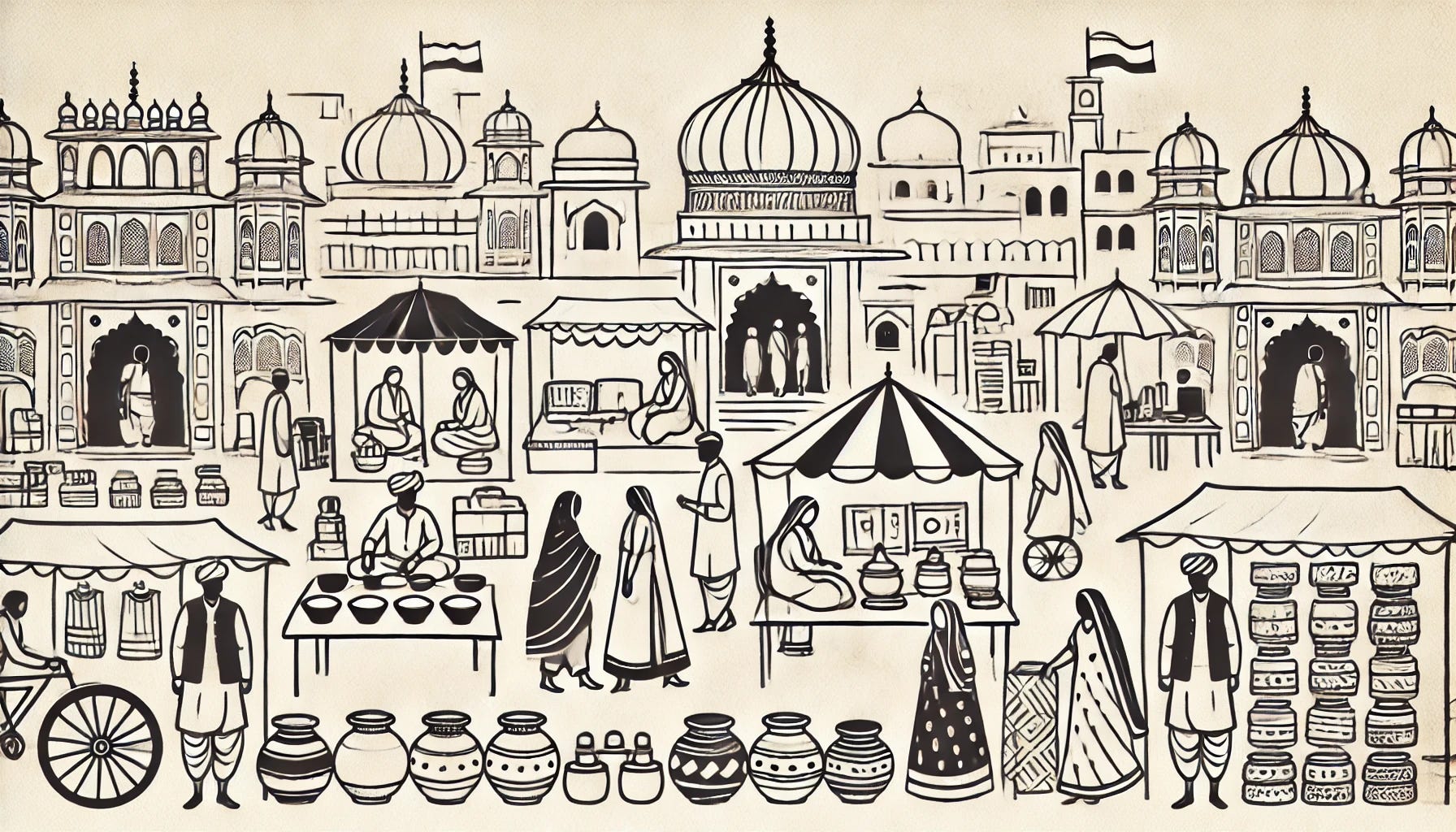
When I introduce myself to new folks in the United States, I identify myself as an “Indian”. In India, sometimes, I would prefer to emphasize my identity as a “Marwari,” a subset of the broader “Indian” identity. Marwaris are an ethno-linguistic group of people from the Marwar region in now Rajasthan, India. This shift in labels I would attach to myself are not arbitrary, but arise from the cost-benefit calculus employed in the market for identities.
Identity as Market Signals
In this piece, I introduce “labels” as signals that communicate identities, which I argue can be understood as an information good consumed by individuals in society.
That degree of division of labour (and specialization) is limited by the extent of the market is one of the first lessons in economics from Adam Smith. A small town or village may have only general physicians, but a larger city can have pediatric gastroenterologists. The degree of division of labour (and knowledge) is constrained by the size of the market. Watch a great video from Dr. Don Boudreaux of GMU on this.
Here, I explore how the degree of specialization of labels is constrained by the size of the market.
Identity as an Information Good
Labels serve as a signal to one’s identity. It conveys information about who we are. This information facilitates social exchange and interaction by providing additional knowledge to other individuals. This is imperfectly so, of course. Not every Indian or every Marwari is the same. But they can provide enough information into a broad set of cultural and social attributes that might facilitate interactions. And the “sellers” of a label can provide more information in addition to the single label. For instance, knowing someone is a Marwari might indicate shared customs like language, festivals, or business ethics within India.
The consumers of identity labels are the individuals who interact with the person signalling their identity. They derive value from understanding the label, which helps them navigate social, cultural, or economic interactions. For example, identifying as Jain may convey vegetarian dietary preferences or the significance of fasting rituals, making interactions around food smoother.
And because I recognize the benefits of reducing transaction costs in interactions with other people, I choose to supply these identity labels. In supplying, one incurs primarily the cost of advertising — which is providing information about these identity labels that individuals might not have. For new people I meet in the US, who do not know the religion Jainism, I incur the cost of providing information about the religion, which gives them some valuable knowledge, such as I am a vegetarian.
Now, the extent of the value is, of course, determined by the consumers. Unless we plan to ever get a meal together, seems unlikely that information about me being a Jain (and a vegetarian) would be valuable to the consumer. In consuming these labels, individuals may incur the cost of learning about these new labels.
It is valuable for my friends in the US to know that I am a Jain and a vegetarian, because they anticipate us getting meals together, or them hosting me at their place for a party, perhaps.
The Economics of Labeling: Costs and Benefits
The degree of specialization of the label that I choose is determined by the extent of the market. By the extent, I mean simultaneously, the number of individuals who would benefit from knowing more about me, and the intensity of the value they would gain from doing so. I consider being a marwari an important part of who I am as a person. But the market for this identity in the US is fairly limited. The marginal benefit for an individual from learning an added degree of specialized identity diminishes. Additionally, the marginal advertising and learning costs from additional degree of specialization of identity increase. It takes more effort to explain and learn what it means to be a marwari from India, than it is to learn that I am a marwari. For instance, explaining the significance of Marwari cultural practices—such as preferences for gold investments or Rajasthani cuisine—may not hold value outside Indian circles.
Thus, the benefits don’t justify me introducing myself as a “marwari” in the US, and I stick to the label of “Indian”. Identity labels can also exhibit network good characteristics, meaning that the marginal cost of supply decreases with additional consumers.
Identity labels are not just cultural artifacts but economic signals that operate within the constraints of marginal analysis and market size. In small markets, broad labels suffice, while larger markets enable greater specialization. This dynamic explains why I introduce myself as “Indian” in the US but as “Marwari” in India. However, each time I choose not to identify as a Marwari, I feel like a part of my self—rich with its unique cultural and personal significance—is missing.
This analysis, of course, is not novel. For those interested, I would recommend reading Thomas Sowell’s Knowledge and Decisions, particularly the section on Sorting and Labeling (pp. 83-93).
Thanks to my friends Carlos and Akshan for helpful conversations.
Comments
Nothing yet. Say the first thing.
Sign in to join the conversation.