
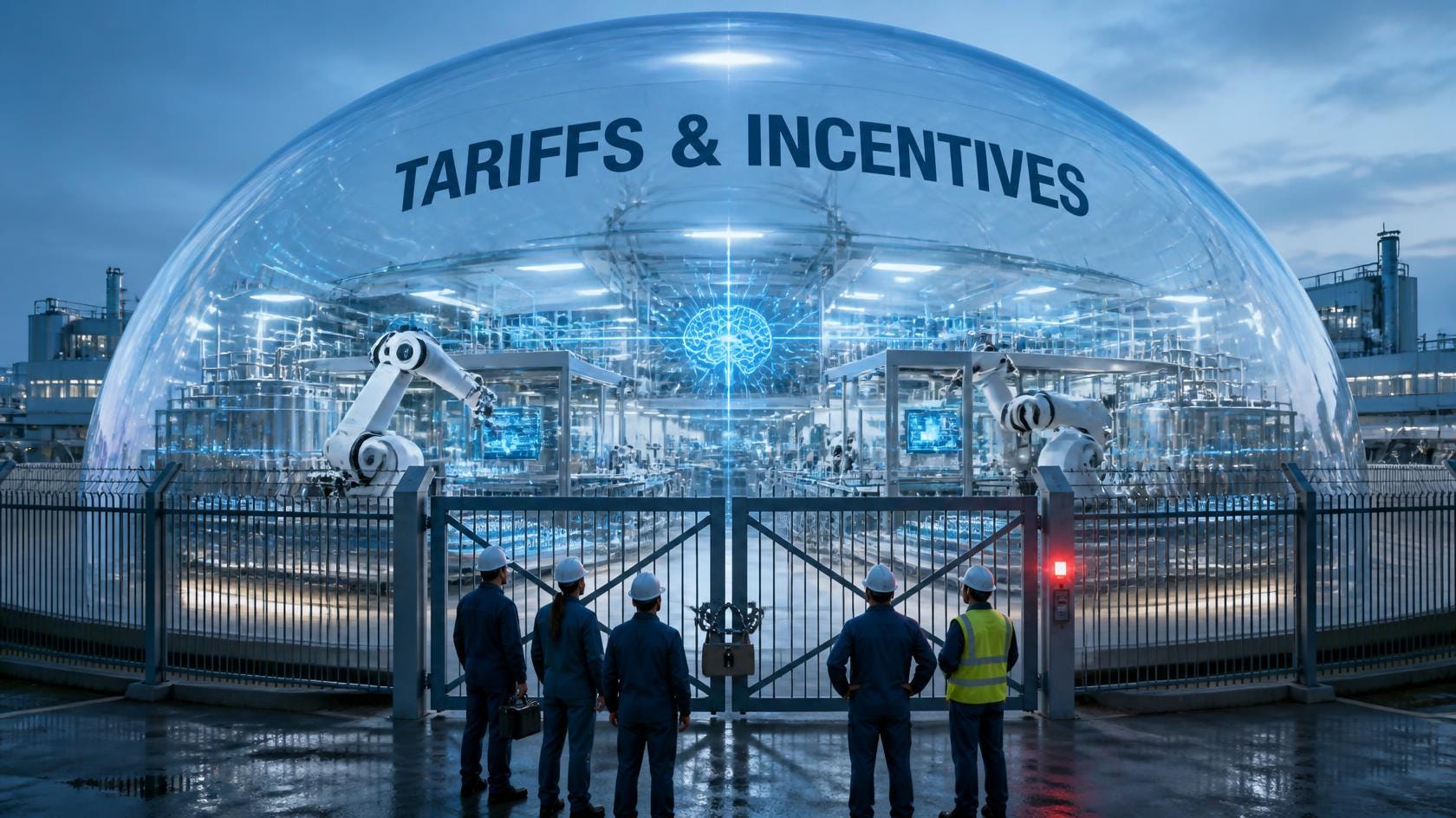
Genentech’s Oregon expansion is the latest proof that tariff pressure and political signalling work. Half a trillion dollars in announced U.S. pharmaceutical capacity is not a rounding error. Fill-finish, sterile injectables and API plants are moving from PowerPoint to concrete.
Yet the same week’s survey data should temper the triumphalism. Nearly nine in ten manufacturing executives now say their reshoring cases depend on AI-enabled automation, analytics or digital operations. Three-quarters admit that without those productivity gains at least one project would stall or need radical redesign. Labour and skills shortages remain the binding constraint for most.
This is the uncomfortable second-order reality. Traditional landed-cost models already understated the full risk of offshore production; the reverse is also true. Domestic plants built to 2019 operating assumptions will struggle against both residual Asian capacity and the new generation of highly automated facilities being designed elsewhere. The FDA’s PreCheck pilot and state incentives can accelerate permitting; they cannot conjure technicians or clean, integrated plant-floor data.
Governments are therefore subsidising two different things. One is genuine capacity that will operate at competitive cost because it is designed from the start around AI orchestration, predictive maintenance and flexible high-mix production. The other is capacity that looks resilient on a press release but will require continuous further subsidy or protection to remain viable.
The practical test is simple. When the next wave of announcements arrives, ask not only how many square feet and how many jobs, but what share of the operating model is already AI-native and how the firm plans to close the skills gap before commercial start-up. Industrial policy that ignores the operating system will buy expensive insurance policies that never pay out.
No posts
Comments
Nothing yet. Say the first thing.
Sign in to join the conversation.