
We’ve curated the most valuable insights, trends, and strategies you need to stay on top of your game in e-commerce. Whether you're looking to optimize conversions, explore new growth tactics, or leverage the latest AI tools, this digest has everything you need to fuel your business growth. Dive into this week’s must-read content and take your e-commerce strategy to the next level!
Let’s start!

Access exclusive, high-paying remote AI training roles with flexible hours. No prior AI experience required.
E-commerce Data & Catalog Specialist - $40 - $50/hour
E-commerce Simulation Expert - $40 - $50/hour
Management Consultant - $154 - $210/hour
Project Management Specialist - $63 - $119/hour

As ecommerce moves faster, traditional product photoshoots are becoming a creative bottleneck. Brands today need a constant stream of fresh visuals across ads, product pages, email campaigns, marketplaces, and social channels. Instead of relying on one-off photoshoots, leading brands are shifting toward reusable visual systems that allow them to continuously generate new content while maintaining a consistent brand identity. AI-powered tools like Hippist AI help brands expand a small set of product images into multiple formats, seasonal variations, and lifestyle scenes—enabling faster creative execution without restarting production from scratch.
Three key takeaways
Traditional photoshoots create static assets, while visual systems create scalable frameworks that can continuously generate fresh content.
AI enables brands to reuse and adapt existing product imagery into new contexts, formats, and campaigns without additional production costs.
Faster content creation allows creative teams to focus on testing and optimization rather than repeatedly producing the same types of assets.

Consumers are becoming increasingly comfortable with AI shopping agents, according to a 2026 survey by Accenture covering more than 25,000 consumers across 16 countries. The research found that 74% of respondents would trust a personal AI agent more than their best friend to make purchases on their behalf. Most consumers are willing to delegate routine tasks such as negotiating deals, handling complaints, renewing subscriptions, and reordering products, while retaining control over more personal or emotionally significant purchases. The study suggests that trust in AI commerce is growing, but consumers still want safeguards, transparency, and the ability to override AI decisions.
Three key takeaways
74% of consumers said they would trust an AI agent to handle routine shopping-related tasks, while 32% would allow an AI agent to make purchase recommendations within predefined limits that they would still approve.
Full autonomy remains limited: only 9% would allow an AI agent to complete purchases without final approval, and just 12% are comfortable with autonomous decisions at the payment stage. Trust depends on factors such as data protection, configurable permissions, transparency, and easy human override.
The findings have major implications for brands and retailers. AI agents will increasingly compare products using structured data, pricing, availability, and verified claims, making machine-readable product information and transparent business practices more important. The report also found that 71% of consumers expect generative AI to influence at least half of their spending decisions over the next year.

As shoppers increasingly use AI tools such as ChatGPT, Google AI Overviews, and Gemini to discover products, fashion retailers need to rethink search visibility. A UK Fashion and Apparel AI Visibility Index from Marketing Signals analyzed 59 UK fashion retailers and found that traditional website traffic does not guarantee strong AI visibility. Some smaller brands significantly outperformed larger retailers because they appeared more often in the sources AI systems rely on, such as editorial articles, forums, and brand reference pages. The article outlines four practical strategies retailers can use to increase the likelihood of being cited and recommended by AI systems.
Three key takeaways
Prioritize inclusion in “best of” articles and editorial roundups. AI models heavily reference publisher content when recommending brands, making digital PR and media placements increasingly important.
Build authentic visibility on Reddit and industry forums. Community discussions are influential training and retrieval sources for many AI systems, so genuine participation and positive brand mentions can improve discoverability.
Strengthen both brand mentions and technical foundations. Consistent editorial coverage, structured data (schema markup), FAQ content, and a strong About page help AI systems understand, trust, and accurately represent a brand.
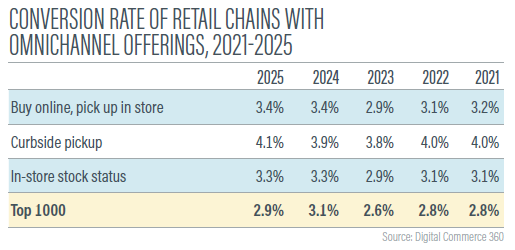
Retailers that offer omnichannel fulfillment options consistently achieve higher ecommerce conversion rates than those that do not. According to Digital Commerce 360’s 2026 Omnichannel Report, services that connect online shopping with physical stores—such as buy online, pick up in store (BOPIS), curbside pickup, and real-time store inventory visibility—continue to drive stronger customer engagement and purchase completion. While some pandemic-era services have declined, retailers are increasingly focusing on the omnichannel features that shoppers use most and that have the greatest impact on conversion.
Three key takeaways
Curbside pickup remains the strongest conversion driver. Retailers offering curbside pickup achieved an average conversion rate of 4.1%, compared with roughly 2.9% for retailers overall, making it the highest-performing omnichannel fulfillment option measured in the report.
Other omnichannel features also boost performance. Retailers that provide BOPIS and real-time in-store inventory visibility report higher conversion rates than merchants without those capabilities, helping shoppers make faster and more confident purchase decisions.
Retailers have adapted omnichannel strategies to changing consumer preferences. While curbside pickup adoption has fallen since its pandemic peak, the availability of BOPIS and in-store stock visibility has increased, reflecting a shift toward services that combine convenience, certainty, and store-based fulfillment.

Retailers looking to capitalize on the 2026 FIFA World Cup should pay close attention to the tournament’s new scheduled 22nd-minute water breaks. Research commissioned by Snapchat found that these breaks are likely to become synchronized “second-screen” moments when millions of Gen Z viewers simultaneously turn to their phones. For younger fans, mobile devices are no longer a distraction from live sports but an integral part of the viewing experience, creating unique opportunities for brands to engage audiences with relevant, real-time content during natural pauses in play.
Three key takeaways
Gen Z fans are highly active on second screens during matches. Three in four are likely to check their phones during scheduled breaks, while fans check their devices nearly ten times per game on average. Messaging, group chats, and social sharing are now core parts of the live sports experience.
The new 22nd-minute water breaks create predictable, high-attention windows for marketers. Because large audiences are expected to engage with their phones simultaneously, brands can deliver timely and contextually relevant promotions, content, and offers without interrupting the viewing experience.
Relevance is critical. Nearly 70% of Gen Z respondents said they would be interested in hearing from brands during breaks if the content relates to what they are watching, particularly categories such as food delivery, drinks, snacks, and match-related experiences.
That’s all for this week! See you in the next edition of E-Commerce Innovator’s Journal. Don’t forget to share these insights with your friends and colleagues to help them grow too!
No posts
Comments
Nothing yet. Say the first thing.
Sign in to join the conversation.