
When I first started writing here, it was basically just to have some of my underlying assumptions as footnotes from when I was having conversations with people where I wouldn't have time to unpack all of my priors. almost like keeping public-facing footnotes. I wasn’t expecting the reception. I wasn’t expecting the outreach from strangers that read like letters from old friends. I wasn’t expecting the invitations into conversations, collaborations, and partnerships that feel strangely inevitable.
And yet, while all this beauty has been unfolding, life has been testing me in quieter, sharper ways. It has felt like I have been standing before a gate, one that I had to step through if I am to meet what is next. All of a sudden I didn’t have much to say, I just had a lot to experience, which these last months have been about. A friend of mine, Daniel Thorson has written extensively about these processes, so I will let you go deeper on this topic with him, but I will say that for every time we compost, something deeper, more coherent, more harmonious arises. For each layer of shame we shed, a deeper layer of Truth emerges.
For most of my life, I have worn two hats. One for the outer world: the successful entrepreneur, the investor, the person who could talk metrics and markets and make things happen. The other I kept in a locked closet: the philosopher, the mystic, the sensitive soul who felt the world’s currents more than its facts, and who could not stop seeing deeper patterns in everything.
It has taken me decades to realize that the two were never separate hats, just a fractured self trying to survive in a culture that only worships speed, extraction, and constant output.
Nature does not grow like our economies do (in fact nor do economies as it turns out). No forest gains height forever. No body keeps growing indefinitely. All living systems pulse through cycles of expansion, contraction, dormancy, and renewal.
Yet somewhere in the Industrial Revolution, and accelerating through the digital one, we began expecting ourselves to perform at an ever-increasing clip. The data is stark:
In the US, average worker productivity has more than tripled since 1945, while real wages have barely moved.
The average human attention span, measured in seconds, has halved since the early 2000s.
Email volume, task-switching, and hours worked have all climbed steadily for decades, even as burnout rates have spiked.
From the perspective of complexity theory, this is a fragile strategy. Systems that only grow in one dimension without rest or renewal accumulate hidden fragility. Complexity thrives on variation, rhythm, and feedback loops. Strip those away, and the system drifts toward entropy, the gradual breakdown of structure into disorder.
Entropy is the universal pull toward disorder. It is the fallen tree in the forest, the rusting metal, the tired body. But there is a lesser-known counterpoint: syntropy, the tendency of living systems to organize, cohere, and grow in complexity over time. I have written more about that here.
Both forces are at work in us all the time. The challenge is that syntropy requires cycles. It is not the product of linear acceleration but of oscillation. We move forward by alternating between order and chaos, activity and rest, structure and surrender.
Fall apart, and the pieces can reassemble into something more whole. Refuse to fall apart, and the system simply decays in place.
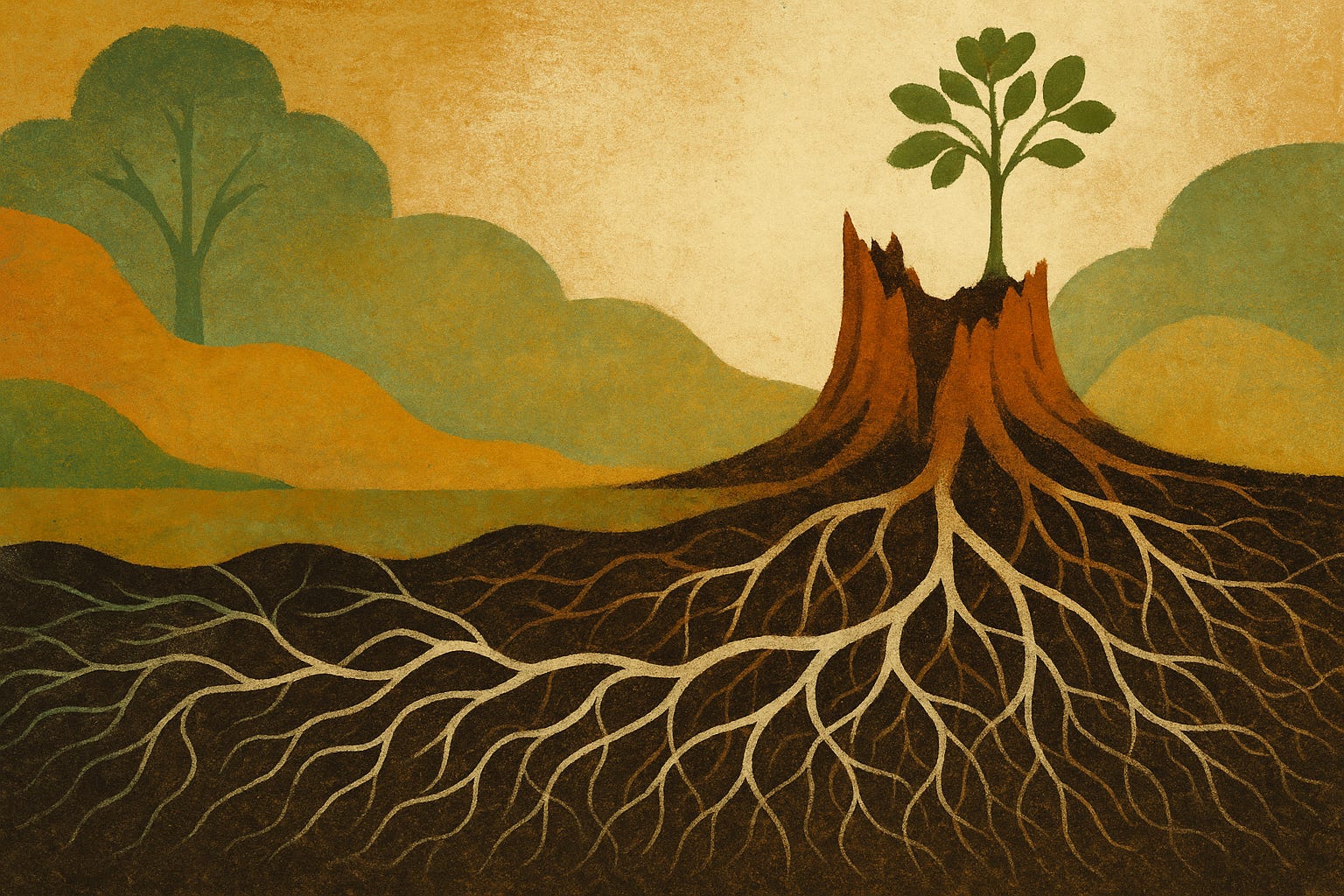
Our culture is built on the fantasy that you can bypass the falling-apart phase, the decomposition. We valorize the launch, the harvest, the sprint, but treat winter as a failure of willpower. This is madness. In ecology, collapse is part of renewal. The forest fire that clears dead brush and mineralizes the soil with its ashes. The flood that fills the land and deposits fertile ground. The death of one species feeding the life of another.
And within the human body, this truth is written most intimately in the menstrual cycle. Each month, the body rehearses the dance of creation and release, life-building and letting-go. What is not carried forward is shed, composted back into the rhythm of renewal. Women live this cycle in their flesh, a wisdom of ebb and flow that our wider culture has largely forgotten.
To honor these cycles is to remember that falling apart is not the end of life, but its condition for continuity.
If syntropy, or love, is life’s self-organizing tendency to move through cycles into higher orders of complexity, then care is its method. Care unfolds in nested layers, and wisdom, at its best, is the ability to make decisions that serve the whole stack at once:
Care for self: rest, nourishment, attention
Care for others: relationship, reciprocity, empathy
Care for place: stewardship, regeneration
Care for life: the long arc of humanity and planet
Care for the all: the mystery that holds it all together
Wisdom cultivation strengthens our capacity to see across layers at the same time. It trains us not just to ask “what is good for me?” or “what is good for others?” but “what choice sustains coherence across self, others, place, life, and the all?”
This is not about balancing competing interests but about discerning actions that are non-contradictory across layers. It’s about stacking care so that it compounds. For example:
Resting when tired (self-care) makes us more present with loved ones (others), more attuned to the land we inhabit (place), and more resilient contributors to society (life).
Regenerating ecosystems (place) also nourishes communities (others), supports future generations (life), and reconnects us to the sacred (all).
The more we practice this layered discernment, the more resilient any system becomes, whether it is your inner life, your team, your community, or our civilization.
The mistake comes when we collapse everything into one layer and mistake it for the whole. I know this from my own experience: years of self-development that turned into endless navel-gazing, or activism that made my world only about saving “the others,” or spiritual pursuits that became the single horizon of meaning. When the world is flattened into one layer, we lose sight of the rest.
And once we see this, care becomes the natural response. Because renewal, whether in forests, bodies, or societies, does not happen in isolation. It requires tending across many layers at once: self, others, place, life, and the greater whole.
Decomposition is not a personal failure, it is a systemic necessity. It is how we compost the old, make space for the new, and keep the pattern alive. When we allow ourselves to fall apart with grace, we align with nature’s rhythm. We stop resisting the ebb to chase only the flow. And in doing so, we become not just more productive in the narrow sense, but more alive.
The fact is, the season always turns. The forest always regrows. It’s just a matter of which timescale you are applying.
And so as all things regrow into new orders of complexity, so do we, if we allow ourselves. The tragedy is that in our culture, this allowance has become a privilege. Time to rest, to shed, to be held through the fall, is rationed for the few when it should be a universal right.
Following cycles is what makes us alive. Yet we have severed our connection to the wider rhythms, the turning of the year, the dance of sun and moon, the pulse of the menstrual cycle, the rise and fall of our own bodies. Renewal is not a luxury good. It is the foundation of life, and a culture that forgets this forgets how to live.
.
No posts
Comments
Nothing yet. Say the first thing.
Sign in to join the conversation.