
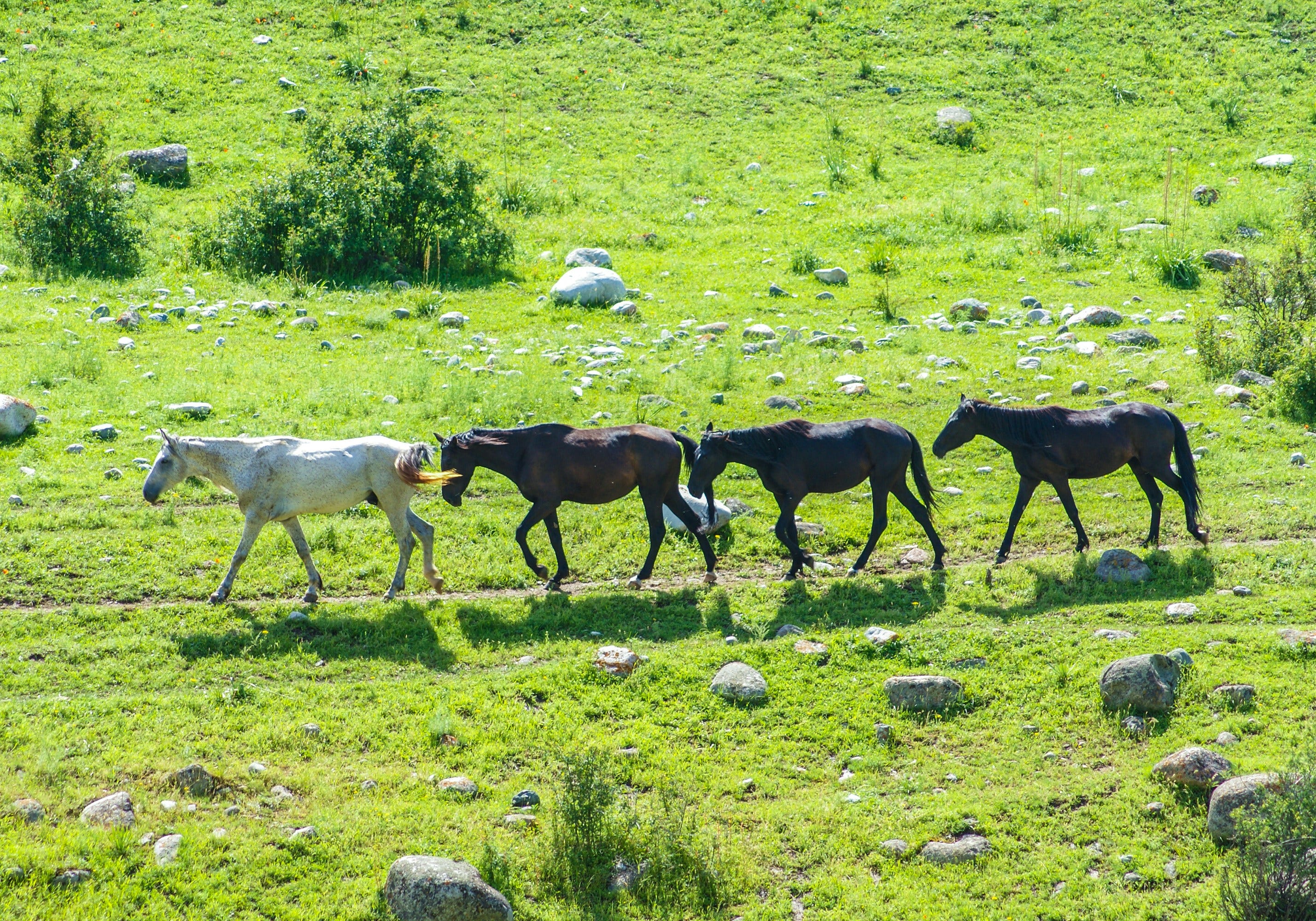
I didn’t expect horses to change the way I see leadership or life. But they did.
Over the last years I have deepened my work with horses, which is increasingly becoming a central calling for me. It has given me some of the deepest insights into leadership, belonging, social dynamics, and not to say understanding myself. It’s a living classroom that reveals something profound about how human groups can organizee, lead, and heal, especially in times of uncertainty and change.
Most people don’t realize this. I certainly didn’t. But horse herds are matriarchal. In wild and feral herds, social order revolves around a lead mare, an older, experienced figure deeply attuned to the landscape. She decides when to move, where to graze, when to rest, and when to flee.
Beside her stands the stallion, whose primary role is protection, holding the perimeter and defending the herd from predators or rivals. While dominant over other males, the stallion defers to the lead mare’s authority over movement and social cohesion. Surrounding them are other mares and offspring, and young males who eventually leave to form bachelor bands or challenge other stallions.
In short, leadership in the herd is matriarchal in guidance and patriarchal in protection, and both roles are essential.
What struck me most was not the hierarchy itself, but how leadership happens. The lead mare doesn’t rule through aggression or dominance. She leads through calm authority, deep memory, and an extraordinary capacity to sense. She reads the environment, feels the mood of the herd, and makes decisions based on collective well-being.
This kind of leadership mirrors the human leaders that typically inspire the most trust: those anchored in emotional intelligence, relational depth, and situational awareness. It’s less about title or power, more about being in tune with what’s needed.
The stallion’s role is often misunderstood. While physically imposing, he rarely directs the herd’s movements. His gift is holding the edge, protecting, defending, and ensuring safety. The lead mare, by contrast, is the navigator, sensing shifts, setting pace, and guiding flow.
Human systems often collapse these roles into a single figure, expecting one leader to both protect and guide. But nature shows us the value of distinguishing these functions, allowing each to play to its strength.
What’s essential to understand here is that the main takeaway is not about biological sex or whether men or women are better. It is about relational functions and qualitative capacities within social dynamics when it comes to leadership. The principles embodied by the mare and the stallion can be seen across many systems, including within the human brain itself.
This division of roles in the herd beautifully reflects the work of Ian McGilchrist, particularly his exploration of the two cerebral hemispheres in The Master and His Emissary. McGilchrist argues that the right hemisphere is holistic, relational, and deeply attuned to context, while the left hemisphere is focused, analytical, and narrowly attentive. One of his central claims is that we have the relationship upside down, where the narrow, analytic mode has come to dominate the holistic one when the opposite is usually the case in nature.
In the horse herd, the lead mare resembles the right hemisphere. She holds the whole, sensing the relational field and making context-sensitive decisions. The stallion represents the emissary, protective and focused on specific threats, ensuring survival at the edges.
When the rational serves the holistic, the system thrives. But when the rational takes control, as often happens in human systems, imbalance, rigidity, and collapse tend to follow. It’s not that one is good and one is bad, but rather the relationship between them is what matters. The herd reveals what McGilchrist’s research also suggests: a healthy system integrates both modes, but it is guided by wholeness.
Herd leadership isn’t static. While the lead mare usually holds the center, different individuals may step forward depending on context: a vigilant horse during danger, a playful one during bonding etc. Leadership flows toward competence and need, then recedes when the moment passes.
This reveals a crucial insight: hierarchy in nature is not rigid but dynamic. It’s an ongoing negotiation, a dance of roles in constant relationship to the environment.
Despite nature offering us models of flexible, adaptive leadership, most human groups struggle to embody them. Our organizations and communities often fall into rigid hierarchies where leadership is tied to status or control rather than to wisdom and relational capacity.
Instead of letting competence flow toward what is needed, we lock people into fixed roles, cutting off the intelligence that living systems depend on. Leaders are expected to guide, protect, hold the big picture, and manage details all at once, leaving them stretched thin. Those at the margins are often left without a path to contribute or integrate their gifts.
Cultural patterns like individualism, ego-driven ambition, and fear of uncertainty feed this rigidity. We hold on tightly to control and in doing so lose the adaptability that makes systems resilient.
The herd offers another way, but as we work to unlearn domination and rediscover relational intelligence in our groups, we also need to do the same within ourselves. Practices like Internal Family Systems (IFS) remind us that in order to move fluidly in outer groups, we need attunement with our own inner system. The parts within us, the protectors, exiles, and managers, need space for listening, integration and attunement.
Without inner coherence, we carry fragmentation into every group we touch. Attunement needs to be alive all the way up and down the “stack”.
One of the most profound things I’ve witnessed is what happens when a rescue horse, often labeled dangerous or unmanageable, joins the herd.
At first, the newcomer stands apart, restless, reactive, testing boundaries. And the herd? It doesn’t panic or attack. Instead, it gives space, allowing the outsider to burn off tension, test the edges, and push against the boundaries. Only when the new horse begins to settle does integration begin, and over time, not only is it accepted, but its unique gifts are welcomed as it finds its place in the social hierarchy.
How often have you seen a newcomer in a human group, someone still shedding their social defenses, only to be ostracized before they have a chance to settle? And what does that reveal about how we, as humans, approach difference and our discomfort with nonconformity?
Healthy communities know how to hold space for disruption and liminality. Dysfunctional ones exile or suppress liminality too soon, and in doing so, they often lose the very gifts that could have renewed them.
Perhaps the deepest teaching from the herd is this: leadership is not about control. It’s about coherence and attunement. Coherence and attunement within the group, as the group.
The mare principle is not tied to biological sex; it’s a qualitative pattern. It’s about whoever carries the capacity to hold the whole, to sense what is emerging, and to weave the relational field. It might be a woman or a man, an elder or even a younger figure with rare attunement.
At its heart, this points to the leader as healer archetype, not healer in the narrow therapeutic sense, but one who restores wholeness. The leader as healer senses fragmentation, brings what’s been exiled back into relationship, and knows when to wait, when to move, when to soften, or when to strengthen. In doing so, they transform chaos into coherence.
We live in a world bucking at the edges, socially, ecologically, and culturally. Many of us carry grief, anger, fear, and confusion as we search for better ways to lead, belong, and hold complexity in our homes, organizations, and communities.
The horse herd offers a living model that feels urgently relevant today: leadership grounded in trust and experience rather than force; hierarchies that are clear yet flexible; a balance between protection and guidance; and an ability to adapt, letting those best suited rise to leadership when needed and step back when the moment passes.
At its core, this is leadership as a relational practice rooted in attunement, presence, and care. It’s not about title or dominance, but about the capacity to hold the whole, sense what is emerging, and help restore coherence when things begin to fragment. It reminds us that resilience depends on dynamic roles, balancing strength with sensitivity, and recognizing that leadership is not bound to gender or ego, but to quality and function.
Key takeaways:
Fluid, dynamic hierarchies strengthen collective resilience.
Relational leadership (the “mare principle”) offers a holistic alternative to command-and-control models.
Protection and guidance are distinct, equally vital functions.
True Leadership adapts to context, with specialists stepping forward when needed and stepping back when the moment passes.
Leadership is not inherently tied to gender but to capacity, attunement, and quality of presence.
Systems break down when ego and narrow leadership models obstruct flexibility and flow.
In a time of profound disruption, the wisdom of the herd offers us a way back toward wholeness, showing how we might move forward together, not by controlling the many, but by listening deeply to what the moment asks.
If the herd has taught me anything, it’s this: real leadership is not about being in charge, it’s about being in tune.
No posts
Comments
Nothing yet. Say the first thing.
Sign in to join the conversation.