
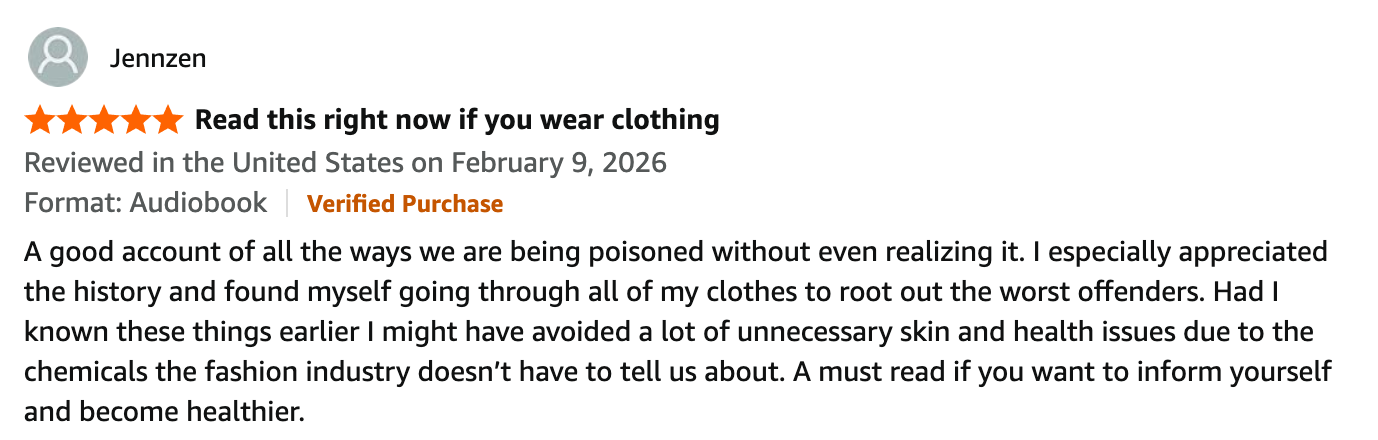
A reader left this comment on one of my articles:
I did skin patch testing and had 9 different positive results. One of them is PPD (p-phenylenediamine) and I was told it can be used in clothing dying processes amongst other things. I have been trying to search around on the internet but can’t figure out how commonly it is used. Do you know?
What a seemingly simple question. This person got tested an an allergy clinic and found out they are allergic to a chemical that might be in clothing. They want to know how to avoid clothing with that chemical.
If this were food or a personal care product, that would be easy. Just look at the ingredient label! In fact, most foods will tell you if they contain nuts or are processed in a facility where nuts are processed, if they’re gluten-free, have touched fish, and more. For beauty products, you can use SkinSafe to look up ones that won’t mess with your skin.
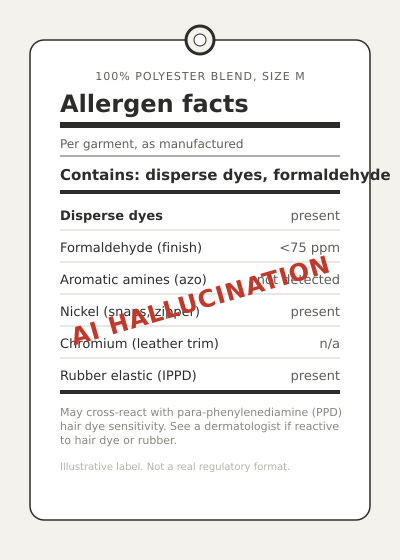
But fashion? Nope. Fashion does not come with an ingredient list. You can’t scan the label and get a green or red light. You can’t check if it has nickel or formaldehyde, or Disperse Blue [insert number here] dye, or anything else that commonly triggers a reaction.
All you get is what the main fabrics are (nothing under 5% of the product is listed unless it’s wool) and where the final assembly (not the dyeing) was done. Finding out if your clothing has any particular allergen (again, aside from wool) is a guessing game. It is like trying to find an old toy in a crowded basement where the only bulb has long since burnt out. You’re just rummaging around in the dark trying not to stick your hands in a mouse nest.
Still, I love a challenge. So I went on a quest to find out the answer for this one reader, and, indeed, for anyone who has ever gotten a patch test.
PPD is not one of the infamous chemicals that we all hear about, and that researchers test for when they buy clothing and publish the scary results. (That would be things like lead, PFAS, BPA, phthalates, cadmium, etc.)
PPD is commonly used in hair dye, and often causes Allergic Contact Dermatitis in hairdressers and to a lesser extent salon clients and at-home hair dyers. This type of eczema presents with itchiness, redness, and swelling. It can be severe, with vesicles (fluid-filled blisters), scalp eczema, complete or partial hair loss, face swelling and even obstruction of the airway, sending its victims to the hospital.
About 4% to 5% of people who get patch tests have a reaction to PPD, and it’s more likely to affect women. It can also take days for the skin reaction to show up after exposure, making it sometimes hard to know what triggered the reaction.
Even if you don’t have an obvious reaction, one 2019 study showed that skin exposed to PPD may already be undergoing changes at the molecular level that weaken its protective barrier. Yikes.
In Europe, PPD is banned in temporary and permanent tattoos, and is limited in hair dyes to a maximum concentration of 2%, but there are no similar regulations in the U.S. (Of course not! Why would there be!)
PPD itself rarely shows up in textiles, that much became clear after emailing Ben Mead at the safe fashion certification Oeko-Tex and Nathaniel Sponsler at the testing consultancy AFIRM Group.
“This is typically a building block for dyes,” Mead wrote. “The issue is that if it were incompletely reacted, or could be broken from the dyestuff during the dyeing process, then you could get residual on the fabric surface.”
But that seems to be so rare as to be not a concern. “Our lab partners say they do not ever see it in meaningful concentrations when using the correct testing approach,” Sponsler wrote. “As such, AFIRM has never had a consensus decision to add it to the RSL, since it is not even close to exceeding generic sensitizer limits.”
But if someone is sensitized to PPD, they are likely sensitized to chemicals with similar structures. When more than 10 years of clinical records at one Patch Test clinic in Ottawa were assessed, they found that a quarter of patients who tested positive for a PPD allergy also tested positive for a textile dye allergy.
Other similar chemicals that could give someone with a PPD allergy a reaction include toluene-2,5-diamine (TDA), Disperse Yellow 3, and Disperse Orange 3. These are listed in AFIRM’s restricted substance list. If a AFIRM member brand tests its clothing and one of these shows up at more than 15 parts per million, it will be reported as present. If it shows up at more than 30 ppm, then the product has failed the test and it will most likely never be put on the shelves.
Mead wrote that Oeko-Tex doesn’t see a high percentage of azo dye failure when it tests clothing for its Standard 100 certification, but he admits that brands going for the Oeko-Tex certification are a self-selected group.
Remember that testing clothing for substances like these is completely voluntary in the United States. Many, many brands—especially ultrafast fashion ones—do not do this testing and can legally sell clothing with Disperse Yellow 3 and other highly sensitizing substances to Americans. We do not see these voluntary test results, either, whether products fail or pass. We just trust that certain brands are testing and won’t sell clothing that can trigger skin issues and other allergic reactions.
These brands say that reports of skin reactions from customers are rare, and take it to mean that their clothes don’t ever cause them. But, if you had a skin reaction to something you wore five days ago, would you know what caused it? And would you report it to the brand, or just think, “Damn it, I’m allergic. I guess I’ll just have to stop wearing that thing”?
In 2019, the European Union proposed restricting PPD and 2,4-toluenediamine (TDA) to 30 ppm, and proposed banning all disperse dyes—not just the ones specifically named in AFIRM and Oeko-Tex’s restricted substance lists—outright.
It never went anywhere, probably because it would have caused chaos. Almost all synthetic clothing is dyed with disperse dyes. I’ve written extensively in my book and on Substack about how disperse dyes and hence synthetic clothes can cause skin reactions. But honestly, you should probably just avoid synthetics if at all possible if disperse dyes are your concern.
Find clothing with an Oeko-Tex label.
Buy from brands that are part of the AFIRM Group.
Avoid synthetic clothing whenever possible.
Introduce new clothing one piece at a time and wait a week to see if it’s caused a reaction, so you can return it and avoid that brand in the future.
See if it helps to avoid dyed clothing.
I wish I had a more precise answer on this topic. Sadly, when it comes to clothing, we can get almost anything we want at whichever price point we want—except clothing that we know is free of toxins and allergens.
Babe, Your Body Acne Is From Your Plastic Clothing
·
March 16, 2025

“For as long as I can remember, I always had a little bit of irritation on my back, some pimples, like, very oily skin. I live a healthy lifestyle. I eat properly. I exercise around five times per week. Even with scrubbing or whatever, still, my skin would break out. I couldn't really figure out what was the cause of it, and I just accepted it as it is.”
How to Assess a Brand for Toxicity
·
April 20, 2025

I get a lot of requests for brand assessments. A lot. Here’s a list of brands that readers have asked me to assess to decide if they’re trustworthy, safe, and likely to be free of hazardous chemicals:
Which Fashion Certifications Can You Trust?
·
November 2, 2025
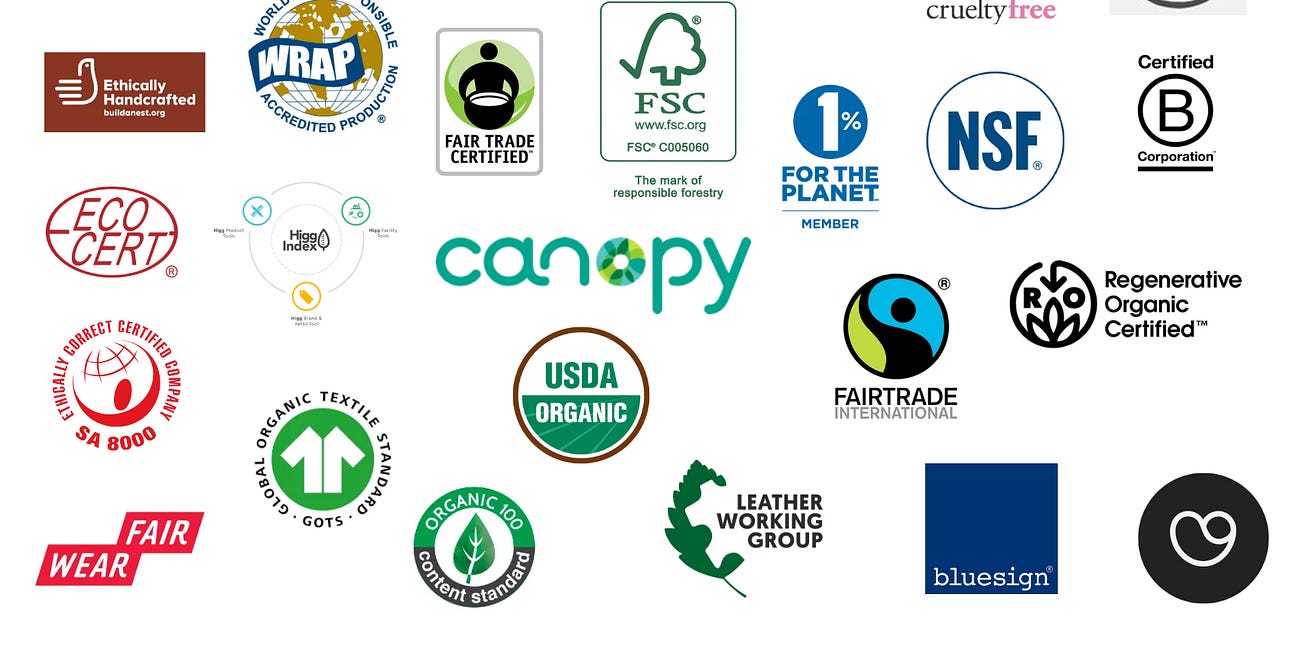
I gave a keynote last week to the Just Zero Waste-Free Future conference, and among the many great questions was one that I didn’t have time to answer in full. It’s the question of sustainable, ethical, and non-toxic certifications for fashion. And it’s a crucial one.
Comments
Nothing yet. Say the first thing.
Sign in to join the conversation.