
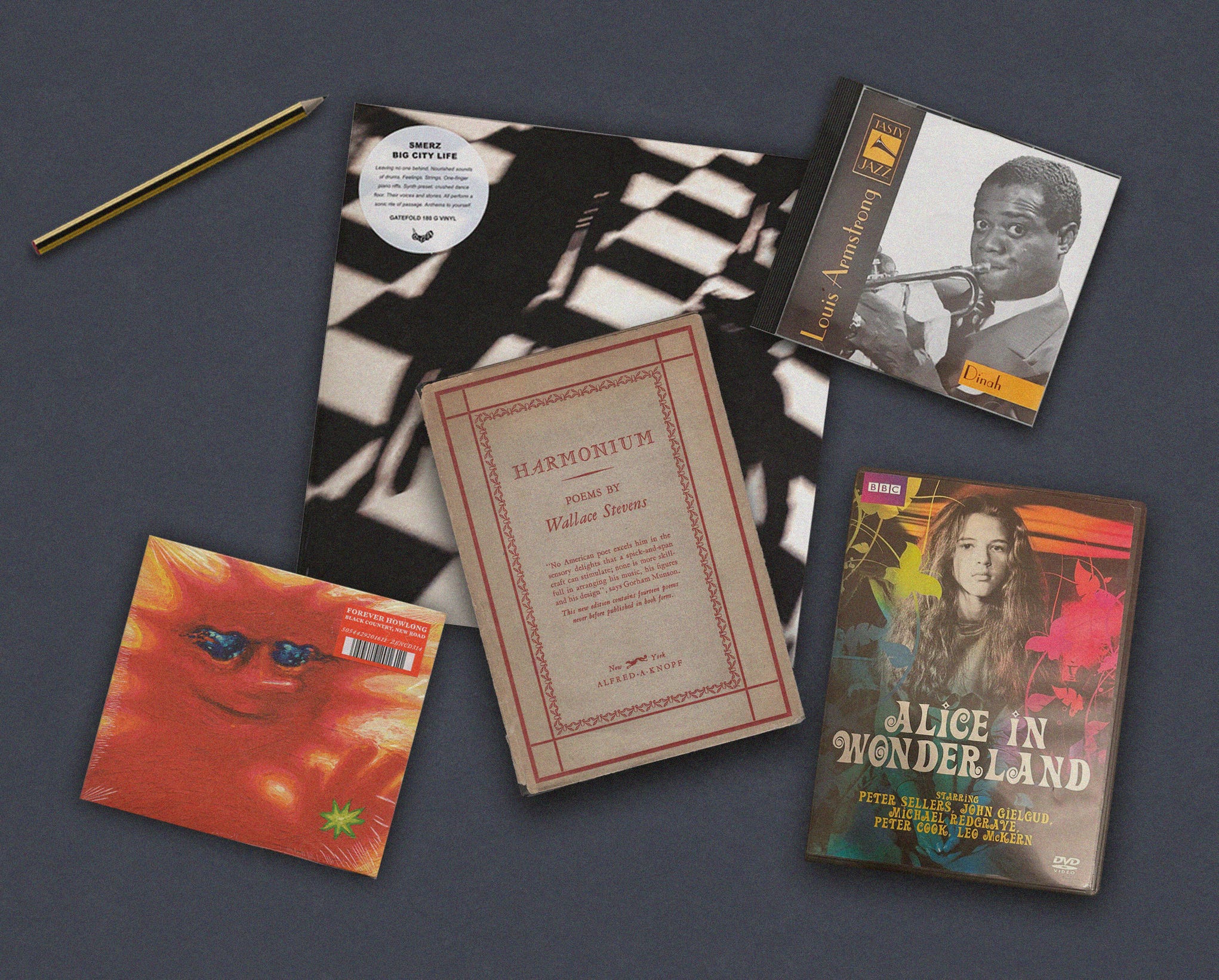
Here he is: the most beautiful American of the twentieth century. All of 31 or 32 years of age. It’s a miracle that we have this performance at our fingertips to watch whenever we want. I have to watch it a couple times a month. To understand why Louis was a totally sui generis kind of musical genius, you have to go listen to squarer versions of the standards he sang, then compare them to what he does with his voice and trumpet. Listen to how he takes the verse of “Dinah,” then extemporises it again and again, each time at a further remove from any intelligible lyrics, zipping around the melody, getting closer to the riffs and harmonies he’s hearing. Each time he uncovers another, more central phrase, behind every line he picks up. And it’s sexier, wittier, and more graceful than the original could ever be. Louis is the heart of jazz because his is the sound of a human voice and an instrument leaping together for the first time from the cool dirt of the Earth up to the heavens, soaring free from every confine, effortless, spontaneous. Too true and too big for life.
There hasn’t really been an American poet better than Stevens since the early twentieth century. Harmonium is his first book, published when he was in his forties, working as a vice president at the Hartford Accident and Indemnity Company. Imagine hearing that your insurance rep had won the Pulitzer Prize.
That is purely twentieth-century activity. Could never happen today. Not least because the insurance agents now decide who gets Pulitzers. Anyways — Harmonium is magnificent and I’ve taken to toting it around with me around London sometimes. “The Comedian as the Letter C” is a particular favourite, with its paean to the imaginary poetic conquistador Crispin. True story: I was reading the poem just before a particularly lousy date, when a girl led me on a long walk up through Soho, which took us past a place called “Bar Crispin.” I should’ve stopped right there, but I let her lead me all the way up near Marylebone, where she promptly left me in Oxford Circus, disappearing to attend to some sudden, possibly invented, trouble with a roommate. I took the bus home and stopped toting the book around for a while.
This is maybe my favorite piece of underrated Sixties art, a total abstract masterpiece. Jonathan Miller’s wild teleplay of Carroll’s romance is almost completely forgotten now, but it’s the most avant garde thing the BBC ever aired, the most psychedelic film I’ve seen, and the only really great adaptation of the book. It starts with a quote from Wordsworth, features a murderers row of BBC comedians from the time (like Peters Cook and Sellers), sports a giant cat’s head floating in the sky, and stars fucking John Gielgud as the Mock Turtle. I don’t know what else to say to recommend it.
There’s also a fascinating little documentary, floating around on YouTube, following Ravi Shankar, as he composes his gorgeous soundtrack for the film, which is absolutely worth a watch. If I’m not mistaken, it was done around the same time he was first meeting the Beatles:
I don’t have much to say about this track that it can’t say itself. The record just came out last week, I think. But I’m 85% sure these Norwegian gals — with their unassuming tacky video and that total Scandinavian deadpan — just created a classic of Zillennial internet yearning. This song sounds like it’s been playing on loop in a junky old car’s tape-deck for like, I don’t know, forty years, maybe. And it’s gonna keep going until we all die, probably. Maybe the kids are alright.
Maybe they always have been (they haven’t). This is the sort of thing Flight of the Conchords would’ve done ironically, with jokey lyrics, twenty years ago. But Smerz are having serious fun and if there’s irony anywhere in it (there is), it’s subordinated to romance, in the end. Which is how you know you’re in the more creative part of the cycle.
My most-listened-to album for May, surely. I love Ants From Up There same as anyone, but the new one is a rarer and lovelier beast entirely. It’s not every day that the anthem-penning lead-singer of a cult-favorite band resigns only for the rest of the band to discover they’ve got three of the most interesting singer/songwriters in all Britain in their ranks already. A friend compared it to Van Dyke Parks. At one point I tried out “Twee Prog.” Whatever it is, it’s the best album of the year so far: the Zoomers have their own New Order now.
Since I’ve shared clips and YouTube favorites, I have to finish with what I consider to be, hands-down, the greatest work of internet art. It’s the YouTube Poop raised to a delirious apotheosis. It’s the cinematic equivalent of vaporwave; the filmic analogue to Chuck Person’s Eccojams. Picard and the gang take a trip and listen to the Floyd, Boards of Canada, Enya, and Broadcast, and Star Trek TNG is revealed for the avant garde pop-futurist art it always might have been. I knew it the first time I saw it, right around the six minute marker, when we cut in from outside the ship to see the Enterprise crew doing the Dark Side/Wizard of Oz synch-up on the bridge — I knew I was glimpsing what the best of the internet is really for, in the end. All of it, all the paranoia, and the drugs, and the cultural/technological upheaval — it was all so we could watch someone make something like Star Trek Acid Party.
Sam Jennings is an American writer and editor living in London. He is Associate Editor at The Hinternet, and runs the Substack Vita Contemplativa.
No posts
Comments
Nothing yet. Say the first thing.
Sign in to join the conversation.