
Last March I had my first experience with Benign Paroxysmal Positional Vertigo (BPPV).
Wikipedia has this to say about what causes BPPV:
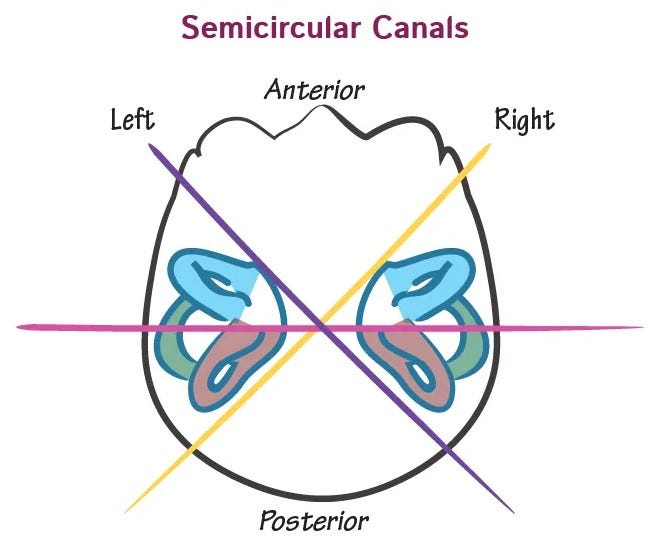
“Within the labyrinth of the inner ear lie collections of calcium crystals known as otoconia or otoliths. In people with BPPV, the otoconia are dislodged from their usual position within the utricle, and over time, migrate into one of the three semicircular canals (the posterior canal is most commonly affected due to its anatomical position).”
After my latest round of BPPV I think Wikipedia’s version of reality is a bunch of hooey, at least for most people. But then I’m not a god-in-a-white-coat, so what do I know?
From my personal experience, I prefer Dr. Berg’s explanation: that BPPV is caused by impaired calcium metabolism due to insufficient Vitamin D. That causes calcium to fall out of suspension in various bodily fluids, where it clumps together, forming tiny crystals. When they form in one of your semicircular canals, if you move they shift around in your inner ear: that causes your brain to get disoriented and the world seems to spin wildly, though only for a short time.
I suspect the same calcium crystals form elsewhere in your body as well, but they aren’t noticed because they don’t cause dramatic symptoms (they are probably just hardening your heart valves or something equally as sinister, so consider BPPV as an early warning signal of greater problems brewing elsewhere). If you solve your BPPV, you might just be solving, or at least improving, a much bigger problem.
I described how in 2025 my Vitamin D levels (cholecalciferol is what was actually measured) were textbook: 72.8, out of an optimal range of 60 to 80 ng/l. And I was supplementing with Vitamin K, as well. If cholecalciferol (which I presume is a proxy for Vitamin D) was actually Vitamin D, I should not be experiencing BPPV. Yet I was.
Last year, my BPPV appeared to resolve rapidly with increased sun availability, which the body uses to create real Vitamin D.
I spent the summer laying out in the sun for 15 minutes or more on most sunny days (which is very often in Southern Idaho), hoping to build a reserve that might last me through the winter. I wasn’t so lucky.
My conclusion was that the cholecalciferol that was being measured in my blood Vitamin D test was not actual Vitamin D. That was sacrilege to those whose Vitamin D supplementation had resolved one or more symptoms of other diseases. Just like massive doses of synthetic Vitamin D helped my sister-in-law’s multiple sclerosis (she would never spend significant time in the sun to see how the real thing compares to Vitamin D supplements).
I’m not saying Vitamin D supplements are necessarily bad or evil, only that they don’t seem to work for BPPV. If they make your life better in some regard, I’m not suggesting that you give them up. If you take them and still have BPPV, I’m merely suggesting how you might fix the BPPV.
The phenomenon of BPPV re-entered my life shortly before mid-January this year. It started as a faint feeling of disequilibrium upon waking. Over the course of a few days it progressed to the point where the world would spin mildly if I changed position too quickly.
Not only was BPPV back, but it was much earlier than last year. My prior experience allowed me to detect it earlier this time around than I had initially (the first time around it took a nasty fall for me to get a clue).
What to do? It would be mid-to-late March before the weather warms and the sun angle is high enough to get enough sun exposure to allow my skin to naturally produce sufficient Vitamin D.
Last fall I had thought that perhaps I would try visiting a tanning salon to attempt to prevent the return of BPPV, but my good intentions never turned to action.
But in mid-January I signed up at one of the three tanning salons within a couple of miles of my house. I opted for the basic, UVB-only tanning bed - the cheapest option - which the young attendant claimed was great for Vitamin D levels. I was suspicious of her knowledge of the subject, but I had to start somewhere. And I typically will opt first for the cheaper option.
I was only able to complete four seven-minute sessions before having to fly to Grand Forks, North Dakota to clear out the apartment of my deceased brother-in-law.
When I first arrived there, I was still having some mild dizziness with abrupt changes in position, but I was able to box and bag loads and loads of his personal effects, clean his apartment, and to safely navigate the compacted snow and ice that blanketed the entire town.
I returned home a week later. By then, I was feeling only very slight dizziness, which was very encouraging. It seemed to me as though perhaps the tiny crystal was slowly dissolving and becoming less problematic.
After a few more tanning sessions, I was able to get up in the morning without having to pause while seated at the edge of the bed before standing up. It seems the UVB tanning bed was doing the trick, and that the calcium crystal that was forming in my inner ear had been dissolved and the calcium was once again suspended in fluid, as Mother Nature had intended.
The mainstream treatment of BPPV involves various movements designed to dislodge the calcium crystal from the inner ear. There are a number of different techniques, since there are a few different parts of the inner ear where the crystals can form. Where they form is likely dependent upon your predominant sleeping position. Unless you’ve experienced some sort of trauma that dislodged an otolith from your utricle.
Of course the maneuvers are only symptom relief. With a continued insufficiency of Vitamin D, the same impaired calcium metabolism can cause another crystal to form in the same place (or elsewhere). Or perhaps the crystal you just dislodged will find its way back to where it started.
If you suffer from seasonal vertigo, it could be worth considering some mid-winter tanning to potentially correct the problem. And that can be at a tanning salon or your favorite snowbird winter hangout, such as Florida, Arizona or a tropical ocean cruise (the further south, the better, since winter sun angles are so low).
If you go the tanning bed route, you’ll need to reconcile the persistent fear mongering from the dermatology industry about potential skin damage or even possible skin cancer. To allay those fears, ALWAYS avoid burning, and build your tan slowly.
My humble opinion is that the dosage makes the poison. Opt for just enough tanning to relieve your symptoms, rather than opting for as much tanning as possible.
But then I’m firmly in the Less-Is-More camp, not the More-Is-Better camp.
If you enjoyed this post, please consider subscribing for free. Since these posts are mostly built around personal anecdotes, I have limited supply to offer. I don’t write on a regular schedule. I’m more likely to write when the weather isn’t that great. When it is warm and sunny, I’d much rather be outside, recharging my batteries!
MY STANDARD ADVICE for triangulating the truth:
BEWARE OF THE BENEVOLENCE OF BILLIONAIRES:
Most billionaires become such by exploiting you, not by thinking of your best interests. Viewing the world through this lens may literally save your life!
Disclaimer: I write about my personal experiences, and what works for me may not work for you. I have no healthcare training, but I’ve been reading passionately on healthcare since being diagnosed with melanoma in early 2004. If you have delegated responsibility for your health to someone else, you should probably continue to do so. If you accept full responsibility for your own health, I hope that the experiences and opinions that I share will help you on your personal healing journey.
Comments
Nothing yet. Say the first thing.
Sign in to join the conversation.